






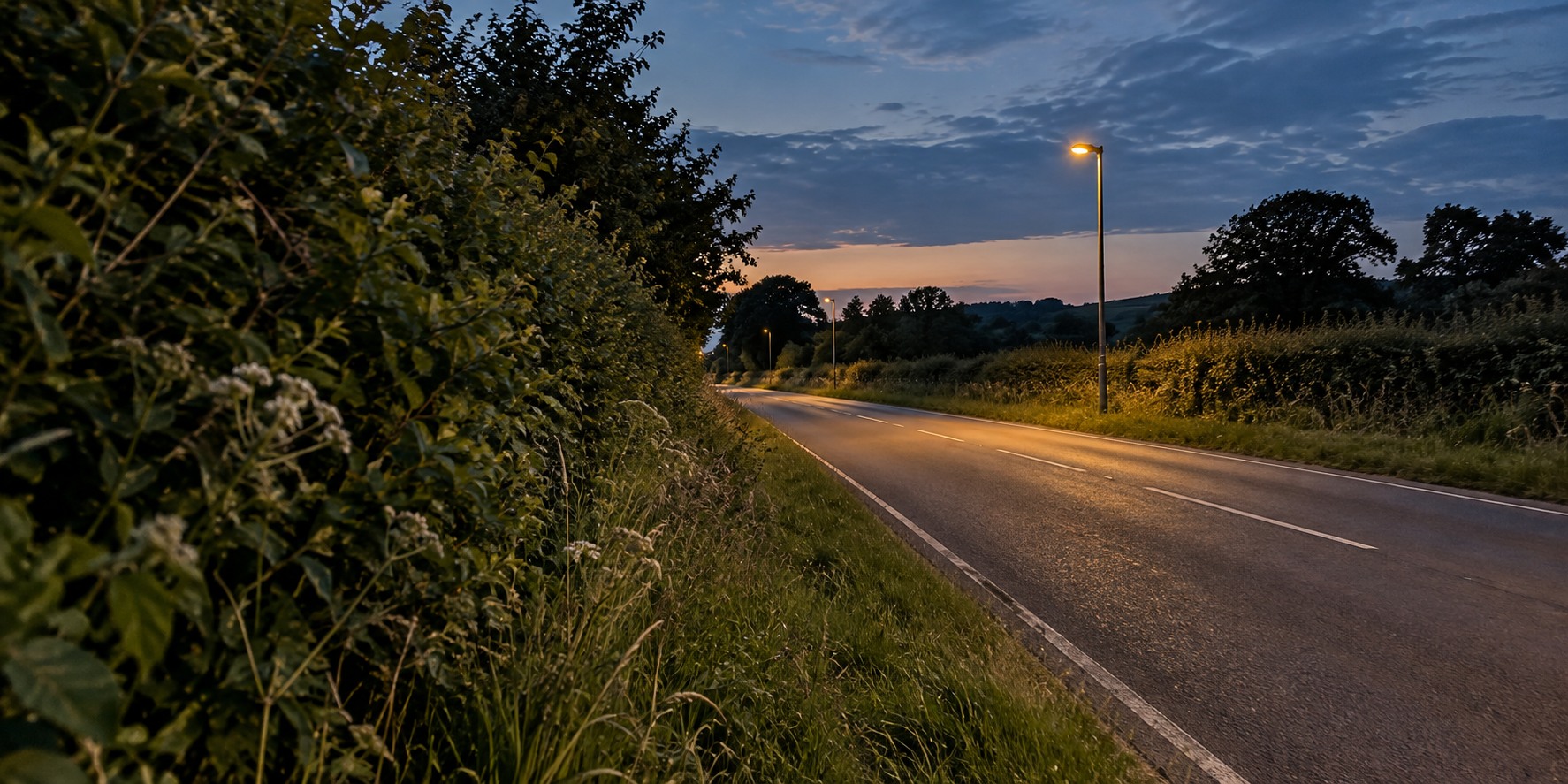
Cover: AI-generated editorial illustration; not the cited research site or a product test. Original study figures and sources appear below.
A lamp with fewer adult insects circling it has not necessarily caused less ecological disturbance. That is the most useful starting point for reading Boyes and colleagues’ 2021 study of street lighting and moth caterpillars in southern England. The researchers looked beyond the conspicuous swarm at the lamp and sampled the life stage living in the vegetation below.
The paper reported lower caterpillar abundance beside established lighting, differences in caterpillar mass, and a separate short-term effect on nighttime feeding activity. These are three findings with different methods behind them. Keeping them separate makes the research more useful to a municipality than reducing it to “LEDs attract bugs” or a single percentage.
This review follows the original Science Advances paper, explains its graphs, and identifies what the evidence can contribute to a habitat-sensitive lighting review. It is not a test of LEOTEK equipment or an estimate of the effect of a particular retrofit.
Why sample caterpillars instead of adult moths?
Adult moths move between locations and may be drawn toward sampling lights. A count at a lamp can therefore mix attraction, movement and local abundance. It is difficult to know whether many moths at one fixture mean a healthy local population, displaced insects from elsewhere, or an increased concentration around a source.
Caterpillars offer a different view. They are comparatively sedentary and develop on local vegetation. Sampling them helps examine the places where moths live through that life stage, rather than only the places adults happen to visit. It does not reveal every mechanism, but it changes the question from attraction to local development and abundance.
The study used daytime beating of hedgerows and nighttime sweep netting of grass margins. These methods sample different habitat assemblages and should not be treated as interchangeable insect censuses. Their value is the consistent comparison of a lit transect with a carefully matched nearby unlit transect.
One paper, two study designs
| Component | What was compared | What it can help establish |
|---|---|---|
| Established-lighting field comparison | Lit and nearby matched unlit hedgerows or grass margins; existing LED and sodium lighting. | Differences in local caterpillar abundance and mass associated with long-standing lighting. |
| Short-term lighting experiment | Temporary LED, high-pressure sodium and unlit treatments in grass margins without a history of lighting. | A rapid change in the sampled nighttime activity of caterpillars under experimental illumination. |
The established-lighting comparison was not a randomized installation experiment. Its strength was examining real lighting and allowing wider spatial replication than a new large-scale installation would easily permit. Careful matching addressed known habitat and management differences, but unmeasured confounding cannot be ruled out entirely.
The short-term experiment asks a narrower causal question over hours. It helps investigate behavior, but it cannot by itself explain the longer-term abundance difference. Neither design should be relabeled to make its conclusion sound stronger.
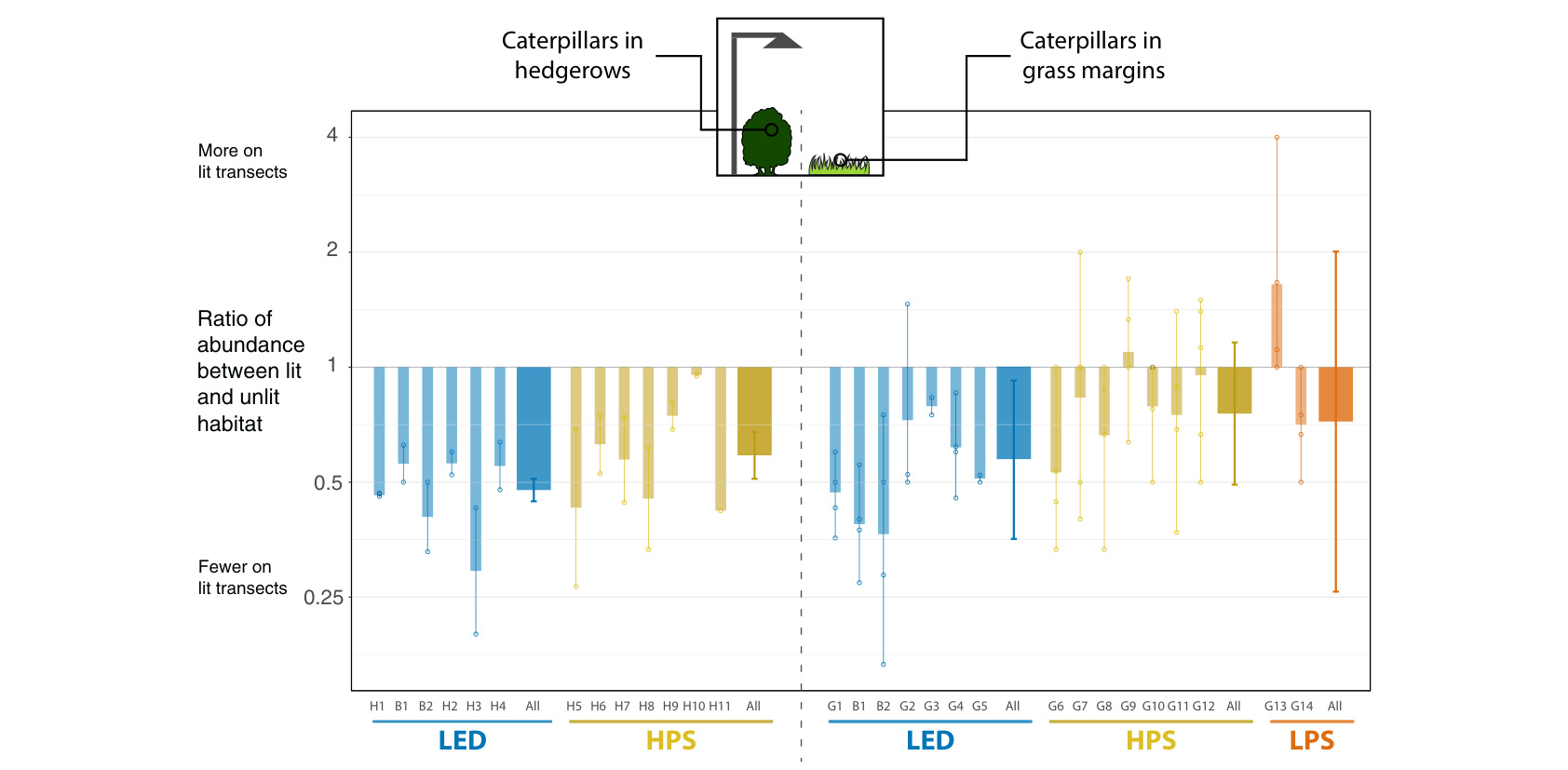
Figure 1: the abundance finding
On small screens, swipe the diagram sideways to read its labels, or open the full-size image below.
Open full-size diagram
The authors sampled 1,656 caterpillars from hedgerows over 25 visits to 13 matched pairs and 822 from grass margins over 64 visits to 15 sites. Some locations contributed to both habitat sampling approaches; adding the two site counts does not create a new count of fully independent landscapes.
The reported overall reduction was 47% in lit hedgerows and 33% in lit grass margins. In the hedgerow analysis, reported reductions were 52% for LED and 41% for high-pressure sodium. In grass margins, the LED comparison showed a 43% reduction; the high- and low-pressure sodium comparisons were not statistically significant at the conventional 0.05 level.
Read the ratio axis first. A value of one marks equal abundance under the plotted comparison; values below one indicate fewer caterpillars on lit transects. The figure uses a logarithmic presentation. The thick model-effect bars carry 95% confidence intervals; the site marks show the paired comparisons and visits described in the original caption.
Those overall effects are model estimates, not a percentage obtained by averaging every visible bar. Visits with zero caterpillars in both transects were included in the model even though they are not illustrated. A reader who counts only the visible points cannot reconstruct the full analysis.
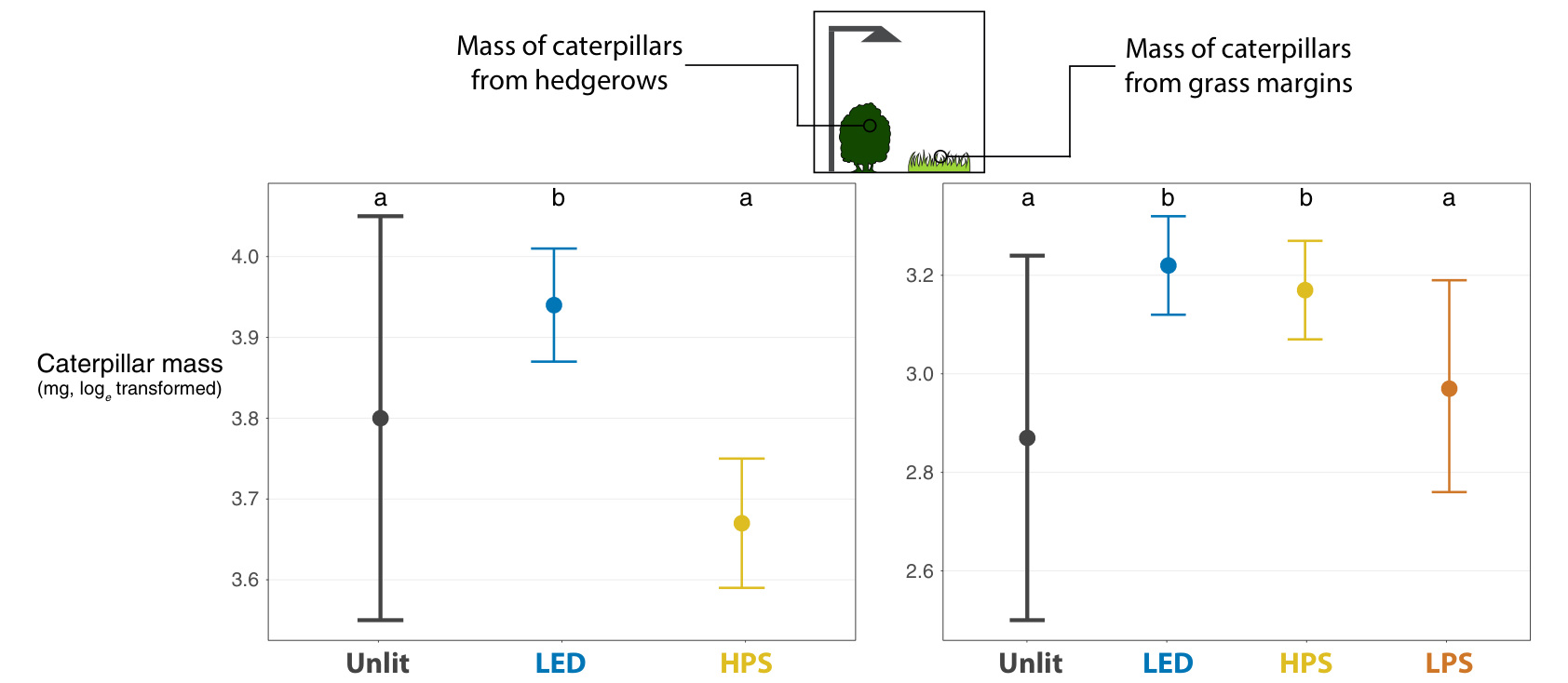
Figure 2: heavier caterpillars do not mean a healthier habitat
On small screens, swipe the diagram sideways to read its labels, or open the full-size image below.
Open full-size diagram
Caterpillars from lit transects were generally heavier. The models accounted for caterpillar morphotype and included random effects, helping address differences in the composition of the samples. The authors interpreted the pattern as consistent with altered development, rather than evidence that lighting improved habitat quality.
This graph plots model estimates of log-transformed mass with standard errors. They are not the 95% confidence intervals used for the overall effects in Figure 1. The letters show the paper’s pairwise significance comparisons; overlapping standard-error bars do not override the model-based tests.
Mass is also a different endpoint from abundance. A sample can contain fewer individuals with a higher average mass. Neither measure alone reveals lifetime reproductive success or the number of adults that will emerge. The useful finding is the difference in development-related measurements alongside the abundance result, without turning either into an unsupported mechanism.
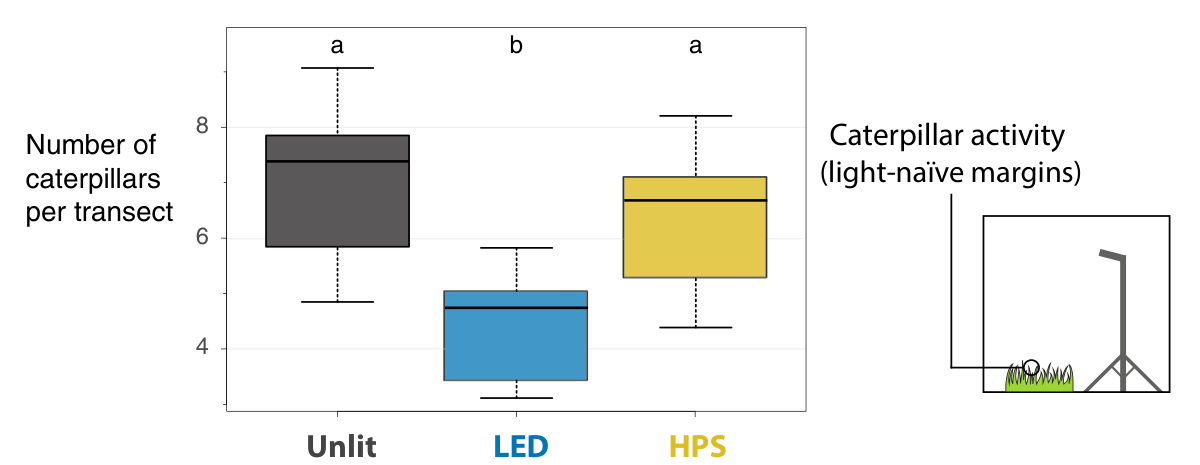
Figure 3: the short-term experiment concerns activity
On small screens, swipe the diagram sideways to read its labels, or open the full-size image below.
Open full-size diagram
The researchers erected lighting rigs before sunset in previously unlit grass margins and sampled one to two hours after dusk. Nocturnal caterpillars normally climb grass stems to feed, making them accessible to sweep netting. Fewer were sampled under white LED light than in the unlit treatment; the high-pressure sodium comparison was not statistically significant.
The paper reports nine replicates for these treatment comparisons. Figure 3 presents the model predictions using boxes, medians and whiskers as defined in its caption. These marks have a different meaning again from the error bars in Figures 1 and 2.
The important interpretation is behavioral: the sampling result is consistent with disruption of normal feeding activity. It is not a count of insects killed during those hours. The longer-term field findings and this experiment complement one another, but the experiment does not identify the full pathway that produced the field abundance difference.
What the comparison does not settle
The lamp categories describe the equipment and settings studied. They are not a controlled test of every possible LED spectrum, output, optic or operating schedule. Spectrum, intensity and installed geometry need their own evidence before a city attributes a difference to just one feature.
The work concerns moth caterpillars in two habitat types in southern England. It does not estimate a percentage loss for every insect order, a U.S. city, or all white LED installations. Nor does it show that switching to a sodium lamp would remove the environmental issue: the hedgerow sodium comparison also showed a reduction.
The authors discuss several plausible mechanisms, including altered egg laying, predation and host-plant effects. These are explanations to investigate, not a list of mechanisms all directly demonstrated by the abundance survey. The distinction matters when selecting mitigation or a monitoring endpoint.
What changes in a municipal design review?
First, define which habitat could receive light and why lighting is needed beside it. A hedge, grass margin or connecting strip may be relevant habitat rather than empty space outside the pavement calculation. A source inventory and habitat map should precede a product comparison.
Second, consider whether the source, lit area or operating period can change. Containing necessary light and preserving unlit habitat addresses exposure more directly than relying on a claim that a lamp attracts fewer adult insects. Those are design choices informed by the research, not mitigations validated quantitatively by this paper.
Third, request configuration-specific spectrum and photometry. A CCT label cannot identify the complete wavelength distribution. The SPD versus CCT guide explains the distinction; the seasonal control guide explains how schedules become maintainable operating records.
Finally, choose monitoring that matches the objective. If the concern is local development or abundance, an adult-attraction count is not automatically a substitute. An ecologist should identify the organism, life stage, sampling method, season and comparison needed. The lighting team should separately verify the installed distribution, shielding and operating states.
Keep a comparison that another reviewer can interpret
For a new local investigation, decide the sampling unit before collecting a large number of readings. Visits, transects and independent sites are different levels of replication. Repeating one illuminated location many times improves its record but does not turn it into many independent installations. The biological sampling plan should explain that structure.
Retain season, vegetation management and source operation with the habitat observations. If a verge is cut between surveys, or one lighting group operates only part of the night, a simple before-and-after average may combine several changes. Record those conditions rather than assuming that the lamp type is the only difference.
The same discipline applies when reporting an improvement. A lower attraction count, a lower receiving-point light level and a change in caterpillar abundance are three results. Present each with its method and uncertainty instead of converting them into a combined wildlife score that no study actually measured.
A useful evidence request
| Ask for | Why it changes the review |
|---|---|
| The habitat and life stage of concern | Prevents a moth-attraction result from becoming a claim about all insects. |
| The exact proposed configuration and operating states | Connects source data to the installed system being reviewed. |
| A map of task lighting and receiving habitat | Shows where exposure could occur, including beyond the roadway. |
| A measurement and ecological monitoring plan | Separates verification of light conditions from a biological result. |
For a full design record, start with the site assessment and carry the agreed evidence into the project specification. Those steps make the next decision reviewable without implying that a single fixture characteristic guarantees an ecological outcome.
Questions readers ask about this study
Does 47% mean that half of all insects were killed?
No. It is the reported reduction in sampled caterpillar abundance in the hedgerow comparison under the study’s analysis. It is not a direct mortality count, a result for all insects, or a prediction for an unrelated installation.
Are fewer insects flying around a lamp evidence of lower impact?
Not on their own. Attraction and local population-related measurements answer different questions. The study is valuable precisely because it examined caterpillars and a separate feeding-activity experiment.
Did the experiment test dimming or an ecological filter?
The results reviewed here do not establish the performance of a proposed LEOTEK dimming profile or filter. Such a proposal needs configuration-specific evidence and site verification rather than a percentage borrowed from this paper.
Where does the next research question lead?
Beyond the lamp and its direct footprint. The companion review of plant interactions beyond the lit area examines a field experiment in which illuminated and adjacent dark areas had different ecological outcomes.
Primary source
Boyes, D. H., Evans, D. M., Fox, R., Parsons, M. S., and Pocock, M. J. O. (2021). Street lighting has detrimental impacts on local insect populations. Science Advances, 7, eabi8322. Figures 1–3 reproduced under CC BY 4.0. Research findings belong to the cited authors; design-review applications above are LEOTEK’s interpretation.