






For ecological outdoor-lighting evaluation, spectral power distribution (SPD) is more informative than correlated color temperature (CCT) because it shows how a source’s output is distributed across wavelengths. CCT describes apparent color, while ecological effects also depend on the amount, direction, timing, duration, setting, and organisms exposed to the light.
Spectral Power Distribution vs. CCT: Why SPD is the better ecological starting point
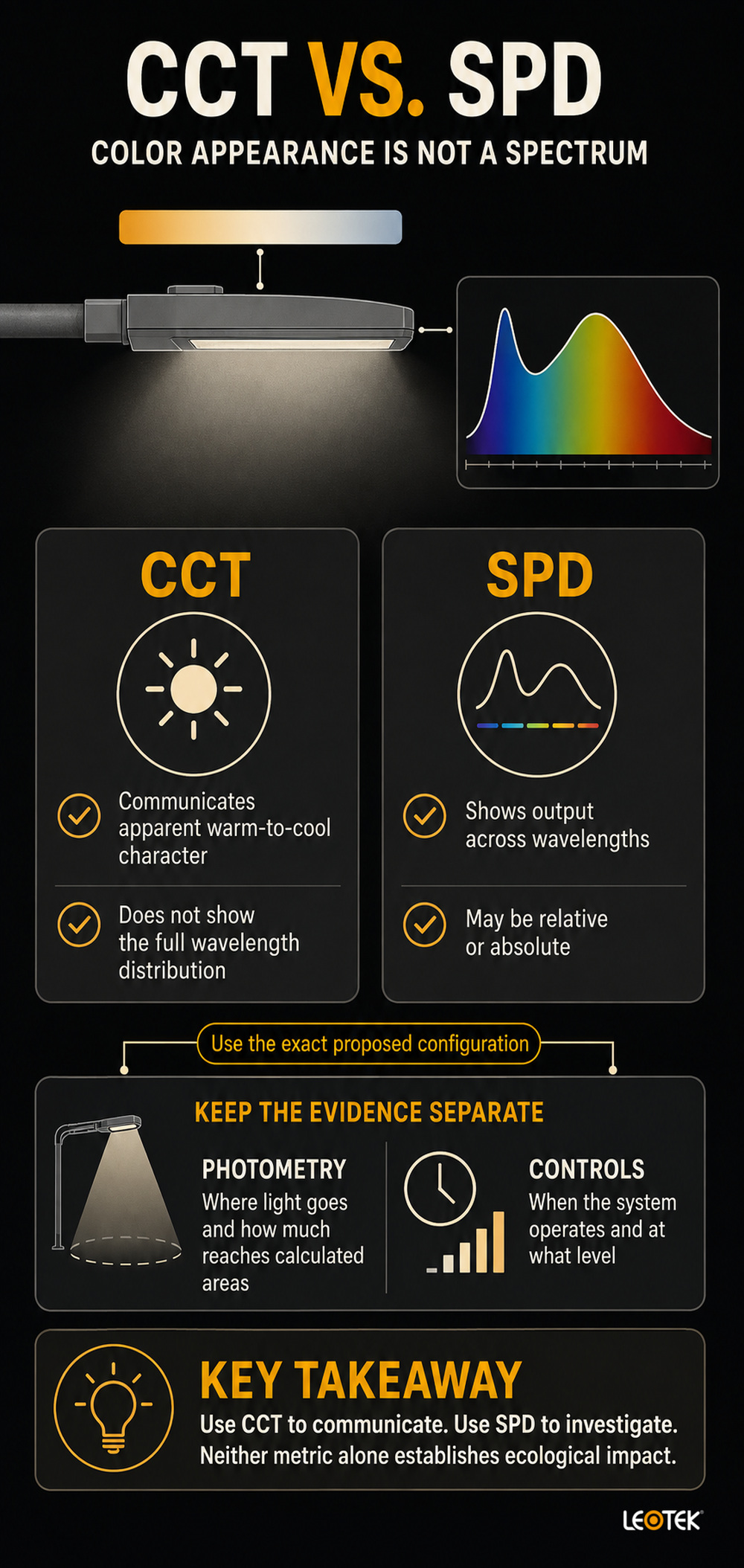
Color temperature is familiar in streetlight conversations because it is compact and easy to compare. A CCT value is a chromaticity-based descriptor of the apparent color of white light, expressed in kelvins. It can help a project team communicate whether a source appears warmer or cooler, but it does not disclose the complete mix of wavelengths leaving the luminaire.
An SPD does. It is a chart or dataset that plots a source’s radiant output across wavelengths. Depending on how it is reported, it may show relative spectral output or absolute spectral power. That information makes SPD the better technical starting point when a city or agency needs to ask a spectrum-specific ecological question.
The distinction matters because outdoor lighting is not evaluated in a vacuum. The U.S. Department of Energy notes that lighting at night serves functions such as navigation and hazard detection while also creating ecological disruption and increased sky brightness. The agency frames the task as balancing intended function with environmental consequences, not selecting a single universal lighting metric (DOE, “Light at Night,” accessed July 29, 2026).
| Measure | What it helps describe | What it does not establish |
|---|---|---|
| Correlated color temperature (CCT) | The apparent warm-to-cool character of a white light source | Its full wavelength distribution, a species response, or ecological impact |
| Spectral power distribution (SPD) | Output across wavelengths for a specific source or configuration | The effect of the installation without exposure, site, and biological context |
| Photometry and lighting design | Where light goes and how much reaches calculated areas | Whether the source’s spectrum is appropriate for a particular receptor on its own |
| Controls and operating schedule | When a lighting system operates and at what level | Whether the selected spectrum is suitable for every habitat or species |
What CCT tells a roadway-lighting team
CCT remains useful. It can make early discussions more legible for staff, elected officials, and community members. It is also one of several familiar entries in a lighting schedule. For basic terminology, readers can review Kelvin values in lighting, but a Kelvin range should not become a proxy for ecological performance.
The limitation is straightforward: CCT reduces a complex spectrum to a color-appearance descriptor. A CCT label therefore cannot identify all of the spectral features that may matter to an ecological question.
That does not make CCT useless. It means the metric should be placed in the right role. Use it to communicate appearance and as one part of a broader outdoor-lighting comparison, not as proof that a product is ecologically preferable.
What an outdoor lighting SPD reveals
An outdoor lighting SPD gives the reviewer a view that CCT cannot provide: the source’s wavelength-by-wavelength distribution. In practice, teams should confirm whether the supplied plot is relative or absolute, which product configuration it represents, its operating condition, and the document revision date.
This is especially important with LED products. LED technology can support many spectral profiles, which is one reason ecological research has examined lamp spectrum rather than treating lamp type or CCT as a complete answer. Longcore and colleagues describe a rapid assessment approach for lamp spectrum in ecological effects of light at night (“Rapid assessment of lamp spectrum to quantify ecological effects of light at night,” 2018). That research supports examining spectral content; it does not create a universal pass/fail threshold for public projects.
The Department of Energy also treats color and spectrum as distinct lighting-quality research areas (DOE, “Lighting Quality,” accessed July 29, 2026). For a municipal reviewer, the practical takeaway is modest: when spectrum matters to the site, ask for an SPD for the exact proposed configuration and interpret it alongside the rest of the design.
Read the axis before comparing the curves
The Australian wildlife guidelines show different spectra with the same nominal 3500 K CCT in Figure 24 (printed p.34). The illustration, credited to Ian Ashdown, makes a specific point: similar apparent color does not uniquely identify spectral shape. View the original source figure and credit. It does not establish that every difference produces a measurable biological effect.
Two independently normalized plots can be particularly misleading. If each has a peak of 1, that common height is a plotting choice, not evidence of equal watts, lumens or habitat exposure. Use the original units and normalization to decide what can be compared.
| Reporting basis | Valid use | Missing information |
|---|---|---|
| Relative SPD | Compare spectral shape or a consistently defined within-spectrum fraction. | Total radiant output and receiving-point exposure. |
| Absolute source SPD | Calculate spectral output under the stated source-test conditions. | Installed geometry and exposure at the habitat. |
| Receiving-point spectral measurement | Describe exposure at that location, orientation and time. | Other positions, operating states and a biological outcome. |
This comparison is LEOTEK’s explanatory table, not test data. For a reproducible band calculation and a denominator example, read the blue-light measurement guide. Request tabulated spectra when the decision depends on an integral; do not estimate a small difference from a compressed chart image.
Why CCT alone cannot describe ecological impact
The most common error in ecological-lighting discussions is to turn a lower CCT into a stand-alone conclusion. An ecological light spectrum review needs more than a Kelvin label: CCT alone does not describe the source’s full SPD, the light delivered beyond the target area, or the exposure received by a nearby receptor.
Artificial light at night can affect biological measures, activity patterns, and life-history traits, according to a meta-analysis by Sanders and colleagues (“A meta-analysis of biological impacts of artificial light at night,” 2021). The evidence base spans different organisms and study conditions. It should not be converted into a claim that one CCT, fixture, or spectral curve protects all wildlife.
DarkSky defines light pollution as the human-made alteration of outdoor light levels from naturally occurring conditions and identifies glare, sky glow, light trespass, and clutter among its components (“What is light pollution?” accessed July 29, 2026). Those components point to a broader project question: where is the light going, how much is present, and when is it operating?
For a more general introduction to the subject, understanding light pollution can help readers orient themselves. This article has a narrower purpose: deciding which measurement better describes the spectrum portion of a habitat-sensitive outdoor-lighting review.
On small screens, swipe the diagram sideways to read its labels, or open the full-size image below.
Open full-size diagram
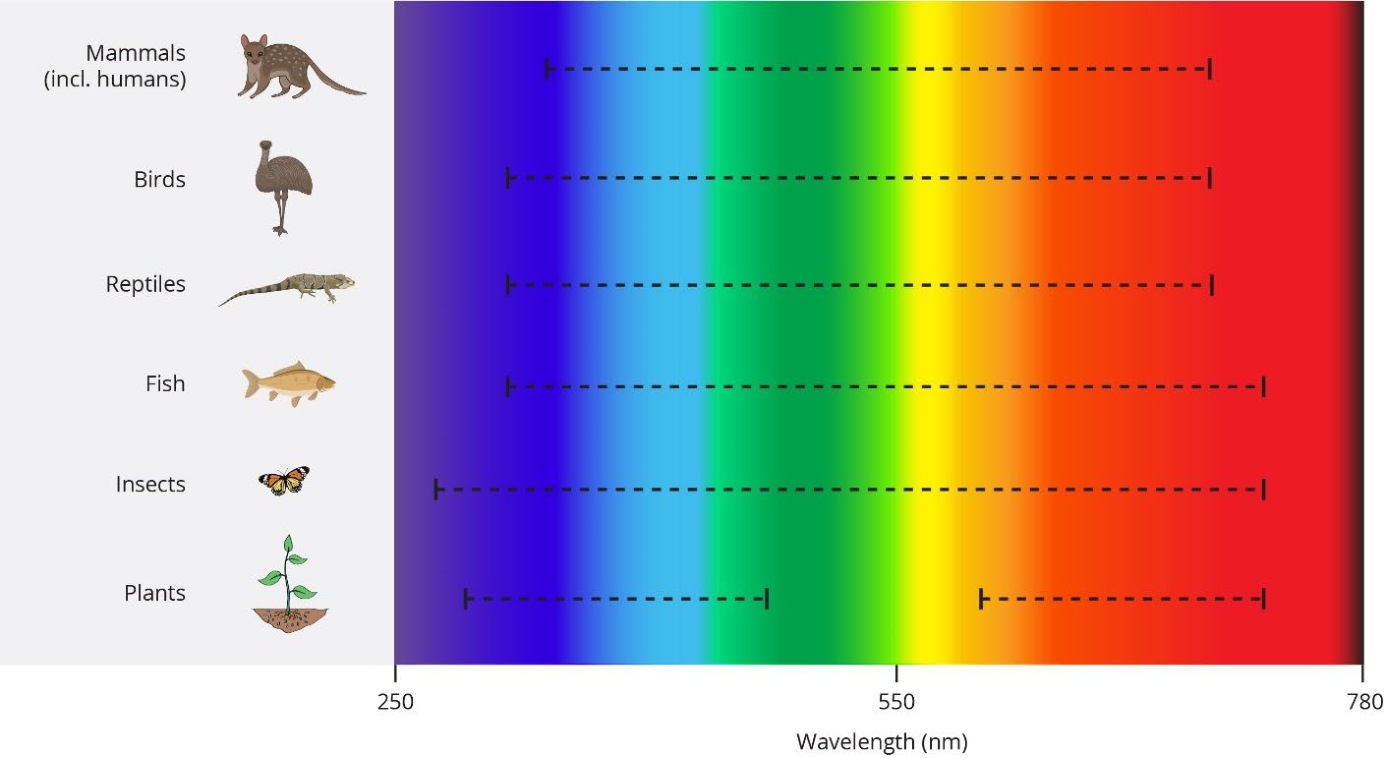
Figure 42 shows why the receptor matters when interpreting a spectrum. Each horizontal range combines the capabilities of representative organisms within a broad group; it is not the response curve of every mammal, insect or plant. Some wavelengths that appear dim to a human observer may still fall within another organism’s detection range. Use the diagram to frame a species-specific question, then examine the actual source SPD and exposure rather than selecting a universal “wildlife-safe” color.
Spectrum is only one part of exposure
An SPD is more revealing than CCT for wavelength content, but it is not a stand-alone prediction of ecological response. Interpretation also depends on exposure and the organisms under consideration. The same source can be used differently depending on mounting height, aiming, optics, shielding, dimming, curfews, roadway geometry, nearby vegetation or water, and the location of sensitive habitat.
The DOE’s outdoor-lighting guidance emphasizes a set of connected practices: use light only where it is needed, use no more than needed, use controls so it operates only when needed, direct it to the intended area, and select color temperature carefully (DOE, “Light at Night,” accessed July 29, 2026). These principles are a useful design framework because they avoid placing all responsibility on spectrum.
For example, an SPD review may identify a feature that warrants closer ecological assessment. The design response may involve more than changing a source: revising optics, reducing spill light, adjusting a schedule, changing the illuminated area, or consulting a qualified lighting and environmental professional about the site. Which response is appropriate depends on the project and applicable requirements.
A practical SPD review for outdoor-lighting projects
Cities and transportation agencies can turn the distinction between spectrum and color appearance into a repeatable documentation process. The steps below are not a universal specification or a substitute for engineering, environmental, or jurisdictional review. They are questions that help a team make a more complete record.
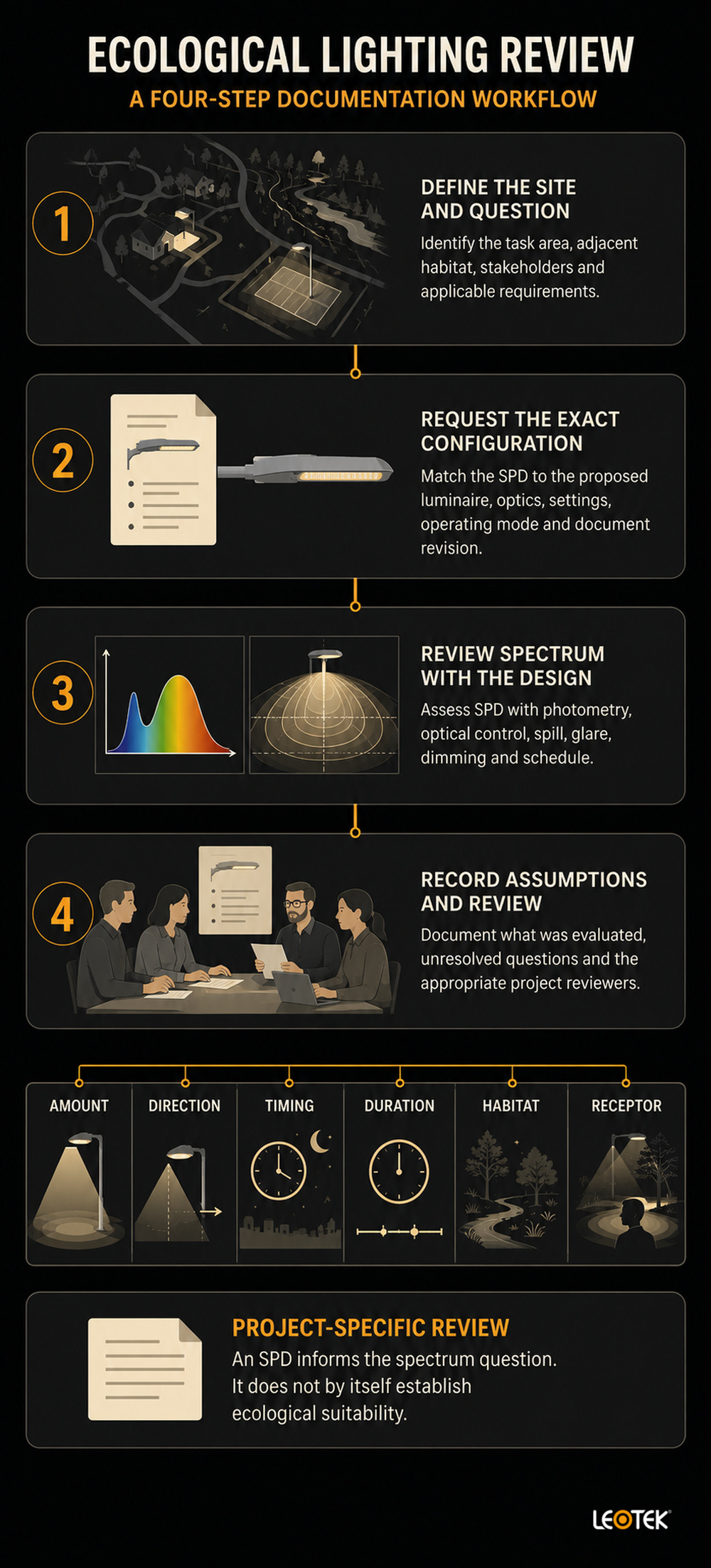
1. Define the site and ecological question
Start with the actual roadway or public-space objective. Is the project replacing existing lighting, adding lighting to a new corridor, or changing operation near a habitat-adjacent area? Identify the intended task area, the adjacent land or water conditions, the stakeholders who manage the site, and any local or agency requirements that govern the work.
This step prevents an abstract spectrum conversation from outrunning the project facts. It also helps distinguish an ecological concern from a broad preference for a particular Kelvin label. The design team can then identify what evidence, if any, is needed for relevant receptors and operating conditions.
2. Request documentation for the exact configuration
Ask for information tied to the proposed luminaire, optics, driver settings, and operating mode. An SPD that represents a different CCT, power level, optic, or product revision may not answer the project question. If a supplier provides a graph, record whether it is relative or absolute, the configuration it represents, and the documentation date.
Also request photometric information, the intended mounting and aiming assumptions, and the proposed control schedule. A roadway light distribution guide can help frame the optical-control discussion. The outdoor lighting applications page can orient readers to application categories, but it is not a substitute for configuration-specific documentation.
3. Review spectrum with the rest of the lighting design
Use the SPD to discuss spectral content, then review it alongside the exposure controls that shape real-world conditions. Consider whether the design directs light only to needed areas, minimizes unnecessary brightness, limits spill and glare, and uses appropriate scheduling or dimming for the site.
Avoid treating a comparison chart as a final answer. A relative SPD may help compare spectral shape, while absolute output and photometry address other parts of the installation. A full review may require separate documentation and qualified judgment to connect source data to a particular habitat or agency requirement.
4. Record assumptions and obtain appropriate review
Document the selected configuration, information reviewed, operating assumptions, and outstanding site questions. This record helps procurement and operations teams understand what was actually evaluated, particularly when a fixture family offers multiple options.
For sensitive sites, involve the appropriate lighting, environmental, and agency reviewers. An online article cannot determine ecological suitability, code compliance, or a project’s required mitigation. It can, however, help a project team ask better questions before it finalizes a selection.
How cities and agencies can specify the decision process
Rather than prescribing an unsupported universal CCT or wavelength threshold, a procurement team can request comparable documentation and define how it will be reviewed. This approach keeps the evaluation connected to the project setting.
Useful questions include:
- What exact luminaire configuration and operating mode does the submitted SPD represent?
- Is the submitted spectral information relative or absolute, and what test or reporting method accompanies it?
- What photometric files and optical-control information correspond to the proposed installation?
- What remote roadway-lighting controls, dimming, scheduling, or other control settings are proposed for the site?
- Which project-specific environmental, roadway, or local-review requirements must the design team address?
The answers should be evaluated with the project’s own technical and environmental criteria. They should not be read as evidence that a manufacturer, technology page, or one lighting metric guarantees a biological outcome.
FAQs about SPD, CCT, and ecological lighting
Is a lower CCT always better for wildlife?
No. CCT does not identify the complete spectrum or the exposure at a site. A lower CCT may be one consideration, but the exact SPD, light level, direction, timing, controls, habitat, and relevant biological evidence still matter.
Can CCT alone tell a reviewer what wavelengths a luminaire emits?
No. CCT describes color appearance, not the source’s complete spectral output. Request an SPD for the exact configuration, then assess it with site exposure and the appropriate evidence and review.
What should a municipality request from a lighting supplier?
Request current documentation for the exact configuration, including SPD information where relevant, photometry, optics, operating settings, control schedules, and document revision information. Then assess those materials against the project’s roadway function, site conditions, and applicable requirements.
Does an SPD chart by itself prove ecological suitability?
No. An SPD describes spectral output. It does not by itself establish the amount of light reaching a receptor, the duration of exposure, species response, regulatory compliance, or ecological outcome.
The practical answer: use CCT to communicate and SPD to investigate
CCT remains useful for communicating color appearance, but SPD better describes the spectrum that is relevant to an ecological-lighting question. Neither should be treated as a stand-alone environmental verdict.
For roadway and public-space projects, the more durable process is to request configuration-specific SPD and photometric documentation, define the site’s actual exposure concerns, and evaluate spectrum with necessity, optical control, amount, timing, and qualified project review. That approach gives cities and transportation agencies a clearer basis for balancing nighttime function with ecological responsibility.
References
Additional technical source: Australian Government DCCEEW, National Light Pollution Guidelines for Wildlife, Version 2.0 (2023). Interpret the cited figures in their original habitat and Australian guidance context; they do not establish a U.S. project criterion.
- U.S. Department of Energy, Light at Night; accessed July 29, 2026.
- PubMed, Rapid assessment of lamp spectrum to quantify ecological effects of light at night; accessed July 29, 2026.
- U.S. Department of Energy, Lighting Quality; accessed July 29, 2026.
- PubMed, A meta-analysis of biological impacts of artificial light at night; accessed July 29, 2026.
- DarkSky International, What is light pollution?; accessed July 29, 2026.