






Cover: AI-generated editorial illustration; not the cited research site or a product test. Original study figures and sources appear below.
The edge of the light beam is not necessarily the edge of an ecological effect. A 2020 field experiment by Giavi and colleagues makes that point through an unexpectedly complex interaction: the same moth can pollinate a flower and lay eggs whose larvae later eat its seeds.
The study compared directly illuminated plants, plants in adjacent dark areas, and plants at separate dark control sites. It then used a controlled corridor experiment to investigate flower visits and egg laying. The most useful lesson is not simply “light reduces pollination.” It is that changes in animal behavior can redistribute interactions into places that remain physically dark.
This article reads the six original figures from Artificial light at night can modify ecosystem functioning beyond the lit area. It separates pollination-related measurements, seed predation and reproductive output, then discusses what a lighting team can reasonably take into a habitat review.
Why one moth can create two opposing outcomes
The researchers used potted Silene latifolia and Epilobium angustifolium as plants for assessing the treatments. In the Silene system, female Hadena bicruris moths can pollinate flowers while also laying eggs there. The resulting larvae feed on developing seeds. A visit therefore cannot automatically be classified as an unqualified benefit or loss.
This is a nursery-pollination interaction. Its outcome depends on both the pollination service and the cost of seed predation. Measuring only visits, or only whether a capsule forms, can miss the other side of that relationship. That is why the paper used several endpoints rather than presenting one pollinator count as the whole result.
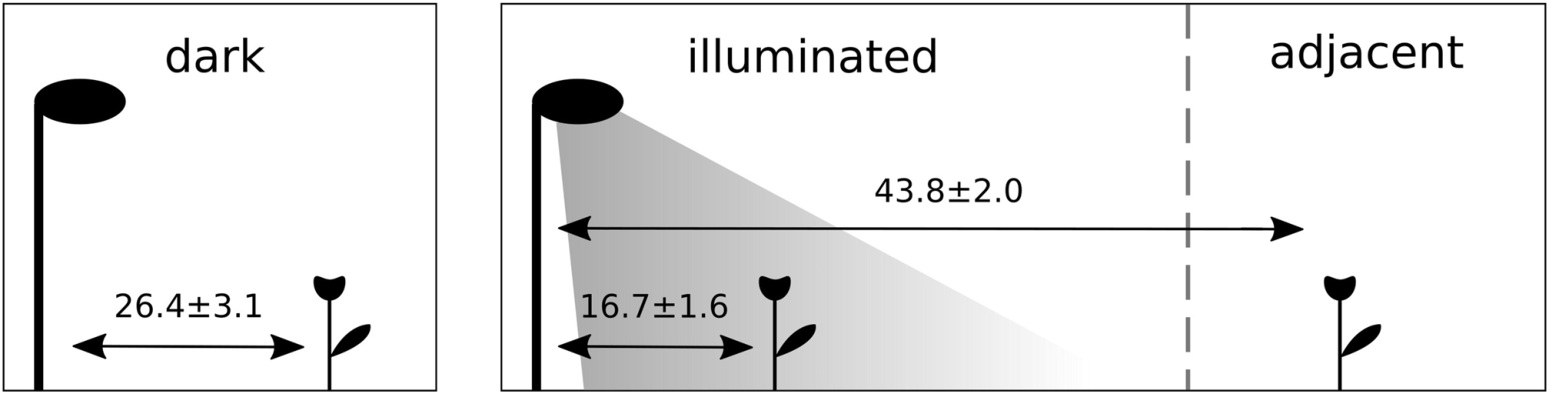
Figure 1: three field conditions, not just light and dark
On small screens, swipe the diagram sideways to read its labels, or open the full-size image below.
Open full-size diagram
The field study used eight unmanaged meadows in the Swiss Prealps. Four received experimental street lamps; four remained dark controls with fake lamp structures. The real lamps were installed on six-meter poles and described as 4000 K LED equipment. The lit meadows included a directly illuminated part and an adjacent part whose measured darkness was comparable with the dark controls.
There were 97 potted plants in total: 47 Silene and 50 Epilobium. These are plant counts, not 97 independently illuminated meadows. The sampling and statistical structure should remain visible when discussing the apparent amount of replication.
Light measurements were made at flower height, approximately 70 cm, with the sensor pointing upward, at least two hours after sunset and without the moon. Those details define the reported exposure. The diagram’s distances and the study’s lux values describe this experiment; they are not recommended habitat-buffer widths or acceptance limits.
Figure 2: a trend is not a conventional significant result
Open full-size diagram
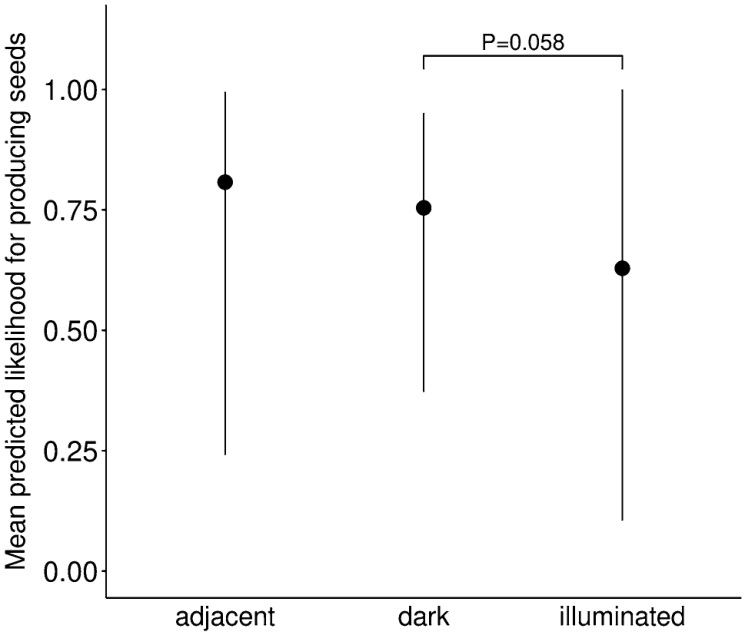
For Epilobium, the likelihood that selected capsules produced seeds was lower under direct illumination than in the dark treatment, but the reported comparison had P = 0.058. The authors described this as a trend. It should not be rewritten as a statistically significant result at a 0.05 threshold.
The graph’s N = 240 refers to the analyzed capsules for that endpoint, not 240 separate plants or field sites. The dots are model-predicted values with 95% confidence intervals. The study selected up to five capsules per plant for seed counts, illustrating why a figure’s sample size needs its unit.
The light treatment did not affect every reproductive endpoint in the same way. In Silene, it did not affect the likelihood of producing seeds; the number of produced seeds also showed no treatment effect for either plant species. A broad claim that both plants simply lost pollination would hide these distinctions.
Figure 3: the adjacent dark area matters
Open full-size diagram
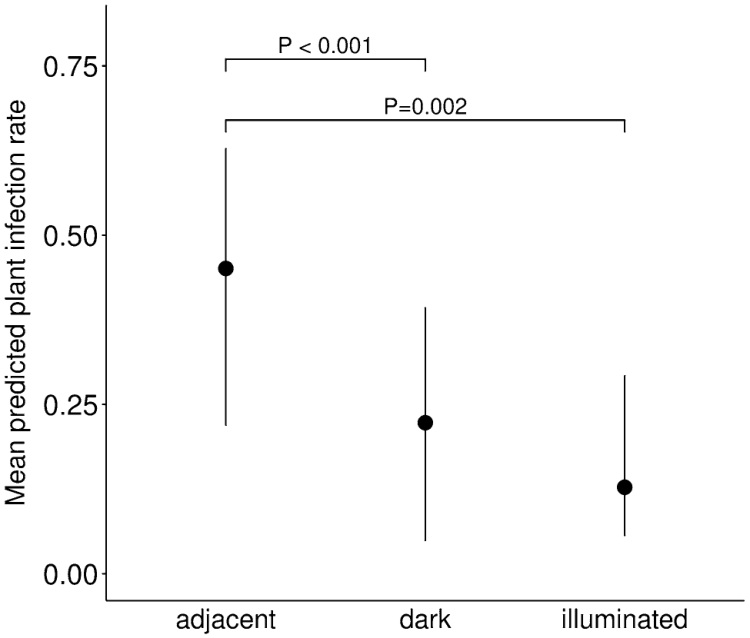
In Silene, the rate of fruit capsules attacked by the moth’s larvae was higher in the adjacent treatment than in either dark controls or the directly illuminated treatment. The reported comparisons were P < 0.001 for adjacent versus dark and P = 0.002 for adjacent versus illuminated. The illuminated-versus-dark difference was not statistically significant.
The paper calls this plant infection rate, but the process here is seed predation by Hadena, not an unspecified plant disease. The endpoint was the proportion of developed capsules attacked by larvae. Explaining that term prevents a reader from mistaking the graph for a pathogen study.
The adjacent locations were dark under the study’s measurement definition. Their different outcome is why a design review cannot assume that everything outside a calculated illumination footprint is ecologically unaffected.
Figure 4: combine the interaction before judging the result
Open full-size diagram
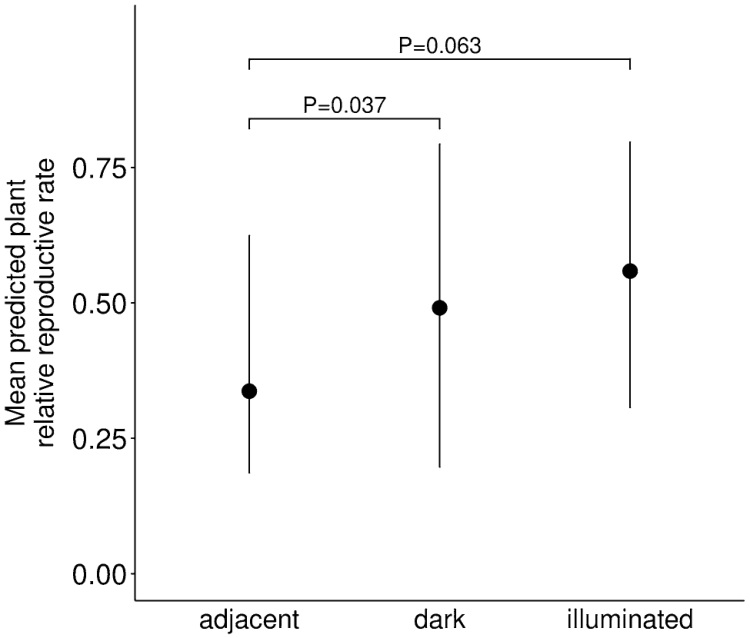
The authors defined relative reproductive output using capsules not attacked by Hadena divided by the total exposed flowers. This is a specific measure of the combined interaction, not a full census of the next generation of plants.
Relative reproductive output was higher in the separate dark controls than in adjacent areas, with P = 0.037. The illuminated-versus-adjacent comparison, P = 0.063, was a trend rather than a conventional significant result. Keep those two statements separate even though both comparisons are marked on the same figure.
The result complicates a familiar assumption: a darker place is not necessarily an independent, unaffected control if it sits beside an illuminated place and organisms move between them. The receiving environment includes interactions and movement as well as measured light.
Figures 5 and 6: test a possible behavioral mechanism
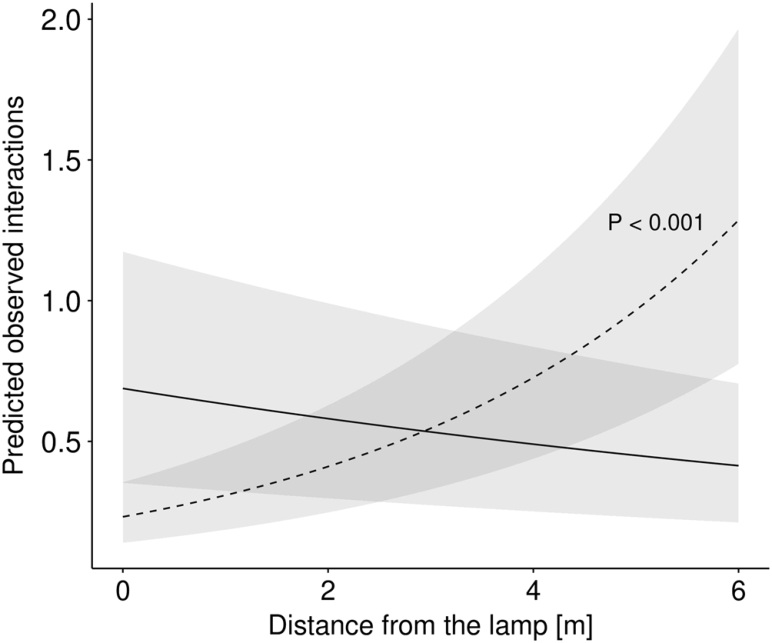
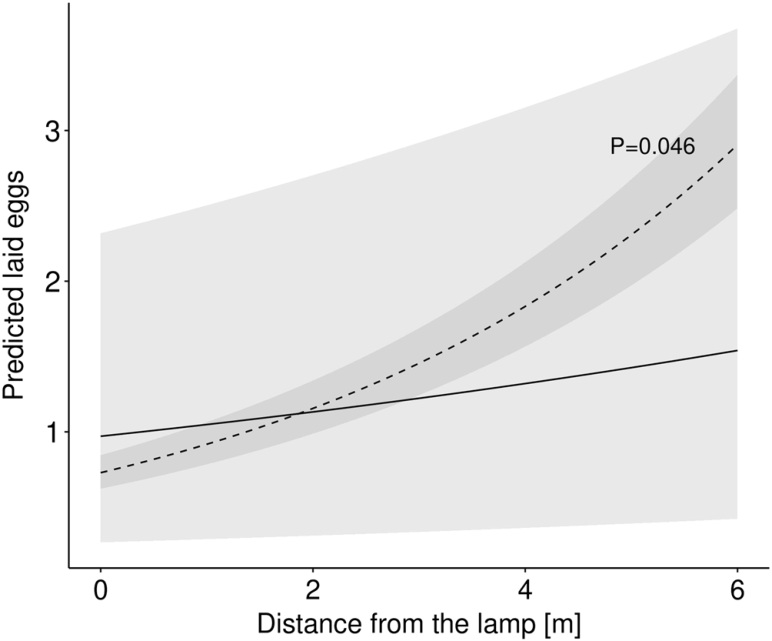
The controlled experiment used three corridors, each eight meters long, with flowers presented at different distances from a lamp. Lit corridors had a light gradient; dark controls had the lamp off. This allowed the researchers to examine visits and egg laying without treating the field pattern alone as proof of how it arose.
Open full-size diagram
Flower visits were lower in lit corridors overall, and within lit corridors they increased with distance from the lamp. The distance effect in the lit treatment was significant at P < 0.001. In Figure 5, the dashed line represents the lit treatment and the solid line the dark control; shaded bands show 95% confidence intervals.
Open full-size diagram
Egg laying also increased with distance from the light in the lit corridors, with a reported distance effect of P = 0.046. The overall lit-versus-dark comparison for eggs on and in the offered flowers was P = 0.060, a trend. The separate test of total eggs laid did not show a significant treatment effect.
These results are consistent with females preferring darker locations for interactions and egg laying, rather than simply becoming unable to lay eggs under light. They support a plausible explanation for the field pattern, but they do not directly track every moth’s movement between the meadow treatments.
Read the endpoints together
| Endpoint | What the paper found | What not to substitute |
|---|---|---|
| Selected capsules producing seeds | A trend under direct illumination for one plant; no equivalent effect for the other. | A claim that every pollinator or plant suffered the same loss. |
| Seed-predator attack in Silene | Higher attack in adjacent areas than in the other two treatments. | An insect-abundance count or a plant-disease result. |
| Relative reproductive output | Lower in adjacent areas than in separate dark controls under the stated measure. | A landscape-wide population forecast. |
| Corridor visits and egg laying | Spatial responses along the experimental light gradient. | A prescribed buffer width for every installation. |
What this means for habitat-edge lighting
The design implication is to define an ecological receiving area rather than stop the review at the beam boundary. That area may include adjacent vegetation, movement routes and the organisms that connect them. The appropriate extent comes from the site’s ecological question, not from copying the experimental distances.
Start by considering whether new lighting can be avoided, moved or reduced in spatial extent. Then review direction, output, timing and spectrum together for the necessary task. The experiment supports considering indirect pathways; it does not quantify how much a particular shield, dimming profile or spectral filter would change these outcomes.
A measurement plan and a biological plan should also remain distinct. The lighting survey can establish what reaches a defined receiving plane. An ecological study addresses interactions, reproduction or another biological endpoint. The before-and-after guide explains how to keep exposure measurements comparable.
For a project beside a connected meadow, park edge or waterway, use the site-assessment process to identify tasks, sources, habitat features and uncertainties. The dark-corridor guide then helps translate the receiving-area question into a spatial design record.
Limits that belong beside the conclusion
This was a study of two plant species and a particular plant–moth interaction in Switzerland. Its lamp configuration, meadow setting, exposure durations and biological relationships do not represent every roadside planting or U.S. habitat. The Silene plants were exposed for about 24 days on average; Epilobium for about 42 days. Those periods are not interchangeable with years of population monitoring.
The field and controlled experiments address connected but different questions. Adjacent-area effects are an observed outcome under the study conditions; the proposed movement mechanism is supported by the corridor work and interpretation. Keeping that distinction is more informative than claiming that light always pushes pollinators into a fixed surrounding radius.
Questions for the next design meeting
Does an unlit habitat edge make a sufficient control site?
Not automatically. If organisms move between lit and adjacent dark areas, the adjacent area may be affected indirectly. The study design must consider independence, movement and the endpoint being measured.
Does the paper prove that lighting always reduces pollination?
No. It found different results for different endpoints, including a trend rather than a conventional significant result for one seed-production comparison. Its stronger adjacent-area findings concerned seed predation and the defined relative reproductive output.
Can its distances become a standard setback?
No. They describe the experimental geometry. A project needs its own habitat assessment, light distribution, operating states and review criteria.
What should be reviewed with an equipment proposal?
The receiving habitat, necessary task, configuration-specific spectral and photometric information, and the intended operating schedule. A product attribute should answer a defined design question. For a different insect endpoint, read the companion caterpillar field-study review.
Primary source
Giavi, S., Blösch, S., Schuster, G., and Knop, E. (2020). Artificial light at night can modify ecosystem functioning beyond the lit area. Scientific Reports, 10, 11870. Figures 1–6 reproduced under CC BY 4.0. The research results are the authors’; project-review applications are LEOTEK’s interpretation.