






Pedestrian Signal
In addition to safety, pedestrian signal systems are key to managing pedestrian flow. In high-traffic environments, large volumes of people must cross efficiently while remaining coordinated with vehicle traffic. Clear and reliable signal indications help regulate crossing behavior, reduce congestion, and improve overall mobility.
Pedestrian Signal
Key Considerations for Pedestrian Signal
In high-density areas, pedestrian signals are not only about safety—they are also critical for managing pedestrian flow and ensuring smooth coordination between different types of road users.
Ensure Clear and Intuitive Communication
Signals must provide clear, easily recognizable indications that can be quickly understood by people of all ages and abilities.
Support Safe and Controlled Pedestrian Flow
Systems should effectively manage pedestrian movement in both low- and high-density environments while maintaining coordination with vehicle traffic.
Maintain High Visibility and Reliability
Consistent performance under different environmental conditions ensures that pedestrians can rely on signal guidance at all times.
LEOTEK pedestrian signal solutions are designed to deliver stable performance, high visibility, and intuitive signal communication, ensuring pedestrians can clearly understand when to cross and helping reduce uncertainty and accident risk in complex roadway environments.
Recommended Products for Pedestrian Signal
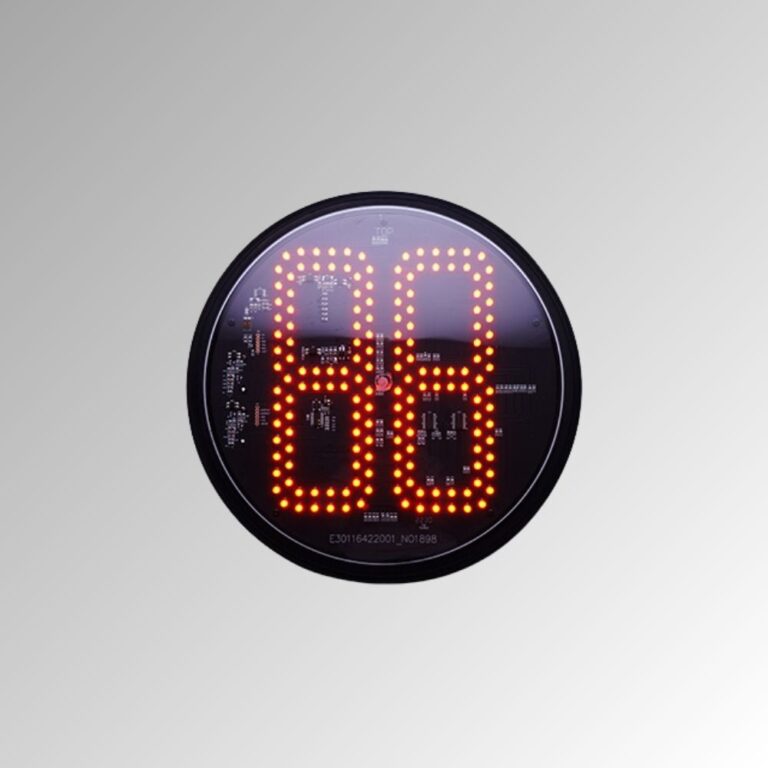
Countdown digits
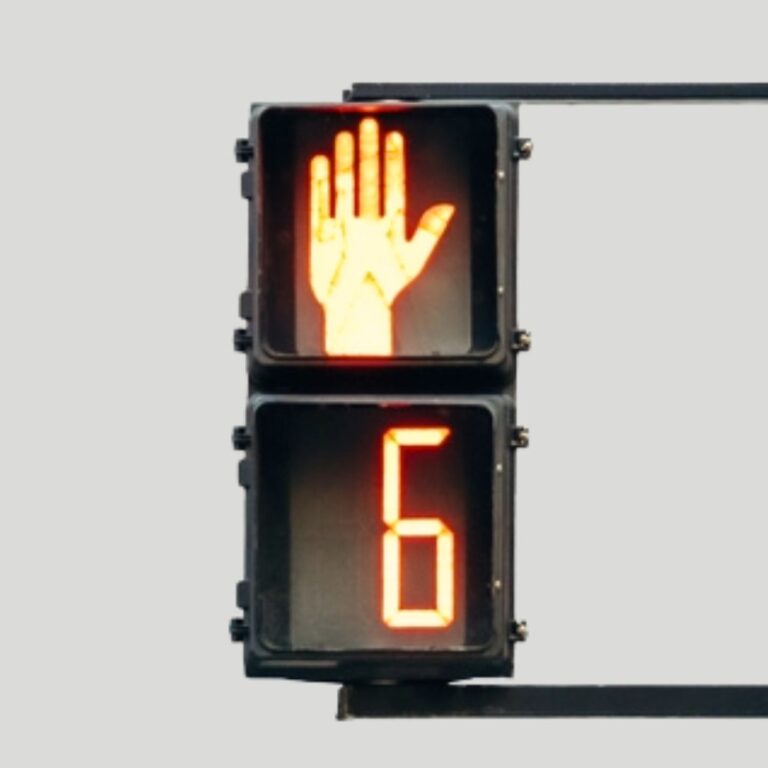
Countdown digits
Choose pedestrian signal solutions when your priority is enhancing pedestrian safety, improving crossing behavior, and providing clear and reliable signal guidance.
Pedestrian Signal FAQ
Technical guidance for municipalities, transportation agencies, consultants, contractors, and signal technicians evaluating pedestrian indications, countdown timing, accessibility, LED module performance, retrofit compatibility, and intelligent intersection technology.
What do the WALKING PERSON and UPRAISED HAND pedestrian signal symbols mean?
The pedestrian symbols communicate when a person may begin, continue, or must wait to cross. A steady lunar-white WALKING PERSON permits a pedestrian to start crossing; a flashing Portland-orange UPRAISED HAND means do not start, but pedestrians already crossing should continue; and a steady UPRAISED HAND means do not enter the roadway. A flashing WALKING PERSON has no assigned meaning and should not be used.
What does a pedestrian countdown signal display tell pedestrians?
A pedestrian countdown display shows the seconds remaining in the pedestrian change interval. It operates with the flashing UPRAISED HAND to help people already in the crosswalk understand the available clearance time; it does not authorize a pedestrian waiting at the curb to begin crossing. Explore LEOTEK CD Series countdown modules.
When is a pedestrian countdown display required under the MUTCD?
The Manual on Uniform Traffic Control Devices requires a countdown display when the pedestrian change interval is longer than 7 seconds. A countdown display may also be used for a change interval of 7 seconds or less. Agencies should apply the current MUTCD edition together with state supplements, local standards, and the approved traffic-control plan. Consult the official FHWA MUTCD.
What is the difference between the WALK interval, pedestrian change interval, and buffer interval?
The WALK interval allows pedestrians to begin crossing. It is followed by the pedestrian change interval, during which the UPRAISED HAND flashes and pedestrians already in the roadway complete their crossing. A buffer interval then displays a steady UPRAISED HAND before conflicting vehicle movements are released, providing separation between pedestrian clearance and the next conflicting phase.
How is pedestrian clearance time calculated at a signalized crosswalk?
Pedestrian clearance time is calculated from the applicable crossing distance and a design walking speed established by the governing standard and engineering assessment. MUTCD guidance commonly uses 3.5 feet per second for the pedestrian clearance calculation, while site conditions may justify a slower speed. The traffic engineer must also consider curb ramps, refuge islands, intersection geometry, pedestrian characteristics, and signal phasing.
How can pedestrian signal timing accommodate slower pedestrians and wheelchair users?
Pedestrian timing can accommodate people who need more time by using a slower design walking speed, providing additional clearance time, or activating an extended timing plan. Depending on agency policy, an extended pushbutton press or passive detection system can request or provide additional time. Any adjustment must preserve coordinated signal operation, accessibility, and the required separation from conflicting movements.
What is a Leading Pedestrian Interval, and how can it improve pedestrian visibility?
A Leading Pedestrian Interval (LPI) begins the pedestrian WALK interval before parallel vehicles receive a green indication. The head start—often approximately 3 to 7 seconds—allows pedestrians to establish their presence in the crosswalk, making them more visible to turning drivers. LPI duration should be selected through an engineering assessment of intersection geometry, turning movements, pedestrian demand, and accessibility needs.
What is a Pedestrian Hybrid Beacon, and when should one be installed?
A Pedestrian Hybrid Beacon (PHB) is a pedestrian-actuated traffic control device used at qualifying crossings, commonly on higher-speed or multilane roads where conventional signs and markings may be insufficient. The vehicle-facing beacon remains dark until activated, reducing unnecessary delay while providing a controlled pedestrian crossing. Installation requires an engineering study using current MUTCD criteria and site conditions. Review FHWA’s PHB guidance.
How does a Pedestrian Hybrid Beacon sequence work for drivers and pedestrians?
A typical PHB changes from dark to flashing yellow, steady yellow, steady red, and alternating flashing red for drivers. The pedestrian signal displays WALK during the steady-red vehicle phase and a flashing UPRAISED HAND during pedestrian clearance. Drivers must stop for steady red; during alternating flashing red, each driver must stop and may proceed only after yielding to pedestrians and confirming the crosswalk is clear.
What is an Accessible Pedestrian Signal, and what information does it provide?
An Accessible Pedestrian Signal (APS) communicates pedestrian signal information in nonvisual formats for people who are blind or have low vision. An APS can provide an audible walk indication, a pushbutton locator tone, a tactile directional arrow, and a vibrotactile WALK indication. The system must identify the associated crosswalk unambiguously and coordinate with the visual pedestrian signal.
Which MUTCD and PROWAG requirements apply to accessible pedestrian signals?
The MUTCD defines the traffic-control operation, indications, audible and vibrotactile features, and pushbutton functions associated with APS installations. The U.S. Access Board’s Public Right-of-Way Accessibility Guidelines (PROWAG) establish accessibility requirements for pedestrian signal heads, pushbuttons, passive detection, and clear-space access. Applicability depends on project scope and adoption by the authority having jurisdiction, so agencies should verify current federal, state, and local requirements. Review the official PROWAG requirements.
How should accessible pedestrian pushbuttons be positioned at a crosswalk?
An accessible pedestrian pushbutton should be reachable from an accessible clear space, positioned close to the crossing it controls, and oriented parallel to that crosswalk. PROWAG places the pushbutton no more than 5 feet from the applicable curb-ramp side or crosswalk line and between 1.5 and 10 feet from the curb or pavement edge. Pole separation, reach range, tactile-arrow alignment, curb-ramp geometry, and alteration constraints must also be evaluated.
How can passive pedestrian detection improve crossing safety and accessibility?
Passive pedestrian detection identifies a person waiting to cross without requiring a conventional button press. When integrated with an approved controller strategy, detection can place a pedestrian call, confirm presence, extend clearance for slower users, or support operational analysis. Sensor coverage, false detections, privacy, accessibility, weather performance, failure behavior, and controller integration must be validated for the specific intersection.
What pedestrian signal module sizes and configurations does LEOTEK offer?
LEOTEK offers multiple LED pedestrian signal configurations for North American and regional applications. The portfolio includes 12-inch square and selected round Hand/Person and countdown modules, plus 16-inch by 18-inch pedestrian and countdown assemblies. Available formats include overlap, side-by-side, separate countdown, and combined pedestrian/countdown displays; voltage, certification, optical appearance, and regional availability vary by model. Explore LEOTEK pedestrian signal products.
What is the difference between overlap, side-by-side, and combined pedestrian countdown displays?
An overlap module presents the WALKING PERSON and UPRAISED HAND within the same display area at different times. A side-by-side design places the symbols in separate areas of a larger face, while a combined pedestrian/countdown module integrates the symbols and countdown digits into one assembly. The correct configuration depends on housing dimensions, viewing distance, agency standards, wiring, controller operation, and regional practice. View the LEOTEK SPC combined module or review the DIL side-by-side module.
What is the difference between pixelated and incandescent-look LED pedestrian signals?
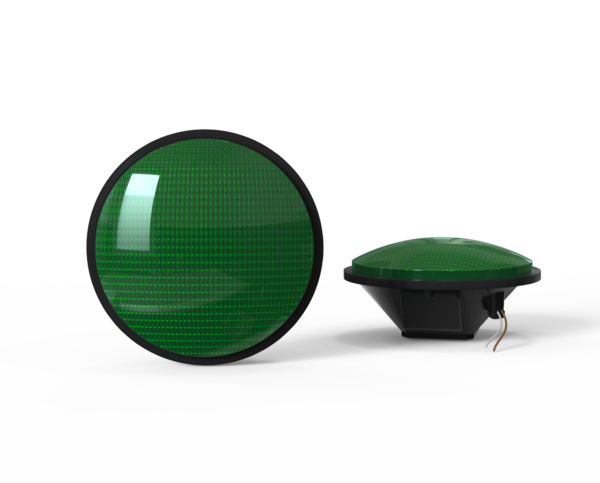
Pixelated displays form symbols or digits from visibly discrete LED points, while incandescent-look optics create a more continuous illuminated appearance that resembles a traditional lamp. Both approaches can use energy-efficient LED technology; selection depends on agency preference, required optical performance, product approval, uniformity, viewing angle, and compatibility with the existing signal face. LEOTEK offers both appearances in selected pedestrian product families. Explore LEOTEK HM Series display options.
Which ITE, MUTCD, and NEMA requirements should a pedestrian signal installation meet?
Each reference serves a different purpose. The MUTCD governs how pedestrian traffic-control devices are applied and operated; ITE specifications address LED module optical, electrical, and physical performance; and NEMA standards can affect controller, cabinet, monitoring, and system compatibility. Agencies should specify the applicable document editions and verify compliance for the exact module, voltage, housing, controller, and project—not rely on a general product-family statement.
What optical, electrical, and environmental performance should agencies compare when selecting an LED pedestrian signal module?
Agencies should compare symbol and digit legibility, lunar-white and Portland-orange chromaticity, luminous intensity, uniformity, viewing angle, voltage range, power consumption, turn-on and turn-off behavior, conflict monitoring, temperature rating, moisture sealing, UV resistance, thermal management, certification, warranty, and approved-products-list status. LEOTEK’s SPC Series combines wide-angle optics, constant-current operation, environmental sealing, an internal conflict monitor, and multiple voltage configurations. Review LEOTEK SPC Series performance.
Can LEOTEK LED pedestrian modules retrofit existing signal housings?
Many LEOTEK pedestrian signal modules are designed for retrofit installation, but compatibility must be confirmed for the exact application. Agencies should verify display dimensions, symbol arrangement, voltage, connector or termination, mounting depth, gasket or O-ring interface, controller and monitor behavior, certification, and approved-product status. Matching the nominal face size alone does not establish electrical or mechanical compatibility. See an LEOTEK HM Series configuration.
How can LEOTEK Interlux™ AI technology support safer pedestrian crossings?
LEOTEK Interlux™ uses AI-enabled sensing, edge processing, and connected intersection technology to analyze pedestrian, cyclist, vehicle, and micromobility movement in real time. When integrated with an approved traffic-control strategy, these insights can support conflict awareness, responsive timing, operational analysis, and proactive safety applications. Interlux complements—not replaces—compliant pedestrian modules, accessible features, controllers, communications, and professional traffic-engineering oversight. Explore LEOTEK Interlux™ AI Traffic Signal.