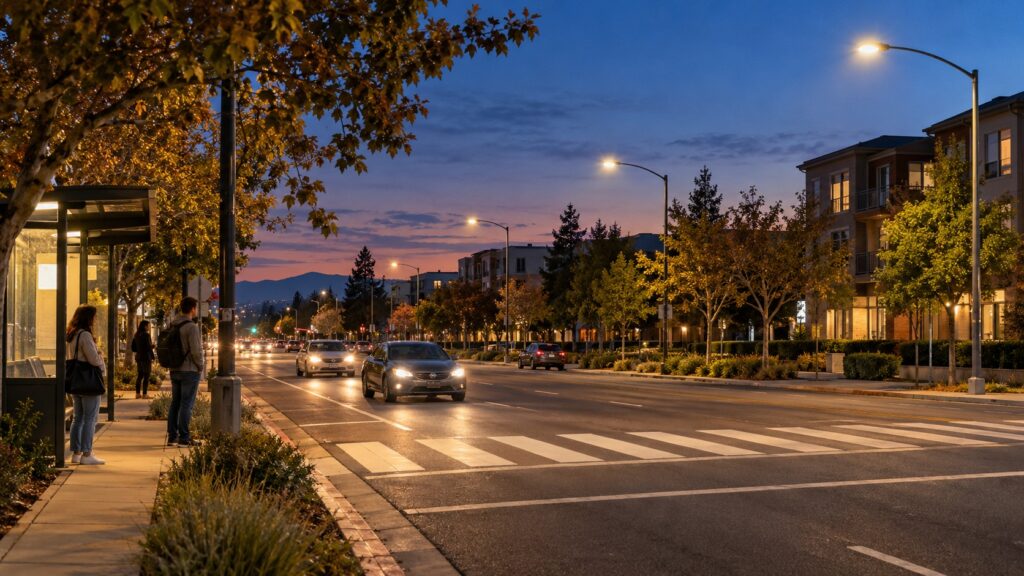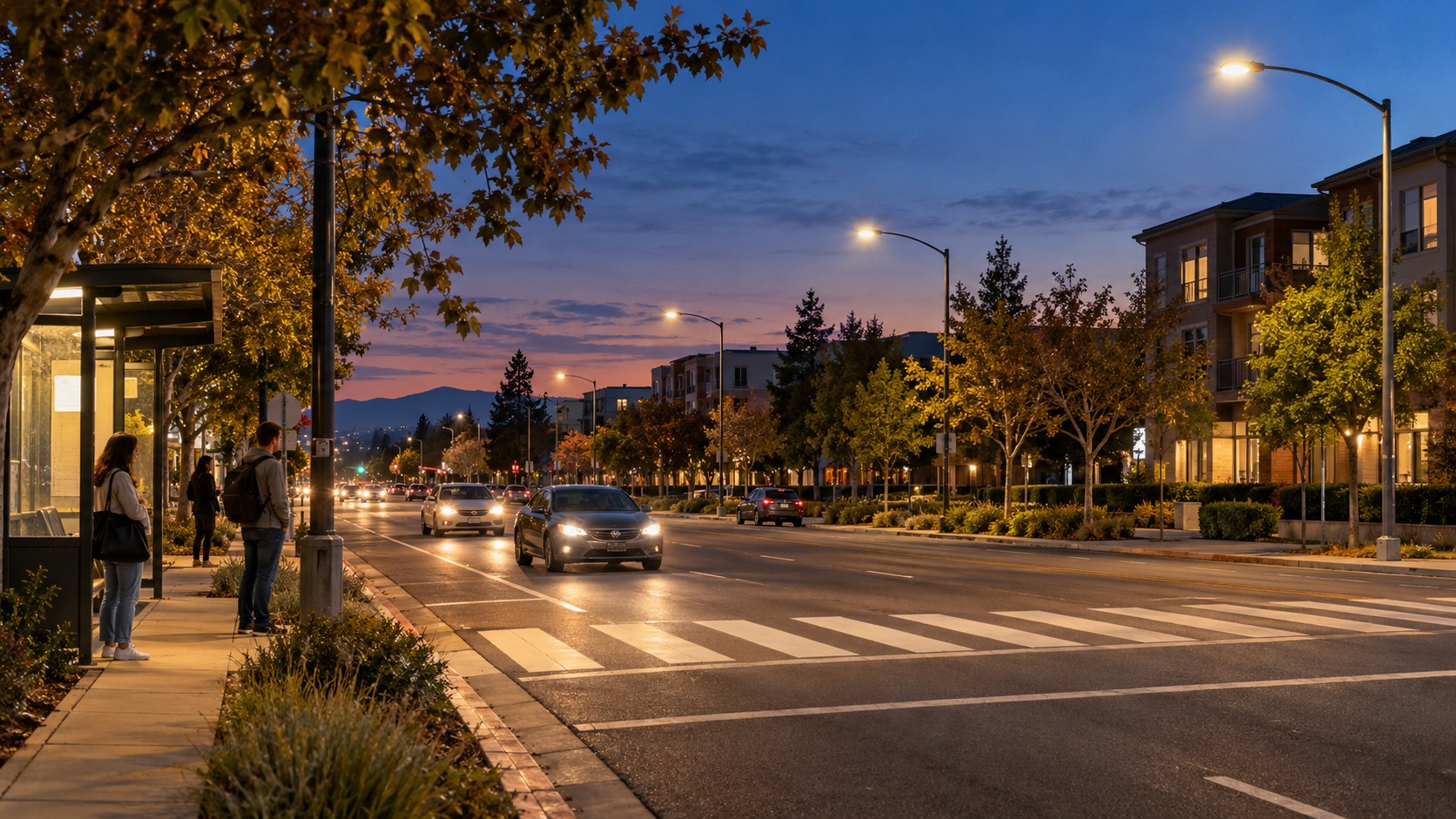






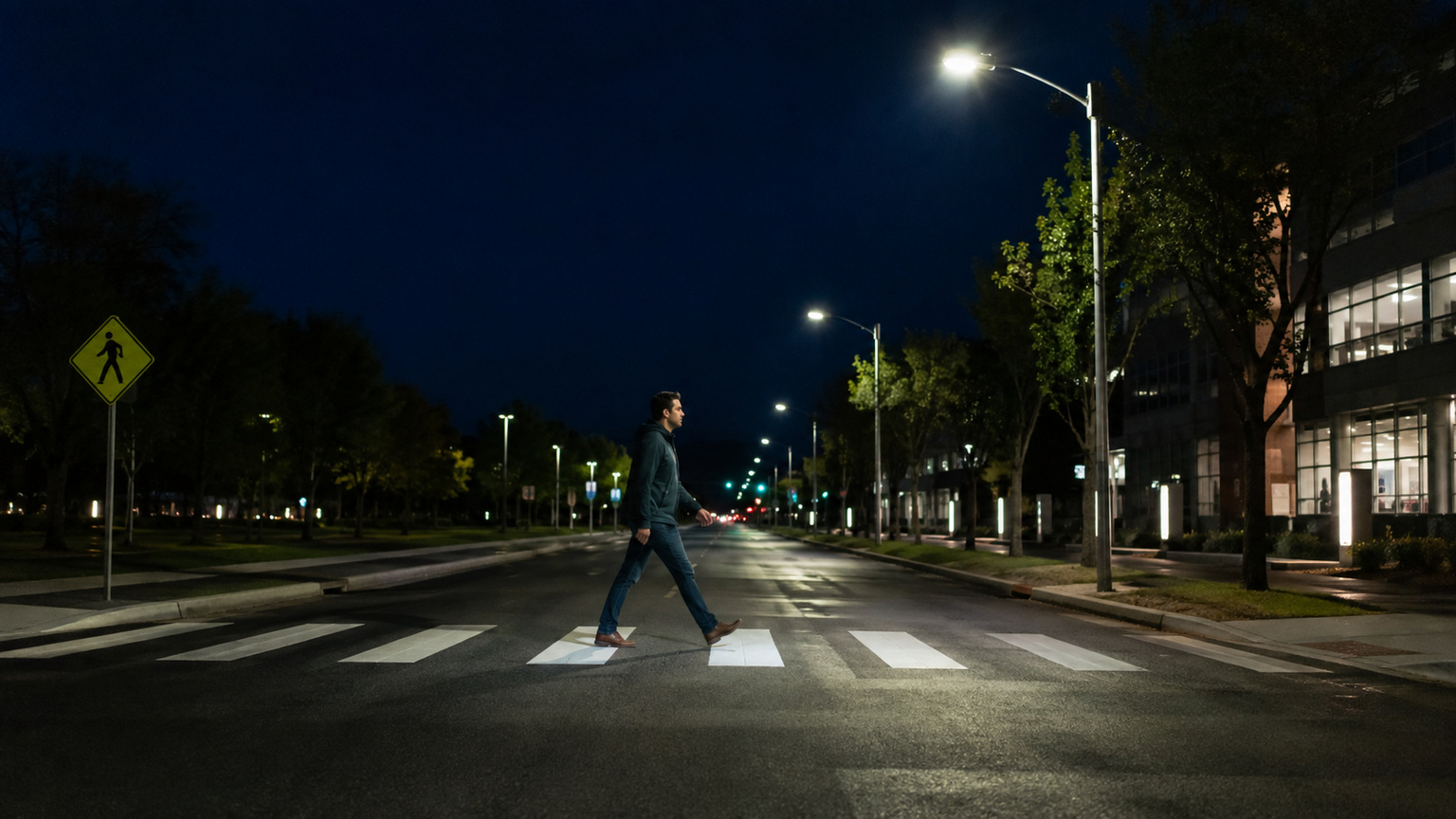
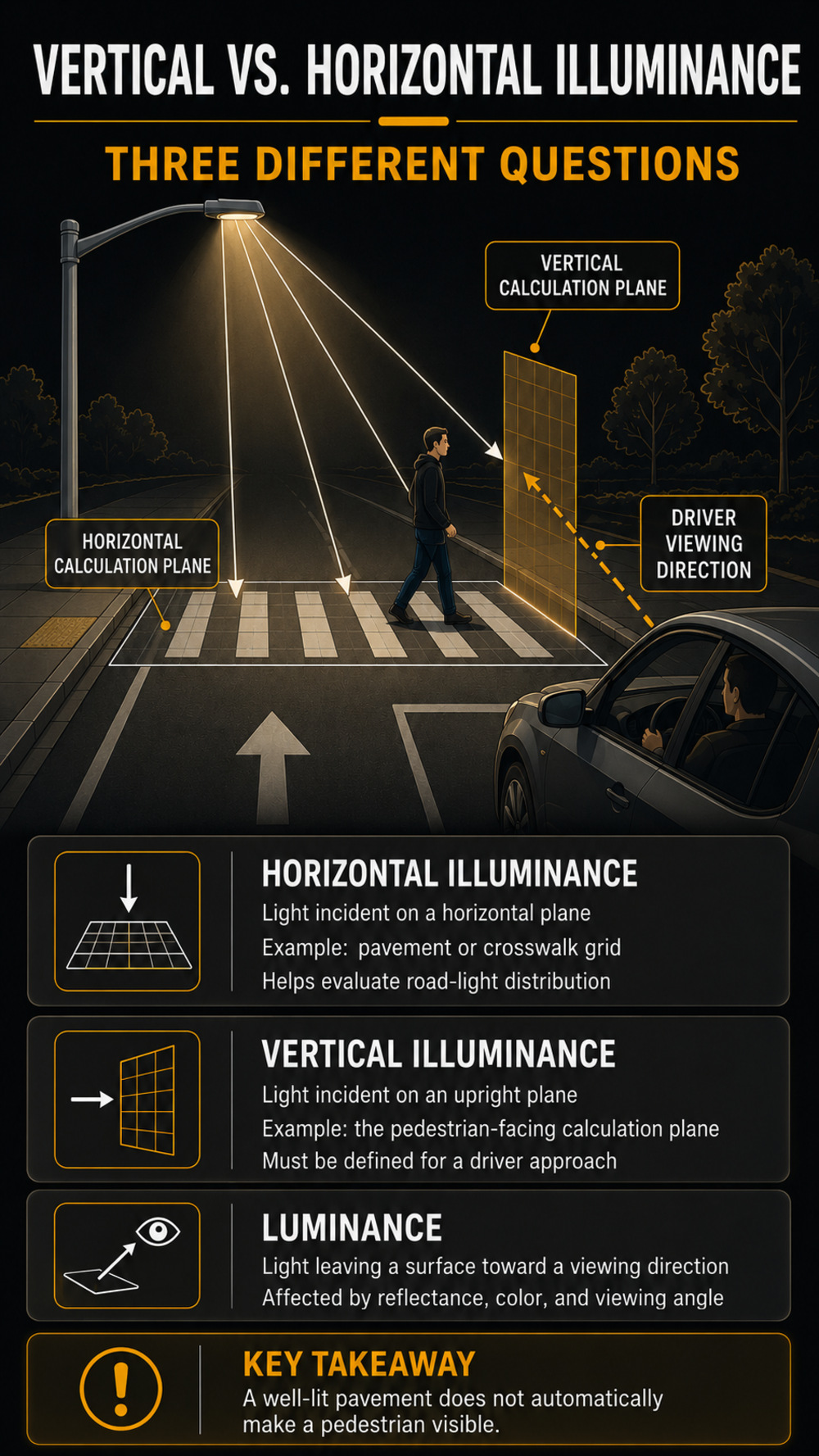
Vertical illuminance measures light incident on an upright plane, such as the side of a pedestrian facing an approaching driver; horizontal illuminance measures light on a horizontal plane, such as pavement. A crossing can therefore show adequate horizontal lux without providing the light or contrast needed to reveal a person from a critical approach direction.
That does not make horizontal illuminance unimportant. It means the two measurements answer different questions, and a defensible pedestrian visibility lighting review should evaluate both within the larger context of contrast, glare, geometry, maintenance, and the driver’s view.
Key takeaways
- Lux is a unit of illuminance. The receiving plane and its orientation determine what the value describes.
- Horizontal illuminance describes light on pavement, but it does not substitute for a driver-facing vertical calculation.
- Pedestrian detection also depends on contrast, clothing, headlamps, glare, background conditions, and viewing direction.
- Agencies should define calculation planes, critical approaches, maintained conditions, and field-verification methods before accepting a design.
Horizontal and vertical illuminance measure different planes
Illuminance and lux in plain language
The Illuminating Engineering Society definition of illuminance describes it as luminous flux incident on a surface per unit area. Its International System of Units (SI) unit is the lux, equal to 1 lumen per square meter.
That definition contains a detail that is easy to overlook: illuminance is measured on a surface. The surface may be pavement, a wall, a sign, a meter sensor, or a calculation plane placed in a lighting model. Change the surface’s position or orientation, and the measured value can change even though the luminaires have not.
For that reason, a statement such as “the crosswalk has 10 lux” is incomplete. Is that an average or minimum? Is it measured horizontally at pavement level or vertically at a specified height? Which way does the vertical plane face? Does the value describe a new installation or maintained performance after expected light loss? The number cannot answer those questions by itself.
Readers who need a broader foundation can review the relationship among watts, lumens, and lux. For pedestrian visibility, however, the next step is to define the plane and the visual task.
A pavement plane is not a pedestrian plane
A horizontal calculation plane is typically represented as an upward-facing surface on or near the roadway. It shows how much light reaches the pavement across a grid of points. That information helps a design team evaluate the amount and distribution of light over the traveled area.
A vertical calculation plane stands upright. At a crossing, it can represent the light incident on the side of a pedestrian facing a specified driver approach. Because a person has more than one side, the relevant vertical illuminance can differ for vehicles approaching from opposite directions.
Consider the geometry without assigning a design value. A luminaire may cast substantial light downward onto the road while sending less light toward the driver-facing side of a person. Moving the luminaire, changing its optical distribution, or changing the vertical plane’s orientation can alter that relationship. A horizontal grid alone does not show it.
Illuminance is not luminance
Illuminance describes light arriving at a surface. Luminance concerns light leaving a surface in a particular direction and is more closely related to what an observer sees. Surface reflectance, color, viewing angle, and the surrounding background all affect that appearance.
This distinction explains why equal illuminance does not guarantee equal visibility. A light-colored coat and a dark coat can return different amounts of light toward a driver. A person may also appear lighter or darker than the background. Vertical illuminance is an important input to that visual task, but it is not a complete model of perception.
Comparison of horizontal illuminance, vertical illuminance, and luminance
| Question | Horizontal illuminance | Vertical illuminance | Luminance |
|---|---|---|---|
| What does it describe? | Light incident on a horizontal plane | Light incident on an upright plane | Light leaving a surface toward a viewing direction |
| Roadway example | Pavement or crosswalk grid | Pedestrian-facing calculation plane | Apparent brightness of the pedestrian, pavement, or background |
| What can it help evaluate? | Amount and distribution of light on the road | Light reaching vertical surfaces from a defined direction | What an observer may see from a defined viewpoint |
| What can it establish alone? | Not pedestrian visibility or safety | Not contrast, glare, or safety | Not the full performance of the lighting system |
Why horizontal lux can miss the pedestrian visibility task
Light on the road does not guarantee light on the person
Pedestrian visibility is directional. A driver approaches from a particular location, looks through a windshield, and sees a person against a background that changes as the vehicle moves. The useful lighting condition is therefore tied to the pedestrian’s position and orientation relative to that approach.
Horizontal illuminance can show a well-lit patch of pavement beneath the person while leaving uncertainty about the person’s vertical surfaces. This is especially relevant when a design review reports only an average horizontal value. An average can conceal low points, and a horizontal average says nothing about the value on a vertical plane.
Luminaire placement, mounting geometry, optical distribution, nearby obstructions, and crossing width can all affect where light lands. Vehicle headlamps contribute another source that fixed-lighting calculations may treat differently depending on the method. These factors should be documented rather than compressed into one brightness number.
Detection depends on contrast
A driver detects a pedestrian by distinguishing the person from the visual background. In positive contrast, the person appears brighter than the background; in negative contrast, the person appears darker. Which condition occurs can change across the crossing and by approach direction.
Clothing matters because materials and colors reflect light differently. Backgrounds matter because storefronts, signs, opposing headlamps, unlit areas, and other surfaces can change the driver’s adaptation and the apparent contrast. The same measured vertical illuminance can therefore accompany different visual conditions.
This is why lighting for pedestrian detection should not be reduced to “more light.” A design team needs to ask whether the arrangement creates usable contrast at the relevant locations without creating other visibility problems.
Glare can compete with visibility
The Federal Highway Administration’s archived roadway-lighting research distinguishes horizontal illuminance, vertical illuminance, luminance, and uniformity. It also explains a dual effect: light on vertical surfaces can help reveal roadway objects, while light reaching the driver’s eye can contribute to glare.
That FHWA study used a vehicle-mounted method in which its vertical measurement more closely represented a driver-view, glare-related quantity than a pedestrian target plane. The result should not be substituted for a current crosswalk calculation method. It does support the broader point that lighting quality cannot be judged by raising one metric without considering the observer’s view.
What crosswalk research actually supports
A frequently cited closed-track study
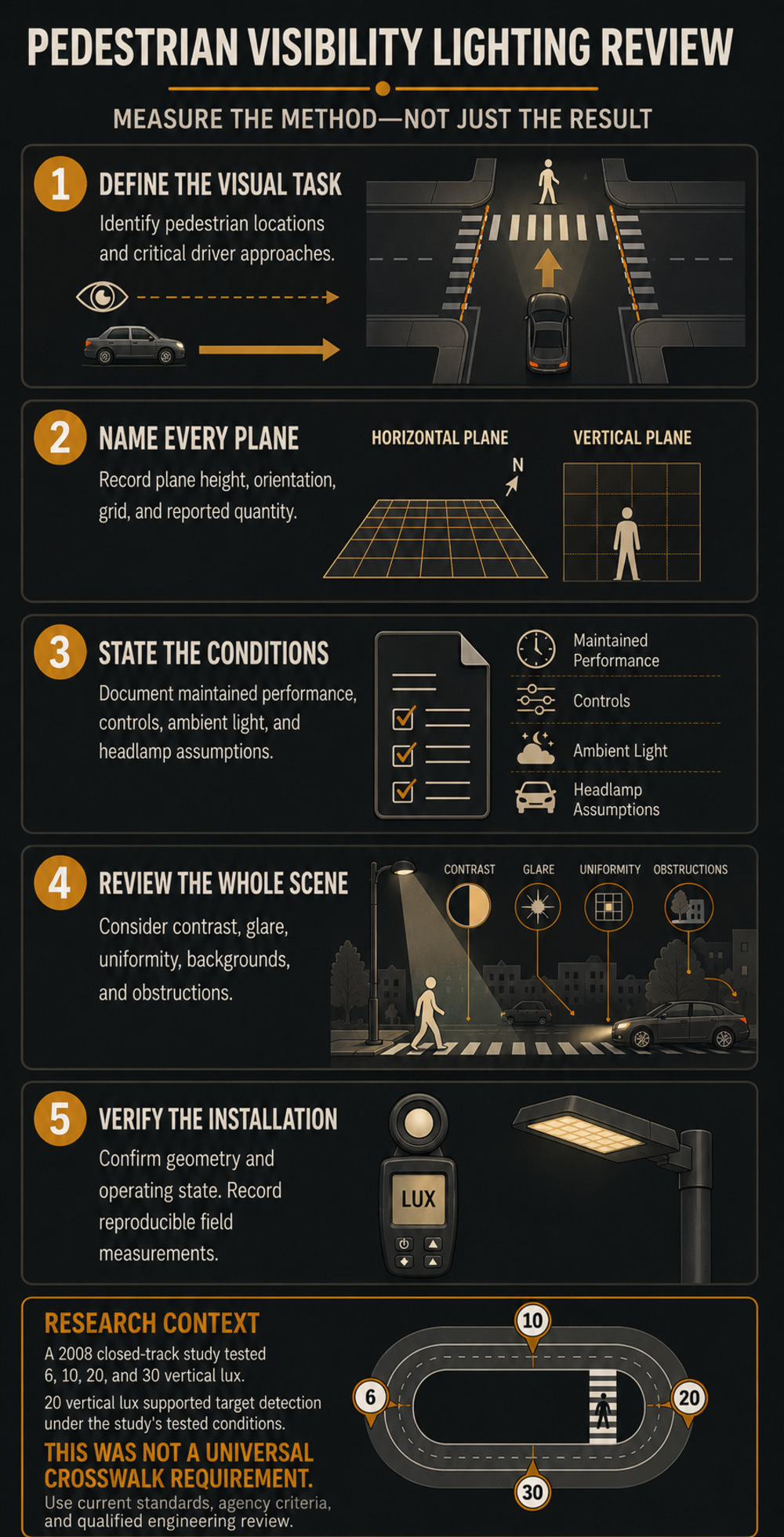
A 2008 study by Christopher J. Edwards and Ronald B. Gibbons examined the relationship between vertical illuminance and pedestrian visibility in crosswalks. According to the Transportation Research Board’s TRID record, 26 participants age 66 or older drove a sport utility vehicle on a closed test track at night.
The researchers tested vertical illuminance levels of 6, 10, 20, and 30 lux. They also varied high-pressure sodium and metal-halide lighting, target type, and clothing color. Detection distance changed with illuminance, source type, target type, and clothing. The abstract suggests that 20 vertical lux provided an adequate level for target detection under the study’s tested conditions.
The study is useful because it connects vertical illuminance to a specific visual experiment rather than treating the metric as an abstract calculation. It also shows why target properties and source conditions must accompany any reported result.
Why 20 vertical lux is not a universal answer
The study does not establish a universal crosswalk requirement. Its participant group was small and limited to people age 66 or older. Testing took place on a closed track with one vehicle and headlamp context, older light-source technologies, selected target objects, and defined clothing colors.
Those boundaries matter. A study finding is not automatically a standard, code provision, agency criterion, or design value for every crossing. The applicable value and method may depend on the crossing type, road classification, traffic approaches, adopted guidance, owner requirements, and other project conditions.
ANSI/IES RP-8-22, *Recommended Practice: Lighting Roadway and Parking Facilities*, is the current IES recommended practice identified in the research for this article. It includes material on calculations, maintenance and operations, street lighting, intersections, roundabouts, and crosswalks. Agencies and design teams should consult the licensed standard and confirm which edition and criteria the project owner has adopted rather than copying a number from a secondary summary.
Measure the method, not just the result
Whenever a report states a vertical lux value, reviewers should look for the measurement conditions attached to it:
- plane height and orientation;
- average, minimum, or point value;
- grid limits and point spacing;
- initial or maintained condition;
- operating state and dimming level;
- ambient-light and headlamp assumptions;
- observer direction; and
- instrument and field-measurement method.
Without those details, two values labeled “vertical illuminance” may not describe equivalent conditions.
Human recognition, facial features, and terminology
Detection and recognition are different visual tasks
Detection asks whether something is present. Recognition asks what it is and may involve understanding movement, orientation, or facial features in a pedestrian environment.
Lighting professionals may evaluate how light reaches vertical and curved features for these tasks, but this article’s evidence does not establish a facial-recognition illuminance threshold. A face is not a flat target, and its appearance depends on light direction, shadows, reflectance, distance, background, and the observer’s view. A qualified lighting professional should select the appropriate modeling method and current criterion.
Human recognition is not biometric surveillance
Terminology about recognizing faces can be misleading. In this article, it refers only to a human observer’s ability to recognize facial features in an outdoor pedestrian setting. It does not refer to camera-based biometric identification, software accuracy, surveillance, or artificial intelligence.
Lighting intended for a human visual task should not be presented as evidence that a camera system will identify people accurately. Camera performance introduces separate questions about sensors, exposure, optics, placement, processing, privacy, security, and agency policy, none of which can be validated by a roadway illuminance value alone.
How agencies can specify and verify pedestrian visibility lighting
The following steps are a project-review framework, not universal requirements. The applicable standard, agency criteria, and qualified design team govern each project.
Start with the visual task and critical approaches
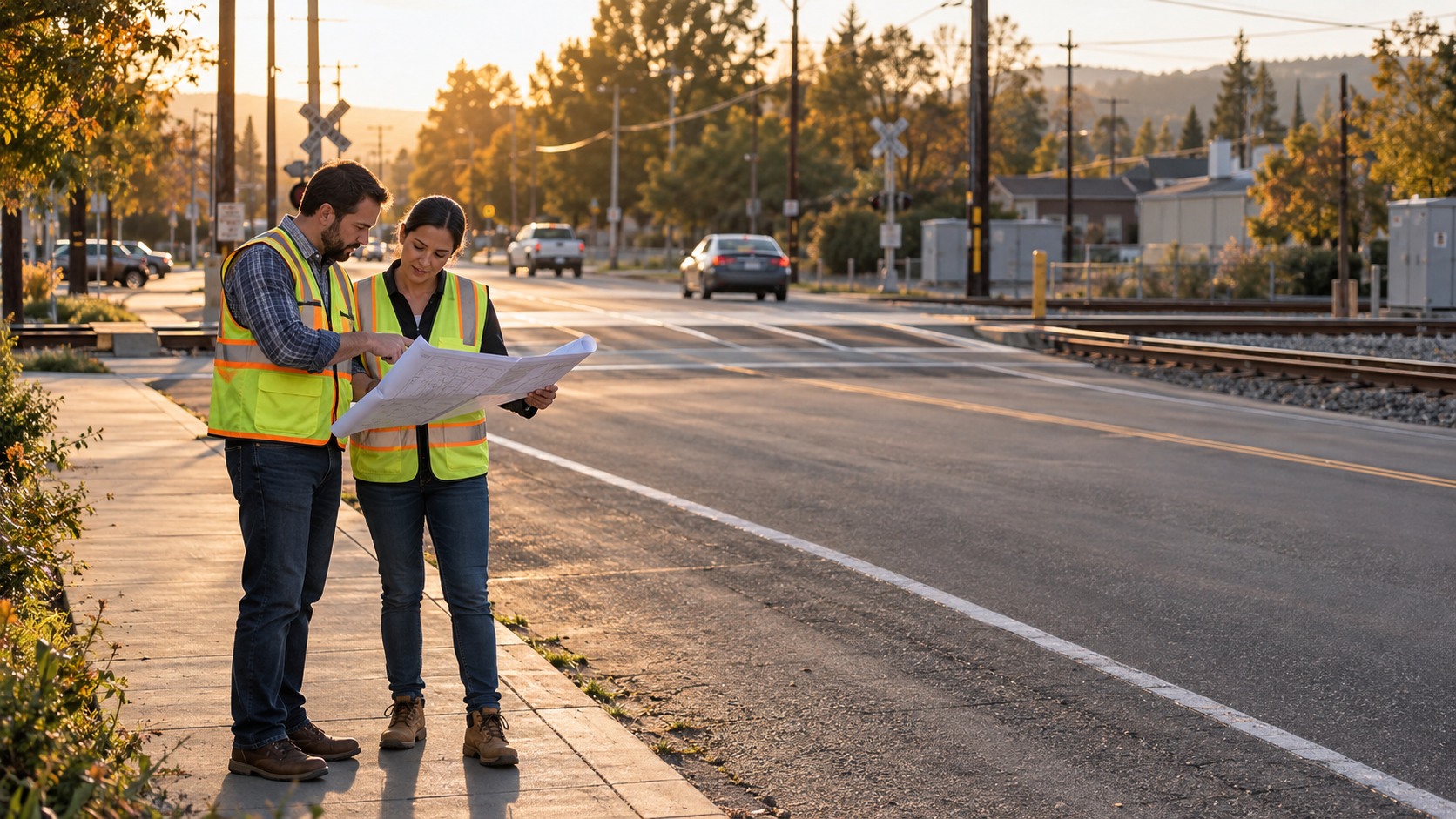
Before requesting photometric calculations, define what the design team must evaluate. Document the crossing limits, pedestrian paths, traffic directions, potential conflict points, observer approaches, and relevant backgrounds. A two-way road may require vertical planes facing more than one direction.
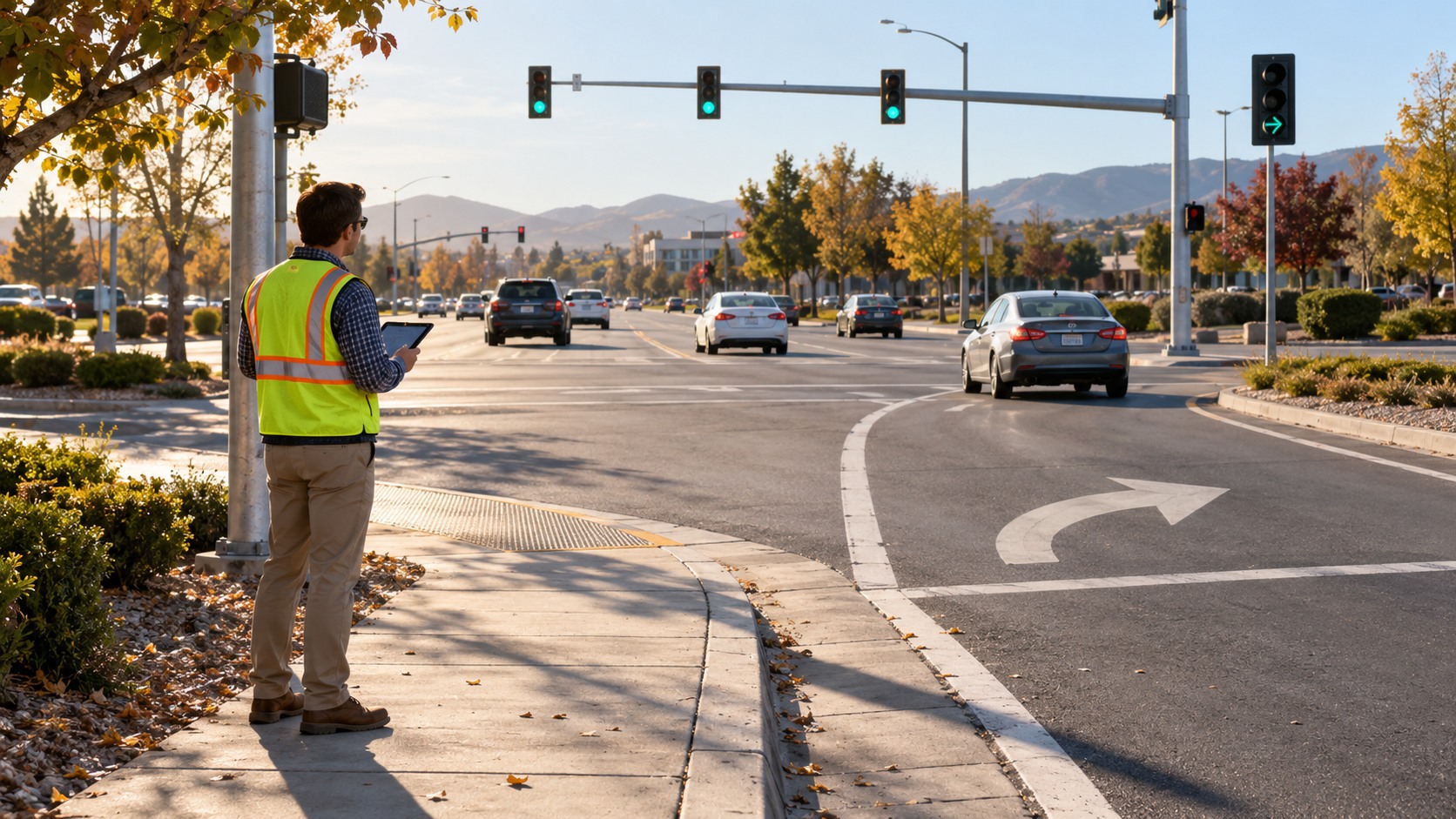
The crossing context matters as well. An intersection, a midblock crossing, and a pedestrian area next to a roadway do not necessarily share the same geometry or governing criteria. Pedestrian area lighting should also be kept distinct from the visibility and operation of pedestrian signal indications.
State the calculation conditions
A specification should state how horizontal and vertical illuminance will be calculated, naming each plane rather than asking only for “lux at the crosswalk.” For each plane, identify the applicable height, orientation, grid, points, and reported quantities according to the current standard and agency criteria.
The submittal should also state whether values are initial or maintained. If maintained performance is required, document the approved light-loss assumptions rather than applying an unexplained factor. Record the operating state, control setting, ambient-light assumptions, and whether headlamp contribution is included.
Photometric files and calculations should correspond to the selected luminaire configuration. A family-level page or marketing description is not a substitute for the exact technical data used in the model. Agencies evaluating broader outdoor lighting applications should still verify each project’s geometry and documents.
Review more than the average
An average can look acceptable while hiding a weak location. Reviewers should inspect minimum values and spatial distribution where the applicable method requires them. They should also examine glare, obstructions, background conditions, and both travel approaches rather than relying on one plan view.
This review should connect the model to the site. Poles, trees, signs, utility equipment, shelters, and changes in grade may affect sight lines or light distribution. Their treatment should be explicit in the design assumptions.
Verify the installation under defined conditions
Commissioning should confirm that installed locations, mounting conditions, orientations, and control settings match the reviewed design. If field measurements are part of acceptance, document the instrument, calibration status, weather and ambient conditions, measurement points, plane orientation, and operating state.
The record should make a later measurement reproducible. After a material site, equipment, or operating change, the agency can then determine whether another review is needed under its maintenance practice. No single recheck interval applies to every owner or system.
A practical review checklist
- Identify the visual task. Define pedestrian locations and the critical driver approaches.
- Name every plane. Record horizontal and vertical plane heights, orientations, grids, and reporting quantities.
- Cite current criteria. Identify the standard edition, agency requirement, and project-specific maintained condition.
- Review the whole scene. Consider contrast, glare, uniformity, obstructions, headlamps, and backgrounds alongside lux.
- Verify what was installed. Confirm geometry and operating state, then document field measurements under defined conditions.
For technical evaluation, procurement teams can consult current lighting specifications and technical resources. Each document should still be checked for the exact product, revision, photometry, and project applicability.
Frequently asked questions
What is vertical illuminance?
Vertical illuminance is the amount of light incident on an upright plane. In pedestrian visibility analysis, that plane may represent the side of a person facing a specified driver approach. The value is meaningful only when the plane’s location, height, orientation, and calculation or measurement method are defined.
Why is horizontal illuminance not enough for crosswalk lighting?
Horizontal illuminance shows light on a horizontal surface such as pavement. It does not show how much light reaches the driver-facing side of a pedestrian. A crosswalk review may therefore need both horizontal and vertical calculations, along with contrast, glare, background, headlamp, and viewing-geometry considerations.
How many vertical lux does a crosswalk need?
No single vertical-illuminance value applies to every crosswalk. The 2008 closed-track study discussed above suggested 20 vertical lux under its specific test conditions, but that finding is not a universal requirement. Use the current applicable standard, agency criteria, crossing geometry, and qualified engineering review.
Where should vertical illuminance be measured?
The governing method and project team should define the height, orientation, points or grid, and approach direction. A meter held vertically without those details does not produce a reproducible acceptance result. Review both the specified calculation method and field procedure before comparing values.
Is facial recognition lighting the same as camera facial recognition?
No. In this article, the phrase means lighting that relates to a human observer recognizing facial features. It does not establish camera or biometric-identification performance, and it should not be used to make claims about surveillance technology.
Vertical illuminance for pedestrian visibility fills a specific gap in roadway-lighting evaluation: it describes light on upright surfaces that horizontal pavement lux cannot show. Used with horizontal illuminance, contrast, glare, geometry, maintained conditions, and current agency criteria, it gives reviewers a more complete way to ask whether a lighting plan addresses the actual pedestrian visual task.
References
- Illuminating Engineering Society (IES). “Illuminance,” ANSI/IES LS-1-25 Nomenclature. Accessed July 17, 2026.
- Illuminating Engineering Society (IES). “Lux,” ANSI/IES LS-1-25 Nomenclature. Accessed July 17, 2026.
- Federal Highway Administration (FHWA). “Chapter 2. Lighting and Crash Relationship,” *Design Criteria for Adaptive Roadway Lighting* (FHWA-HRT-14-051). Accessed July 17, 2026.
- Transportation Research Board TRID. “Relationship of Vertical Illuminance to Pedestrian Visibility in Crosswalks,” Edwards and Gibbons (2008). Accessed July 17, 2026.
- Illuminating Engineering Society (IES). ANSI/IES RP-8-22, Recommended Practice: Lighting Roadway and Parking Facilities. Accessed July 17, 2026.
- LEOTEK. “Watts to Lumens, Lumens to Lux: The Ultimate Guide to Understanding Lighting Performance”. Accessed July 17, 2026.
- LEOTEK. “Outdoor Lighting”. Accessed July 17, 2026.
- LEOTEK. “Resources & Documents”. Accessed July 17, 2026.