

















AI anomaly detection for streetlights should be validated against a documented baseline and field-confirmed conditions, not judged by the number of alerts a system produces. For a city or transportation agency, the useful question is whether alerts help the operations team find, assess, and resolve defined asset conditions with an acceptable level of error.
AI anomaly detection for roadway assets flags operating patterns that differ from an established normal baseline. For streetlights, validation means comparing alerts with field-confirmed conditions and measuring both false alarms and missed events. An alert is not, by itself, proof that a luminaire, controller, communications link, or other roadway asset has failed.
Key takeaways
- Establish a baseline for each asset cohort and operating context before judging alerts.
- Compare alerts with field-confirmed conditions and count both false alarms and missed events.
- Require operators to see the source signal, comparison period, and reason an alert was escalated.
- Define workflow measures before the pilot, such as time to triage or confirmed-alert disposition.
- Keep field verification, agency engineering judgment, and data-governance review in the loop.
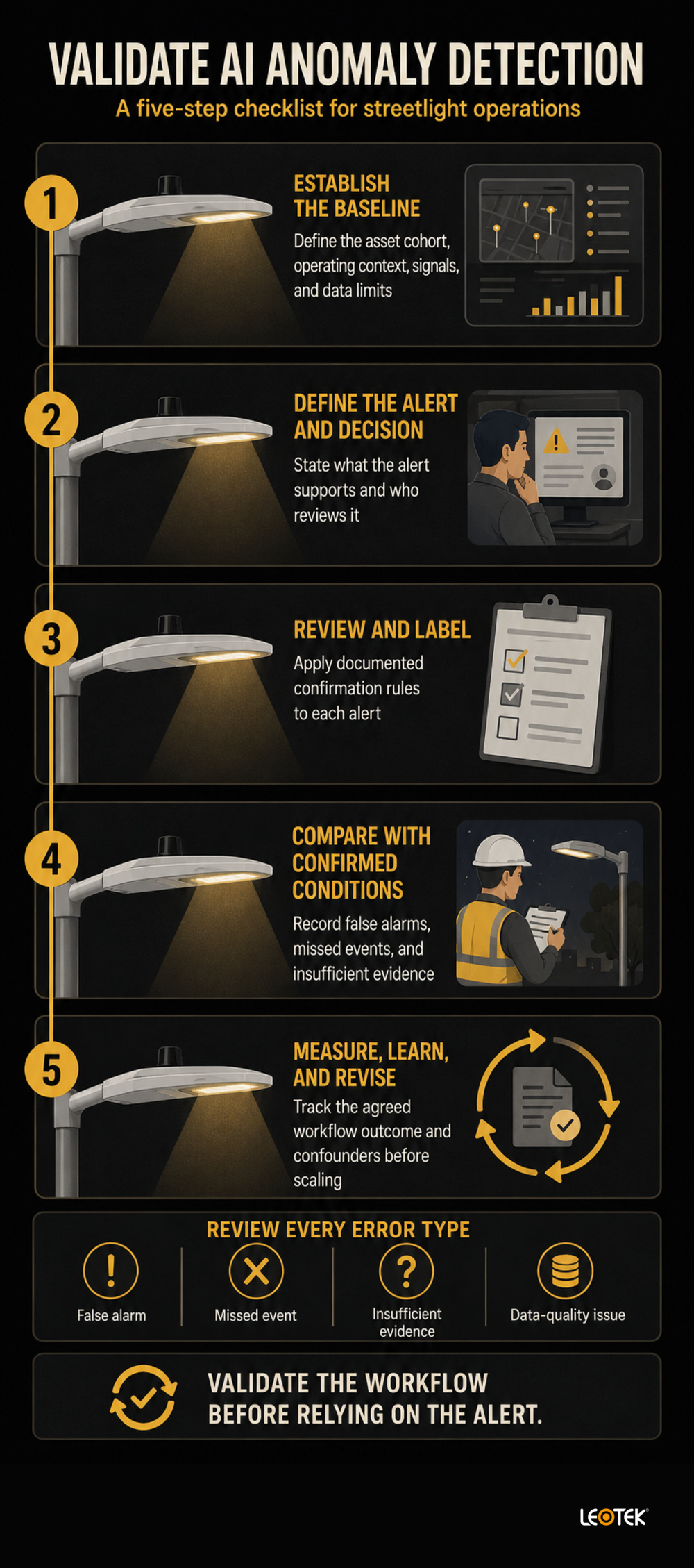
A five-step validation checklist
- Establish baseline data for the defined asset cohort and operating context.
- Define the alert, the decision it supports, and the reviewer responsible for disposition.
- Review and label alerts using documented confirmation rules.
- Compare alerts with confirmed conditions and record false alarms, missed events, and insufficient-evidence cases.
- Measure the agreed workflow outcome, record confounders, and revise the process before scaling.
What AI anomaly detection means for streetlight operations
AI anomaly detection uses historical and current information to flag a pattern that differs from the pattern the system has learned or been configured to expect. In a connected-lighting context, the input may include controller status, switching or dimming commands, energy data, alarm history, asset records, or communications events. The exact inputs, their quality, and their availability depend on the deployed architecture.
This is narrower than a claim that artificial intelligence can diagnose every asset issue. A system might flag an unusual status pattern, for example, while the eventual cause could be a controller, luminaire, communications path, schedule, data-quality problem, or a condition that requires a site visit to understand. The alert should begin a review process, not end it.
The distinction also helps separate this topic from a general introduction to predictive maintenance for roadway assets. Predictive maintenance can be a broader condition-based maintenance approach. This article addresses the evidence needed to validate one part of that approach: whether anomaly alerts are dependable enough to inform a defined roadway-asset workflow.
Separate telemetry, alerts, and confirmed conditions
Start by naming three different things:
- Telemetry is the record of a device, asset, or system state, such as a controller status or reported energy value.
- An anomaly alert is a system-generated indication that a pattern differs from the agreed baseline.
- A confirmed condition is the result of review, which may include a work record, remote diagnostic evidence, or field verification under the agency’s process.
Treating these as interchangeable creates misleading results. If every alert is counted as a failure, an agency cannot tell whether it has a high-performing detection process or simply a noisy notification stream. Conversely, if the team records only confirmed alerts and not conditions that the system missed, it cannot see a potentially important blind spot.
Define the decision before configuring the model
An alert must have an operational purpose. It may help a team prioritize a review queue, identify assets that merit remote inspection, or support a dispatch decision after an operator checks the context. It should not be framed as an autonomous authorization to alter a safety-critical roadway condition.
Write the intended decision in one sentence before the pilot starts. For example: “This alert will identify assets for same-day remote review by the lighting operations team.” That statement establishes who receives the alert, what happens next, and what evidence is needed before a work order or escalation occurs.
Start with usable baseline data
A model cannot be meaningfully evaluated against a vague definition of normal. The baseline is the documented reference used to decide whether a later pattern is unusual. It should reflect the assets, data, and operating context actually in scope, rather than an assumed citywide norm.
The Federal Highway Administration’s asset management resources cover guidance, risk management, life-cycle planning, and asset-management planning. They do not prescribe a streetlight anomaly threshold, but they support an important discipline: connect a pilot to a defined asset-management process and risk decision.
Inventory assets, signals, and maintenance history
Build a pilot inventory that records the asset identifier, asset type, location reference used by the agency, controller relationship where applicable, and the data sources that will be evaluated. Note whether each source is continuous, event-based, delayed, estimated, or sometimes unavailable.
Then document the maintenance history available for the cohort. Historical records can provide candidates for confirmed conditions, but they may be incomplete or use inconsistent labels. A maintenance ticket closed as “resolved” does not necessarily establish which component caused the condition. The pilot team should preserve that uncertainty instead of converting it into a clean label without evidence.
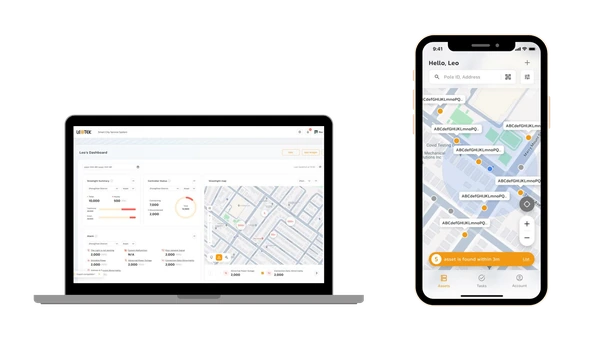
For connected-lighting evaluations, a product page can explain a vendor’s stated functions, but it is not a validation result. LEOTEK describes RenAI roadway infrastructure management as a platform for roadway and streetlight management, including remote control, scheduled dimming, fault detection, energy reporting, asset management, and AI assistance. That is useful context for what an evaluation team may ask to inspect. It does not establish a particular false-alarm rate, a savings result, or suitability for a specific agency.
Record normal operating context and data-quality limits
“Normal” may change with schedule changes, planned dimming, seasonal daylight patterns, commissioning activity, communications outages, or asset replacements. Capture those known conditions in the baseline. Otherwise, a normal planned change can appear as a successful anomaly alert, and a model may be credited for noticing an event that was already expected.
Also record data gaps and changes in data collection. A missing or delayed message can be operationally important, but it is not automatically evidence of a failed luminaire. This is why a validation log should distinguish a suspected asset issue from a telemetry-quality issue.
Test alerts against field-confirmed outcomes
Validation is an operating process, not a one-time model demonstration. It needs a defined period, a stable alert definition, and a review path that records what happened to each alert. If the threshold, source data, asset cohort, or reviewer rules change during a pilot, log the change and evaluate the periods separately where practical.
Create an alert-review and labeling workflow
For each alert, record the alert ID, affected asset or group, timestamp, source signals available to the reviewer, initial disposition, reviewer, and the basis for confirmation or dismissal. When field work occurs, link the result back to the alert without assuming that a repair proves the alert’s interpretation.
Use clear labels. A confirmed alert matches a field-verified or otherwise reliably confirmed condition under the agreed rule. A false alarm is an alert that review does not confirm as that condition. A missed event is a confirmed condition that the system did not flag under the same evaluation rules.
The review should also allow “insufficient evidence” and “data-quality issue” where those better describe the outcome. Forcing every case into true or false can hide the very operational limits that a pilot is meant to uncover.
Measure errors, not only alert volume
Count confirmed alerts, false alarms, missed events, and alerts with insufficient evidence. Then review the cases by asset cohort, operating context, signal availability, and time period. A single aggregate rate can conceal a pattern that matters operationally, such as alerts clustering after a schedule change or only on assets with intermittent communications.
Do not publish or procure against a universal acceptable rate. The cost of a false alarm and the consequence of a missed condition differ by workflow, asset, location, staffing, and agency policy. The more useful result is a transparent record of error types and the disposition path for each one.
Time measures need the same care. Time to triage can mean the elapsed time from an alert to an initial documented disposition. It is not the same as repair time, public-safety performance, or a promise of response. Define the clock, ownership, exclusions, and baseline before comparing periods.
Require explainability that operators can use
Explainability in this setting means that an operator can see enough context to understand why a system raised an alert and can decide what to check next. It is not proof that a system is correct, and it does not remove the need for review.
The NIST AI Risk Management Framework is a voluntary framework intended to help organizations incorporate trustworthiness considerations into the design, development, use, and evaluation of AI systems. It is not a roadway-asset performance standard or a product certification. Its emphasis on evaluation supports a practical expectation: an agency should be able to inspect how an alert entered its workflow.
Show the evidence behind an escalation
Ask for an alert view that identifies the affected asset or cohort, the source signal or signals, the comparison window, a priority or confidence label and its documented meaning, the change that triggered escalation, and the available history. The interface does not need to reveal proprietary implementation details to support meaningful operations review. It does need to avoid presenting an unexplained score as a final operational conclusion.
An illustrative record might show that a controller’s reported pattern differed from its own recent baseline after a documented schedule change. The reviewer would then see both the anomaly and the schedule context before deciding whether to investigate. This is an illustrative workflow, not evidence of a particular product’s behavior.
Keep human review and engineering judgment in the workflow
Define who can dismiss, escalate, or modify an alert. Give reviewers a way to record why a condition was confirmed, dismissed, or left unresolved. Those records improve auditability and make later model or rule changes easier to evaluate.
Agency engineering, operations, procurement, data-governance, cybersecurity, and privacy requirements remain applicable to the deployment. A platform’s alerting function does not decide those requirements. Where a connected system is under consideration, connected streetlight management may provide a relevant product pathway, but compatibility, data handling, and project fit require project-specific review.
Measure operating outcomes, not just model activity
A high volume of notifications is not an operating outcome. Before a pilot begins, select a limited set of measures that match the decision the alerts are intended to support. Keep the measures descriptive and measurable rather than promotional.
Select measures before deployment
Possible measures include the share of reviewed alerts that meet the team’s confirmation rule, the number of alerts lacking enough evidence for disposition, time to triage, repeat dispatches associated with a defined condition, or maintenance-backlog status for the pilot cohort. These are candidate measures, not promised benefits.
For each measure, document the baseline period, asset cohort, source records, calculation rule, owner, and known confounders. A change in staffing, work-order practice, communications coverage, weather, asset replacement, or scheduled dimming can affect a result. Reporting those conditions is more useful than claiming that the model alone caused a difference.
Compare like with like
Compare a pilot cohort with its own documented baseline where possible. If the agency compares two cohorts, confirm that their asset types, operating context, and review rules are comparable enough for the intended decision. Avoid turning a short pilot into a citywide performance claim.
This approach also clarifies what a vendor should provide: the data fields needed for review, methods for exporting or retaining alert records, change documentation, and a way to associate alerts with confirmed outcomes. Teams seeking supporting materials can review technical documents and resources before treating any technical statement as a project requirement.
Questions to ask before scaling a roadway asset analytics pilot
Scaling should follow a review of the evidence generated by the pilot, not merely a successful demonstration. Use questions that test the process as well as the technology.
Data, governance, and accountability
- Which assets, sources, and conditions are in scope, and which are excluded?
- Who owns the alert definition, baseline updates, reviewer access, and change log?
- How will the agency retain alert records, review notes, and field-confirmation evidence?
- What happens when data is missing, late, inconsistent, or affected by a planned operating change?
- Which agency requirements govern cybersecurity, privacy, access, retention, and procurement for this project?
Operations, integration, and evidence
- What decision does each alert support, and who has authority to make it?
- What field or remote evidence confirms the condition?
- How are false alarms, missed events, and insufficient-evidence cases recorded?
- What system or work-order integration is needed, and how will changes be tested?
- What evidence supports claimed outcomes for the proposed asset cohort and operating conditions?
The answers should be specific enough to become pilot acceptance criteria. If they are not, the team may be evaluating a concept rather than a dependable workflow.
Validate the workflow before relying on the alert.
AI anomaly detection for streetlights can be useful when it helps an agency focus review on patterns that deserve attention. Its value should be demonstrated through a documented baseline, field-confirmed outcomes, transparent error review, and measures that match the maintenance workflow.
For teams with a defined asset cohort and evaluation criteria, LEOTEK offers technical documents and resources and a path to discuss a roadway infrastructure project. Those conversations should begin with the agency’s data, workflow, and evidence requirements rather than an assumed outcome.
Frequently asked questions
What is a false alarm in streetlight anomaly detection?
A false alarm is an alert that review does not confirm as the condition the alert was defined to identify. The review rule should be documented in advance and should allow for outcomes such as insufficient evidence or a data-quality issue when those are more accurate.
How long should a roadway asset analytics pilot run?
There is no universal duration. The pilot should run long enough to include the operating conditions and review volume needed for the agency’s defined decision. Document the period, asset cohort, schedule changes, data gaps, and any rule changes so the findings can be interpreted correctly.
What data should an agency retain to audit an AI alert?
Retain the alert identifier, timestamp, affected asset or cohort, source signals available at review, baseline or comparison context, reviewer disposition, confirmation evidence, and any model or rule change that affected the alert. Retention, access, and privacy practices should follow the agency’s applicable requirements.
Does anomaly detection replace field inspection?
No. An anomaly alert is an indicator for review. Depending on the condition and agency workflow, confirmation may require remote diagnostics, maintenance records, field inspection, or engineering review.
References
- National Institute of Standards and Technology, AI Risk Management Framework; accessed July 26, 2026.
- Federal Highway Administration, Transportation Asset Management; accessed July 26, 2026.
- LEOTEK, Predictive Maintenance; accessed July 26, 2026.
- LEOTEK, RenAI AI Roadway Infrastructure Management System; accessed July 26, 2026.
- LEOTEK, LEOLink Solutions; accessed July 26, 2026.
- LEOTEK, Resources and Documents; accessed July 26, 2026.