











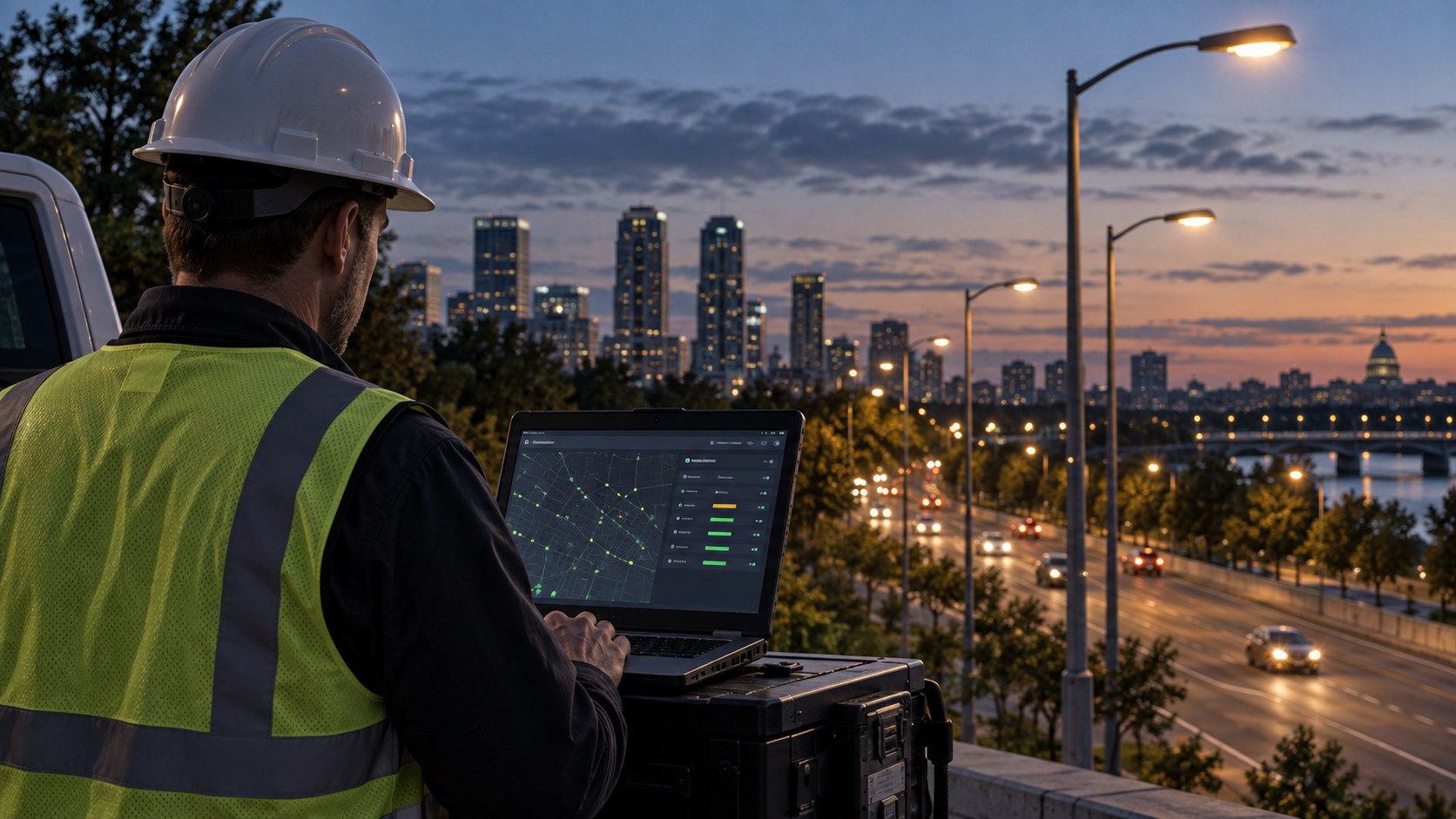
A streetlight firmware update program should be managed as a controlled infrastructure change, not as a remote button press. Before a fleet rollout, an agency should verify device eligibility, authorize the release, test it, monitor it, and confirm the documented recovery path for the exact equipment in service.
For connected roadway lighting, over-the-air (OTA) updates can make it possible to deliver device software without visiting every asset. That possibility does not establish that every luminaire, controller, or network can receive updates remotely, nor that a particular update will be safe to deploy. The appropriate workflow depends on the device architecture, supported software versions, network design, vendor documentation, and the agency's operating requirements.
Key takeaways
- Start with an accurate asset inventory that ties each connected luminaire or controller to its hardware, software version, location, and ownership.
- Require a release to be authenticated, integrity-protected, and separately authorized before it reaches a production cohort.
- Test first, then use staged cohorts and defined pause criteria instead of updating an entire fleet at once.
- Treat rollback and recovery as capabilities to verify for the exact device and release, not as features to assume.
Release governance
A five-gate OTA rollout
Planning framework only. Confirm OTA and recovery support in documentation for each exact device and release.
What an OTA streetlight firmware update changes
Firmware is the low-level software that helps a device perform its intended functions. In a connected-lighting environment, it may reside in a luminaire, a controller, or another device in the communications path. An OTA update is the remote delivery and installation of that software through the supported management and network architecture.
In this context, a connected luminaire is a lighting asset with a communications-enabled component. A controller may coordinate or relay commands where the architecture uses one. An image is the firmware package offered to a device, and a version record identifies the approved and installed software state.
The phrase matters because it describes more than downloading a file. The Internet Engineering Task Force (IETF) notes that firmware updates can remediate vulnerabilities, correct defects, update configuration, or add functionality. Its firmware update architecture for IoT also makes clear that devices need a way to evaluate whether an image applies to them and whether it is trustworthy. Those are general IoT principles, not proof that a given roadway-lighting product supports every function described.
For an operator, the practical unit of control is the release record: which image or package is approved, which device types it applies to, which versions it replaces, when it may run, and what result is expected. A reliable record also links the release to the test evidence, approval, deployment cohort, and recovery instructions. That is how a version number becomes an operationally useful change record rather than a field in a dashboard.
Benefits that depend on the deployment
When a device and its management system support remote updating, a well-governed program can give an agency a way to address software issues without planning a separate physical visit to every eligible asset. It can also allow an agency to manage a known release state across a distributed fleet. These are potential lifecycle benefits, not guaranteed cost, uptime, or security outcomes.
Connected-lighting operations already involve tasks such as remote switching, dimming, schedules, fault notifications, energy tracking, reporting, maps, alarms, and asset management in some product architectures. Readers evaluating that operating context can review LEOTEK's page on connected streetlight management. That page should not be read as evidence that a particular product supports OTA firmware, a specific security control, or a recovery method.
Why roadway-lighting fleets need their own change process
Roadway-lighting assets are distributed, may have different installation vintages, and can sit behind different network or ownership boundaries. A release that is suitable for one hardware revision or controller arrangement may not apply to another. Connectivity can also be intermittent, and an update window may need to respect local maintenance practices and the operational importance of the lighting network.
These conditions do not make OTA updating inappropriate. They make segmentation important. The Cybersecurity and Infrastructure Security Agency (CISA) observes that operational-technology environments often combine legacy systems with newer connected devices and that owners and operators need to account for those constraints when applying mitigations. See CISA's Industrial Control Systems guidance. A roadway-lighting network is not automatically an industrial control system or critical infrastructure; the point is to avoid assuming that a newer control workflow erases legacy constraints.
The risks to govern before deployment
The main risks are not limited to a failed download. A firmware release is an authorized change to device code, so the agency should govern who can approve it, how the device verifies it, whether the release applies to the device, and what happens if installation or startup fails.
Confirm authenticity, integrity, and authorization
The IETF architecture distinguishes authentication, integrity protection, and authorization. In plain terms, a device should be able to determine who created a release, whether the image or its manifest was modified, and whether the requesting party is permitted to initiate the update. The RFC 9019 security discussion describes these concepts for IoT firmware-update architectures.
An agency does not need to prescribe a particular cryptographic implementation in a general article. It should, however, ask the vendor to document image provenance, signature or integrity-verification behavior, authorization roles, trust-anchor or key-management responsibilities, and the process for revoking or replacing credentials. Procurement and cybersecurity teams should review those answers against the agency's own policies and the exact proposed architecture.
Check compatibility and dependencies
Compatibility is more than a model name. A deployment may depend on a hardware revision, bootloader, controller, network module, configuration, or installed version. If one component requires another to be updated first, the order and failure behavior need to be understood before the maintenance window begins.
Build eligibility rules that are specific enough to exclude uncertain assets. For each cohort, retain the device identifier, location or circuit grouping where appropriate, hardware and software version, communications path, configuration baseline, and the reason it is included. This baseline helps the team distinguish an intended firmware change from configuration drift that occurred before or during the rollout. Assets without sufficient records should be investigated rather than silently added to a rollout.
Plan for interruption and failed startup
An interrupted transfer, power event, loss of connectivity, or failed startup can leave an asset in a state that needs intervention. A recovery approach may use a backup image, a recovery image, or another vendor-defined method, but those options are architecture-specific. RFC 9019 discusses recovery strategies as part of a resilient update design; it does not mean every device has automatic rollback.
The National Institute of Standards and Technology (NIST) frames firmware resiliency around protecting firmware against unauthorized changes, detecting unauthorized changes, and recovering securely. NIST SP 800-193 addresses platform firmware, rather than streetlighting specifically, but its protect-detect-recover framing is useful for evaluating an agency's governance process.
Preserve enough evidence to investigate
Version visibility is essential after the update, not just before it. Operators need to know which assets were eligible, offered a release, downloaded it, installed it, restarted successfully, reported the intended version, or entered an exception state. Keep timestamps, approval records, deployment logs, relevant alerts, and the final disposition for each exception according to the agency's records practices.
That evidence also helps separate firmware release management from predictive maintenance for roadway assets. Maintenance analytics may inform how a team prioritizes work, but they do not replace release approval, compatibility checks, or recovery planning.
A practical governance workflow for OTA smart lighting
The following workflow is a planning model, not a universal standard or a substitute for vendor instructions. It gives engineering, operations, cybersecurity, and procurement stakeholders a common sequence for evaluating a streetlight firmware update.
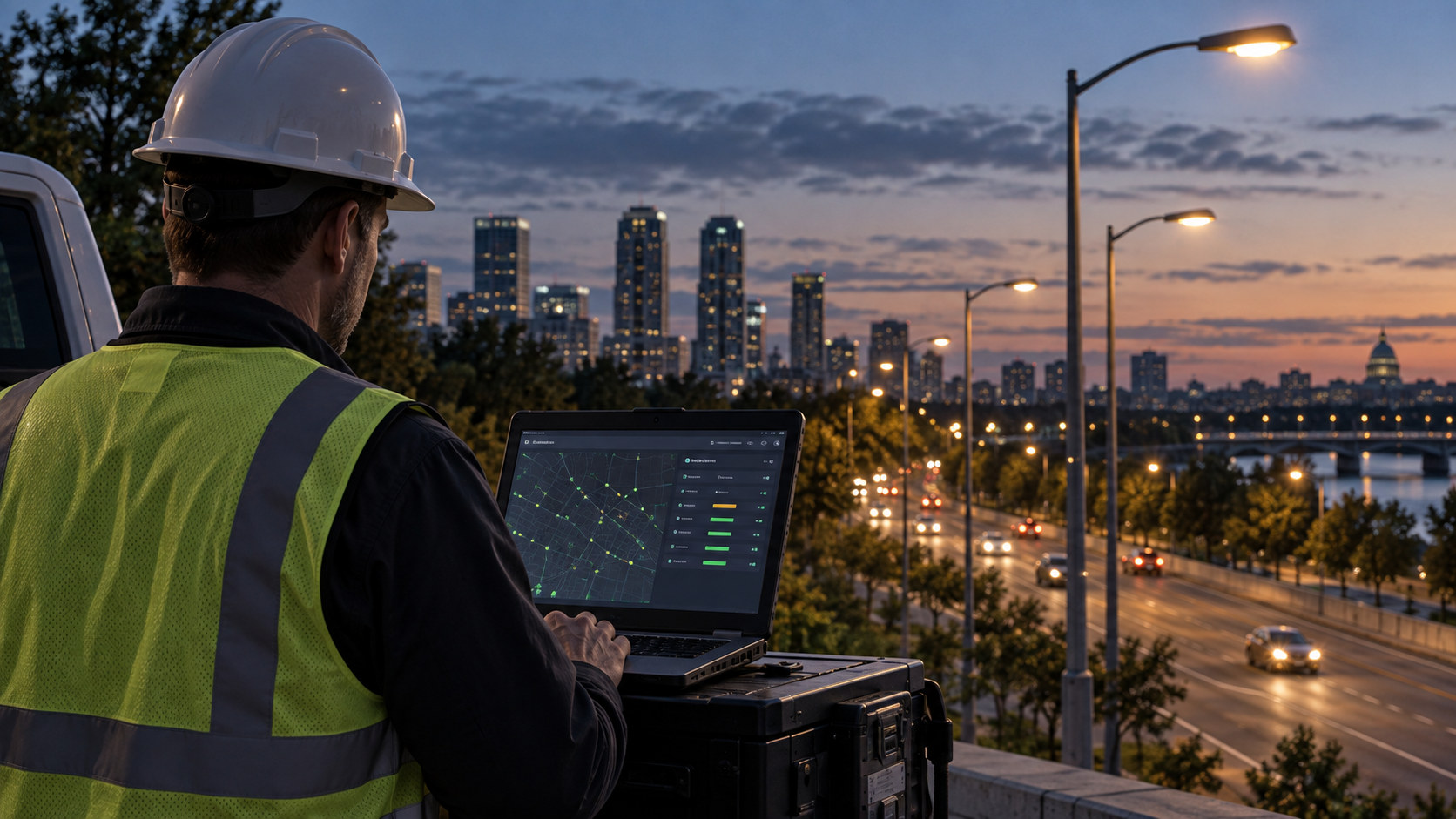
| Workflow step | Typical decision owner | Evidence to retain |
|---|---|---|
| Establish eligibility | Engineering and operations | Asset-to-version reconciliation and cohort criteria |
| Approve the release | Designated technical and governance roles | Release notes, prerequisites, authorization record, and maintenance window |
| Test and stage | Engineering, operations, and vendor technical contacts | Test result, pilot disposition, pause criteria, and exception records |
| Close or recover | Operations with defined escalation | Version verification, deployment logs, recovery actions, and final reconciliation |
The roles in this table are an agency planning model, not a required organizational structure. The agency should assign authority according to its own policies and the responsibilities established with its suppliers.
1. Establish the asset and version baseline
Create the authoritative list of assets that could be considered for the release. Record the information needed to make an eligibility decision: device and controller type, hardware revision where available, installed firmware, configuration baseline, communications status, location or operational grouping, and responsible owner.
Then reconcile that list with the management system and field records. If the agency cannot determine which version is installed or whether a device belongs to the supported cohort, it should not treat the asset as ready for unattended updating.
2. Review the release and assign approval roles
Obtain the release notes and current documentation for the exact equipment. Identify the issue addressed, affected versions, prerequisites, known limitations, installation sequence, expected reboot or service behavior, verification method, and recovery instructions. Ask who authors the release, who can authorize deployment, who can initiate it, and who can stop it.
Separate release preparation from deployment approval where the agency's governance model calls for it. The IETF notes that an entity creating an image need not be the same entity authorized to deploy it. That separation can help agencies make authorization decisions explicit rather than embedding them in an operational account.
3. Test a representative cohort
Test in a nonproduction environment where feasible, or use a small, approved pilot cohort that represents the proposed production conditions. The test should cover the eligible hardware and software combinations, the expected communications path, normal completion, interrupted transfer behavior where the vendor supports testing it, version reporting, and documented recovery.
Define what evidence constitutes a pass before testing starts. Avoid treating a successful update of one device as proof that every field condition is covered. A pilot is useful because it provides evidence about the selected cohort, not because it guarantees fleet-wide results.
4. Stage deployment and define pause criteria
Move from pilot to successive cohorts only after the previous cohort reaches the agreed verification state. Set the maintenance window, support contacts, communication plan, and stop conditions in advance. Examples of stop conditions can include unexpected installation failures, missing version reports, an unexplained change in device behavior, or a recovery path that does not perform as documented.
Staging is an operational control, not a claim that a system will avoid disruption. It gives the agency a deliberate decision point before a problem affects more eligible assets.
5. Monitor, reconcile, and close the change
During and after each cohort, monitor the status signals the system actually provides. Reconcile the planned cohort with the completed cohort and identify every exception. Confirm the installed version using the vendor's documented method, preserve the release and approval evidence, and record any follow-up work.
For teams evaluating centralized visibility alongside other roadway assets, LEOTEK describes a roadway asset management platform. That contextual link does not establish firmware-deployment functionality. The exact device and platform documentation remains the source for update capability, compatibility, and support decisions.
Designing a credible rollback and recovery plan
Rollback is not automatic. Before approving a release, confirm the documented recovery method for the exact device, hardware revision, installed version, and proposed update. The plan should specify whether a prior image can be restored, whether a recovery image or local intervention is required, who has authority to invoke the procedure, and how success will be verified.
A credible plan also names the operational stop conditions. If a cohort exceeds the agency's agreed threshold for failed installation, missing telemetry, or unexpected behavior, pause the rollout. Preserve the affected asset list and diagnostic records before beginning recovery. Do not substitute assumptions about a generic OTA platform for the vendor's current instructions.
Recovery planning should include the possibility that a field visit is needed. Identify the escalation route, safe access process, parts or tools that the vendor documentation calls for, and the reconciliation step after the device returns to service. Engineering and operations teams should determine the appropriate procedure for the jurisdiction, equipment, and maintenance environment.
Procurement questions for connected luminaire software
NIST's IoT Device Cybersecurity Capability Core Baseline is a starting point for organizations identifying cybersecurity capabilities for devices they manufacture, integrate, or acquire. It is not a certification, a product checklist that every device satisfies, or a replacement for project-specific review. Use it to organize questions such as these:
- Which models, hardware revisions, controllers, and existing software versions are eligible for this release?
- What release documentation identifies prerequisites, dependencies, known limitations, and the supported installation sequence?
- How does the device verify the authenticity and integrity of an image or manifest, and who controls the associated authorization policy?
- What roles can create, approve, initiate, pause, and audit deployments?
- How are device version, update status, exceptions, and logs reported or exported?
- What happens after a power or network interruption, and what recovery methods are documented for each supported configuration?
- How long will the supplier provide security updates and technical documentation for the installed equipment?
- What evidence is available for testing the proposed configuration before production deployment?
For model-specific specifications, versions, guides, and warranty materials, begin with product specifications and resources. Verify the document date, revision, model applicability, and contractual terms before relying on it in a procurement or deployment decision.
Frequently asked questions
What is an OTA streetlight firmware update?
It is a controlled delivery of device software to eligible connected lighting assets without a technician visiting each asset. A responsible program verifies eligibility and release provenance, tests a cohort, stages deployment, monitors results, and follows a documented recovery process when needed.
Can every connected luminaire receive firmware remotely?
No assumption should be made. Remote-update capability depends on the exact luminaire, controller, hardware revision, installed software, communications architecture, and vendor support. Verify those details in current documentation.
What should trigger a pause in a rollout?
The agency should define pause criteria before deployment. They can include unexpected update failures, incomplete version reporting, behavior outside the approved test evidence, or an inability to execute the documented recovery procedure. The appropriate criteria are specific to the equipment and operating environment.
Is rollback always possible after a firmware update?
No. Some architectures may support a prior or recovery image, while others may require a different recovery process or on-site intervention. Confirm the method and its prerequisites for the exact device and release before approving the rollout.
What records should an agency keep after deployment?
Keep the release identifier, eligibility rules, approved cohort, test evidence, approvals, maintenance window, deployment and exception logs, final version verification, and any recovery actions. Retention requirements should follow the agency's records and cybersecurity practices.
Treat firmware releases as governed infrastructure changes
When supported by the equipment and documentation, OTA updates can make a streetlight firmware update process more manageable. The value is not in automating a fleet-wide change without scrutiny; it is in making each authorized change traceable, testable, observable, and recoverable within the agency's operating model.
Before selecting a release process, verify the current model-specific documentation, supported versions, and recovery instructions. Then align the rollout plan with agency engineering, operations, cybersecurity, and procurement review.
For a defined model-specific documentation or connected-lighting evaluation question, discuss a roadway infrastructure project.
References
- Internet Engineering Task Force, RFC 9019: A Firmware Update Architecture for Internet of Things Devices.
- National Institute of Standards and Technology, Platform Firmware Resiliency Guidelines.
- National Institute of Standards and Technology, IoT Device Cybersecurity Capability Core Baseline.
- Cybersecurity and Infrastructure Security Agency, Industrial Control Systems.
- LEOTEK, LEOLink Solutions.
- LEOTEK, RenAI AI Roadway Infrastructure Management System.
- LEOTEK, Predictive Maintenance.
- LEOTEK, Resources and Documents.