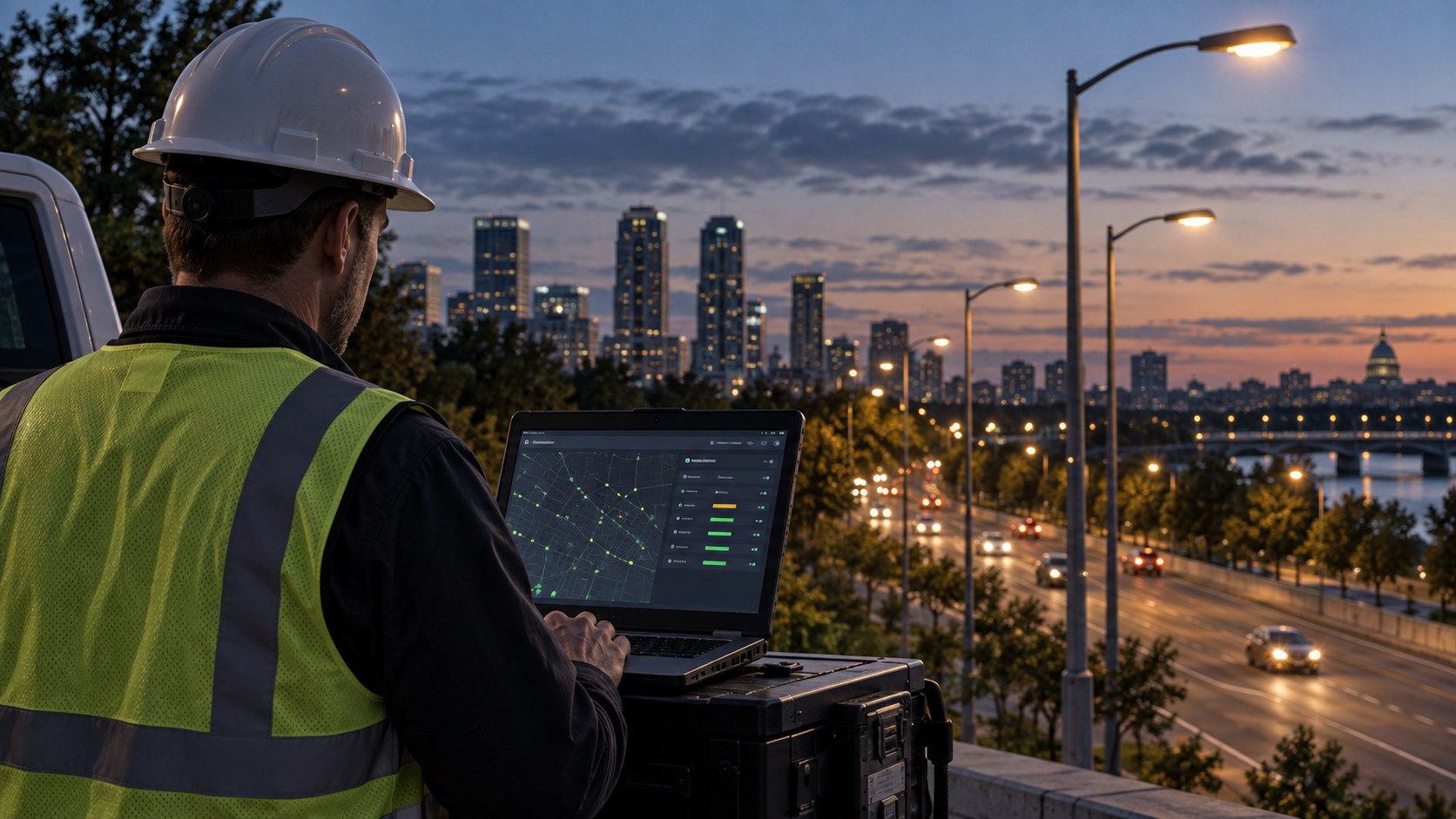











A streetlight digital twin is a structured digital representation of roadway assets and their relationships, maintained from authoritative records and, where appropriate, selected current or historical operating data. It can support better visibility and planning, but its value depends on the quality of the data, the purpose of the model, and the controls around how people use it.
Key takeaways
- A digital twin is more than a map or asset list: it connects assets, attributes, relationships, and update rules to a defined decision.
- Accurate identifiers, field validation, and clear sources of record matter before adding sensors, dashboards, or 3D views.
- A twin can support planning, documentation, maintenance triage, and bounded scenario analysis; it does not guarantee prediction, savings, or operational optimization.
- Connected-lighting platforms can contribute useful data, but a connected platform is not automatically a digital twin.
- Agencies should begin with one accountable workflow and define what evidence would make the model useful.
What a streetlight digital twin is and is not
For roadway infrastructure, a useful working definition is an asset model that brings together the records needed to understand a physical asset, its configuration, its place in a network, and its relationship to other assets. A streetlight may relate to a pole, circuit, controller, roadway segment, work order, drawing, or maintenance record. The model should also state who owns each record, how it is updated, and which decisions it is intended to inform.
This definition is deliberately practical. A digital twin does not need to begin as a photorealistic 3D scene. In many municipal programs, a reliable relationship model and a disciplined data process will be more valuable than a visual model that looks complete but relies on stale or conflicting records.
Platform documentation provides one useful reference point. Microsoft describes digital-twin models as entities with properties, components, and relationships that can form a graph; its architecture can incorporate IoT and business-system data, query the model, retain historical data, and support visualization (Microsoft Learn, accessed July 26, 2026). That is an example of a platform architecture, not a universal definition or evidence that any specific roadway system has those capabilities.
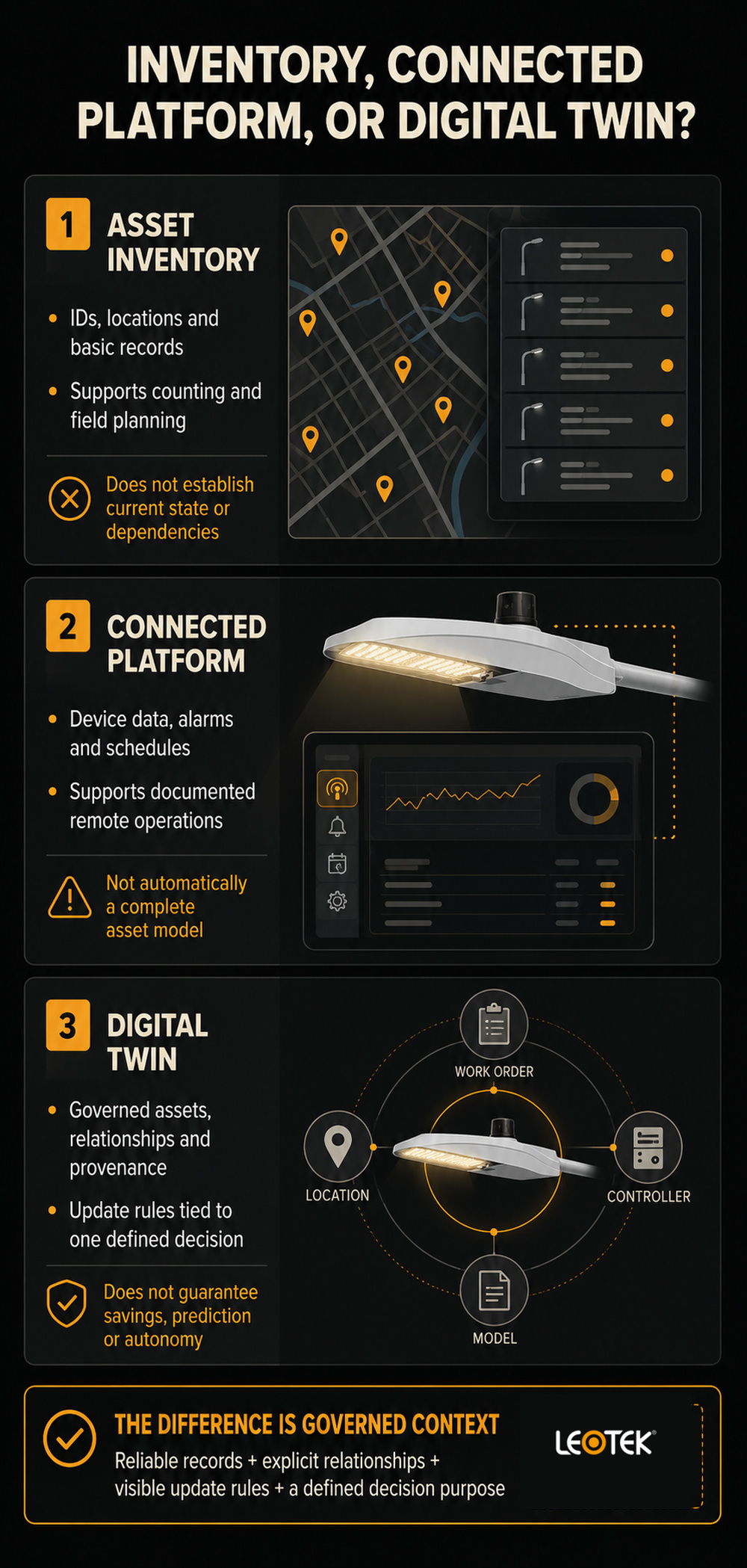
Inventory, connected platform, and digital twin
These terms often overlap in project discussions, but they describe different things.
| Layer | What it may contain | What it can support | What it does not establish |
|---|---|---|---|
| Asset inventory | Asset ID, location, type, ownership, installation date, and basic condition fields | Counting assets, reconciling records, and planning field work | Current operating state, accurate dependencies, or a predictive model |
| Connected-management platform | Controller or device data, alarms, schedules, remote commands, and reports | Operations teams can review the functions documented for the specific platform | A complete asset model, validated relationships, or a digital twin by itself |
| Digital twin | Asset records plus defined relationships, data provenance, update rules, and a decision purpose | Contextual planning, analysis, and investigation within its validated scope | Guaranteed savings, autonomous action, or correct conclusions from incomplete data |
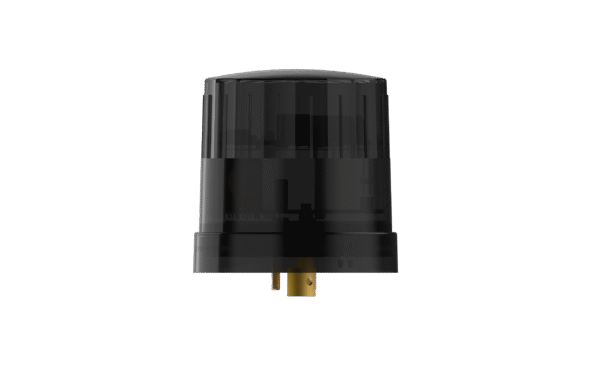
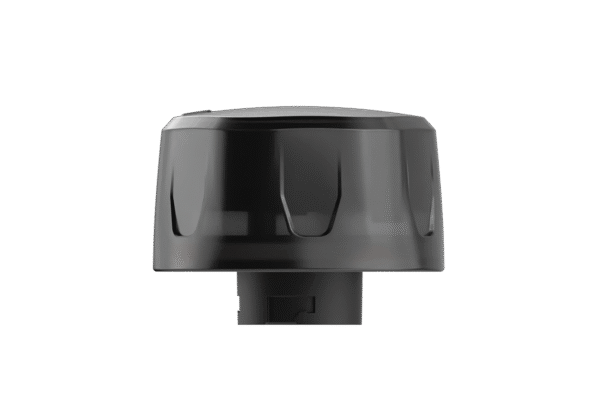
For example, LEOTEK presents connected streetlight management through LEOLink as including controllers, remote switching and dimming, scheduling, fault notification, energy tracking, reporting, maps, alarms, and asset management. Those stated capabilities may supply useful operational inputs to an asset model. They do not, on their own, demonstrate that a deployment is a digital twin or that it will produce a particular outcome.
Build the data foundation before the visual model
The difficult part of a roadway asset digital twin is usually not drawing a symbol on a map. It is deciding which records are trustworthy enough for the decision at hand, linking them consistently, and making change management routine.
For this reason, a streetlight asset management data model should define not only the fields to collect, but also the relationships, source systems, quality status, and update responsibility behind them.
Start with a decision, then define the record
An agency should first identify a bounded decision. It might be reconciling a district’s streetlight inventory before a maintenance program, locating assets that share a controller or circuit, or assembling documentation for a planned replacement. The purpose determines the fields, relationships, freshness, and validation effort that are reasonable.
A streetlight record could include a canonical identifier, location, responsible organization, asset class, configuration, installation or maintenance history, and links to applicable documents. The word “could” matters: these are planning examples, not a universal schema. The appropriate fields depend on the agency’s workflow, the systems already in use, and the confidence required for the decision.
Relationships need equal care. A pole identifier that is not consistently associated with its luminaire, circuit, or controller can create false certainty. Before teams use a relationship for work assignment or analysis, they should know whether it came from a design record, a field survey, an integration, or an assumption that still needs verification.
Make provenance and update rules visible
Every important field should have a source of record, an update method, and a date or status that tells users how much confidence to place in it. A model that shows an asset as active, for instance, should distinguish a recently verified field status from an old inventory value.
This is also where governance becomes practical. Decide who may correct an asset ID, who approves a configuration change, how duplicate assets are resolved, and what happens when the field record conflicts with a vendor, work-order, or geographic-information-system record. Agencies should define these controls rather than assume a platform provides them.
Transportation asset management already places lifecycle planning, risk management, and data integration in an agency context. The Federal Highway Administration’s asset-management guidance, accessed July 26, 2026 is a useful starting point for that broader discipline. It does not require agencies to adopt a digital twin or validate a streetlight-twin business case.
Practical uses for cities and transportation agencies
The strongest uses are narrow enough to be checked. A team should be able to say what decision the model supports, which inputs it uses, and how it will recognize an error.
Planning and documentation
An asset model can help teams bring related records into one review process. For example, a planned streetlight replacement may require a team to reconcile asset IDs, locations, configurations, document references, and responsible groups before a field visit. Linking those records can reveal missing documentation or relationships that need validation.
This is a planning aid, not a substitute for design review. It does not establish a luminaire’s photometry, pole suitability, electrical capacity, code compliance, or procurement eligibility. Those questions need the applicable engineering analysis, current documentation, and jurisdictional review.
Maintenance triage and work coordination
When a reliable asset record is connected to maintenance and event information, a team may use the context to prioritize investigation. A fault notification, for example, becomes more actionable when the responsible asset, location, related controller, maintenance history, and record confidence are clear.
That is different from claiming failure prediction. Predictive maintenance for roadway assets is a useful related concept, but prediction requires implementation-specific data, a validated method, and a documented baseline. A digital twin should make uncertainty easier to see, not hide it behind a score or alert.
Scenario analysis and lifecycle discussions
A twin can also support transparent “what changes if” conversations. Teams may use it to trace which records and relationships would need to change if a maintenance boundary, asset ownership assignment, or equipment plan changes. It can give lifecycle discussions a common reference model.
The scope must remain explicit. A general asset model does not accurately simulate lighting performance, traffic operations, electrical loading, cost, or field conditions unless specialized inputs, assumptions, and validation support that use. Presenting an unvalidated output as a forecast creates a risk of false precision.
Where a digital twin can mislead
The label “digital twin” can create an impression of completeness that the underlying records do not deserve. Agencies should plan for these limits from the start.
Incomplete, stale, or conflicting data
An attractive dashboard cannot resolve a missing asset identifier, an unverified location, or a configuration changed in the field but not in the source system. Inconsistent IDs can break relationships across work orders, controller records, and asset inventories. A model should expose missing, estimated, and conflicting values rather than treating them as settled facts.
Field validation is particularly important when a model will influence a work plan or capital decision. A small, documented sample can help a team understand which attributes are reliable enough to use, where the data gaps are concentrated, and whether the proposed workflow should be narrowed.
Integration, governance, and security boundaries
Connecting systems introduces questions that a visual model cannot answer by itself: which data can move between systems, who can modify it, how long it is retained, how changes are logged, and what happens if a connection fails. Procurement teams should ask for evidence appropriate to the intended architecture rather than infer security, privacy, interoperability, or retention practices from a product category or marketing label.
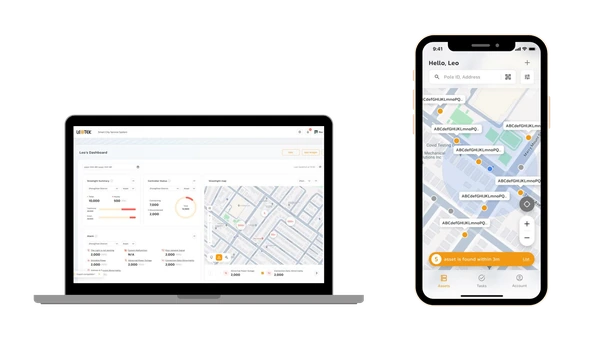
LEOTEK describes RenAI roadway infrastructure management as a cloud-based roadway and streetlight management platform with controller integration, remote control, scheduled dimming, fault detection, energy reporting, asset management, and AI assistance. Readers evaluating any platform should still verify the project-specific data architecture, compatibility, access controls, documentation, and validation approach. The stated platform functions do not establish predictive accuracy, cybersecurity posture, or a digital-twin deployment.
Decision limits and accountability
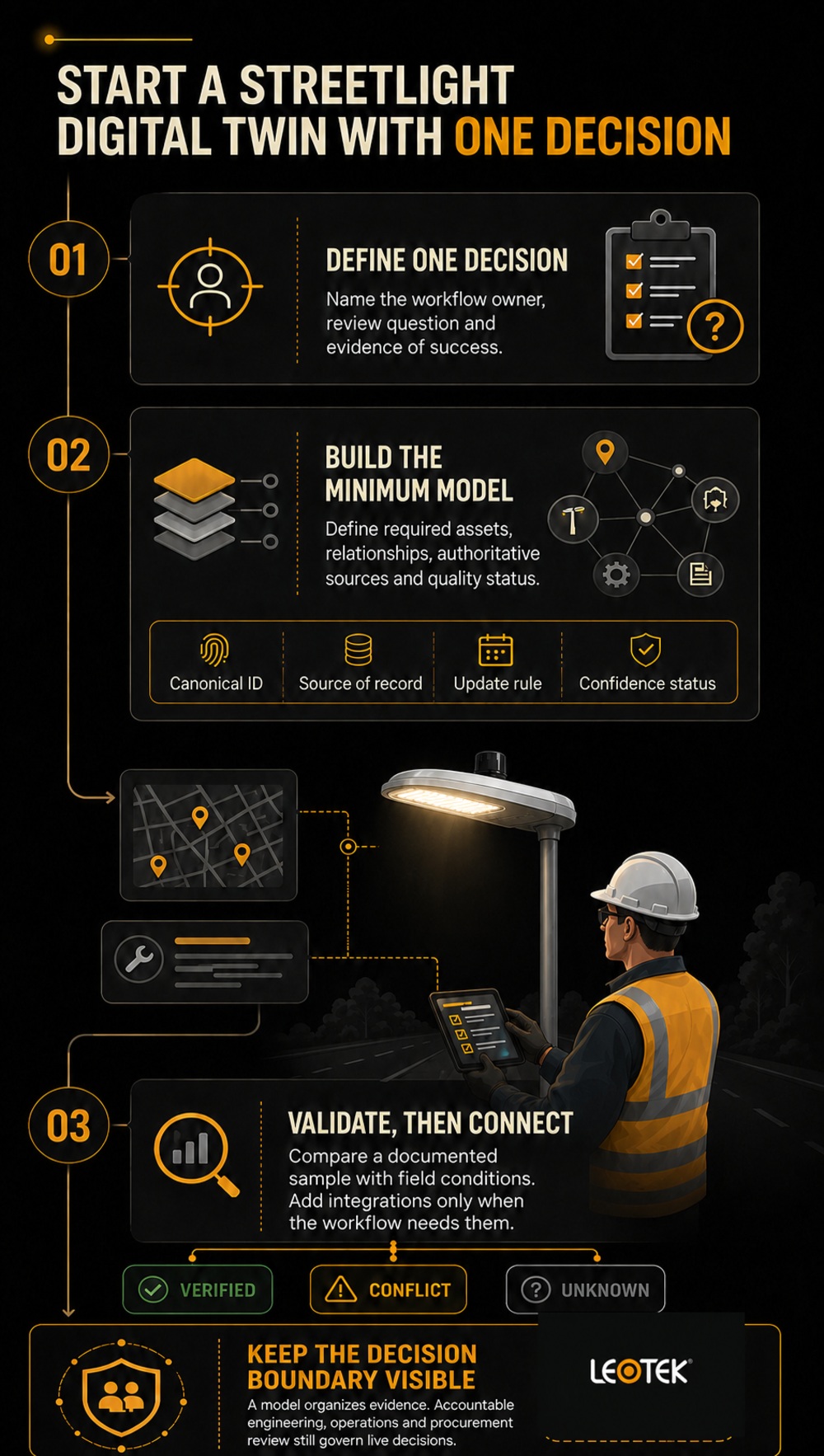
A model can organize evidence, but it should not replace accountable review. Agency engineering and operational processes remain necessary for live roadway operations, electrical work, safety-sensitive decisions, standards interpretation, procurement determinations, and public-policy choices.
This is not a reason to avoid asset modeling. It is a reason to define a decision boundary before implementation. A model can help a reviewer see what is known, what is linked, and what still needs verification. It should not convert assumptions into approvals.
A practical starting sequence
Start small enough that teams can test both the data and the working process. A limited first use can establish whether a larger program is justified without asking an unproven model to carry every asset-management need at once.
1. Choose one decision and define success evidence
Select a workflow with a clear owner and a measurable review question. For instance, an agency might seek to reconcile the inventory and maintenance records for one district before scheduling a field-validation effort. Success could mean that the team can identify the authoritative record for each included asset and document unresolved conflicts.
This is a planning example, not a verified deployment outcome.
2. Define the minimum model and validate it in the field
List the required entities, relationships, source systems, and quality checks. Establish how an asset is uniquely identified, which relationships matter to the chosen workflow, and how users will flag exceptions. Then compare a documented sample against field conditions and revise the model where the assumptions fail.
Keep the acceptance criteria visible. If a location, controller relationship, or configuration cannot be validated, the model should retain that uncertainty rather than silently filling the gap.
3. Connect systems only when a workflow needs them
Integrations should serve a defined task, such as reviewing current event information alongside an asset record. A data connection that does not change a real workflow adds complexity, ownership questions, and potential failure modes without a clear decision benefit.
For readers who are evaluating connected-lighting and roadway-management options, begin with the documented functions and technical materials for the specific solution. Do not assume that a controller, platform, API, or visualization will satisfy an agency’s data and governance requirements without project-level review.
Questions to ask platform and implementation teams
The following questions help turn a broad “digital twin” proposal into a reviewable scope:
- What is the canonical asset ID, and how is it reconciled across inventory, work-order, geographic, and device records?
- Which source system is authoritative for each field, relationship, and document reference?
- How are updates timestamped, approved, audited, and corrected when records conflict?
- Which asset relationships are modeled, and which have been validated in the field?
- What historical data is retained, and what does a missing or delayed update look like to a user?
- Which integrations are required for the first workflow, and what happens when an integration is unavailable?
- What evidence supports role-based access, data export, retention, security, and change-control requirements for this project?
- How will the agency test acceptance, maintain ownership, and avoid dependence on undocumented assumptions after handoff?
These questions are procurement-neutral. They do not prescribe one data model or platform. They make it easier to distinguish a documented capability from a proposed workflow and an intended benefit from an observed result.
Conclusion: Treat the twin as a decision tool, not a promise
A streetlight digital twin can be a useful way to organize asset context for planning, documentation, maintenance triage, and carefully bounded analysis. Its credibility comes from verified records, explicit relationships, transparent update rules, and a decision scope that users can test.
For a defined technical-evaluation question, consult LEOTEK technical documents and verify the current model, revision, and project applicability of any material used in a decision. If a project team has already defined its asset-data or platform question, it may also contact LEOTEK to discuss that specific inquiry; the appropriate architecture and outcomes still require project-level evaluation.
Frequently asked questions
Is a connected streetlight system automatically a digital twin?
No. A connected system may provide operational data such as events, schedules, or remote-control functions. It becomes part of a digital-twin approach only when those inputs are governed within a defined asset model, including relevant relationships, sources of record, update rules, and a stated decision purpose.
For public infrastructure, agencies should also confirm the model’s decision boundary, data ownership, validation approach, and operational accountability.
What information should a roadway asset digital twin contain?
It should contain the information needed for its intended workflow. Common planning examples include an asset identifier, location, responsible organization, asset class, configuration, maintenance history, document references, and selected relationships to poles, circuits, controllers, or roadway segments. Field validation and data provenance determine whether a record is reliable enough to use.
Can a digital twin predict streetlight failures?
Not by definition. Prediction requires relevant historical and current data, a method that has been tested for the use case, and a documented way to assess its accuracy. A twin may organize the inputs needed for investigation, but it does not prove predictive performance.
Does a digital twin need a 3D model?
No. A visual model can help people understand context, but a useful twin can begin with structured records and relationships. The priority is whether the model supports a validated workflow, not whether it is visually elaborate.
How should an agency start with a streetlight digital twin?
Start with one decision, define the minimum records and relationships needed, identify the authoritative sources, and validate a bounded sample in the field. Add integrations only when they support that workflow, and document the assumptions and acceptance criteria before expanding.
References
- Microsoft, Azure Digital Twins Overview; accessed July 26, 2026.
- Federal Highway Administration, Asset Management Guidance; accessed July 26, 2026.
- LEOTEK, LEOLink Solutions; accessed July 26, 2026.
- LEOTEK, RenAI AI Roadway Infrastructure Management System; accessed July 26, 2026.
- LEOTEK, Predictive Maintenance; accessed July 26, 2026.
- LEOTEK, Resources and Documents; accessed July 26, 2026.