












No communications option is universally best for smart streetlights. This NB-IoT vs. LTE-M vs. RF mesh comparison helps agencies evaluate coverage, ownership, and procurement conditions: cellular options need verified carrier, device, and service evidence, while mesh needs a validated field-network design and operations plan before procurement.
Connected controls can support functions such as scheduled switching, dimming, alarms, energy reporting, and asset records. But those functions only work as intended when the communications layer, controller, backhaul, software, and operating process are designed together. Start with the streetlight operation you need, then test the network assumptions behind it.
Key takeaways
- NB-IoT and LTE-M are cellular low-power wide-area options. Their suitability depends on verified local carrier availability, service terms, device compatibility, and the application profile.
- RF mesh is an architecture, not one product or one standard. It can shift more network infrastructure and operations to the agency or its delivery partner.
- Do not select on a generic coverage, latency, or cost claim. Test the actual corridor, controller, network, and backhaul arrangement.
- Compare lifecycle responsibilities, not only initial equipment. Include connectivity, gateways, backhaul, commissioning, monitoring, security maintenance, replacement, and contract exit.
- Make a representative pilot part of the selection process. Define acceptance criteria before installation begins.
Start with the streetlight operation, not the radio
The choice between NB-IoT, LTE-M, and RF mesh is often framed as a radio comparison. For a city or transportation agency, it is more usefully a service-design decision. The radio is one element in the path from a field controller to the people and systems that need to act on its data.
Begin by documenting what the program must do. A streetlight network may send schedules, dimming commands, status changes, fault alerts, energy information, or asset identifiers. Each workflow creates different expectations for delivery, retry behavior, reporting, and field support. A simple scheduled-control program should not be specified as though it were a continuous, high-volume data application. Conversely, a workflow that depends on timely acknowledgement needs a testable definition of what “timely” means for that project.
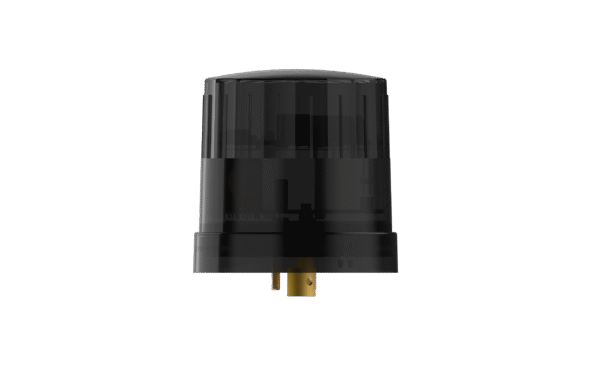
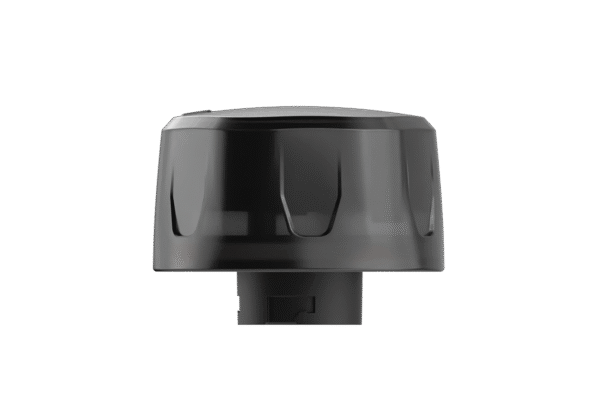
This distinction matters when planning outdoor lighting applications. A luminaire, a controller, a communications bearer, and management software are separate components. Do not infer that a roadway lighting product supports a particular cellular technology or mesh protocol without current, model-specific documentation.
Define the deployment boundary and workflows
Write down the boundaries before comparing technologies:
- Which streetlights, cabinets, gateways, and backhaul connections are in scope?
- Which operational workflows require communications, and how often do they occur?
- What information must be visible to operators, and what can wait for a routine report?
- Who will commission devices, investigate exceptions, manage credentials, replace failed equipment, and update firmware?
- Which existing systems need data, and what export or interface evidence is required?
The output should be a requirements list, not an assumed technical solution. It creates a consistent basis for evaluating vendors and prevents a feature list from disguising missing operational responsibilities.
Separate coverage from availability and ownership
Coverage is not a single yes-or-no condition. For cellular options, a carrier map is a planning input, but it is not a substitute for measurements at the installed locations and in the installed enclosure. For mesh, a proposed topology is also a planning input, not proof that every device will have an acceptable path after poles, buildings, terrain, foliage, interference, and backhaul are considered.
Availability is broader than signal. It includes the commercial service arrangement, hardware support, installation process, monitoring tools, escalation path, replacement strategy, and any constraints on software or data access. Ownership is broader still: cellular can place more of the access network outside the agency, while a field mesh can put more responsibility for gateways, backhaul, RF planning, and network operations within the project boundary. Neither arrangement is automatically simpler or less expensive.
How NB-IoT, LTE-M, and RF mesh differ
NB-IoT, LTE-M, and RF mesh should be compared as different approaches to connecting field devices. The following descriptions provide a starting point, not a compatibility matrix or a procurement determination.
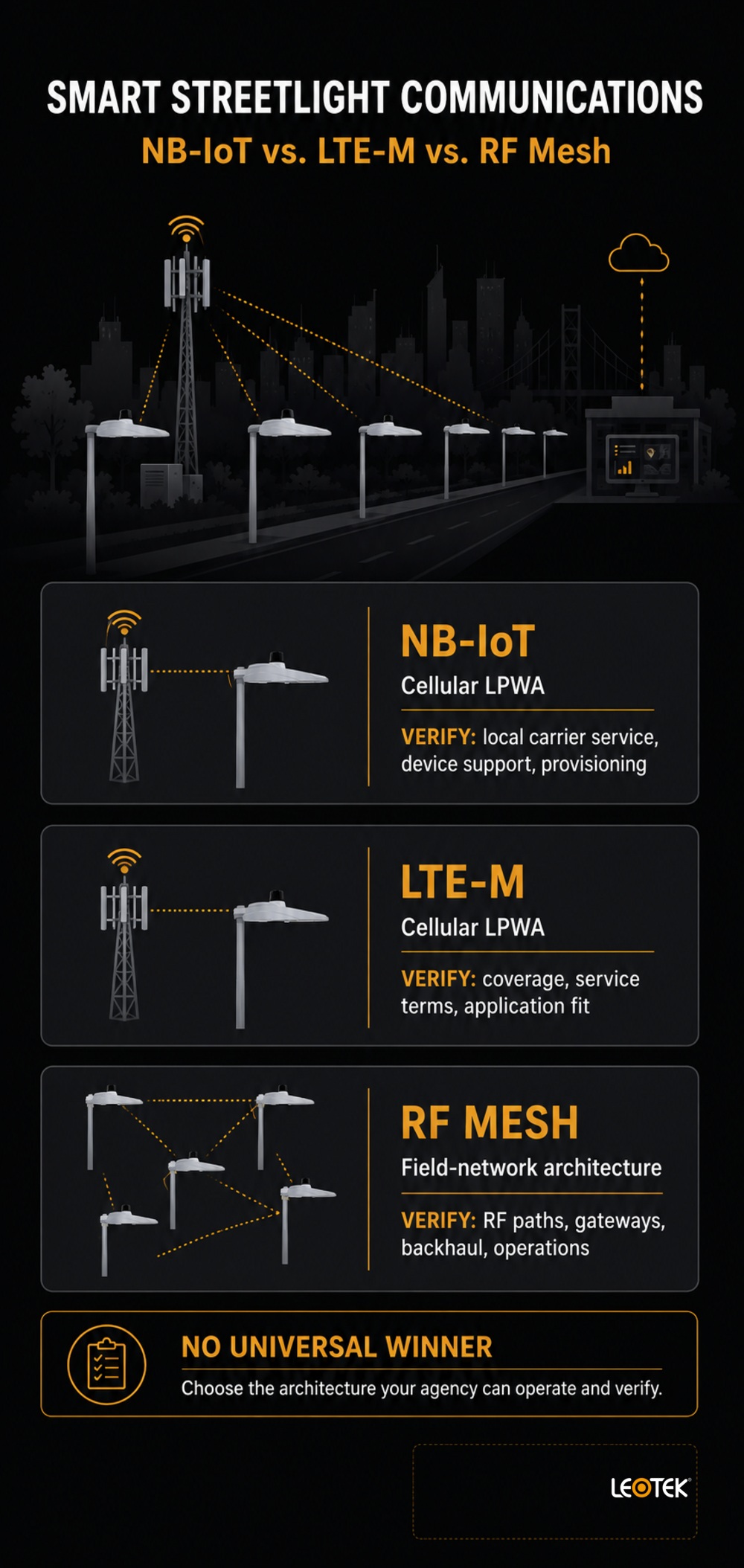
NB-IoT: low-power cellular connectivity to validate locally
The GSMA describes NB-IoT as a standards-based low-power wide-area technology designed for IoT devices, including extended coverage and lower device complexity. In a streetlight context, that makes NB-IoT a cellular option worth evaluating where the application has modest data needs and local carrier support is confirmed.
The key word is confirmed. A general technology description does not establish that a particular carrier offers service at every pole, that a controller supports the required bands and service arrangement, or that performance will meet a project’s command and reporting needs. Agencies should ask how coverage will be tested, how devices will be provisioned, how SIM or eSIM lifecycle is handled, and what happens when service or hardware reaches end of support.
NB-IoT should not be selected because of a generic battery-life statement. Streetlight controllers are often powered from the lighting system, and power behavior depends on the actual controller, configuration, reporting pattern, and installation. Evaluate the whole device and service design rather than transplanting a claim from a different IoT use case.
LTE-M: a cellular LPWA option to assess against application needs
LTE-M is the simplified name for LTE machine-type communications low-power wide-area technology, associated with LTE Cat-M1 and 3GPP Release 13. GSMA describes it as reusing the LTE installed base while reducing device complexity and providing extended coverage.
For smart streetlight communication, LTE-M belongs in the same disciplined evaluation as NB-IoT. It may be a candidate when its documented characteristics and local service availability align with the application. That statement is intentionally conditional. A technology label alone does not establish a project’s achievable latency, throughput, roaming arrangement, coverage, or long-term service policy.
During evaluation, require the supplier and relevant carrier to document the exact device, network, service plan, supported geography, activation method, support model, and testing approach. If a proposal relies on a future network change, obtain a written migration and responsibility plan rather than treating the change as a benefit. The agency should also decide whether it needs a direct relationship with the connectivity provider or wants that service managed through another party.
RF mesh: a field-network approach with local infrastructure responsibilities
RF mesh usually refers to devices relaying communications through a local wireless network. It is not a single radio technology, standard, or interoperability claim. A standards-based example is Wi-SUN Field Area Network (FAN): the Wi-SUN Alliance says FAN can interconnect industrial devices such as streetlights and positions it for large outdoor networks. That example does not mean every RF mesh offering is Wi-SUN FAN or interoperable with it.
The practical attraction of a mesh approach can be local network control and a field architecture that does not require each node to depend on a cellular subscription. That does not mean it has no recurring costs. Gateways, backhaul, network operations, monitoring, spares, RF surveys, configuration, security maintenance, and support still need an owner and a budget.
Mesh design also needs careful validation. A route that looks adequate during a small proof of concept may behave differently across a full corridor or after changes in the built environment. Ask for the proposed gateway plan, backhaul resilience assumptions, installation sequencing, network-health monitoring, exception handling, and recovery process. Treat node count, range, reliability, and latency as project-specific test results, not universal marketing values.
Compare the options across procurement criteria
The table below is a streetlight communications selection comparison. It avoids universal performance values because those values depend on the device, carrier or network, configuration, geography, installation, and traffic pattern.
| Criterion | NB-IoT | LTE-M | RF mesh |
|---|---|---|---|
| Network dependency | Verify carrier availability, service arrangement, and device support locally. | Verify carrier availability, service arrangement, and device support locally. | Verify the radio design, gateway plan, backhaul, and operating model locally. |
| Agency infrastructure responsibility | Usually centered on field devices and the contracted connectivity/service relationship; confirm the boundaries. | Usually centered on field devices and the contracted connectivity/service relationship; confirm the boundaries. | May include gateways, backhaul, RF planning, monitoring, and support, depending on the delivery model. |
| Coverage validation | Measure representative installed locations and document exception areas. | Measure representative installed locations and document exception areas. | Survey the site and validate routes, gateways, backhaul, and exception areas. |
| Application fit | Compare the actual control, telemetry, alarm, and update requirements to documented service and device behavior. | Compare the actual control, telemetry, alarm, and update requirements to documented service and device behavior. | Compare the traffic pattern to documented network design and operating procedures. |
| Lifecycle cost categories | Include service, provisioning, support, replacement, and contract terms. | Include service, provisioning, support, replacement, and contract terms. | Include gateways, backhaul, RF operations, monitoring, support, replacement, and contract terms. |
| Interoperability evidence | Require current controller, module, and platform documentation. | Require current controller, module, and platform documentation. | Require current protocol, controller, gateway, and platform documentation. |
| Security and support evidence | Require identity, patching, vulnerability, support, and end-of-support documentation. | Require identity, patching, vulnerability, support, and end-of-support documentation. | Require the same evidence for devices, gateways, backhaul, and management systems. |
The table deliberately does not declare a winner. A rural corridor with verified cellular service may arrive at a different decision than a dense municipality with an existing field-network operations capability. The point is to identify evidence that must be gathered before a choice is made.
Commissioning and handoff deserve their own comparison as well. Require each proposal to state who performs installation validation, records the installed configuration, trains operators, owns open exceptions, and signs off on acceptance. The same documentation should identify how the project will migrate when a controller, carrier service, gateway, or software component reaches end of support. Those responsibilities are operational requirements, not optional implementation details.
Use a selection framework for cities and transportation agencies
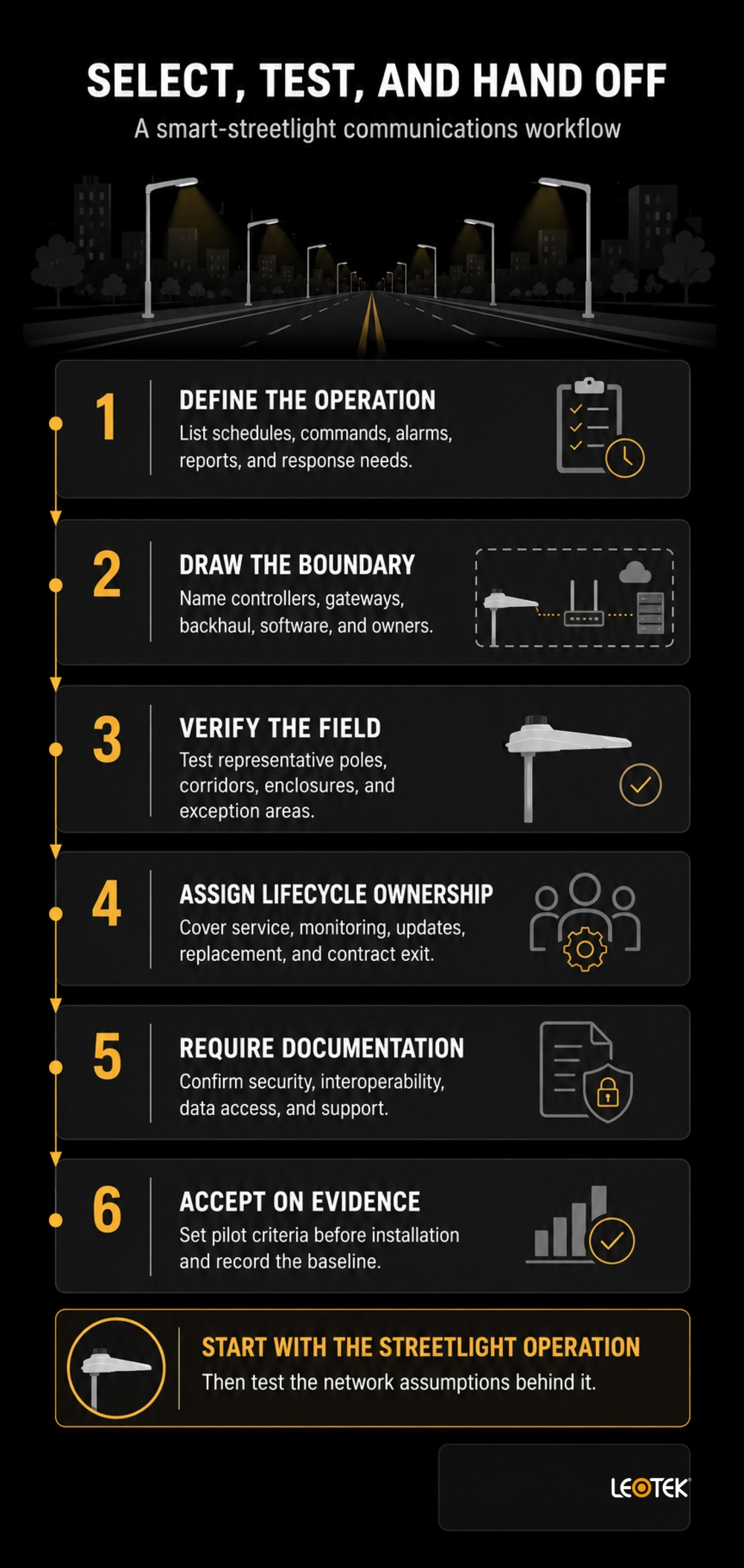
A credible selection process moves from requirements to field evidence, then to lifecycle accountability. It should include engineering, operations, information technology or security, procurement, and the parties responsible for field maintenance.
Build a representative pilot and acceptance plan
A pilot should represent the conditions that can invalidate an architecture: varied pole spacing, difficult coverage areas, distinct roadway environments, relevant backhaul conditions, and normal operating workflows. It should not be limited to the easiest block or only to a bench demonstration.
Set acceptance criteria before deployment. For example, define the coverage-test method, the documented exception process, command-delivery evidence, alarm workflow, outage behavior, commissioning records, and the transition to operations. The criteria should describe observable results for the project, not adopt an unsourced generic benchmark.
Record the baseline configuration and any changes during the pilot. This makes it possible to distinguish a technology limitation from a configuration, installation, or process issue. It also gives procurement teams an evidence trail for expanding, revising, or declining the approach.
Evaluate lifecycle ownership and commercial terms
Initial equipment cost is only one line in a streetlight communications decision. Create a lifecycle comparison that names who is responsible for connectivity, gateways, backhaul, commissioning, monitoring, incident response, security updates, replacement devices, training, and data export.
For cellular options, clarify subscription ownership, activation and suspension processes, service changes, hardware replacement, and contract exit. For mesh options, clarify who maintains gateways and backhaul, who monitors network health, what spares are held, and how changes are planned. In either model, define what operational data the agency can access and what form it takes.
Do not present cellular as inherently higher operating cost or mesh as inherently lower operating cost. The result depends on the project’s scale, existing assets, contract structure, staffing, geography, and support model. A complete comparison makes those assumptions visible.
Require security, data, and interoperability documentation
Connected streetlights are IoT devices in an operational infrastructure environment. The NIST Cybersecurity for IoT Program frames IoT cybersecurity as risk-based and emphasizes that there is no one-size-fits-all solution. That is a useful procurement principle: do not presume that the bearer alone makes a deployment secure.
Require documentation for device identity and credential management, encryption and key handling where applicable, firmware and security-update procedures, vulnerability reporting, logging, access roles, data retention, data export, support obligations, and end-of-support treatment. Ask which elements apply to controllers, gateways, backhaul, and management software. Have the agency’s relevant security and legal stakeholders assess the final requirements for the specific architecture and jurisdiction.
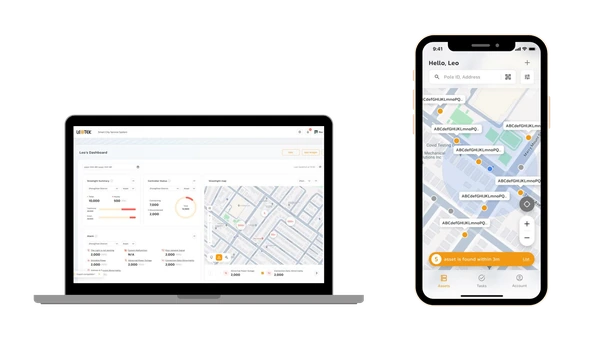
Interoperability needs equally concrete evidence. A proposal should identify the controller model, communications module, network or gateway, management system, interface method, versions, and any dependencies. A platform page is not a substitute for that evidence. LEOTEK describes connected streetlight management as including functions such as remote switching and dimming, schedules, fault notification, energy tracking, reporting, maps, alarms, and asset management; it should not be read as proof of support for any particular NB-IoT, LTE-M, or RF mesh configuration.
Questions to put in a smart-streetlight communications RFP
An RFP should turn assumptions into deliverables. The following questions can help teams compare proposals on evidence rather than labels.
- What exact controller, communications module, gateway, backhaul component, and management software version is proposed?
- How will the supplier test coverage or RF paths at representative installed locations, and how will it document exception areas?
- What current carrier approval, device certification, and geographic service evidence applies to the proposed cellular configuration?
- Which streetlight workflows are supported, how are they tested, and what evidence will be provided for command delivery, alarms, reporting, and recovery?
- Who owns and administers connectivity subscriptions, gateways, backhaul, credentials, and network-monitoring tools?
- What are the procedures for provisioning, replacement, decommissioning, and transfer of a controller or communications service?
- What security updates, vulnerability notifications, support terms, and end-of-support commitments apply to each component?
- What data can the agency export, in what format, under what access controls, and after what retention period?
- What local infrastructure, permits, power, mounting, or backhaul are required for gateways or other field equipment?
- What pilot acceptance criteria, documentation, training, and operational handoff are included?
- What happens if a carrier service, gateway, controller, or software component must be migrated or retired?
These questions do not replace project engineering, cybersecurity review, or procurement requirements. They create a clearer record of where technical and operational accountability sits.
Choose the architecture the agency can operate and verify
NB-IoT, LTE-M, and RF mesh can all be relevant to connected roadway lighting, but each requires different proof. NB-IoT and LTE-M require local carrier, device, and service validation. RF mesh requires a validated field design and a clear plan for gateways, backhaul, and network operations. Every option needs a documented controller-to-platform compatibility path, a security and support process, and a representative pilot.
For teams preparing submittals or due diligence, LEOTEK provides product specifications and resources; verify each document’s current date, model, and revision before relying on it. Where a project has defined coverage, operations, or integration questions, readers can discuss a roadway infrastructure project with LEOTEK. Neither resource changes the need for project-specific technical and agency review.
FAQs
Is NB-IoT or LTE-M better for smart streetlights?
Neither is always better. Both are cellular low-power wide-area options, and the choice should follow verified local coverage, device compatibility, service terms, required workflows, support expectations, and lifecycle ownership. Do not infer project performance from a general technology description.
When is RF mesh a good fit for a streetlight network?
RF mesh is worth evaluating when a project can support a field-network design, including RF planning, gateway placement, backhaul, monitoring, and operations. Its fit depends on the surveyed environment and the agency’s or delivery partner’s ability to own those responsibilities.
Does RF mesh avoid all recurring communications costs?
No. A mesh approach may avoid a per-node cellular subscription in some designs, but it still has lifecycle costs for gateways, backhaul, network operations, monitoring, security maintenance, support, replacements, and contract services. Compare complete lifecycle responsibilities rather than one cost category.
What should a city test before selecting streetlight communications?
Test representative field locations and real operating workflows. Document coverage or RF paths, installed-device behavior, command delivery, alarms, reporting, outage recovery, commissioning, security processes, and operational handoff. Agree on acceptance criteria before the pilot begins.
References
- GSMA, Narrowband Internet of Things (NB-IoT); accessed July 26, 2026.
- GSMA, LTE-M (LTE Cat-M1); accessed July 26, 2026.
- Wi-SUN Alliance, Wi-SUN FAN 1.1; accessed July 26, 2026.
- National Institute of Standards and Technology, NIST Cybersecurity for IoT Program; accessed July 26, 2026.
- LEOTEK, Applications for Outdoor Lighting; accessed July 26, 2026.
- LEOTEK, LEOLink Solutions; accessed July 26, 2026.
- LEOTEK, Resources and Documents; accessed July 26, 2026.