


LM-80 measures luminous-flux and color maintenance for LED packages, arrays, or modules under stated test conditions; TM-21 projects longer-term luminous-flux maintenance from applicable source data. For a streetlight claim based on LM-80 and TM-21, neither method alone proves how long the complete luminaire will operate without failure.
That distinction matters when a city, utility, or transportation agency reviews an LED streetlight submittal. A projected hour value can be useful, but only after the reviewer confirms what was tested, how the projection was produced, and whether the evidence matches the offered luminaire.
Key takeaways
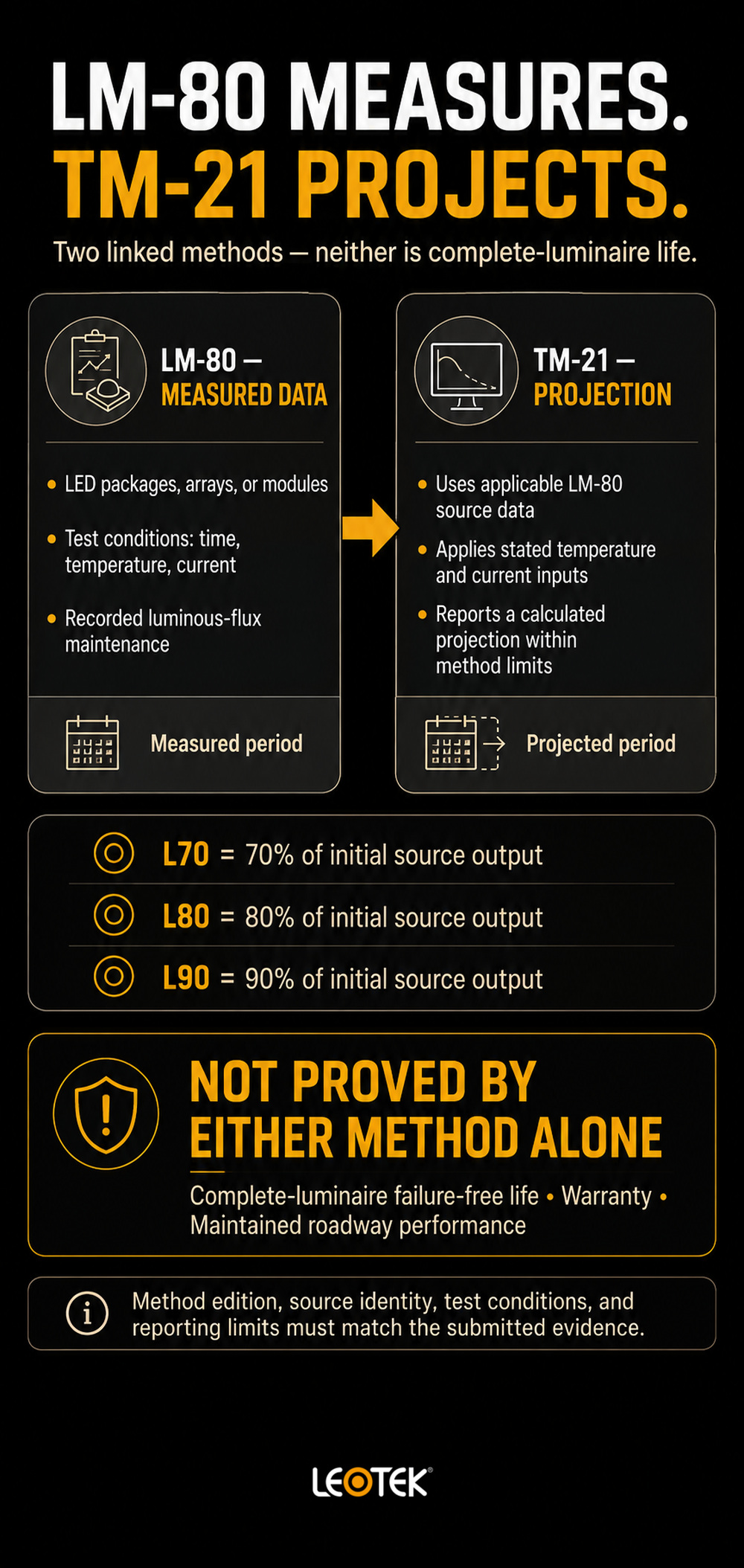
- LM-80 produces measured LED-source maintenance data, not a complete-streetlight life rating.
- TM-21 turns applicable source data into a projection; it is not a physical test lasting for the projected number of hours.
- Temperature, drive current, source identity, and luminaire configuration determine whether the evidence applies.
- Driver, control, surge, seal, optical, warranty, and maintained-roadway-performance questions require other evidence.
LM-80 and TM-21 for streetlights in one view
The simplest accurate summary is: LM-80 measures; TM-21 projects. Both concern LED lumen maintenance, which is the change in luminous flux over time relative to an initial value. Luminous flux is measured in lumens; readers who need a refresher can review the distinction among watts, lumens, and lux.
Initial lumens, efficacy, and lumen maintenance answer different questions. Initial lumens describe light output at the beginning of operation. Efficacy relates that output to electrical power. Lumen maintenance describes how much source output remains after operating over time under defined conditions.
| Question | LM-80 | TM-21 |
|---|---|---|
| What is it? | A measurement method | A projection method |
| What does it address? | LED packages, arrays, or modules | Longer-term luminous-flux maintenance based on applicable source data |
| What is the output? | Measured maintenance data under reported conditions | A calculated projection with stated inputs and reporting conventions |
| What must a reviewer check? | Source identity, test edition, laboratory, duration, temperatures, currents, samples, and results | Source data, temperature/current inputs, method edition, calculation output, and reporting limit |
| What does it not establish by itself? | Complete-luminaire service life | Failure-free luminaire operation, warranty, or maintained roadway lighting |
The Illuminating Engineering Society (IES) TM-21 calculator describes the official tool as projecting luminous-flux maintenance based on the 2021 American National Standard. That source confirms the character of the result: it is a projection, not a guarantee.
LM-80 and TM-21 are also methods, not product certifications. A statement that an LED source was tested according to LM-80 or that a projection was calculated according to TM-21 does not, by itself, establish a product listing, regulatory approval, or procurement eligibility.
What an LM-80 report measures
An LM-80 report should identify the LED package, array, or module tested and present maintenance data gathered under controlled conditions. The method addresses the light-producing source, not every component in an assembled streetlight. DLC solid-state lighting requirements treat LM-80 data as one part of a broader product testing and reporting framework.
That scope is easy to blur in a short specification. Saying that a “streetlight passed LM-80” can wrongly suggest that the housing, driver, surge protection, seals, controls, and optical system all underwent the same maintenance test. A more accurate statement identifies the LED source and the report that covers it.
Test conditions define the evidence
An LM-80 result has meaning in relation to its test conditions. Review the LED-source identity, applicable standard edition, laboratory, report date, test duration, test temperatures, and drive currents. Also record the sample size and other sample information, measurement intervals, and reported behavior.
These fields are not administrative trivia. Temperature and electrical loading can affect LED-source behavior, while test duration determines the measured evidence available to a later projection. Sample information helps the reviewer understand what data set underlies the reported result.
The exact procedural requirements depend on the edition cited in the report and any qualification program or specification that adopts it. Agencies should not rely on a generic internet summary for minimum test duration, sample rules, interpolation, rounding, or acceptance criteria. The controlling documents are the actual report, the applicable standard edition, and the project requirement.
Measured maintenance is not projected life
An LM-80 report records what happened during the test period. It does not physically operate a complete streetlight for every hour later shown in a lifetime claim.
This is the first checkpoint in a submittal review: separate the measured period from the projected period. If a data sheet shows one large hour value without the underlying test duration and conditions, the reviewer cannot tell how much of the statement is measured and how much is calculated.
LM-80 may also provide color-maintenance data within its scope. That does not mean a luminous-flux projection automatically establishes long-term color behavior for the complete luminaire. Color claims should be tied to the specific test method, report, and configuration that support them.
What TM-21 projects from the test data
TM-21 provides a standardized way to project longer-term luminous-flux maintenance from suitable LED-source data. It does not replace LM-80; it depends on measured data and the conditions needed to apply that data.
The projection process fits the applicable data to the method defined by the cited TM-21 edition. Its output should preserve the relevant source identity, test duration, temperature and current basis, and reporting convention. The number is meaningful only with that context.
Reading L70, L80, and L90 carefully
An L-value expresses a lumen-maintenance threshold. In general terms, L70 concerns the point associated with 70% of initial luminous flux, L80 with 80%, and L90 with 90%. The notation in a real report may include additional information, so reviewers should use the definitions and format provided by the applicable edition and output.
An L70 value does not mean the source abruptly turns off when it reaches 70%. It marks a parametric threshold related to light output. Nor does it show that every complete luminaire in a streetlight population will remain operational until that point.
Reviewers should not infer a population or failure-probability interpretation unless the submitted evidence expressly defines and supports it. A separate statistical designation cannot be inferred from an L-value alone.
Calculated and reportable values are not interchangeable
A calculation may produce a mathematical crossing point beyond what the method permits a supplier to report for the available data. A well-documented submittal should distinguish the calculated result from the reportable projection and use the notation required by the applicable standard or program.
This is why the largest hour number is not automatically the best evidence. A reviewer should ask how the value was generated, which source data were used, what reporting boundary applies, and whether the submitted wording preserves that boundary.
The DesignLights Consortium (DLC) solid-state lighting (SSL) V6.0 and LUNA V2.0 technical requirements, effective January 5, 2026, include testing and reporting expectations involving LM-79, LM-80, and TM-21. DLC requirements can provide a useful qualification framework, but they do not automatically replace an agency’s project specification. The reviewer must confirm the program version and pathway that actually apply.
Why streetlight operating conditions matter
An LED source tested in a laboratory must be connected to the conditions inside the offered luminaire. For municipal outdoor lighting applications, that connection is especially important because housing design, electrical loading, ambient conditions, and component placement influence the source’s operating environment.
Why is in-situ temperature needed for a streetlight projection?
An in-situ temperature measurement test (ISTMT) measures temperature at a defined point while the source operates in the luminaire or other relevant system. The result helps establish whether the LM-80 temperature data can be applied to that configuration.
The DLC testing-laboratory requirements identify ISTMT, LM-79, LM-80, and LM-84 among tests that may be involved in an application. Exact laboratory, setup, and acceptance rules still come from the current program and test documents.
A single temperature number without its measurement point, setup, ambient condition, orientation, operating mode, and configuration is incomplete evidence. Reviewers should be able to trace the submitted value to the offered streetlight and the projection that uses it.
Drive current and configuration must match
LED-source behavior also depends on electrical operating conditions. The drive-current basis used in the source data and projection must be relevant to the luminaire’s actual setting. Field-adjustable output, multiple wattages, selectable currents, or different thermal configurations can create more than one operating case.
Catalog identity matters for the same reason. A family name alone may cover several outputs, correlated color temperatures, optics, drivers, controls, or housing sizes. The evidence package should identify the exact offered configuration rather than relying on a family-level statement.
Component substitutions can break the evidence chain
If the LED source, driver setting, board layout, thermal interface, or another relevant component changes, the earlier evidence may no longer describe the offered product. A substitution is not automatically unacceptable, but reviewers should require documented technical equivalence under the applicable program and project rules.
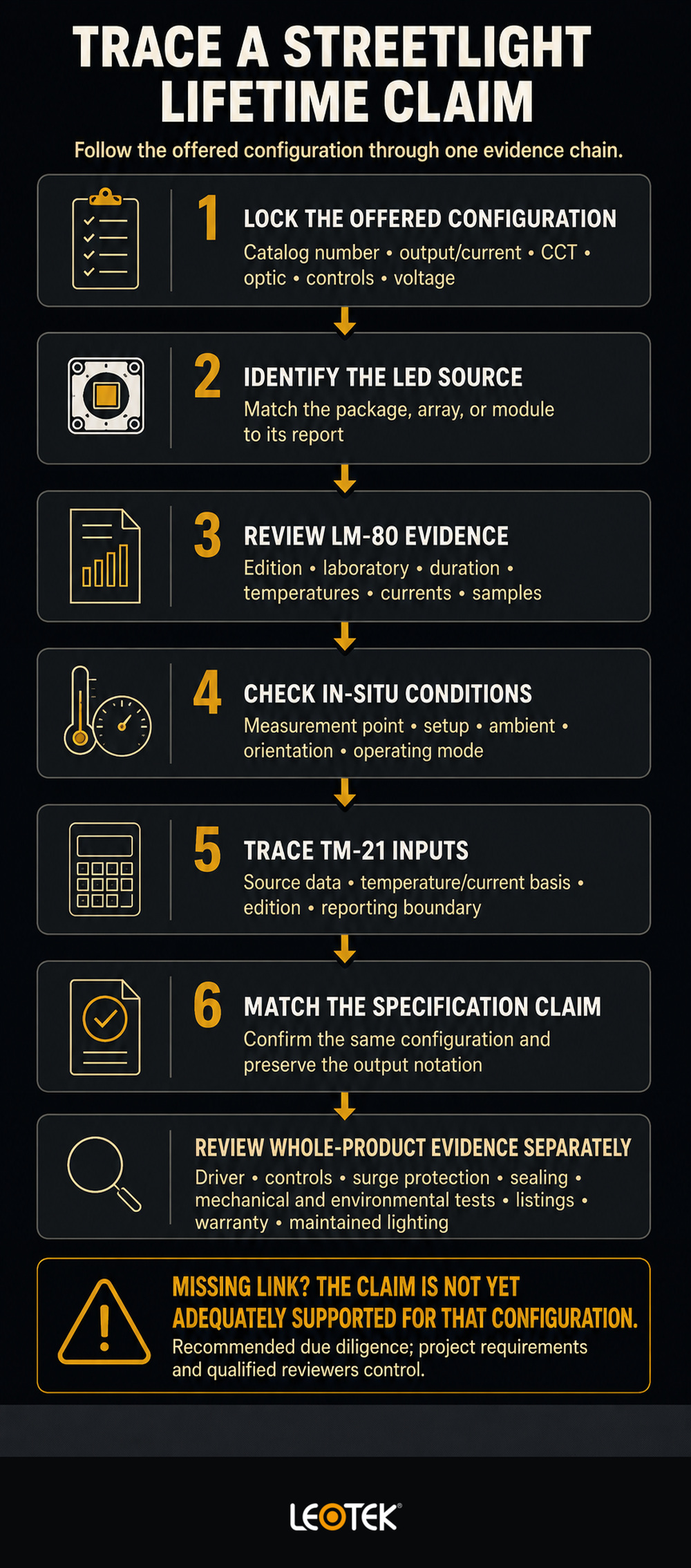
A disciplined review follows one chain: offered catalog number to source identity, source report, in-situ condition, TM-21 output, and specification claim. When a link is missing, the projected LED life statement is not yet adequately supported for that configuration.
What LM-80 and TM-21 do not prove about streetlight life
The central limitation is system scope. The U.S. Department of Energy’s 2011 report, *LED Luminaire Lifetime: Recommendations for Testing and Reporting* (PDF), explains that luminaire lifetime involves the complete system and that LED-source lumen depreciation is not the only failure mechanism. Although the report predates current LM-80 and TM-21 editions, this component-versus-system distinction remains foundational.
Lumen depreciation is not complete-luminaire failure
LED equipment can experience gradual performance change or an abrupt loss of function. Together, the methods address a source-level lumen-maintenance pathway. They do not predict every failure mode in the luminaire.
A driver can stop operating while the LED source would otherwise retain output. A control or connector can fail. An optical or sealing problem can affect delivered light. These examples show why source maintenance and luminaire reliability must be evaluated separately; they do not assign a failure rate or dominant cause to any particular product.
Other components and field stresses need separate evidence
A streetlight operates as an assembly exposed to its electrical, mechanical, thermal, and environmental setting. Relevant questions can include driver and control reliability, surge protection, sealing, corrosion protection, vibration, thermal interfaces, optics, connectors, installation, and serviceability.
LM-80 and TM-21 do not establish those attributes. Each claim needs the appropriate model-specific test report, listing, specification, engineering evaluation, or contractual document. No single acronym should stand in for a complete technical submittal.
Warranty and maintained roadway performance are different questions
A warranty is a contract with defined terms, duration, exclusions, and remedies. A TM-21 projection is a technical calculation. One does not set or prove the other.
Likewise, a source L-value is not a complete lighting maintenance factor. Roadway design depends on project photometry, geometry, operating conditions, applicable design criteria, and an agency-approved maintenance approach. A luminaire might remain energized yet no longer meet a project’s maintained illuminance, luminance, uniformity, or other criteria. Conversely, a maintenance plan may call for action before any source reaches an L-threshold.
Economic service life is different again. It can reflect energy, maintenance, labor, spares, controls, operational needs, and risk. The source-maintenance evidence supplies one technical input, not a lifecycle-cost conclusion.
How agencies can review a lifetime claim
The following checklist is recommended due diligence, not a universal legal or engineering requirement. Agencies should adapt it to their adopted standards, funding rules, qualification programs, and project specifications.
- Lock the offered configuration. Record the catalog number, output or current setting, correlated color temperature, optical configuration, controls, voltage, and relevant ambient rating.
- Identify the LED source. Match the package, array, or module to the LM-80 report rather than accepting a family name alone.
- Review the source report. Record the standard edition, laboratory, report date, sample conditions, currents, temperatures, test duration, and reported anomalies or failures.
- Check the in-situ result. Confirm the temperature measurement point, setup, operating mode, ambient condition, and value for the relevant luminaire configuration.
- Trace the TM-21 inputs. Verify the source data, temperature/current basis, standard edition, calculation date, and configuration used.
- Separate calculated from reportable. Preserve the output’s notation and any reporting boundary instead of copying only the largest number.
- Request whole-product evidence. Evaluate the driver, controls, surge protection, environmental and mechanical tests, product listings, and warranty through their own documents.
- Review maintained lighting. Use project-specific photometry and an agency-approved maintenance factor; do not substitute an LED-source L-value for the complete analysis.
- Control substitutions. Require notification and evidence when a component or setting changes the basis of the accepted projection.
- Assign qualified review. Have the agency’s lighting engineer and procurement or legal staff evaluate the technical and contractual requirements within their roles.
Common red flags
- A spec sheet supplies only an hour value.
- The LED source is not identified.
- No in-situ temperature evidence is provided.
- The standard edition or test duration is omitted.
- A projection is presented as a warranty.
- Component substitutions are unrestricted.
For a specific configuration, use current product specifications and technical resources to assemble the evidence package. Confirm each document’s model, date, and revision with the project team; the resource hub itself does not prove that a report applies to every product.
Frequently asked questions
Does L70 mean a streetlight fails at 70% output?
No. L70 identifies a lumen-maintenance threshold associated with 70% of initial source output. It is not, by itself, a prediction of abrupt failure or a complete-luminaire replacement rule.
Is TM-21 a physical life test?
No. TM-21 is a projection method applied to suitable measured LED-source data. The projected period is not the same as the period physically measured under LM-80.
Can two streetlights using the same LED source have different projections?
Potentially. Operating current, in-situ temperature, housing design, configuration, and the applicable calculation inputs can differ. The actual reports are needed to determine whether and how the projections differ.
Is an LM-80 report enough for a streetlight specification?
No. It can support the LED-source portion of a lumen-maintenance claim, but an agency also needs to assess applicability, whole-product performance, reliability, environmental and mechanical evidence, project photometry, listings, and contractual terms.
How are LM-79 and LM-84 different from LM-80 and TM-21?
At a high level, the DLC testing and reporting framework distinguishes the roles of these methods. LM-79 addresses electrical and photometric measurements of solid-state lighting products, while LM-84 addresses luminous-flux and color maintenance for LED lamps, light engines, and luminaires. LM-80 concerns LED packages, arrays, or modules, and TM-21 provides a source-maintenance projection method. The exact scope and requirements must be checked against the editions adopted for the project.
What should a city request from a supplier?
Request the LM-80 report covering the exact LED package, array, or module used in the offered configuration, along with configuration-specific in-situ temperature evidence, the applicable TM-21 output, and the records that connect them. Then request separate model-specific support for the driver, controls, environmental and mechanical requirements, product listings, warranty, and maintained-lighting calculations.
Practical conclusion
In an LM-80 and TM-21 streetlight review, disciplined traceability is more useful than the largest projected hour value. The defensible question is not simply “How long is the projection?” but “Does the measured source data, operating condition, calculation, and separate whole-system evidence match the streetlight the agency is buying?”
References
- Illuminating Engineering Society (IES). “TM-21 Calculator”. IES Standards Toolbox. Accessed July 26, 2026.
- DesignLights Consortium. “Technical Requirements for LED Lighting: SSL V6.0 and LUNA V2.0”. Accessed July 26, 2026.
- DesignLights Consortium. “Testing Laboratory Requirements”. Solid-State Lighting Technical Requirements. Accessed July 26, 2026.
- U.S. Department of Energy. *LED Luminaire Lifetime: Recommendations for Testing and Reporting*. June 2011. Accessed July 26, 2026.
- LEOTEK. “Outdoor Lighting”. Accessed July 26, 2026.
- LEOTEK. “Watts to Lumens, Lumens to Lux: The Ultimate Guide to Understanding Lighting Performance”. Accessed July 26, 2026.
- LEOTEK. “Resources & Documents”. Accessed July 26, 2026.