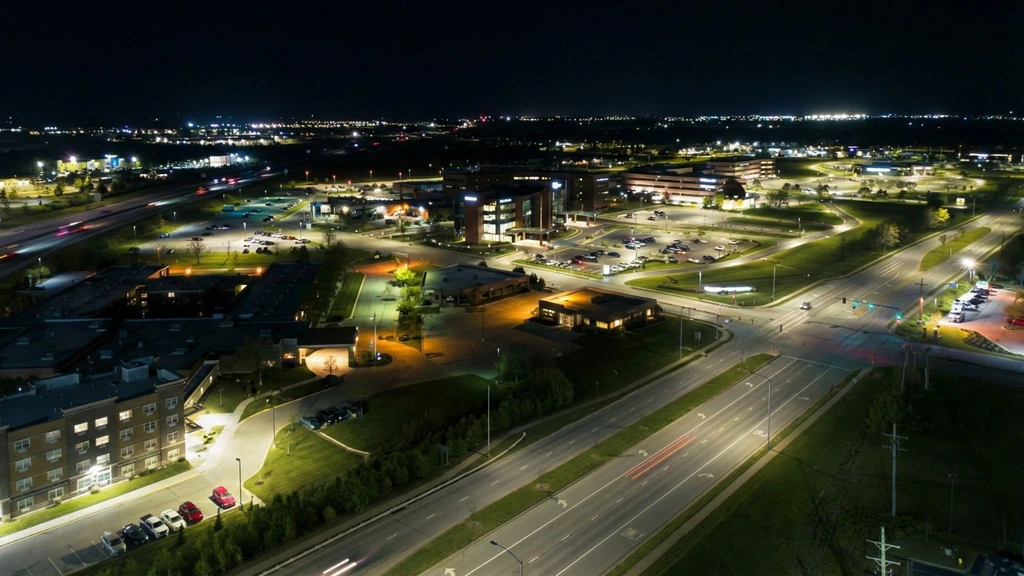

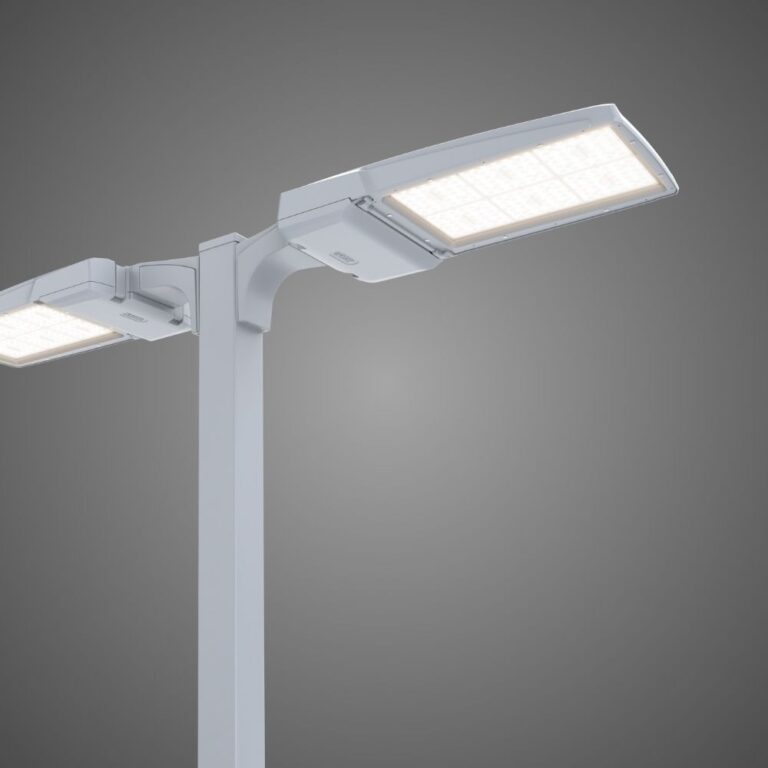
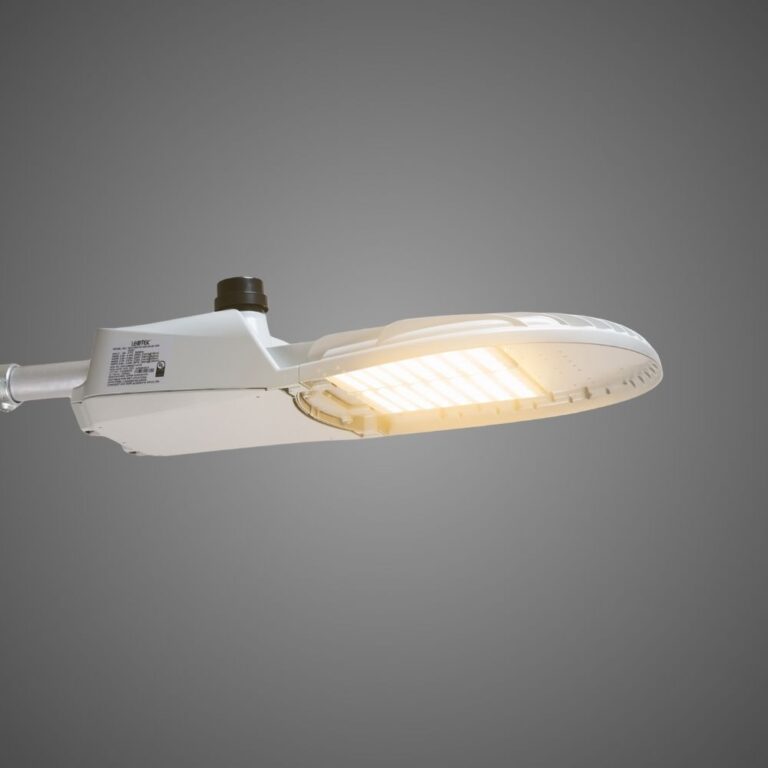
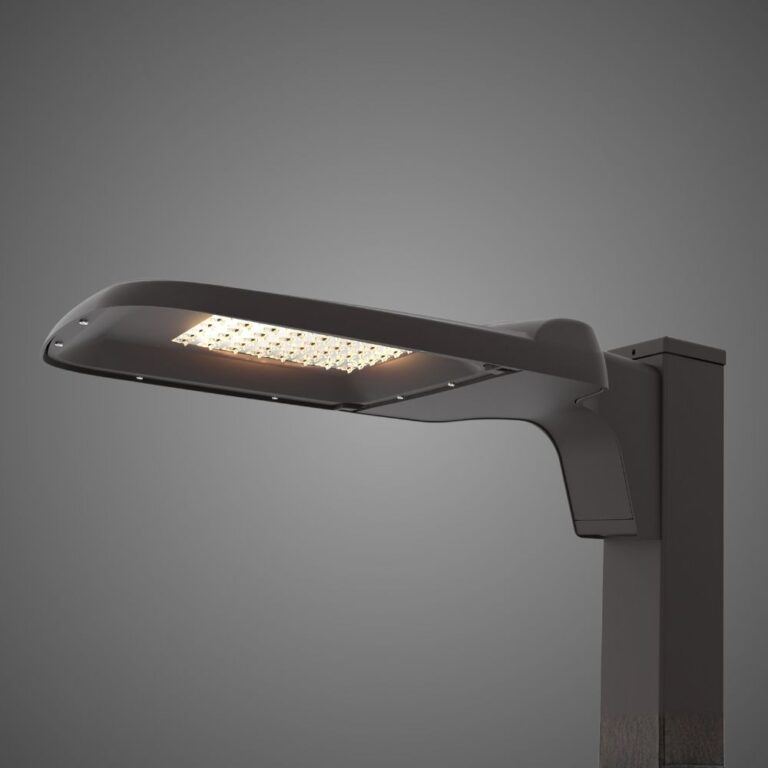







A municipal streetlight audit is a reconciled record of each light, who owns it, how it is billed and maintained, and what field conditions could affect a conversion. Before selecting LED equipment, a city or agency should compare its records with field observations and document what is verified, uncertain, or in need of qualified review.
An audit creates a baseline for design, procurement, installation planning, and future maintenance. It does not, by itself, establish lighting compliance, electrical compatibility, structural capacity, tariff eligibility, or the suitability of any replacement product.
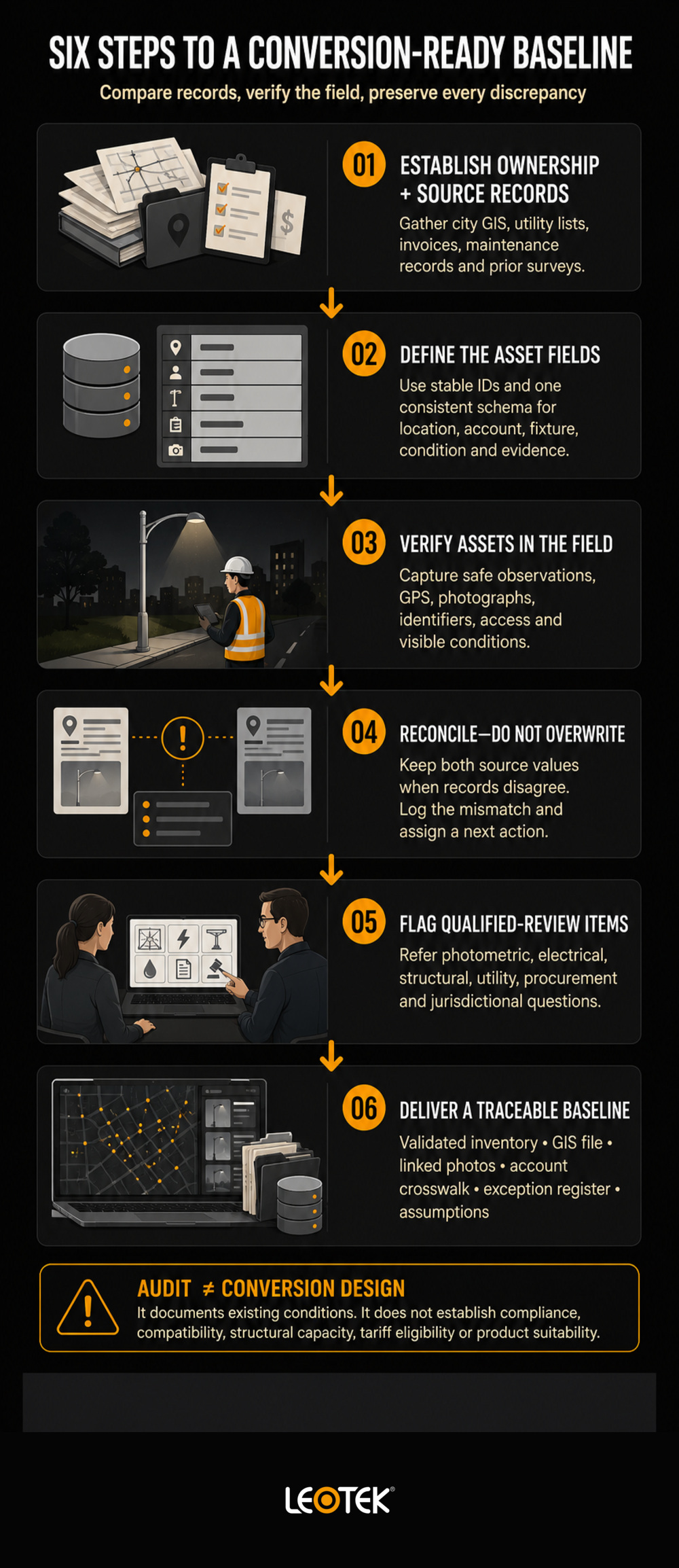
A practical audit has six steps:
- Establish ownership and source records.
- Define the asset fields.
- Verify assets in the field.
- Reconcile billing, circuit, and failure records.
- Flag issues requiring qualified review.
Key takeaways
- Start with city, utility, billing, GIS, and maintenance records, then verify them in the field.
- Use one consistent streetlight inventory structure for fixtures, poles, locations, accounts, circuits, rates, and failures.
- Record discrepancies instead of silently choosing one data source over another.
- Separate observed conditions from decisions that need photometric, electrical, structural, utility, procurement, or jurisdictional review.
Define the audit before collecting data
The first task is to define what decisions the audit must support. A city considering an LED conversion may need a reliable fixture count, a clearer picture of ownership, a map of assets, or a way to reconcile utility charges with actual equipment. Those are related needs, but they are not the same deliverable.
Set an audit boundary in writing. Identify the streets, parks, parking areas, bridges, alleys, or other public locations included; the record systems to be compared; and the people responsible for resolving exceptions. A boundary prevents a field team from treating every outdoor light in the jurisdiction as part of the same program without confirming ownership or purpose.
Separate inventory from conversion design
An inventory documents existing conditions. It can capture what is installed, where it is located, and what records say about it. A conversion design determines how a replacement should perform in a particular setting. Conflating the two can produce an inaccurate scope: an observed fixture label is not a replacement specification, and an asset count is not a photometric plan.
That distinction is especially important where a project will later consider roadway and area lighting. The audit can assemble the inputs a design team needs, while outdoor lighting applications can help readers explore the relevant application categories. Neither an inventory nor an application page should be treated as proof of a particular fixture’s output, controls, warranty, listing, or project fit.
Confirm ownership and decision boundaries
For each asset, identify whether records indicate municipal ownership, utility ownership, a lease arrangement, or an unresolved status. Also record the source of that conclusion. A city GIS layer may label a pole one way while a utility invoice, asset list, or agreement says something else. The mismatch is a finding to resolve, not a reason to guess.
Ownership affects who can authorize work, who maintains the asset, which account carries charges, and what information may be needed before a conversion is scoped. Transfer terms, tariffs, utility rules, funding conditions, and approvals vary by jurisdiction. Keep those questions in an exception register for the utility, city counsel, procurement team, or other appropriate reviewer rather than presenting a general answer as universal advice.
Build a field-ready streetlight inventory
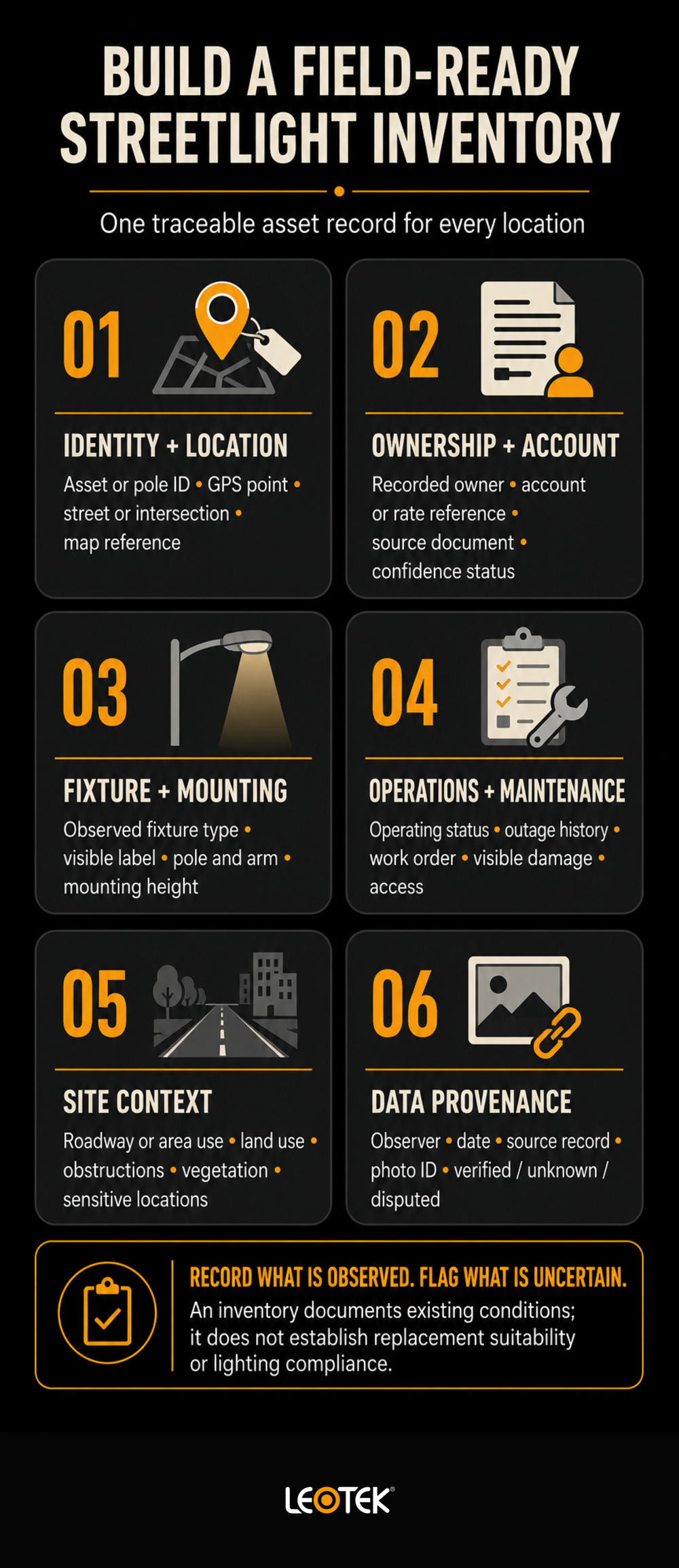
Build one asset record for every location in the audit boundary. Give it a stable identifier, even if the identifier is provisional until records are reconciled. A simple spreadsheet may be sufficient for a small pilot; a geographic information system (GIS)-compatible dataset is often more useful when the network is large or multiple teams will use the results.
The City of Ellsworth, Maine’s 2025 streetlight acquisition, inventory-mapping, and LED-conversion RFP illustrates the types of field data a municipality may request: pole ID, GPS location, fixture type, wattage, arm length, mounting height, and GIS-compatible files. It is an example of one city’s requested scope, not a national checklist or a completed-project result. Read the Ellsworth RFP.
Use a consistent asset schema
The following fields are practical audit recommendations. A municipality should adapt them to its records, asset-management system, utility relationship, and project purpose.
| Field group | Useful fields to capture | Why it matters |
|---|---|---|
| Identity and location | Asset or pole ID, GPS point, street or intersection, side of road, and map reference | Makes field observations traceable and helps expose duplicate or missing records. |
| Ownership and account | Recorded owner, account or rate reference, source document, and confidence status | Supports later reconciliation of responsibility and billing information. |
| Fixture and mounting | Observed fixture type, visible label information, pole type, arm type, mounting height, and arm length | Gives later reviewers a documented existing condition without assuming replacement compatibility. |
| Operations and maintenance | Operating status, reported outage history, work-order reference, visible damage, and access constraints | Helps distinguish a one-time observation from a recurring maintenance issue. |
| Site context | Roadway or area use, adjacent land use, obstructions, vegetation, nearby sensitive locations, and photographs | Provides context for later design, access, and stakeholder review. |
| Data provenance | Field observer, date, source record, photo ID, and verified/unknown/disputed status | Keeps the inventory auditable when records conflict. |
Illustrative municipal streetlight audit inventory fields. Treat this table as a streetlight inventory checklist to adapt, not a universal technical specification.
Do not turn the table into an engineering specification. For example, record observed wattage or label information, but do not infer illuminance, distribution, or suitability from that field alone. Readers who need a basic explanation of how watts, lumens, and lux differ can consult this lighting-performance guide; project-specific photometric analysis still depends on geometry and distribution.
Make photos and notes usable later
Photographs are most valuable when they can be matched to an asset record. Adopt a naming convention, capture the direction of view where practical, and note whether the image shows a fixture, pole, arm, access condition, obstruction, or label. Avoid using a photo as evidence for a detail that is not visible.
Use a small, standardized set of observation statuses, such as verified, needs record check, inaccessible, disputed, or referred for review. This makes a gap visible to the project team. It is more useful than filling every field with an assumption simply to complete a table. In the final dataset, retain whether a value is field-observed, record-derived, disputed, inaccessible, or referred for qualified review so a later user can judge its basis.
Verify assets in the field and reconcile the records
A municipal streetlight audit should compare independent sources rather than treating any single list as complete. Begin with the records available to the city or agency: GIS layers, utility asset lists, invoices, maintenance systems, prior surveys, capital plans, and known outage reports. Then use field observations to confirm or challenge the record.
Plan repeatable field collection
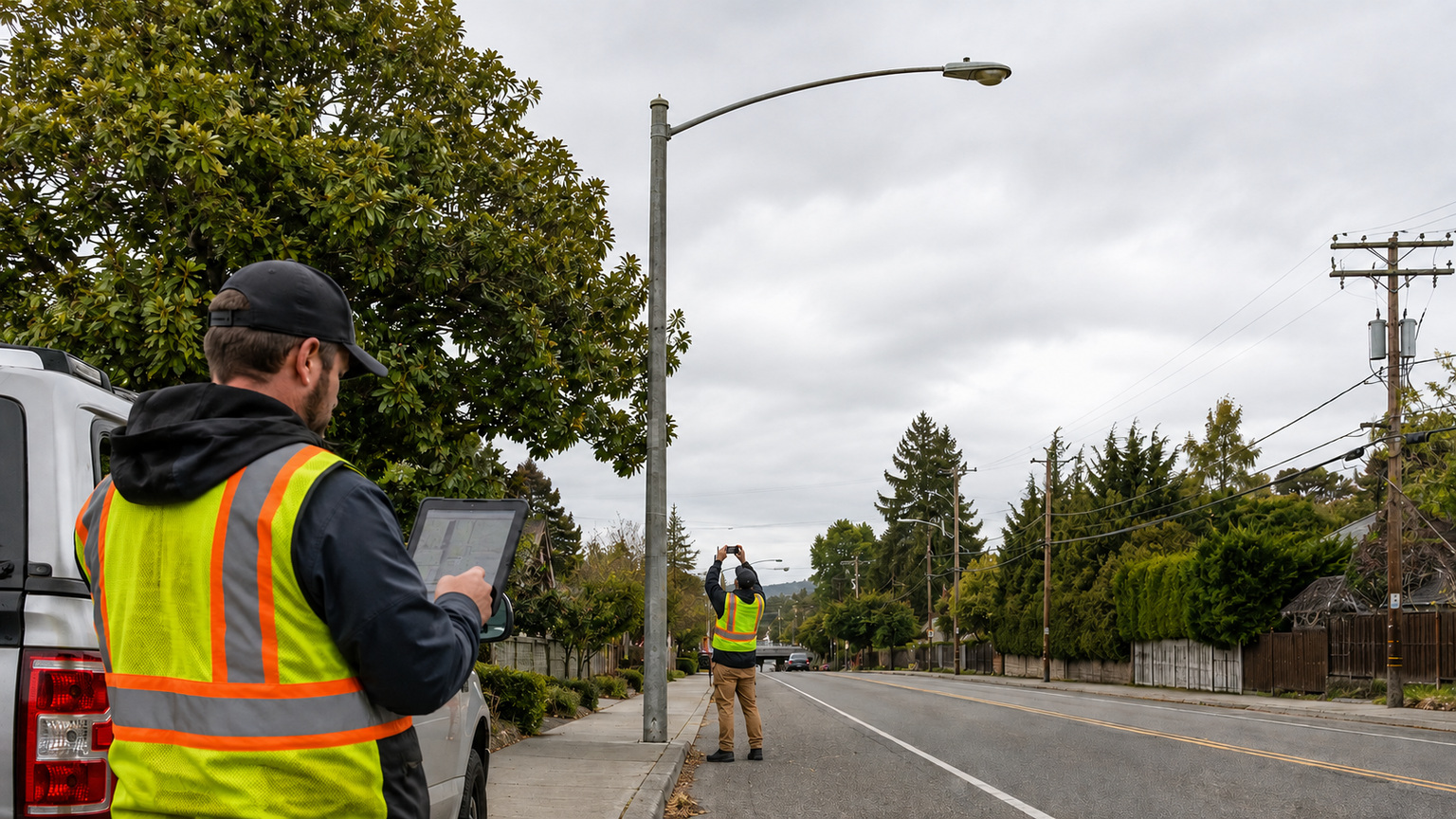
Use a consistent form and a short field protocol so that multiple observers capture comparable information. Confirm how assets will be identified, how GPS accuracy will be recorded, how inaccessible locations will be marked, and where photos will be stored. Field teams should follow their organization’s safety procedures and should not perform electrical, climbing, or structural work outside their training and authorization.
Repeatability matters because the audit may be used months later by design, procurement, installation, finance, and operations teams. A record that says only “bad pole” or “light out” gives little context. A record that identifies the asset, observation date, image, visible condition, and escalation status can be checked by the right reviewer.
Reconcile the records instead of overwriting them
Create a discrepancy log when field and office records disagree. Common discrepancies include:
- an asset present in the field but missing from GIS or billing records;
- a location or pole ID that does not match the listed record;
- conflicting owner, account, tariff, fixture-type, or wattage information;
- a duplicate record for one physical asset;
- an asset marked active in one system but observed as removed, inaccessible, or non-operational; and
- a work-order history that cannot be linked to a stable asset identifier.
For every discrepancy, preserve the source information and assign a next step. The next step might be a utility-account review, a records correction, a return field visit, or escalation to an engineer. Do not delete the original value simply because another source seems more recent. Maintaining provenance makes it possible to explain why the final baseline changed.
Billing and tariff records deserve the same discipline. A rate label on an invoice is not proof that it maps cleanly to one physical fixture, and a field observation does not resolve a billing question by itself. Reconcile accounts, rate references, ownership status, and asset identifiers with the entity responsible for the relevant records before using them in a financial analysis.
Assess conditions that can change conversion scope
The audit should surface conditions that could alter the project boundary, field access, installation sequence, or level of professional review. It should not attempt to resolve every technical question on the spot.
Fixtures, poles, arms, and access
Document the existing arrangement: fixture and mounting type, pole and arm configuration, visible corrosion or damage, clearance constraints, vegetation, and access conditions. Note whether the observation is visual only. A visual observation can flag an issue, but it cannot establish pole capacity, wind loading, electrical compatibility, or a remedy.
A worker accesses a double-arm streetlight pole from an elevated bucket; field teams should record observable pole, arm, luminaire, and access conditions for each asset.
Effective projected area is one example of a topic that belongs in later engineering evaluation, not in a field team’s final determination. This overview of effective projected area can provide orientation, but fixture and pole suitability require project-specific review.
Circuits, controls, tariffs, and failure history
Where records permit, associate assets with circuits, control groups, accounts, tariff references, and work orders. These associations help a project team understand how the system is organized and where data is incomplete. Do not assume that adjacent lights share a circuit or that a historic outage record identifies a particular fixture without a verified reference.
Failure history can be useful when it is tied to a date, asset ID, and work order. It may reveal recurring locations, access challenges, or gaps in asset records. It does not prove a root cause or predict future performance. Keep the audit factual: report the record, the source, and the unresolved question.
Lighting, community, and site context
Record conditions that a later design and stakeholder process may need to consider: roadway geometry, intersections, pedestrian areas, adjacent residences, vegetation, obstructions, nearby water or habitat-sensitive areas, and access limitations. These notes are inputs, not conclusions about glare, safety, ecological effect, or compliance.
If the project will later evaluate distribution, color temperature, shielding, controls, or dimming, preserve the site context and refer those choices to the applicable design, utility, and jurisdictional process. An audit becomes more valuable when it captures why a location may need additional review without claiming what the final solution must be.
Deliver a conversion-ready baseline
The final audit package should allow another team to understand the network without repeating the entire survey. At minimum, organize the material so every asset record can be traced to a source and a field observation.
A useful handoff package can include:
- A validated inventory with identifiers, locations, observed conditions, and source status.
- A GIS-compatible map or location file with documented coordinate practices.
- Linked photographs and field notes with dates and asset references.
- An ownership, account, tariff, and billing crosswalk that identifies unresolved items.
- A discrepancy and exception register with owner, next action, and review status.
- A list of inputs for photometric, electrical, structural, utility, procurement, and installation planning.
- A record of assumptions, exclusions, inaccessible locations, and data-quality limits.
The same baseline can support closeout later. Ellsworth’s RFP, for example, requested as-built documentation, GIS data, fixture warranty details, maintenance guides, and utility-account updates after installation. Those details illustrate how a pre-conversion inventory can maintain continuity through a project; they are not requirements for every municipality.
For readers moving into technical evaluation, LEOTEK technical documents provide a starting point for current product specifications and related resources. Verify the document date, model, revision, and applicability before relying on any document for procurement or design.
Avoid audit mistakes that distort the plan
Several shortcuts can undermine an otherwise careful LED conversion assessment.
Relying only on a billing list. Billing records may be necessary, but they may not contain location, field condition, ownership clarity, or a stable match to every physical asset.
Counting fixtures without mapping them. A count cannot reveal duplicate records, unserved locations, access constraints, or the relationship between an asset and its surrounding context.
Treating observed wattage as a replacement input. An observed label helps describe existing conditions. It does not determine lighting performance, a replacement configuration, or operating cost.
Assuming ownership from location. A light on a municipal street may still have an ownership or agreement status that requires confirmation.
Losing the connection between a finding and its evidence. A photo, invoice reference, GPS point, work order, and field note are much more useful when they share an asset ID.
Hiding uncertainty. Unknowns and discrepancies are legitimate audit results. Flagging them early helps the project team assign the correct reviewer before the uncertainty turns into a change order or a contested assumption.
Frequently asked questions
What is included in a municipal streetlight audit?
It typically includes a location-based inventory, ownership and account references, observed fixture and mounting information, field condition notes, photographs, maintenance history where available, and a log of mismatches between records. The exact scope should match the project’s decision needs and jurisdiction.
How is a streetlight inventory different from a photometric design?
An inventory records what exists. A photometric design evaluates how a proposed lighting arrangement performs for a defined site and objective. The inventory supplies inputs to that later work but does not replace qualified design review.
Why verify ownership and tariffs before an LED conversion?
Ownership, accounts, rates, and utility arrangements can affect who controls the asset and which records are relevant to a feasibility or cost analysis. They should be confirmed with the responsible parties rather than inferred from a location or a single invoice.
What should be verified in the field?
Verify what can be observed safely and consistently: asset location, identifiers, fixture and mounting characteristics, visible condition, access constraints, photographs, and any differences from available records. Escalate electrical, structural, design, and regulatory questions to qualified reviewers.
Who should review structural, electrical, and lighting-design questions?
The appropriate qualified professionals, utility representatives, and authority having jurisdiction (AHJ) personnel depend on the project and location. The audit should identify the issue and preserve the relevant evidence so those reviewers can assess it.
Start with a baseline that can be checked.
A municipal streetlight audit gives an LED conversion a traceable starting point: each asset has a location, a record source, a field observation, and a clear status. That discipline prevents a fixture count from becoming an unsupported scope, cost, or design assumption.
When the baseline is complete and a project team has defined its technical questions, readers can discuss a roadway infrastructure project with LEOTEK. The appropriate next step remains project-specific: confirm current documentation, ownership and utility records, and the reviews needed for the jurisdiction before making conversion decisions.
References
- City of Ellsworth, Maine, “RFP: Streetlight Acquisition, Inventory Mapping, and LED Conversion Services”, 2025 municipal RFP used as an illustrative scope example; accessed July 26, 2026.
- LEOTEK, “Outdoor Lighting”; accessed July 26, 2026.
- LEOTEK, “Watts to Lumens, Lumens to Lux: The Ultimate Guide to Understanding Lighting Performance”; accessed July 26, 2026.
- LEOTEK, “Calculating EPA: Mastering the Effective Projected Area for Optimized Fixture Placement on Light Poles, Luminaires, and Flood Lights”; accessed July 26, 2026.
- LEOTEK, “Resources & Documents”; accessed July 26, 2026.