
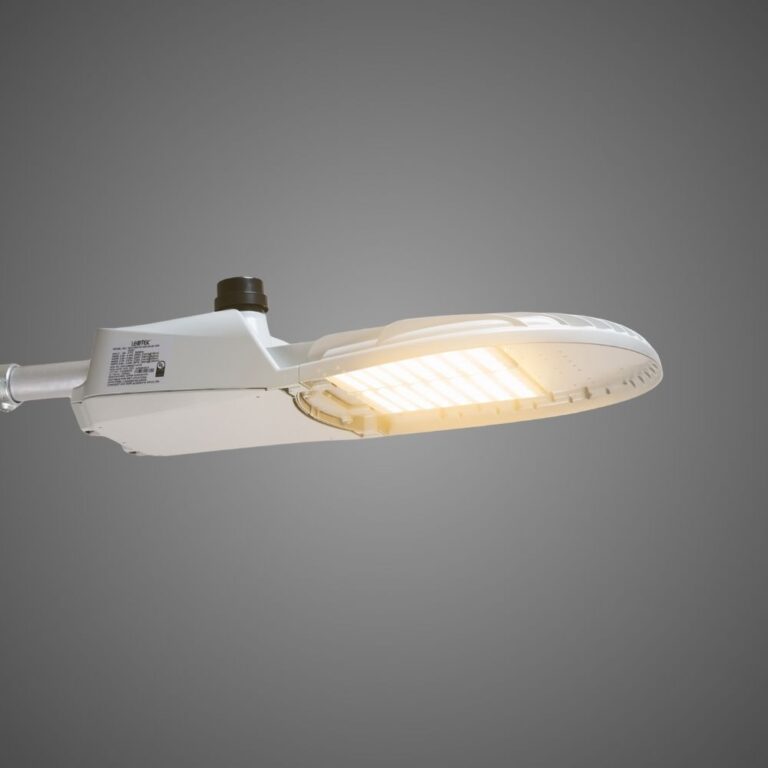
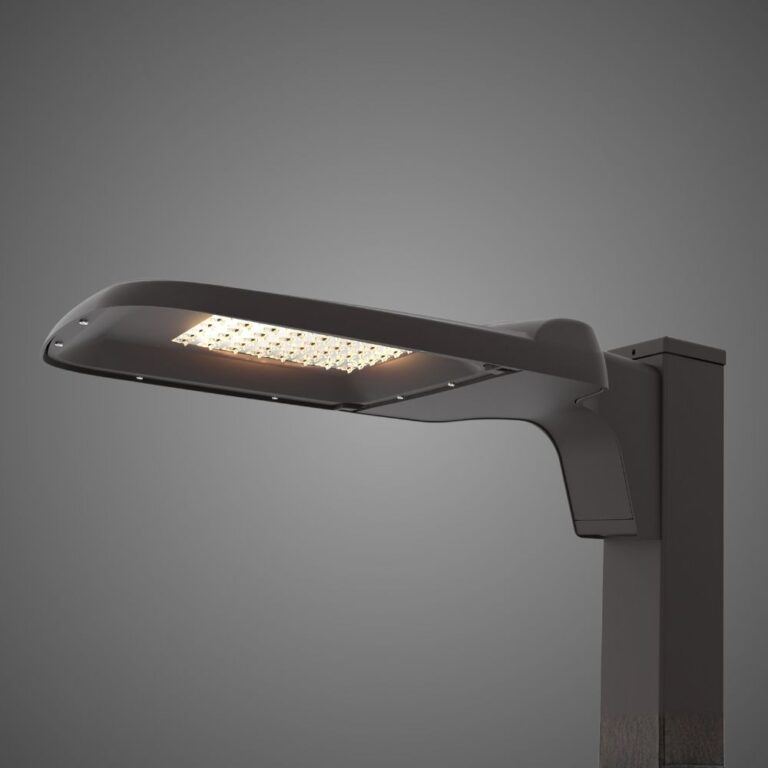
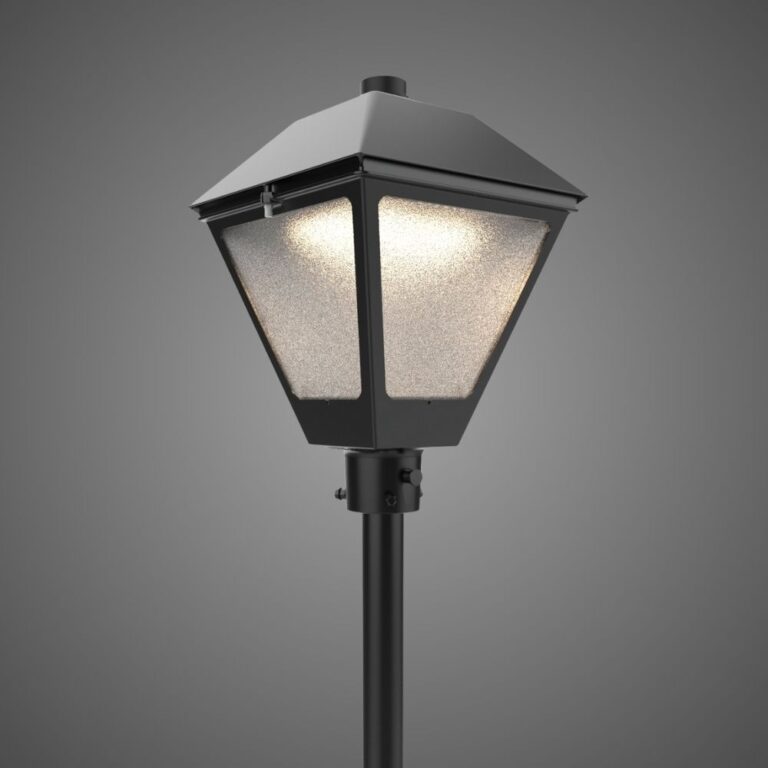

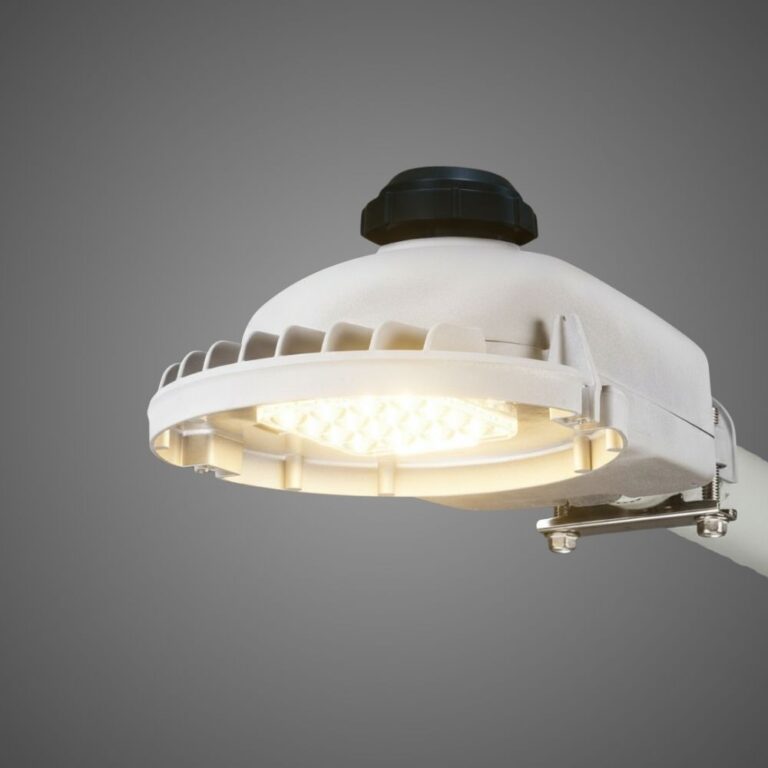
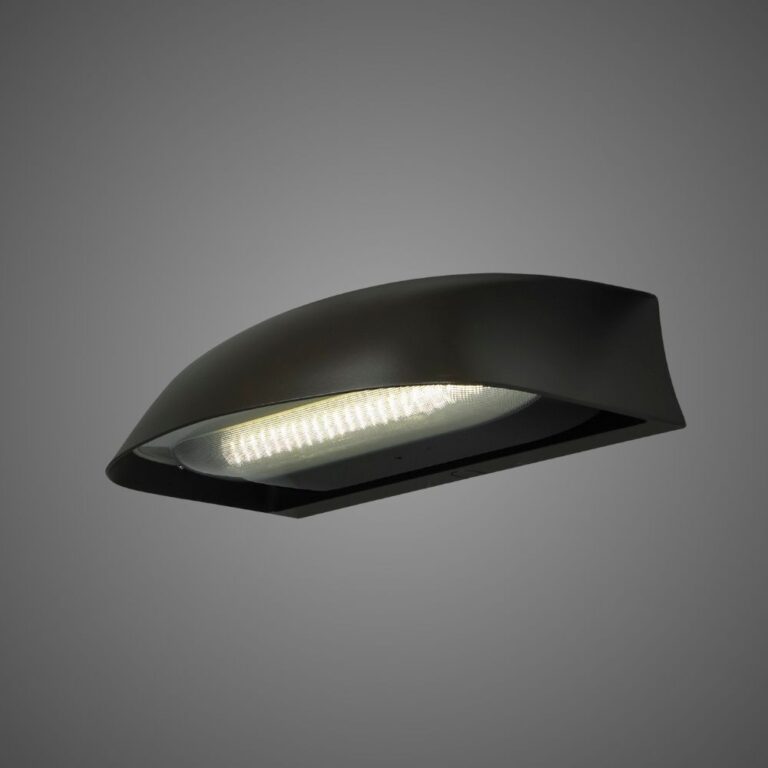
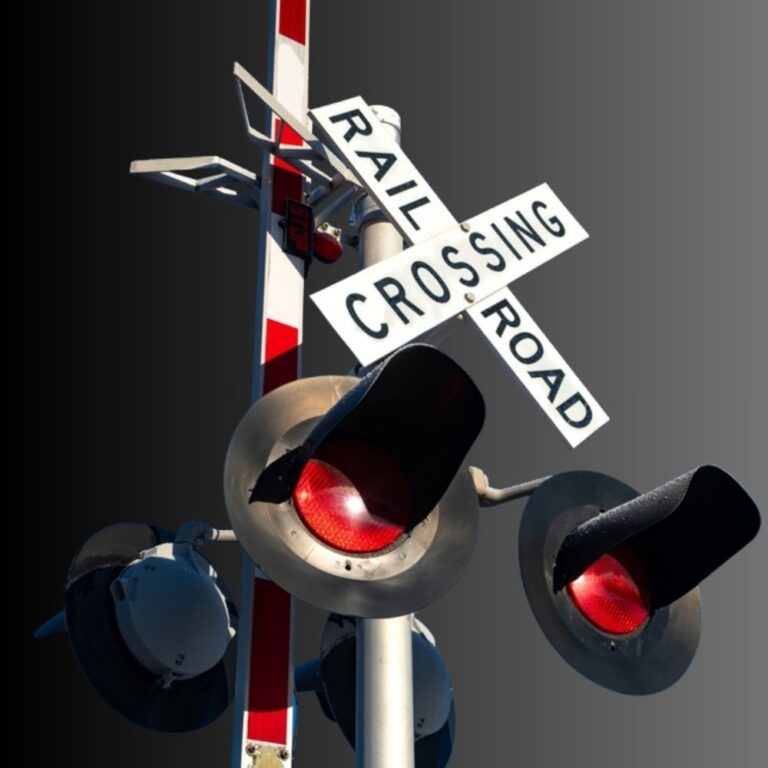
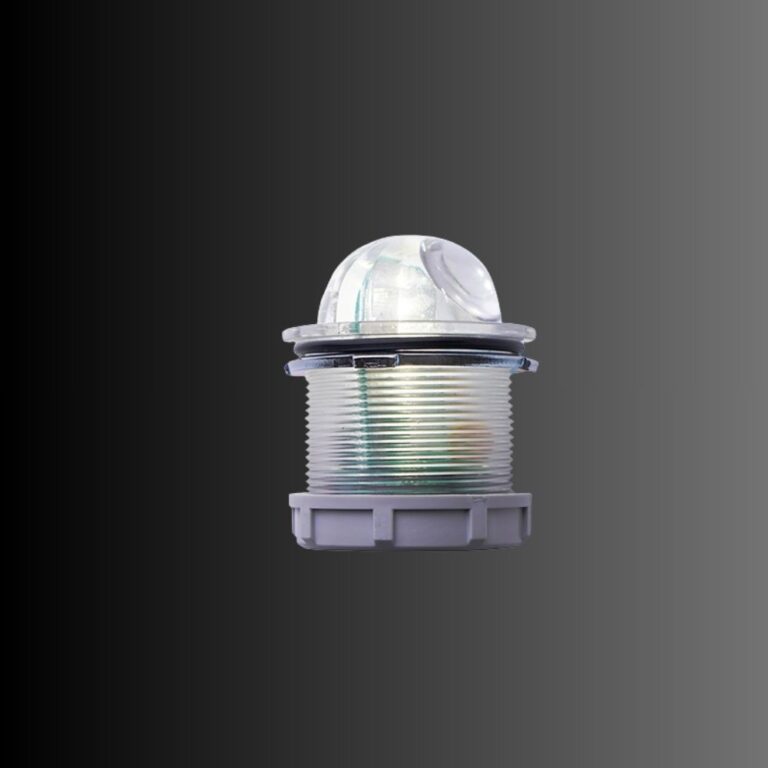
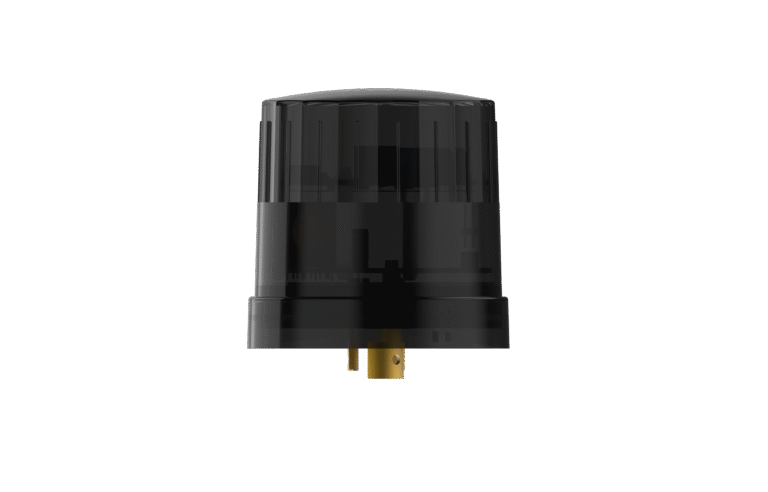
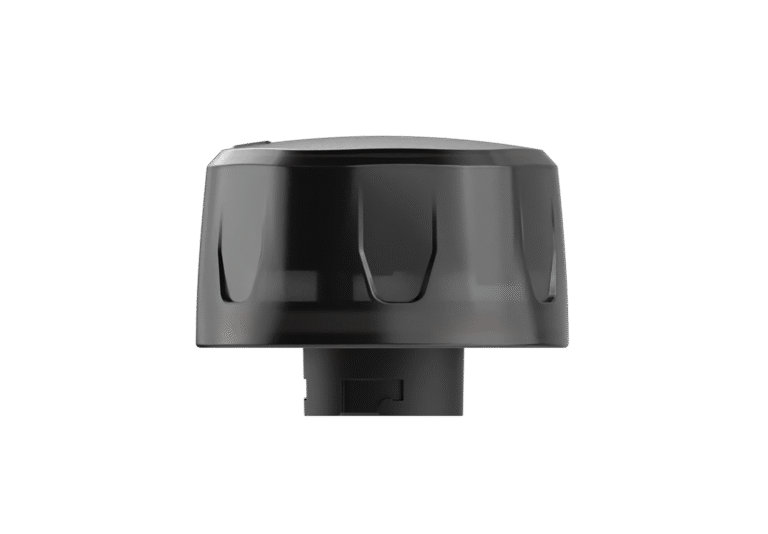


Ambient temperature affects an LED streetlight by changing how readily the luminaire can release internally generated heat. Hot conditions can raise LED and driver operating temperatures, accelerating lumen depreciation and stressing components, while cold conditions generally favor LED thermal performance but still require verified low-temperature and cold-start ratings.
For cities and transportation agencies, the practical question is not simply whether LEDs work in heat or cold. It is whether the exact luminaire, driver, controls, and configuration are documented for the temperature conditions at the project site.
Key takeaways
- A streetlight’s ambient air temperature is not the same as its internal LED or driver temperature.
- Higher LED operating temperatures can accelerate light-output degradation and shorten useful life.
- LEDs generally perform well in cold conditions, but the exact luminaire, driver, and controls must be verified for minimum operating and cold-start conditions.
- LED package data such as LM-80 and TM-21 results do not, by themselves, establish the service life of an entire streetlight.
Why ambient temperature matters to an LED streetlight
An LED streetlight converts electrical energy into light, but it also produces heat. That heat must travel away from the light-emitting junction, through the package and circuit board, across thermal interfaces, and into the luminaire housing or heat sink. From there, it must dissipate into the surrounding environment.
According to ENERGY STAR’s explanation of LEDs and heat (accessed July 26, 2026), heat sinks absorb heat from LEDs and release it into the surrounding environment. ENERGY STAR also identifies thermal management as a central factor in maintaining performance over an LED product’s useful life.
Ambient temperature affects the last part of that path. When the surrounding air is hotter, the luminaire has less thermal headroom for rejecting its internally generated heat. When the air is colder, the temperature difference can make heat rejection easier. The exact result, however, depends on the complete luminaire design and operating condition.
Ambient, case, and junction temperatures are different
Three temperature terms commonly appear in LED documentation:
- Ambient temperature is the temperature of the air around the luminaire at a defined location and under defined conditions.
- Case temperature is measured at a designated point on a component, such as a driver or LED module, and may be used to evaluate whether that component is operating within its limits.
- Junction temperature is the temperature at the semiconductor junction where the LED produces light.
These values are related, but they are not interchangeable. A weather station reading does not reveal the LED junction temperature or driver case temperature. Luminaire construction, electrical power, drive current, mounting, thermal interfaces, airflow, and exposure can all affect internal conditions.
This distinction also prevents another common mix-up: ambient temperature is not correlated color temperature. Ambient temperature describes the luminaire’s environment, while correlated color temperature describes the apparent color of the light and is expressed in kelvins.
Output, illuminance, and service life are separate measures
Temperature questions often combine several different performance measures. Light output is expressed in lumens, while illuminance on a roadway is commonly expressed in lux or foot-candles and also depends on optics, mounting geometry, spacing, and the illuminated surface. The guide to watts, lumens, and lux provides more background on those distinctions.
Service life is a different question again. A luminaire may continue operating while its output slowly declines, or another component may fail before LED lumen depreciation reaches a specified threshold. An agency should therefore evaluate immediate output behavior, maintained output, and complete-luminaire reliability as related but distinct issues.
What high temperatures can do to output and service life
High ambient temperature does not automatically cause an LED streetlight to fail. It does make thermal management more demanding, and the consequences depend on the design, load, controls, and exposure of the exact configuration.
ENERGY STAR states that the higher the temperature at which LEDs operate, the more quickly their light degrades and the shorter their useful life becomes. This supports a clear general conclusion: sustained higher LED operating temperature can accelerate lumen depreciation.
It does not support a universal numerical rule. Claims such as a fixed lumen loss per degree or a fixed lifetime reduction for every temperature increase require product-specific data. Agencies should be cautious when a proposal applies a simple temperature multiplier without identifying the tested LED package, drive current, component temperatures, test duration, and calculation method.
Immediate output and protective behavior are model-specific
Temperature may affect immediate output, input power, or control behavior, but there is no single response shared by every high-temperature luminaire. A design may operate normally across its rated range. Another may reduce drive current or output near a thermal limit. The applicable behavior should be documented in current performance curves, control descriptions, or thermal test data for the submitted configuration.
This is important during photometric review. A nominal lumen value does not show whether the luminaire changes output near a temperature limit. If temperature-dependent output matters to the design, the agency should request the relevant curve or test condition rather than estimate the effect from a general LED article.
Heat can affect more than the LED packages
The LED driver converts incoming power into the electrical conditions needed by the LED array. Drivers contain their own temperature-sensitive parts and have specified operating or case-temperature limits. Controls, surge-protection devices, connectors, seals, and optical materials also contribute to complete-luminaire reliability.
There is no defensible universal driver-life multiplier for all streetlights. Instead, reviewers should request the driver’s temperature limits, the basis of any lifetime claim, and evidence that the driver was evaluated in the installed luminaire configuration. A component rating in isolation may not describe the temperature that the component reaches inside a closed housing.
Site conditions can differ from a climate average
An annual average temperature is rarely the only value that matters. Agencies should consider credible site extremes and the conditions under which the luminaire will operate. Direct solar exposure, mounting orientation, restricted heat transfer, accumulated debris, and operating schedule may warrant review because they can affect the thermal environment.
These factors do not justify an invented correction factor. They identify questions for project-specific evaluation. The appropriate response is to compare site conditions with current luminaire documentation and, where necessary, obtain engineering confirmation from the manufacturer or responsible design professional.
| Condition | General effect | What agencies should verify |
|---|---|---|
| High ambient temperature | Reduces thermal headroom and can accelerate lumen depreciation. | Maximum ambient rating, component temperatures, output or power derating, and complete-luminaire reliability evidence. |
| Cold ambient temperature | Generally helps the LED thermal path reject heat. | Minimum operating rating, cold-start conditions, driver and control limits, and complete-luminaire documentation. |
How LED streetlights behave in cold weather
Cold weather is generally favorable to the LED light source because lower ambient temperature can help the luminaire move heat away from the LEDs. The U.S. Department of Energy’s LED Basics page (accessed July 26, 2026) lists good performance in cold temperatures and instant-on operation among the beneficial characteristics of LED technology.
That general advantage should not be translated into a claim that every streetlight used in cold weather will operate at any temperature. A complete streetlight includes a driver, controls, wiring, seals, optical materials, and mechanical interfaces. Each relevant part must be suitable for the specified operating range.
Cold performance does not remove the need for ratings
The minimum ambient operating temperature should apply to the exact luminaire configuration, not merely to the LED package. Reviewers should also confirm whether the published minimum covers normal operation, cold starting, dimming, communication functions, and any attached control equipment.
Cold-start capability deserves separate attention. Confirm whether the low-temperature documentation covers both continued operation and initial energization. Do not assume that one published rating establishes both conditions.
More light is not automatically more useful light
It is sometimes said that LEDs become brighter in cold weather. Even if an LED source exhibits a temperature-dependent change, a city should not assume that a cold condition will create a predictable roadway-lighting improvement. The magnitude and control response are model-specific, and roadway illuminance still depends on distribution, geometry, and other design factors.
The better procurement question is whether the manufacturer documents output across the required ambient range. That keeps the evaluation tied to maintained roadway performance instead of an unsupported generalization about cold LEDs.
Cold weather does not eliminate maintenance risk
Lower temperatures do not make a complete luminaire failure-proof. Electronics, seals, wiring, controls, optics, and mechanical parts can determine when service is required. Moisture, icing, and repeated temperature changes may also be relevant project conditions, but their effects should be assessed from applicable product and environmental test evidence rather than assumed.
For maintenance planning, agencies should avoid treating a broad claim about LED cold performance as a substitute for complete-luminaire documentation, warranty review, and field inspection procedures.
How to read temperature and lifetime documentation
LED streetlight lifetime language can appear precise while describing only one part of the product. Understanding the scope of each test or projection helps reviewers compare submittals more accurately.
What L70 means
L70 describes the point at which light output is projected or measured to remain at 70% of its initial value under the stated conditions. DOE explains that LED useful life is commonly described by the operating time until output reaches 70% of initial output.
L70 is not necessarily the date when a streetlight stops working. It is also not automatically the correct end-of-life criterion for every roadway application. An agency’s maintained-lighting requirements may call for action before that point, while another component can fail earlier.
Likewise, an L70 value is not a warranty term. Warranty coverage, conditions, exclusions, and remedies come from the current contractual warranty for the exact product.
What LM-80 and TM-21 cover
Illuminating Engineering Society (IES) LM-80 is used to measure luminous flux and color maintenance for LED packages, arrays, or modules under specified conditions. IES TM-21 provides a method for projecting long-term lumen maintenance from LM-80 data.
The IES position on LED product lifetime prediction (accessed July 26, 2026) emphasizes two limits. First, these methods apply to LED components, not every part of a complete luminaire. Second, projections must remain within the method’s allowed extrapolation bounds. Use the applicable current editions required by the project because edition-specific procedures and limits may differ.
An LM-80 report and TM-21 projection can therefore support an LED-component lumen-maintenance claim. They cannot, by themselves, prove how long the driver, optics, housing, seals, controls, or assembled streetlight will remain acceptable in service.
Complete-luminaire reliability needs broader evidence
IES notes that complete luminaires combine LED components with housing, optics, and drive circuitry, creating failure mechanisms beyond the LED component level. DOE likewise cautions that electronics can fail before the LEDs and that color shift may become unacceptable before a luminaire ceases to emit light.
DOE’s technical reports and briefs on solid-state lighting (accessed July 26, 2026) illustrate the broader reliability landscape, with research areas including LED maintenance, aging, drivers, optical performance, and luminaire stress testing. Those reports are a research gateway, not proof for a specific streetlight. Any quantitative finding must be checked for product type, test method, date, and applicability.
For an agency evaluation, the evidence package should connect the LED-component data to the actual thermal conditions in the proposed luminaire. It should then address other components and complete-product failure modes separately.
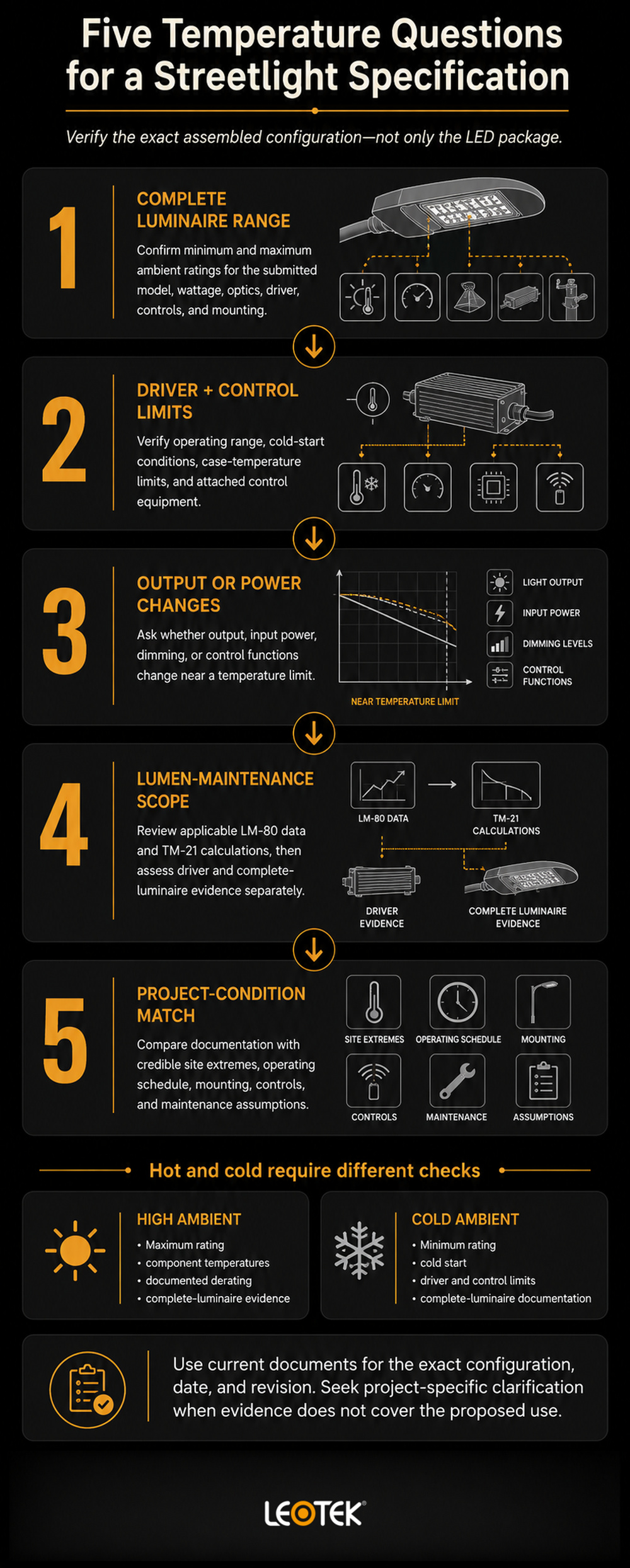
Five temperature questions for a streetlight specification
The following questions are an evaluation framework, not universal specification language. Agencies should adapt them to their design criteria, procurement rules, climate, and engineering review process.
1. What is the complete luminaire’s ambient operating range?
Ask for the minimum and maximum ambient temperatures for the exact submitted model, wattage, optical configuration, driver, controls, and mounting arrangement. Confirm that the range applies to the complete luminaire rather than only one component.
2. What limits apply to the driver and controls?
Request the driver operating range, cold-start condition, designated case-temperature limit, and basis for any driver lifetime statement. Include control nodes, sensors, or communication devices when they are part of the project configuration.
3. Does the luminaire change output near a temperature limit?
Determine whether output, input power, dimming, or control functions are derated or otherwise changed within the required range. If so, request the applicable curves and test conditions, and account for the documented behavior in the lighting design.
4. What does the lumen-maintenance claim actually cover?
Request the applicable LM-80 data and TM-21 calculation for the LED components, including the tested temperatures, drive conditions, duration, and projection basis. Then ask for separate evidence addressing the driver and complete luminaire. Do not accept a package-level projection as the sole proof of streetlight service life.
5. Do the test conditions match the project?
Compare the documentation and applicable warranty terms with credible site extremes, operating schedule, controls, mounting, and maintenance assumptions. Verify document dates and revisions. If the evidence does not cover the proposed use, seek project-specific clarification rather than assuming equivalence.
These questions fit naturally within a broader review of municipal outdoor lighting applications, but application pages are not substitutes for exact model documentation.
Plan for climate-appropriate output and maintenance
An assessment of how ambient temperature affects an LED streetlight should begin with the site’s expected operating conditions and end with evidence for the exact assembled product. Climate averages can provide context, but credible extremes and configuration-specific limits determine whether the submittal covers the application.
The strongest review separates four questions: How does the luminaire manage heat? Does output change within the required range? What supports the LED-component lumen-maintenance projection? What supports the reliability of the driver and complete luminaire?
Before finalizing a roadway-lighting specification, compare those answers with current product specifications and technical documents. Check the model, configuration, date, and revision of each document, and rely on qualified project engineering review where the evidence or application requires it.
Frequently asked questions
Does cold weather make LED streetlights brighter?
LED technology generally performs well in cold temperatures, but a predictable brightness increase cannot be assumed for every streetlight. Output behavior depends on the LED package, drive current, luminaire design, and controls. Use the exact product’s documented output across its rated ambient range.
Can heat shorten the life of an LED streetlight?
Higher LED operating temperatures can accelerate lumen depreciation and shorten LED useful life. The effect on an entire streetlight also depends on the driver, optics, seals, controls, and other components, so a product-specific reliability review is necessary.
What is the difference between ambient and junction temperature?
Ambient temperature is the temperature of the air surrounding the luminaire. Junction temperature is the internal temperature at the LED’s light-producing semiconductor junction. They are related through the product’s thermal path but are not the same value.
Does L70 equal streetlight service life?
No. L70 is a lumen-maintenance point at which output reaches 70% of its initial value under stated conditions. A complete streetlight may require service earlier because of application requirements or failure of another component, and warranty coverage is a separate contractual matter.
Do LM-80 and TM-21 test an entire luminaire?
No. LM-80 addresses lumen and color maintenance for LED packages, arrays, or modules, and TM-21 projects lumen maintenance from that data. Complete-luminaire reliability also depends on the driver, housing, optics, seals, controls, and other components.
References
- U.S. Environmental Protection Agency / ENERGY STAR. “Learn About LED Lighting”. Accessed July 26, 2026.
- U.S. Department of Energy. “LED Basics”. Accessed July 26, 2026.
- Illuminating Engineering Society. “PS-10-18: IES Position on LED Product Lifetime Prediction”. Issued October 9, 2018; modified 2025. Accessed July 26, 2026.
- U.S. Department of Energy. “Technical Reports & Briefs”. Accessed July 26, 2026.
- LEOTEK. “Watts to Lumens, Lumens to Lux: The Ultimate Guide to Understanding Lighting Performance”. Accessed July 26, 2026.
- LEOTEK. “Outdoor Lighting”. Accessed July 26, 2026.
- LEOTEK. “Resources & Documents”. Accessed July 26, 2026.