
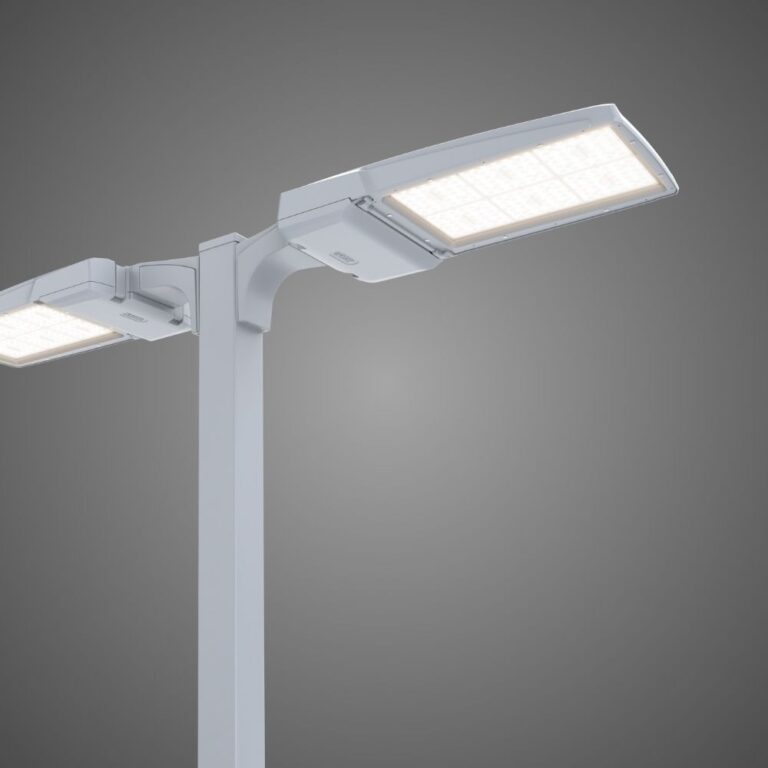
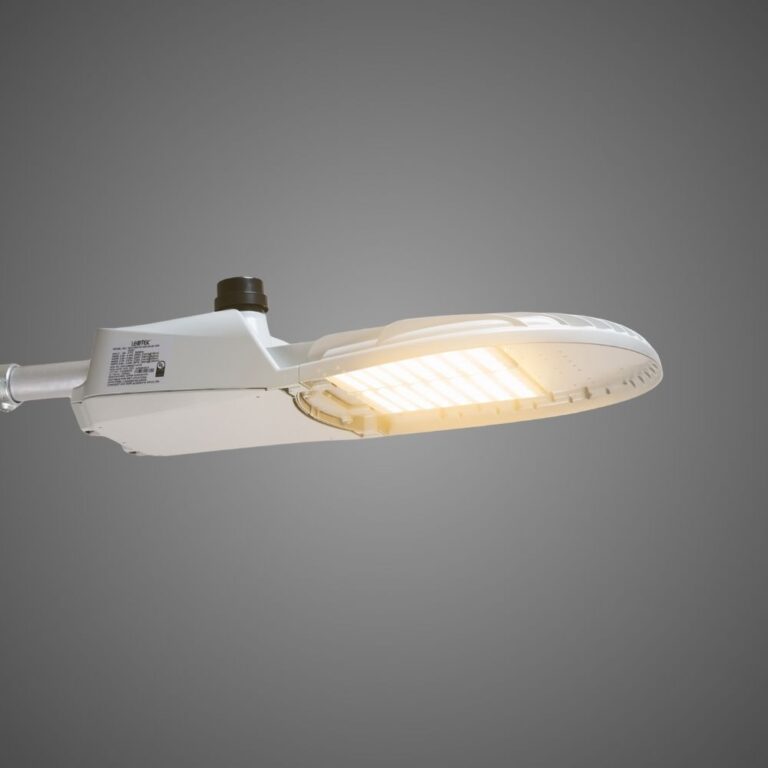
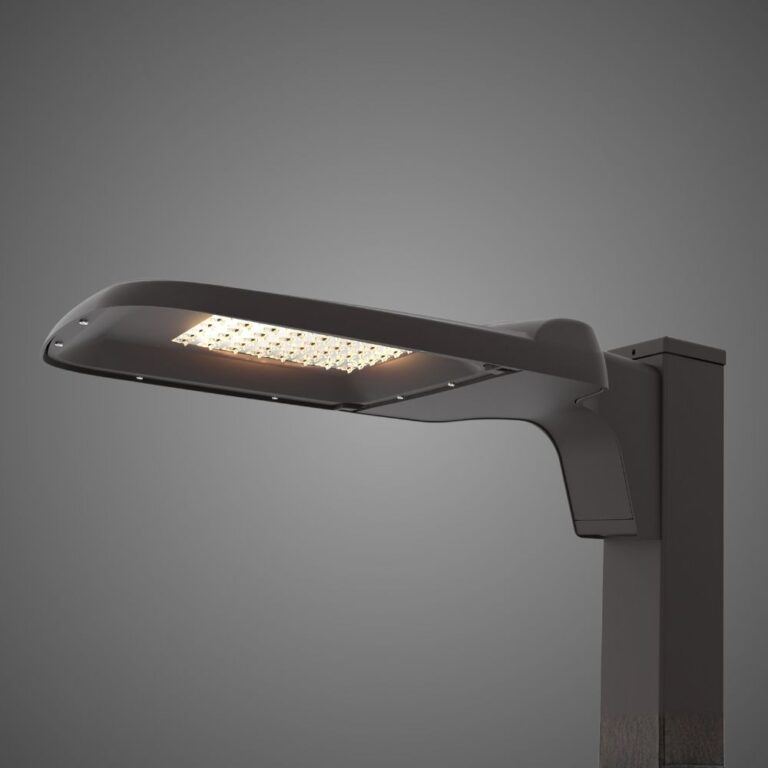
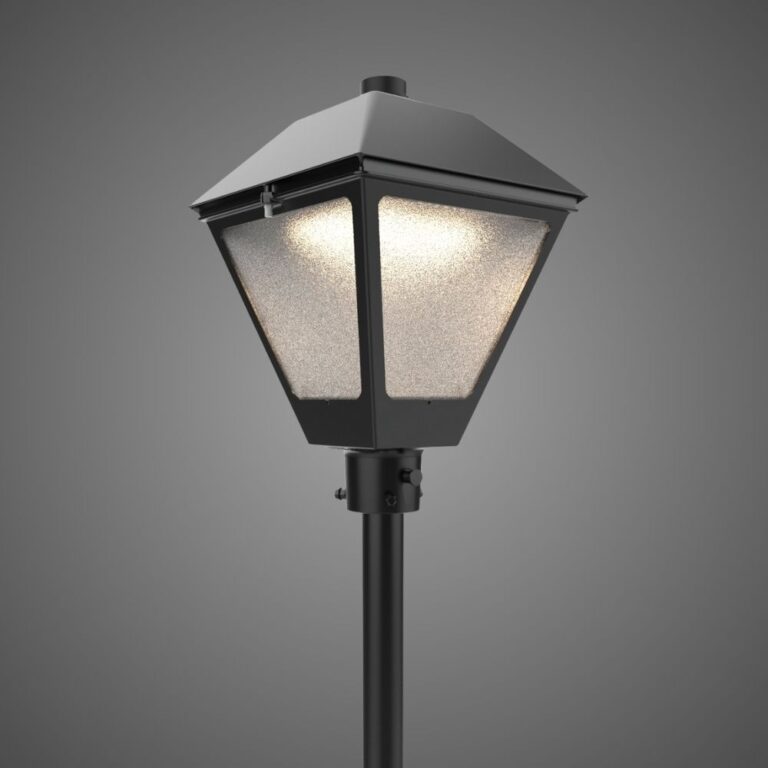

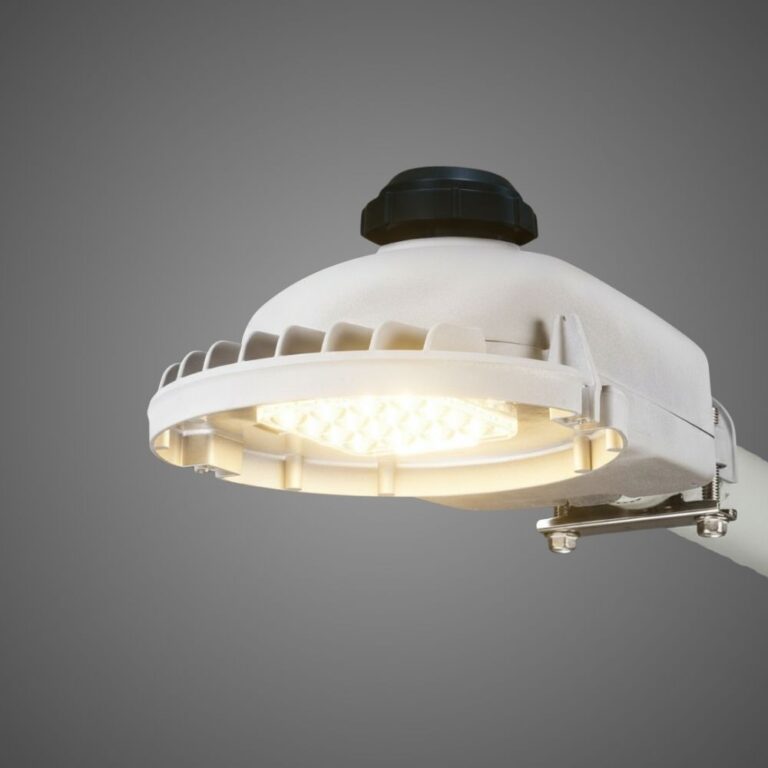
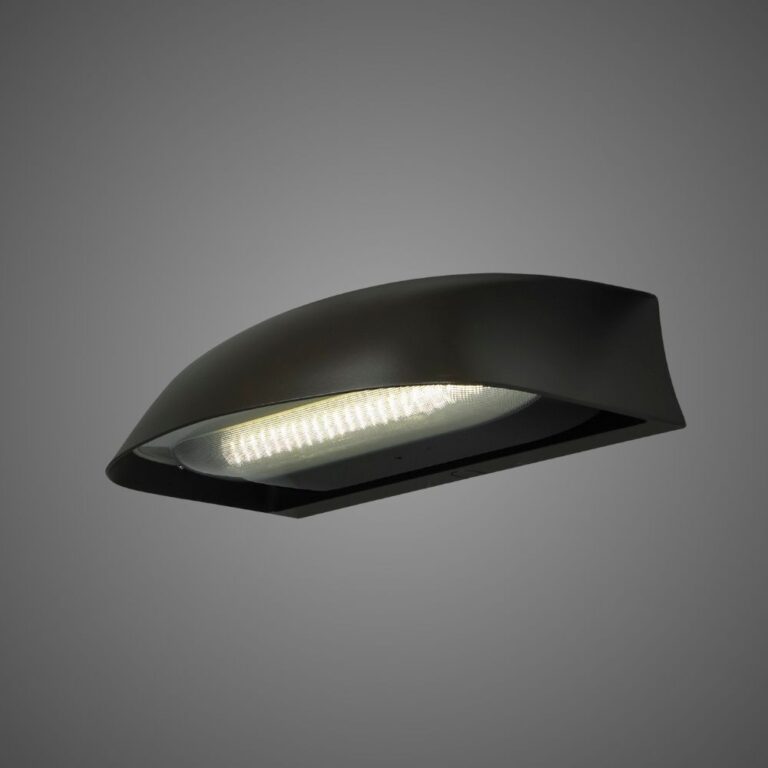


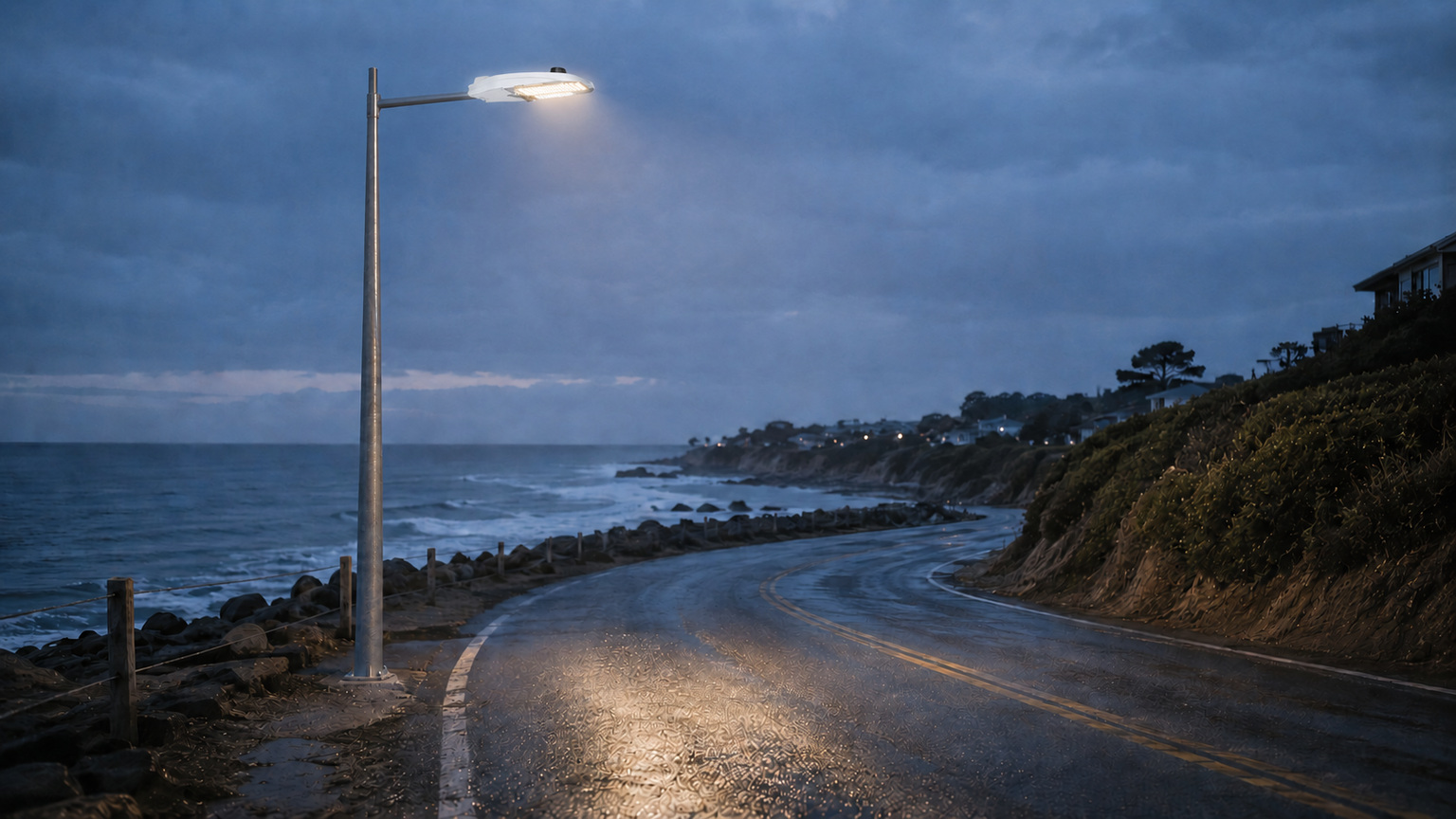
Coastal streetlight corrosion is best managed as an installed-assembly and maintenance decision, not as a single material label or salt-fog hour count. For a roadway luminaire near salt water, agencies should evaluate the local exposure, housing and finish, fasteners and interfaces, seals and drainage, documentation, and the plan for inspection and repair.
Salt-laden air, recurring wetness, wind-driven deposits, and sheltered joints can make outdoor-lighting durability a central lifecycle concern. The practical question is not whether a fixture is described as “marine grade.” It is whether the proposed configuration, evidence package, and maintenance approach fit the conditions at the actual site.
Key takeaways
- A coastal exposure brief should describe local salt, moisture, wind, geometry, and maintenance conditions before a luminaire is selected.
- Review the full assembly, including coating, cut edges, fasteners, hinges, seals, cable entries, and the pole interface.
- Salt-fog testing can provide comparative information under stated laboratory conditions, but it is not a standalone forecast of coastal service life.
- Ingress protection and corrosion resistance address different questions; one does not prove the other.
- Require configuration-specific documentation, then have the responsible engineer and procurement team determine project requirements.
Why coastal exposure changes streetlight durability
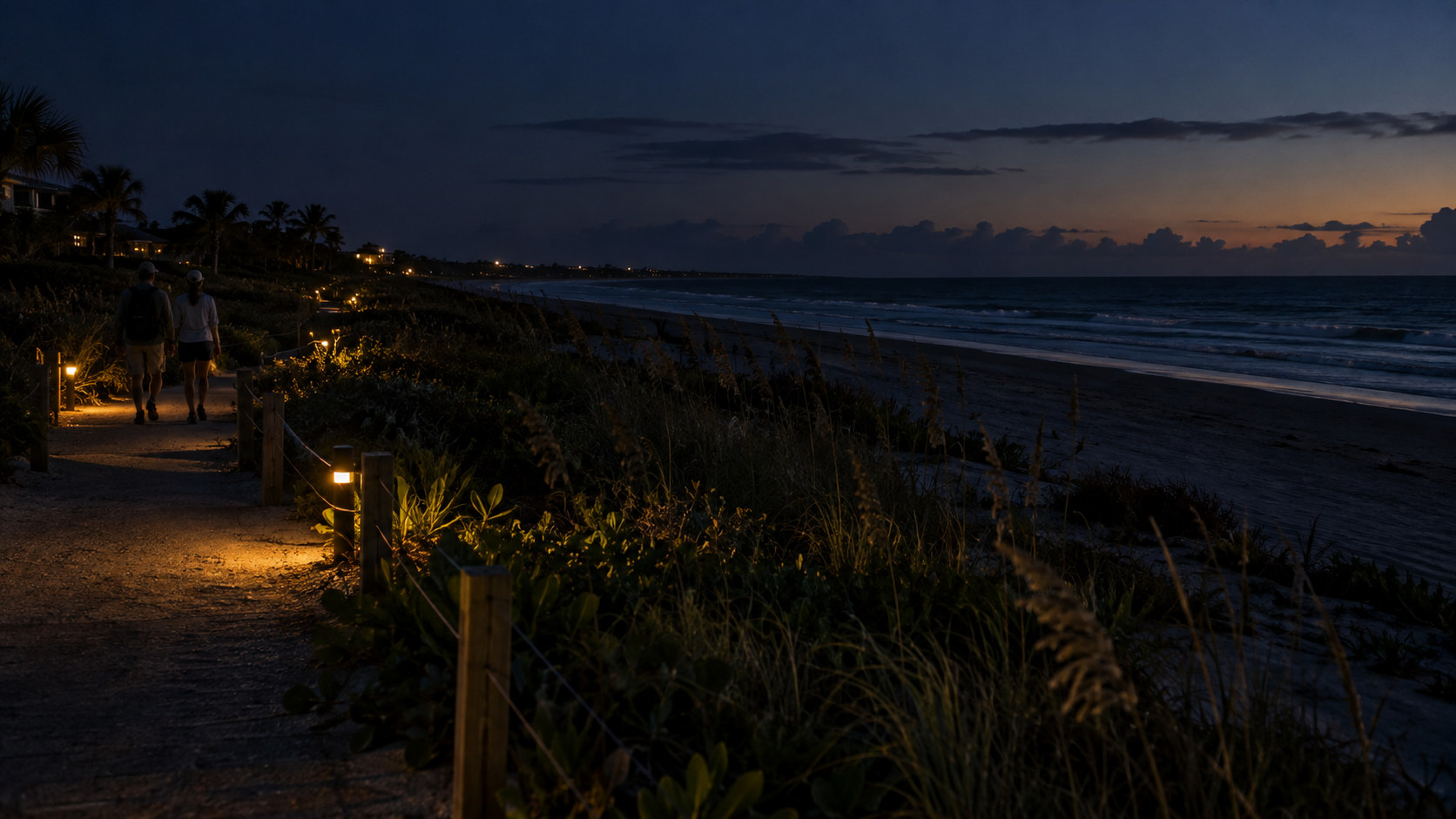
Roadway lighting in coastal settings may experience more than occasional rain. Airborne salt can settle on exposed surfaces and in sheltered areas. Moisture can keep those deposits active, while drying and re-wetting can repeat the exposure. Wind direction, mounting orientation, traffic spray, nearby structures, vegetation, and access for cleaning can all influence what reaches a luminaire and what remains on it.
That variation is why a generic distance-from-shore rule is a weak substitute for site assessment. Two installations at a similar distance from water can have different exposure if one faces prevailing wind, receives direct spray, or retains deposits at joints, while the other is sheltered and regularly rinsed. A project team should record the conditions it can observe rather than assume a universal coastal category.
The same principle applies to specification language. A broad requirement for a “corrosion-resistant” streetlight does not say which parts must resist which exposure, how performance will be assessed, or what evidence is acceptable. A more useful requirement identifies the installed configuration, its materials and interfaces, and the documentation that supports the selection.
Evaluate the installed assembly, not only the housing
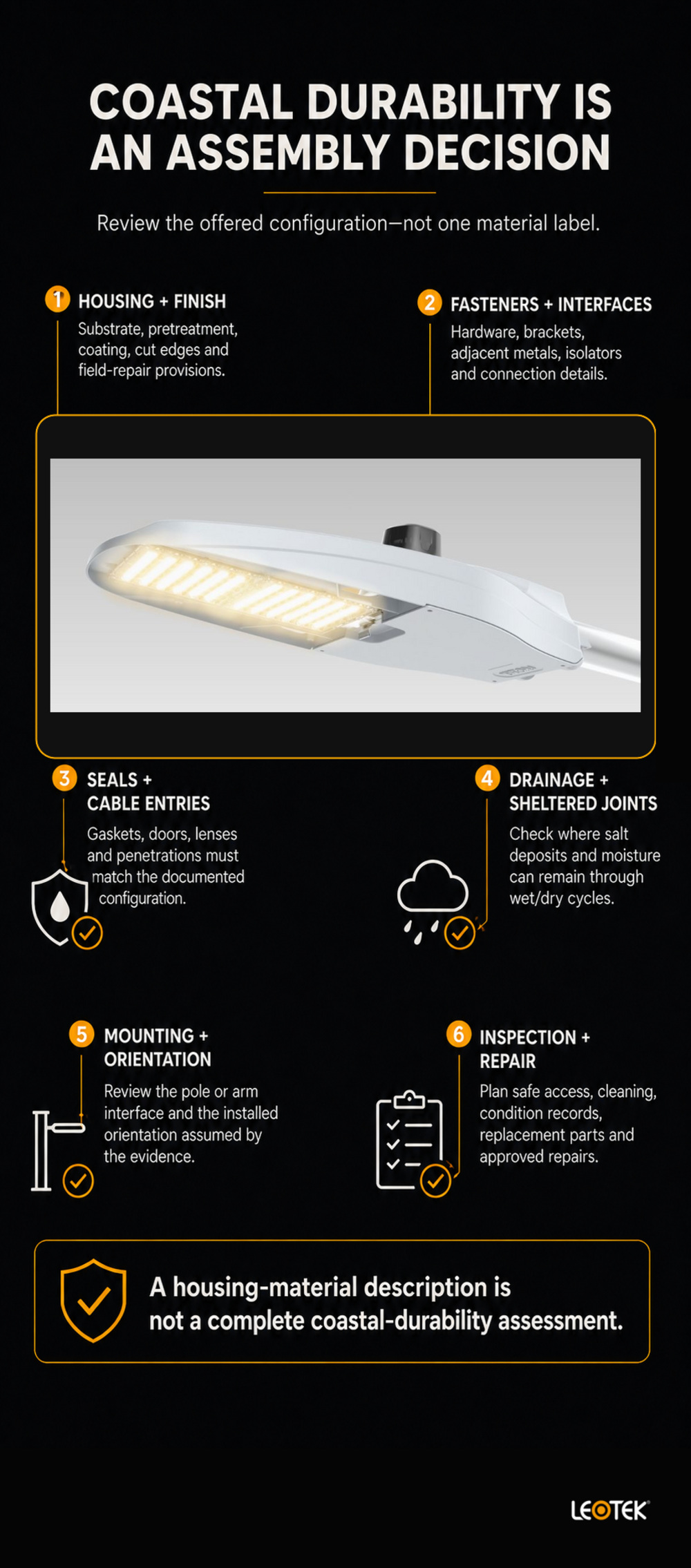
A luminaire housing is only one part of the system in the field. A review should also account for the coating or finish, door and hinge areas, lens and frame interfaces, brackets, mounting hardware, cable entries, gaskets, drainage features, and the connection to the pole or arm. These locations may have different geometries, coatings, material combinations, or opportunities for deposits and moisture to remain.
This is not a claim that every part will corrode at the same rate. It is a reason to avoid treating a body-material description as a complete coastal-durability assessment. The supplier should identify what has actually been tested or documented for the offered configuration, including any hardware, mounting, and finish assumptions that affect the result.
Ingress protection is not corrosion evidence
Ingress protection addresses how an enclosure performs under defined test conditions involving solid objects and water. It is useful information for an outdoor electrical enclosure, but it does not, by itself, establish coating durability, resistance to a salt-laden atmosphere, fastener compatibility, or service life at a coastal site.
Readers who need the underlying terminology can consult this guide to IP ratings. It is an educational starting point, not evidence that a particular luminaire has a particular rating or is suitable for a marine environment. Ask for both the enclosure information relevant to the project and separate corrosion-related evidence for the configuration being considered.
Start with a site exposure brief
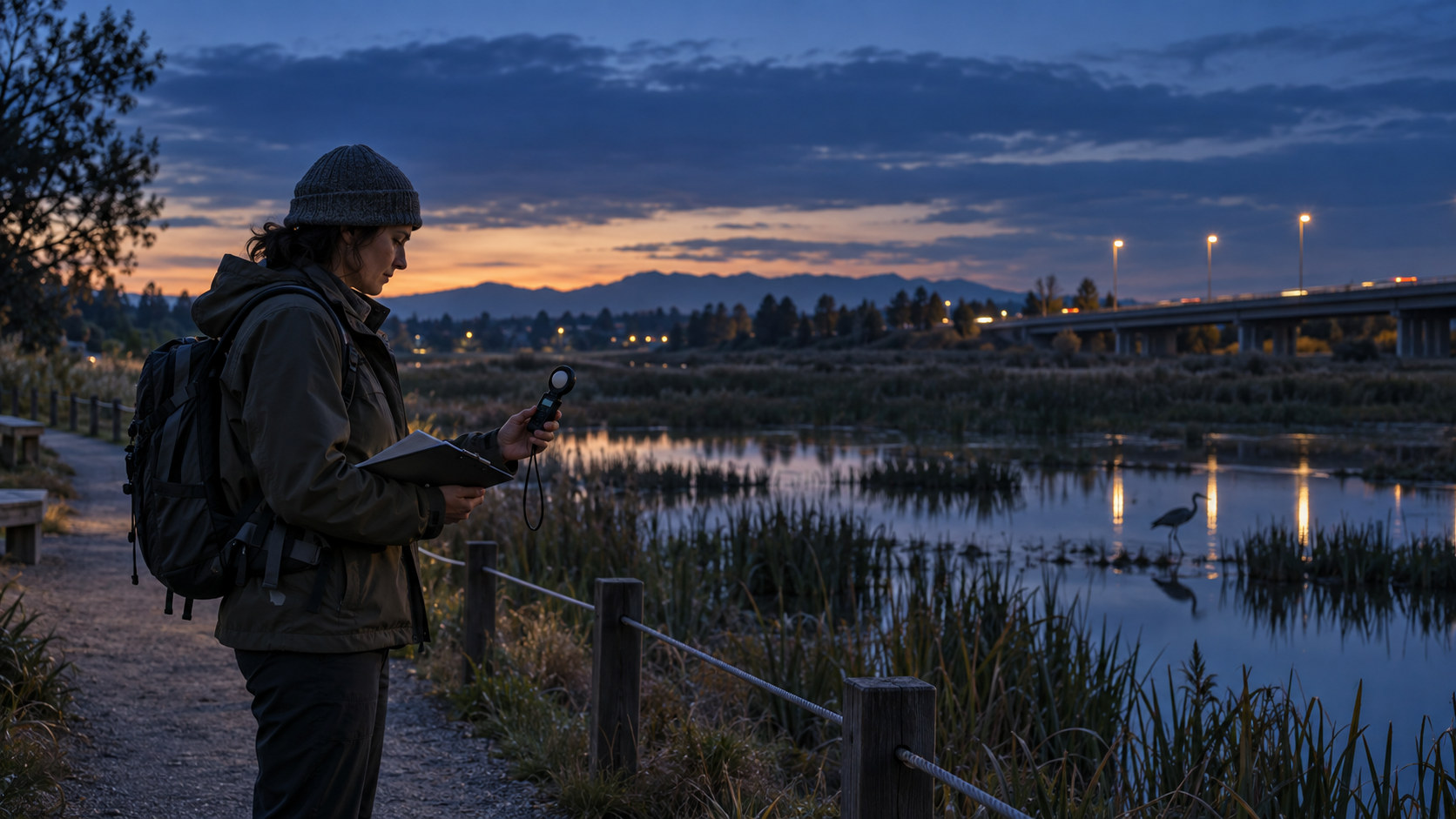
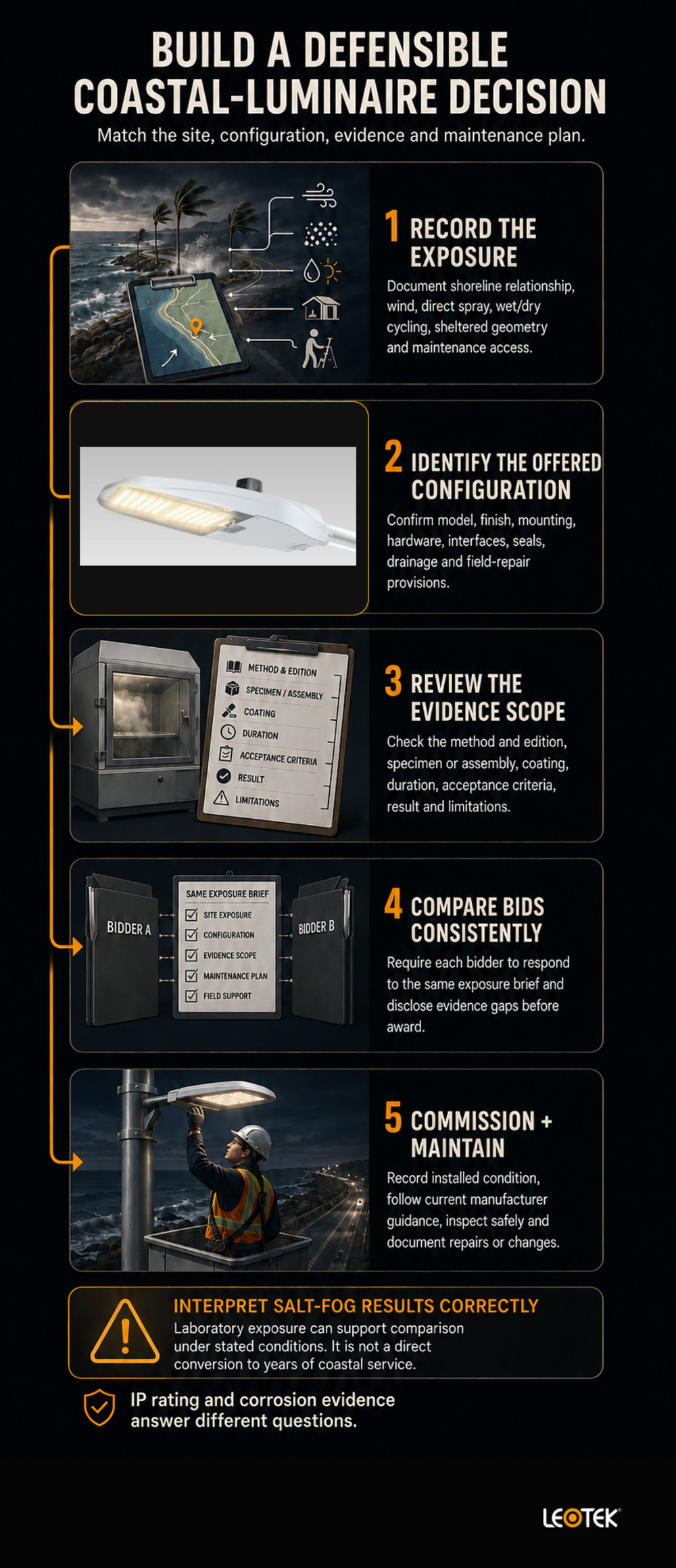
Before comparing materials or test reports, create a concise exposure brief. It gives engineering, procurement, operations, and suppliers a shared description of the problem to solve. It should be based on project observations and applicable agency requirements, not on a marketing category.
| Observation to record | Why it matters to the review | Question for the submittal |
|---|---|---|
| Shoreline relationship, elevation, and orientation | Exposure can differ with topography and prevailing wind. | What conditions does the offered configuration address? |
| Direct spray versus airborne salt | Direct spray and deposited salt may create different service conditions. | What test or field evidence is relevant to this exposure? |
| Wet/dry cycling and sheltered geometry | Joints and recesses can retain moisture or deposits. | How are interfaces, drainage, and access addressed? |
| Mounting arrangement and adjacent metals | Interfaces may affect the behavior of the assembled system. | Which materials, coatings, isolators, and fasteners are included? |
| Cleaning and inspection access | A maintenance plan depends on safe access and manufacturer instructions. | What cleaning, inspection, repair, and replacement guidance applies? |
The brief does not need to predict a corrosion rate. Its role is to make assumptions visible. It can also identify who must review the conditions: the lighting designer, electrical engineer, structural reviewer, maintenance lead, supplier, and agency procurement staff may each have a different part of the decision.
The same brief can make bid comparisons more consistent. For example, a procurement record can require each bidder to state the offered finish, hardware, mounting assumptions, test-report scope, and maintenance instructions against the same site observations. That does not make competing configurations equivalent. It makes differences and evidence gaps easier for the responsible reviewers to see before award or installation.
It is also useful to separate observed conditions from conclusions. A record might note wind-facing placement, a sheltered joint, or restricted maintenance access without declaring that any one condition proves a corrosion category or expected service life. The design and procurement team can then apply the project’s applicable requirements to documented facts.
For agencies planning a wider program, the outdoor lighting applications hub can help orient the discussion around roadway and area-lighting uses. It should not be used as model-level proof of material, finish, corrosion, warranty, or compliance performance.
Evaluate materials, finishes, and interfaces together
Rather than selecting corrosion-resistant streetlight materials by label alone, start with questions. What is the housing substrate? What surface preparation and coating system are specified? Are edges, holes, seams, and fastener locations treated consistently? What materials meet at the mounting interface? What happens if a finish is damaged during shipping, installation, or service? The answers should be specific to the offered configuration.
For steel structures, ISO 12944-2:2017 describes a framework for classifying principal environments and corrosivity, including special corrosion stresses, for protective paint-system selection. Its scope is steel structures; it is not a luminaire qualification or a substitute for the applicable project specification. Still, it reinforces a useful procurement principle: environmental exposure is an essential input to protective-system selection.
Request the coating-system description, substrate and pretreatment information, applicable test evidence, and acceptance criteria. If a report applies only to a flat coated panel, a different hardware set, or an earlier finish revision, its relevance to the supplied luminaire may be limited. The comparison should state those limits rather than silently extending the result to the full installed assembly.
Ask how interfaces and trapped moisture are managed
Where different metals, finishes, or fastening methods meet, the project review should examine the actual interface. Geometry, moisture retention, surface condition, electrical continuity, and local contaminants can all matter. This is an engineering review question, not a reason to declare any particular metal combination acceptable or unacceptable in every coastal installation.
The same caution applies to gaskets, cable entries, doors, and drainage. A seal may protect an enclosure under its stated conditions, while another part of the assembly can still retain deposits or moisture. Ask the supplier to identify the relevant parts and the installed orientation assumed by its documentation.
Do not infer a luminaire’s materials, coating thickness, fastener grade, or corrosion class from a family page, product photograph, or general category description. If the project needs a specific attribute, require current configuration-specific documentation and review it against the site exposure brief.
This review also benefits from a clear handoff. Engineering can identify the environmental and interface questions that affect design; procurement can state the submittal requirements; operations can identify access and recordkeeping needs; and suppliers can respond to the offered configuration. The handoff does not replace professional judgment, but it reduces the chance that a decision relies on an isolated brochure statement or a test report with an unclear scope.
Use salt-fog evidence correctly
Salt-spray testing for outdoor lighting is a controlled laboratory exposure; salt fog is often called salt spray. ASTM B117 describes an apparatus and procedure for creating and maintaining a salt-spray environment and notes that it has been used to produce relative corrosion-resistance information for metal and coated-metal specimens.
That is useful, but the limitation is as important as the result. ASTM states that predicting natural-environment performance from standalone salt-spray results has seldom been correlated, and that correlation or extrapolation is not always predictable. A report showing a stated number of hours is therefore not a direct conversion to years of coastal service. It does not establish suitability at a particular road, the behavior of an untested assembly, or the outcome after field damage and maintenance.
What a salt-fog report can answer
A well-scoped report can help compare specimens under the stated chamber conditions. It may show the test method and edition, specimen material and coating, preparation, exposure duration, evaluation criteria, observations, and the laboratory’s stated result. That information can be relevant when it matches the component and finish under consideration.
It cannot answer every procurement question. The report may not cover the luminaire’s hinges, gaskets, fasteners, mounting interface, cut edges, or production configuration. It may not represent local salt deposition, direct spray, ultraviolet exposure, temperature cycling, traffic contaminants, installation damage, or the agency’s maintenance practice. Those gaps should be recorded rather than filled with an implied service-life claim.
Questions to ask before relying on test evidence
Ask for the test method and version, specimen or assembly tested, coating and pretreatment, exposure duration, any scribe or damaged-edge treatment, acceptance criteria, evaluation method, and the exact result. Also ask whether the evidence is supported by relevant field exposure or other documentation. The project team can then decide whether the evidence fits the exposure brief and procurement requirements.
Verify the edition required by the contract or specification. This article does not determine which edition a project must use.
Turn evidence into procurement requirements
A coastal streetlight submittal should enable the agency to evaluate the actual offer. The following checklist can make that request more concrete without prescribing a universal material or test threshold:
- Configuration identification: model, finish, mounting arrangement, and the hardware included in the offer.
- Material and finish description: housing substrate, coating system, pretreatment, relevant interfaces, and any field-repair provisions.
- Evidence package: test method/version, specimen or assembly scope, duration, acceptance criteria, results, and stated limitations.
- Interface details: drawings or documentation for fasteners, brackets, pole or arm connection, cable entries, seals, drainage, and dissimilar-material interfaces.
- Operations information: manufacturer instructions for inspection, cleaning, repair, replacement parts, and any conditions that affect warranty review.
- Project review record: the site exposure brief, applicable agency requirements, and the responsible parties’ decisions.
This approach distinguishes documentation from proof. A test report should be evaluated, not merely collected. A warranty statement should be read in the governing contract and current documents, not assumed from a general product description. Electrical, structural, code, and procurement determinations remain project- and jurisdiction-specific.
For technical validation, use product specifications and resources to locate relevant documentation. Confirm each document’s date, model, revision, and scope before relying on it in a submittal or specification.
Plan inspection and maintenance for coastal conditions
Durability continues after procurement. At commissioning, agencies can establish a baseline record of the installed configuration and visible condition. Photographs, location information, configuration records, and any accepted evidence package can help future staff distinguish a new condition from an existing one.
Inspection planning should reflect the exposure brief, agency maintenance practice, safe access, and manufacturer guidance. During an appropriate inspection, staff may document coating damage, accumulated deposits, seal condition, hardware condition, drainage concerns, and changes at interfaces. Observations should be escalated through the agency’s maintenance and safety processes rather than treated as a universal diagnosis.

A worker accesses a pole-mounted streetlight from an elevated platform.
Cleaning and repair need the same discipline. Do not assume a cleaning chemical, method, or interval applies to every finish, enclosure, or site. Follow current manufacturer instructions and applicable safety procedures. Qualified personnel should handle electrical, structural, or other safety-sensitive decisions, and the agency should document repairs that could affect corrosion protection or future warranty review.
Build a defensible coastal-luminaire decision
The strongest coastal streetlight corrosion decision is transparent about what is known and what still needs confirmation. Start with the local exposure, evaluate the whole installed assembly, interpret salt-fog evidence within its laboratory limits, and make maintainability part of the selection. That process is more useful than treating a single material label, IP designation, or test duration as a guarantee.
When a project has a defined site and configuration, teams can review product specifications and resources and discuss a roadway infrastructure project with the relevant technical stakeholders. The next step should be a configuration-specific review against the project’s exposure, procurement, and maintenance requirements.
Frequently asked questions
Is a high IP rating enough for a coastal streetlight?
No. An IP rating addresses the enclosure’s performance under its stated ingress-test conditions. It does not alone establish corrosion resistance of the housing, finish, fasteners, interfaces, or the installed assembly in a salt-laden environment. Review enclosure evidence alongside configuration-specific corrosion documentation and the site exposure brief.
Does a longer salt-fog test mean a longer coastal service life?
Not by itself. ASTM B117 states that standalone salt-spray results have seldom correlated with natural-environment performance and that extrapolation is not always predictable. A longer test may be useful comparative evidence under the reported conditions, but it is not a calendar-life forecast for a coastal roadway installation.
What documentation should a coastal streetlight submittal include?
Request identification of the offered configuration, materials and finish, test scope and method, acceptance criteria and results, interface and mounting details, and current maintenance and repair instructions. Compare that package with the site exposure brief and applicable project requirements. Confirm the date, revision, and scope of each document.
Which streetlight parts are important to inspect near salt water?
The review should not stop at the housing. Depending on the configuration and safe-access plan, document the finish, joints, hinges, lens and frame interfaces, fasteners, cable entries, gaskets, drainage areas, brackets, and pole interface. The responsible team should determine what to inspect and how often based on the site, manufacturer guidance, and agency procedures.
References
- LEOTEK, guide to IP ratings; accessed July 29, 2026.
- LEOTEK, outdoor lighting applications; accessed July 29, 2026.
- iso.org, ISO 12944-2:2017; accessed July 29, 2026.
- astm.org, ASTM B117; accessed July 29, 2026.
- LEOTEK, product specifications and resources; accessed July 29, 2026.