







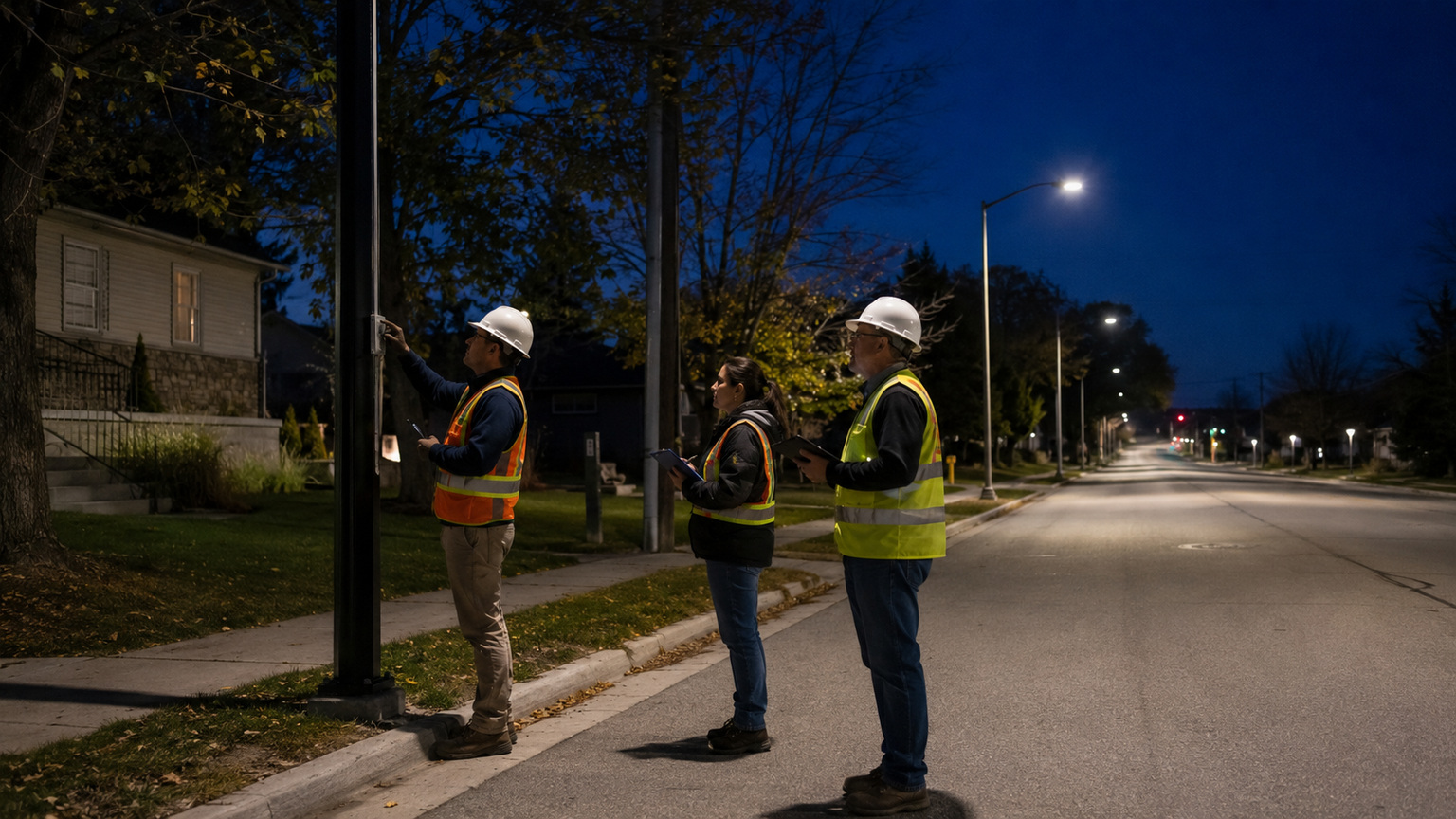
A useful municipal streetlight pilot project starts with a written decision question and a comparable baseline. It then documents lighting observations, controls behavior when relevant, installation and maintenance conditions, energy data, and a defined approach to resident feedback.
The purpose is to reduce uncertainty for a project-specific next step, not to prove that a configuration will produce the same result everywhere. That distinction makes the pilot more useful to public works teams, lighting and traffic engineers, procurement staff, elected officials, and residents who need to understand what the city is evaluating.
Key takeaways
- Define the decision the pilot will inform before selecting sites or equipment.
- Record baseline conditions and pilot conditions so that later comparisons are intelligible.
- Evaluate lighting, operations, energy, installation, and feedback as separate evidence streams.
- Treat estimates and vendor projections differently from measured results.
- Close the pilot with a decision record that states findings, limitations, and the next action.
Start with the decision the pilot must inform
A streetlight pilot project is a limited, documented evaluation of specified lighting or control conditions at selected sites. It compares pre-defined evidence to help an agency make a defined next decision. It is not a substitute for final engineering, code review, commissioning, procurement evaluation, or jurisdictional approval.
The first useful question is not “Which fixture is best?” It is “What uncertainty must this pilot reduce?” The answer might concern observed lighting conditions on a certain roadway type, the installation workflow for a particular asset population, the operation of a proposed control schedule, or the quality of information available for a future solicitation.
Define the boundary before installation
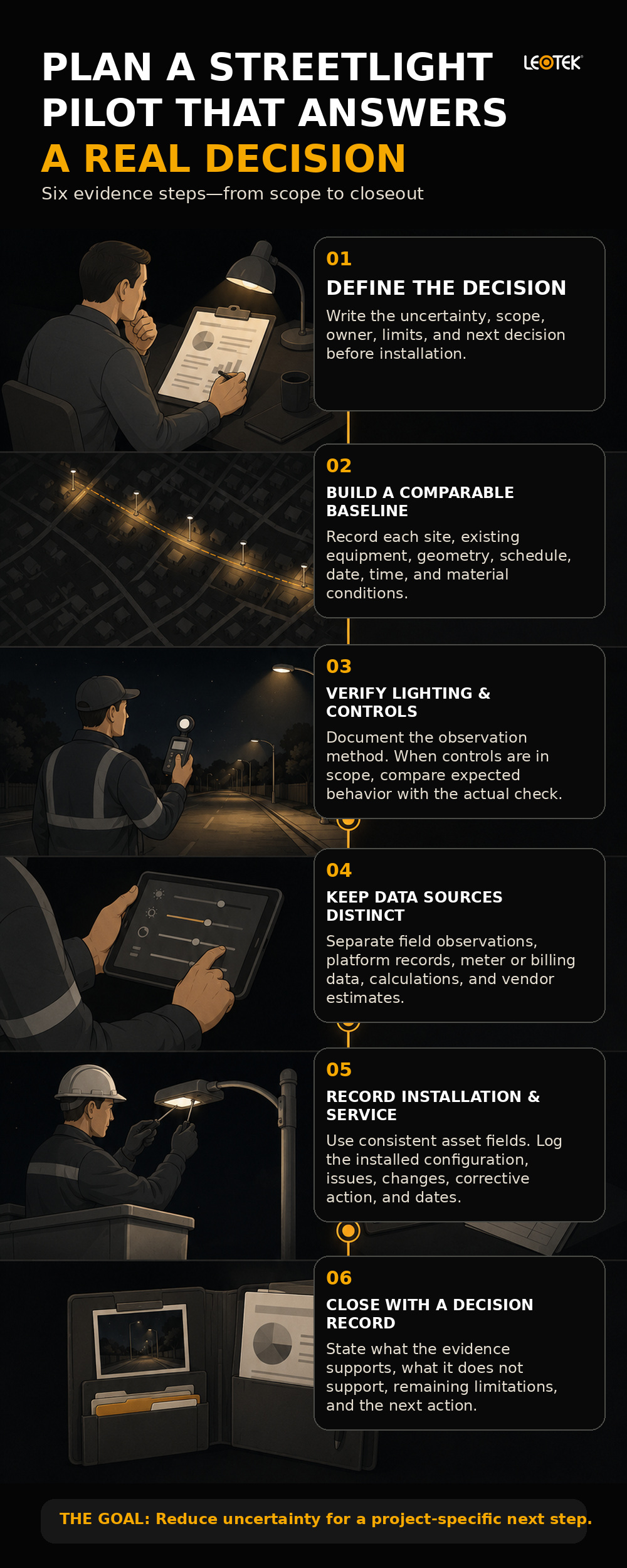
Write the decision in one sentence. For example: “Determine whether the pilot evidence is sufficient to prepare a project-specific procurement package for similar local streets.” That statement is deliberately narrower than a promise about energy, safety, or resident acceptance.
Then list what the pilot will and will not test. A pilot may compare documented conditions at selected blocks, but it cannot by itself establish a universal design standard, predict every maintenance condition, or establish a citywide financial result. Naming those limits at the outset prevents the closeout report from claiming more than the evidence supports.
The scope should also identify the pilot owner, the people who will make the next decision, the permitted changes during the test, and the point at which a change requires re-documentation. A late change to mounting, shielding, operating schedule, control settings, or site selection can make an apparent comparison difficult to interpret if it is not recorded.
Agree on evidence, not just preferences
Before field work begins, finalize and date the evidence categories and the method for each. This does not require a universal scorecard. It does require the city to decide what records it needs in order to answer its own question.
Before installation, document the acceptance criteria for each evidence category: who will review it, what limitation would prevent interpretation, and what result would trigger the next decision. These are project-specific decision rules, not universal lighting or procurement requirements.
For a municipal LED trial, the team may identify lighting observations, installation records, maintenance records, energy data, control-operation records, and stakeholder feedback. For each category, name the source, the collection period, the responsible party, and the limitation. A spreadsheet, work-order system, field form, or asset platform can all be useful if the fields and definitions remain consistent.
Stakeholder participation should be purposeful. Maintenance staff may need to record access or service observations. Engineering staff may need to define the applicable review method. Procurement staff may need a clear list of current documents and configuration details. Communications staff may need a transparent way to receive and classify public comments. These roles should inform the plan; they should not turn a pilot into an unstructured collection of opinions.
Build a comparable baseline and pilot plan
The baseline gives the pilot its reference point. Without it, a later observation may be interesting but not comparable. The baseline need not be complicated, but it should be complete enough to explain the conditions being compared.
Record existing conditions at each site
Create a site record before changes occur. Include location or asset identifiers, roadway or public-space context, existing equipment description, mounting and geometry notes, known operating schedule, relevant surrounding conditions, and the date and time of observation. Record weather or seasonal conditions when they may affect an observation, rather than treating them as noise to ignore.
The record should distinguish what was observed from what was supplied by another source. For example, a field observer can record a visible condition and timestamp. An energy interval or billing record should retain its source and date range. A manufacturer document should retain the exact model, configuration, document date, and revision that applies. Avoid using a family-level page or a generic brochure as proof of a specific configuration.
For readers developing broader specifications after a pilot, municipal outdoor lighting can provide application-level orientation. It should not replace model-specific documentation or project review.
Select sites to answer the question
Site selection should follow the decision question. If the decision concerns a particular street type, land-use setting, or operational constraint, select sites that expose that condition. Document the selection rationale so that readers of the closeout report understand what the pilot represents and what it does not.
There is no universal number of luminaires, blocks, or weeks that makes a pilot valid. A larger pilot is not automatically better if sites, baseline records, and the decision question are poorly defined. Conversely, a small pilot may be sufficient for a narrow implementation question but not for a broad citywide conclusion.
Where a comparison site is used, document why it is comparable and what remains different. Traffic, adjacent lighting, vegetation, pavement condition, construction activity, season, weather, and operating schedules can all affect observations. The appropriate response is not to claim perfect equivalence; it is to disclose material differences and interpret results within those limits.
Evaluate lighting and controls in the field
Energy information alone cannot answer every pilot question. The U.S. Department of Energy identifies color and spectrum, flicker, glare, and luminance perception as distinct lighting-quality research areas in its Lighting Quality overview. That does not prescribe a municipal roadway-pilot standard, but it supports treating lighting quality as more than a single energy metric.
Use a documented observation method
State who will observe, where they will stand or travel, when observations occur, what conditions are recorded, and how observations are retained. When qualified photometric or engineering review is needed, name that need in the plan and preserve the applicable method and records. Do not infer performance from a product label, color-temperature value, or nominal wattage.
Field notes can cover visible conditions, glare concerns, transition areas, dark areas, obstructions, and maintenance-related observations. They should not be converted into a claim that the pilot improved visibility or safety unless the study method and evidence support that conclusion. For public infrastructure, agency engineering judgment and applicable requirements govern final design decisions.
If the pilot gathers feedback, separate a comment from a measured result. A comment may be valuable evidence about a location, time, or concern. It does not establish a population-wide outcome unless the feedback method, respondent group, response pattern, and limitations support that inference.
Verify controls only when controls are in scope
If the pilot includes dimming, scheduling, remote switching, alerts, or asset data, document the expected behavior before activation. Then retain a record of the configured behavior, actual observation or system record, date and time, and any exception. Do not assume that a claimed control interface will behave identically across all equipment.
The Department of Energy study The Energy and Operational Impacts of Using 0-10V Control for LED Streetlights characterized 23 LED streetlights that claimed dimmability through a 0-10V interface and reported performance variation. Its findings apply to the study’s defined interface and sample, not every luminaire or control system. Still, they support a practical pilot discipline: verify the actual control behavior and expected light levels for the configuration being evaluated.
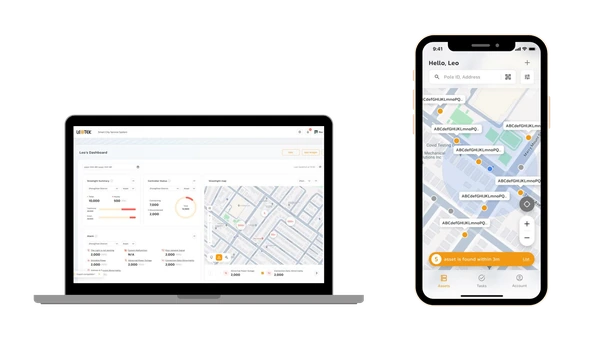
Where connected operation is part of the question, the connected streetlight management page is a relevant reader pathway. Treat it as solution information, not as evidence that a specific pilot will generate a particular operational or financial outcome.
Capture installation, maintenance, and energy evidence
Installation and service records can provide context that a before-and-after energy comparison may not capture. A pilot should capture the work required to install, commission, adjust, inspect, or service the selected configuration. This gives operations and procurement teams a factual basis for identifying questions that remain open before a larger project.
Keep work records consistent
Use the same fields for each pilot asset or location. At minimum, record the equipment identifier, configuration as installed, installation date, observed issues, corrective action, and whether the condition was resolved. If a change is made during the pilot, record the original condition and the date of the change.
Avoid translating work records into a maintenance-cost claim unless the pilot has a defined baseline, complete cost treatment, and a method appropriate to the decision. A useful closeout report can instead state the count and type of recorded events, the observation period, and the limitations of the record.
If controls or asset information are included, specify whether the evidence comes from field observation, a work order, a meter, a billing record, or a platform record. The data source matters because each answers a different question.
Define the energy comparison before collecting it
An energy comparison needs a stated boundary: assets included, time period, data source, operating schedule, and conditions that may affect interpretation. If the pilot uses modeled or projected energy values, label them as estimates and identify their inputs. Do not present them as measured savings.
DOE notes that documented field studies can examine energy use, lighting performance, and control-system operation in its Field Studies and Real-World Solutions. Its examples are not a roadway-pilot protocol, so a municipal team should adapt the evidence plan to its specific setting and review needs.
This approach also avoids a common mistake: combining measured consumption, a vendor projection, and a maintenance estimate into one unsupported headline. Keep those streams separate. The decision-makers can then see what was observed, what was calculated, and what still needs validation.
Include resident response without overinterpreting it
Resident response can document location-specific concerns for follow-up alongside system data. It is most useful when the team treats it as structured feedback rather than a referendum on the entire project.
Define who is asked, when, and how
Document the communication channel, dates, geography, question wording, and any eligibility or access limitation. Decide whether the process is open comment, an intercept survey, a targeted stakeholder discussion, or another method. These approaches produce different kinds of evidence and should not be pooled without explanation.
Classify feedback by location, time, issue type, and operating condition where possible. For example, a glare concern should retain the relevant site and observation time. A comment that lacks a location may still be recorded, but its limitation should be clear. Do not report a percentage or trend if the collection method does not support one.
Pair feedback with site records
The team can review feedback alongside installation records, field notes, and the documented operating schedule. That may identify a question for further inspection. It does not prove that one variable caused the reported experience.
When communicating results, use careful language: “The pilot received comments concerning this location during the stated period,” rather than “The pilot caused resident dissatisfaction” or “The new lighting improved satisfaction.” This preserves the usefulness of public input without overstating its evidentiary weight.
Turn pilot results into a procurement-ready decision record
The closeout record is where a municipal streetlight pilot becomes useful evidence. It should enable someone who was not present during installation to understand the question, evidence, interpretation, limitations, and recommended next action.
Summarize findings and limitations together
Organize the closeout around the original decision question. For each evidence category, identify the source, period, finding, and limitation. Keep missing data visible rather than filling gaps with assumptions.
A concise decision record can include:
- The pilot question, scope, sites, and selection rationale.
- Baseline and installed-condition records, including changes made during the pilot.
- The documented methods for field observations, controls checks, energy comparison, work records, and feedback.
- What the evidence supports, what it does not support, and what should be verified next.
- The proposed next action, such as further study, a revised pilot, a project-specific design review, or procurement preparation.
For a pilot intended to document uncertainty, this structure can be more informative than a pass/fail declaration. It also gives procurement staff a traceable basis for asking better questions of vendors and internal reviewers.
Use a pilot evidence matrix to preserve context
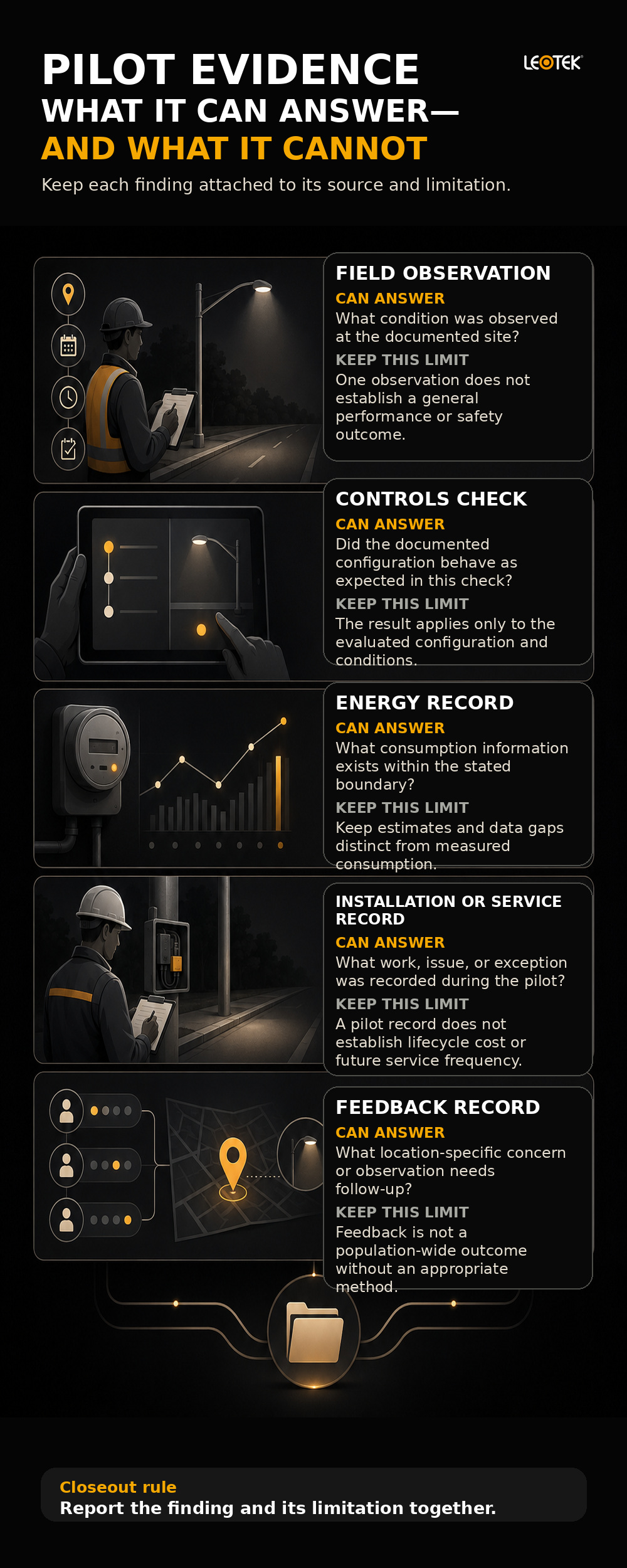
An evidence matrix can keep the closeout record usable when several teams collect information. It is a planning aid, not a universal municipal template. Create one row for each evidence stream and retain the same definitions from the pilot plan through the closeout review.
| Evidence stream | Record before collection | Decision-use question | Limitation to retain |
|---|---|---|---|
| Field observation | Location, date, time, observer, and method | What condition was observed at the documented site? | An observation does not establish a general performance or safety outcome. |
| Controls check | Expected setting, configuration, and timestamp | Did the documented configuration behave as expected in this check? | The result applies to the evaluated configuration and conditions. |
| Energy record | Assets, data source, time period, and schedule | What consumption information is available within the stated boundary? | Estimates, tariff assumptions, and missing intervals must remain distinct from measured data. |
| Installation or service record | Asset identifier, work performed, and date | What work or exception was recorded during the pilot? | A pilot record does not establish lifecycle cost or future service frequency. |
| Feedback record | Channel, respondent scope, location, and date | What concern or observation needs follow-up? | Feedback is not a population-wide outcome without an appropriate method. |
Assign an owner for each row and retain the original data source. At closeout, the team can identify which rows answer the decision question, which require follow-up, and which cannot support a conclusion. This makes the handoff to engineering, operations, and procurement more transparent without claiming that the pilot alone establishes a procurement outcome.
Request current technical documents for shortlisted configurations
Before a pilot transitions into a solicitation or project decision, obtain the current documents that apply to the exact configuration under consideration. That may include specifications, installation information, warranty terms, and other project-relevant documentation. The product specifications and resources hub is an appropriate starting point, but each document still needs verification for model, date, revision, and project applicability.
If the evidence record has defined a specific roadway-infrastructure question, readers may also contact LEOTEK to discuss it. The article does not imply a response time, product availability, engineering approval, or project fit. Agency requirements, qualified review, and applicable jurisdictional processes remain controlling.
Municipal Streetlight Pilot Project FAQs
Practical answers for municipalities planning, evaluating, and documenting an LED streetlight pilot project.
What is a municipal streetlight pilot project?
A municipal streetlight pilot project is a limited, documented evaluation of selected LED luminaires, controls, or operating conditions at representative locations. It helps a municipality compare baseline and pilot conditions before making a larger design, procurement, or deployment decision.
How do you plan a municipal streetlight pilot project?
Begin by defining the decision the pilot must support. Select representative sites, document existing conditions, establish evaluation criteria, install the exact proposed configurations, and collect lighting, controls, energy, maintenance, and resident-feedback records. Finish with a closeout report that identifies findings, limitations, and recommended next steps.
What should an LED streetlight pilot evaluate?
An LED streetlight pilot should evaluate the evidence relevant to the project decision. This may include photometric performance, observed glare, uniformity, spill light, controls behavior, energy consumption, installation requirements, maintenance conditions, asset records, and structured community feedback.
How many streetlights should be included in a pilot project?
There is no universal number of streetlights required for a valid pilot. The pilot should include enough representative locations to answer its defined decision question. Site type, roadway geometry, mounting conditions, surrounding land use, controls, and operating schedules can be more important than fixture quantity alone.
What baseline data should be collected before an LED streetlight pilot?
Baseline data should identify the location, asset ID, existing luminaire, mounting height, pole spacing, arm configuration, roadway context, operating schedule, controls, energy-data source, and known maintenance conditions. Record observation dates, times, weather, and seasonal conditions when they may affect the comparison.
Does a streetlight pilot require photometric evaluation?
Project-specific photometric evaluation is the appropriate method for reviewing how a proposed configuration distributes light under the documented roadway geometry. Requirements vary by agency and jurisdiction, but wattage, lumens, or color temperature alone cannot establish roadway-lighting performance.
How should a city measure energy use during a streetlight pilot?
Define the assets, measurement period, data source, operating schedule, dimming settings, and comparison boundary before collecting energy data. Measured consumption, calculated estimates, utility billing data, and vendor projections should be reported separately so decision-makers understand what was measured and what remains an assumption.
Should resident feedback be included in a streetlight pilot?
Yes, when the municipality uses a documented feedback method. Record the location, date, time, operating condition, communication channel, and type of concern where possible. Resident comments can identify issues for investigation, but they should not be presented as a population-wide outcome without an appropriate survey method.
How should streetlight controls be tested during the pilot?
Document the expected schedules, dimming levels, overrides, alerts, and communication behavior before activation. Test the installed luminaire, driver, controller, and management platform as one configuration, and record timestamps, observed behavior, system data, exceptions, and corrective actions.
What should a streetlight pilot closeout report include?
The report should include the decision question, pilot scope, site selection rationale, baseline conditions, installed configurations, evaluation methods, lighting and controls observations, energy and work records, feedback, limitations, unresolved questions, and recommended next action.
Can pilot results be applied to an entire city?
Not automatically. Pilot findings apply to the evaluated sites, equipment, operating settings, observation period, and documented conditions. A citywide program may include different roadway types, pole arrangements, electrical systems, community contexts, and maintenance requirements that require additional review.
What happens after a municipal streetlight pilot is completed?
The municipality should compare the findings with the original decision criteria and document the next action. Possible outcomes include further testing, revised configurations, project-specific engineering review, development of procurement requirements, or a decision not to proceed with the evaluated approach.
References
- U.S. Department of Energy, The Energy and Operational Impacts of Using 0-10V Control for LED Streetlights, January 10, 2024; accessed July 26, 2026.
- U.S. Department of Energy, Lighting Quality; accessed July 26, 2026.
- U.S. Department of Energy, Field Studies and Real-World Solutions; accessed July 26, 2026.
- LEOTEK, Applications for Outdoor Lighting; accessed July 26, 2026.
- LEOTEK, LEOLink Solutions; accessed July 26, 2026.
- LEOTEK, Resources and Documents; accessed July 26, 2026.