




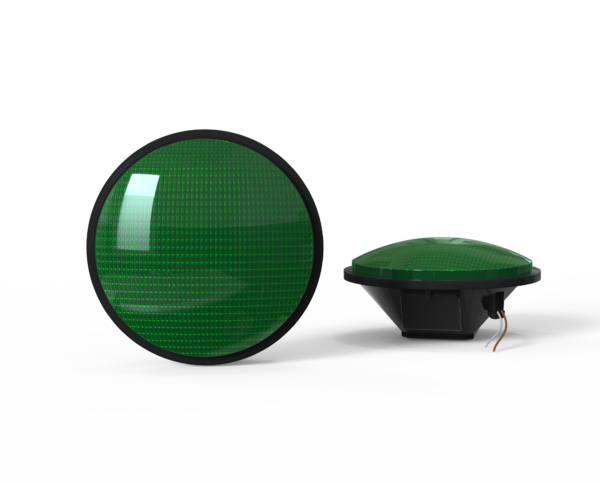


A durable lens and a sealed joint address different exposure paths. The useful question is how the documented design and installation protect the module, not whether one feature can be called 'weatherproof.'
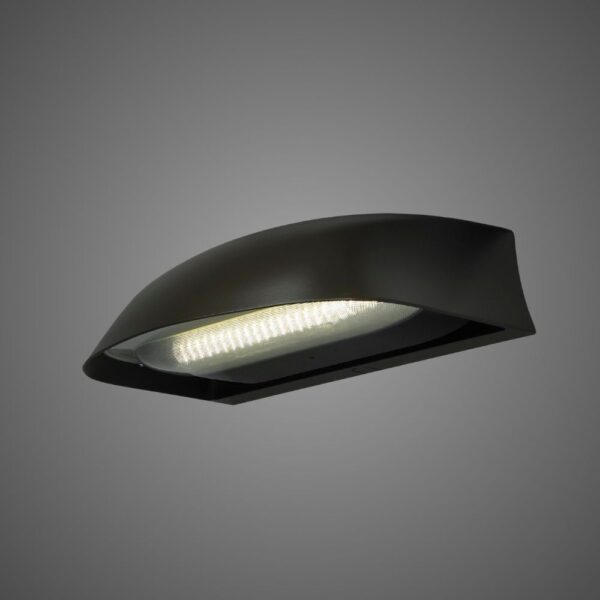
The reviewed SPC AC sheet identifies a hard-coated, UV-stabilized polycarbonate lens, complete gasket sealing and a one-piece housing. Those are the construction features available to discuss from that document. (LEOTEK SPC 80-135 Vac specification)
Keep each feature's function distinct
A lens-treatment claim does not establish the seal at a joint. A gasket claim does not, by itself, establish how every wire entry or surrounding head performs. Follow each required exposure question to its applicable assembly and evidence.
Do not substitute a generic O-ring cutaway or an invented internal potting diagram for the actual manufacturer information. If the relevant interface is not shown, obtain the drawing or installation instructions.
Do not manufacture an ingress rating
The reviewed SPC sheet describes moisture and dust resistance, but those words should not be converted into an unreported IP code or an underwater-use claim. Use only the rating and test basis actually supplied for the configuration. (LEOTEK SPC 80-135 Vac specification)
Similarly, a cited moisture method needs its report and acceptance conditions. An attractive rain photograph is not an ingress test.
| Requirement | Stated scope | Evidence detail to preserve |
|---|---|---|
| Exposed materials | Suitable for prolonged environmental exposure without degradation that interferes with function or appearance | Minimum material service rating: 60 months in a south-facing Arizona Desert installation |
| Ambient operating temperature | -40 C to 74 C | The source defines measurement at the exposed rear of the module; do not substitute a junction-temperature limit |
| Dust and moisture | Protection includes rain and blowing rain | Source cites MIL-STD-810F, Method 506.4, Procedure 1; a weather-sealed feature does not by itself supply this report |
An agency requirement example, not measured performance or evidence of current LEOTEK qualification.
Source: NYCDOT Specification 65D, June 2017; PDF page 4 / printed page 353; Articles 65D.2.3.1-65D.2.3.3. Read the original government source.
Historical June 2017 document. Confirm the governing project edition, exact module configuration and supporting test reports. A materials service rating is not a record of completed field exposure.
Check the installed interfaces
A retrofit review should identify the head, door, retaining arrangement, gasket interface, wiring entry and any required clearance. Obtain the manufacturer's instructions for the ordered variant and follow the agency's installation requirements.
The module's published features do not establish that every existing surrounding component is in good condition or that every replacement arrangement is suitable. Keep the part and the installed assembly distinct.
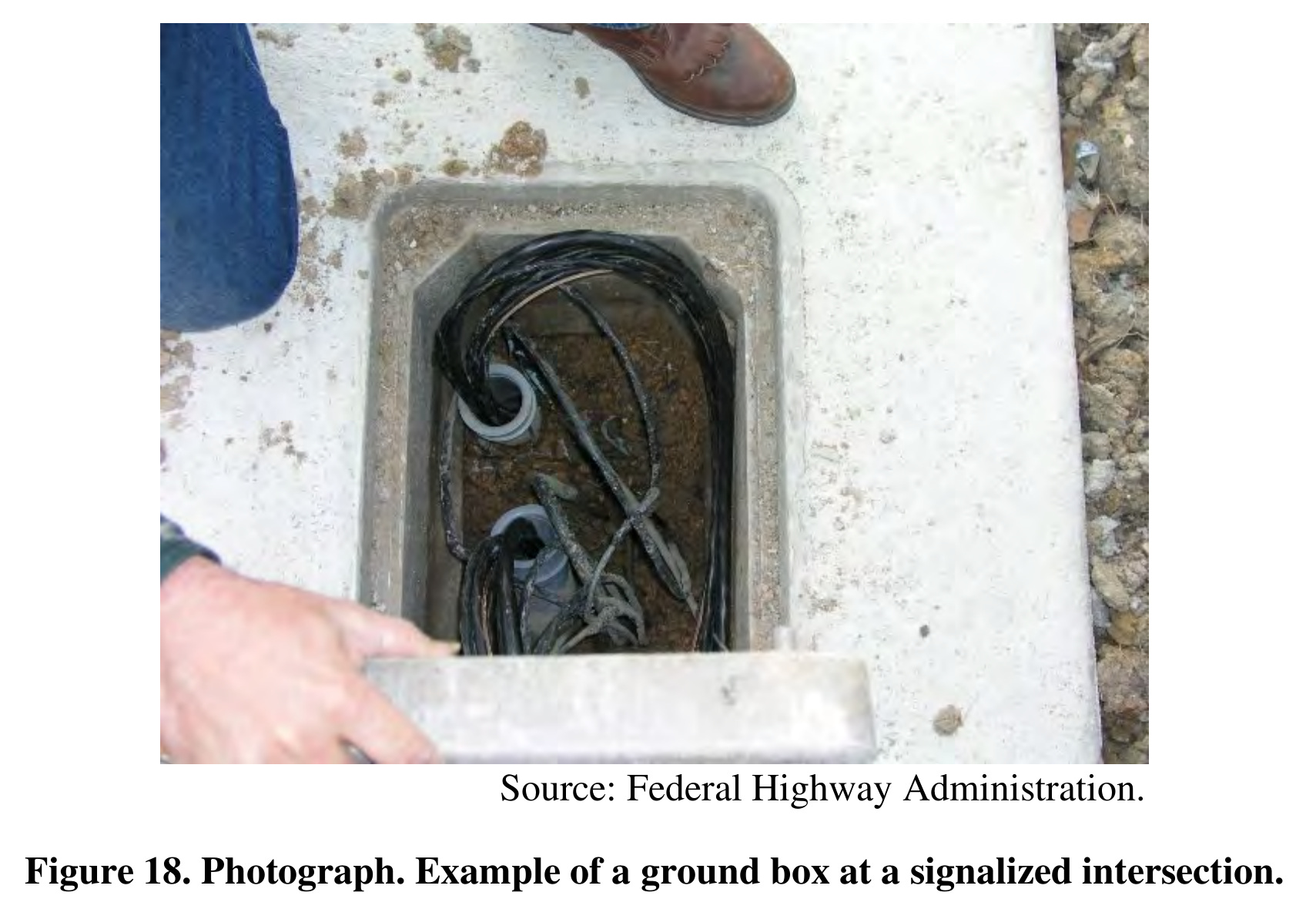
The FHWA photograph shows a ground box at a signalized intersection. It brings the installation boundary into view: field wiring and enclosures continue beyond the LED module. In a moisture investigation, identify the location of the observed condition before assigning it to a module seal, cable entry or another part of the installation.
The open box is an inspection example, not evidence of water damage or a LEOTEK installation. Its condition cannot establish the ingress rating of an unrelated component.
Use evidence to narrow the diagnosis
When investigating moisture, retain photographs, the affected model and installation information. Ask which interface or exposure the supporting record addresses. That produces a specific technical discussion without claiming that every visible condition proves the same failure mechanism.
Water resistance is a system of interfaces
The visible lens is only one boundary between the environment and the equipment. The lens-to-body joint, cable entry, connectors and the relationship to the surrounding head can each matter. A statement about a sealed optical module does not describe every joint in a complete signal assembly. Start a review by drawing the boundary of the item whose performance is actually claimed.
This changes the questions asked after a wet-weather complaint. Water observed in an outer housing is not automatically proof of water inside the module. Conversely, a dry outer surface does not establish the condition behind a lens. The investigation needs the observed location, the relevant assembly boundary and the supported inspection method. Qualified personnel should use the applicable maintenance instructions; this article does not prescribe opening or modifying an energized assembly.
Condensation and an ingress path are different hypotheses
A visible moisture symptom can lead to several possible explanations. The initial observation should not be promoted directly into a root-cause conclusion. Record where moisture appears, whether the condition changes with weather or time, which components are affected and what inspection actually confirms. If the source is unverified, keep that uncertainty in the record rather than assigning a seal failure by assumption.
An illustrative event log might distinguish an obscured exterior lens, moisture on the inside of a head door, and moisture observed within a module through a supported inspection. Those descriptions would lead to different evidence requests. The useful output is a narrowed diagnosis tied to the correct component, not a more dramatic photograph.
FHWA's snow-conditions report provides a related caution: precipitation can create a visibility problem at the exposed face even when the module's internal electrical function is not the issue. Environmental suitability therefore needs more than a single sealed or weatherproof label. This reference concerns winter obscuration; it does not prove a water-ingress mechanism.
Read the environmental test as a complete sentence
A meaningful test claim identifies the item, exposure, method and required outcome. The historical NYCDOT Specification 65D references a defined blowing-rain procedure. It should be read within its dated agency and pedestrian-module scope. It is an example of a specific requirement, not evidence that every module bearing a similar weather-resistance description has passed it.
For a procurement comparison, ask whether the offered configuration matches the tested configuration, including relevant entries, joints and accessories. Then identify what the report actually evaluated after exposure. Visual condition, electrical operation and optical performance are not interchangeable acceptance outcomes. If the evidence covers only one of them, that is the boundary of the supported conclusion.
A laboratory result also does not waive installation requirements. An approved component can be placed in an assembly with a damaged mating surface or a configuration outside the supported instructions. The field closeout should therefore document the restored assembly, the correct replacement parts and the required functional checks. It should not invent a new sealant, vent or cable-entry modification from a general article.
Use maintenance history to distinguish isolated and recurring problems
Suppose an illustrative fleet records several wet-weather complaints. Count affected components against the installed population, and retain installation date, location, configuration and confirmed cause. A cluster from one installation period may suggest a different investigation from scattered events across several models and ages. The observations identify questions; they do not establish causation without follow-up.
The asset-management framework in FHWA's lifecycle-planning chapter is useful for connecting condition, maintenance action and lifecycle planning. For streetlight analogies, remember that a luminaire and a signal module have different product requirements. The transferable practice is recording what happened to the asset and what intervention followed, not borrowing one product category's qualification as proof for another.
The practical outcome is a feedback loop: observe the symptom accurately, inspect within the supported procedure, identify the affected boundary, restore the approved configuration and retain the result. That loop helps both the agency and the supplier learn from a problem without turning a broad weather-resistance phrase into an unlimited field guarantee.
Photograph the condition before disturbing the evidence
Opening an assembly can change the condition being investigated. Water may drain, a gasket may move, or condensation may clear. When practical within the agency's authorized maintenance procedure, record the condition as found before disassembly. Include the installed orientation, visible moisture location and relevant external damage. A close-up without the assembly context can make it difficult to tell which interface the photograph actually shows.
A useful record distinguishes moisture on an exposed surface, moisture between components and moisture apparently inside a sealed boundary. Those are observations, not diagnoses. Link them to the model and installation history, then follow the applicable service and safety instructions. An improvised opening or added sealant can complicate the investigation and may change the construction being evaluated. Obtain the manufacturer's procedure before treating such changes as routine remedies.
The purpose is to preserve competing explanations long enough to evaluate them. A cracked component, displaced seal, wiring entry and temperature-related condensation suggest different follow-up questions. Finding one plausible path does not prove that every other path is intact. Likewise, the absence of a visible path during a dry inspection does not establish performance during the reported exposure.
Do not compare test names without their boundaries
Two reports may both mention rain while testing different things. One may evaluate an individual module, another a housing assembly with specified cable entries and orientation. Their durations, imposed conditions and acceptance criteria may differ. A result should be associated with the construction actually tested rather than generalized to every surrounding component in the installed head.
For a practical review, describe the claim in one sentence: this configuration, assembled this way, was evaluated by this method under these conditions, with this reported result. If one element is missing, identify the gap. This is a proposed reading method, not a replacement environmental standard. The detailed historical requirements in NYCDOT Specification 65D show why a short weather-resistant phrase cannot convey the whole test basis.
A coating deserves the same precision. A lens treatment can have a specified surface function without establishing the performance of the lens-to-body joint, cable interface or complete installed assembly. Ask which claim the evidence supports. Combining a coating statement with a gasket statement does not create an unreported IP classification, immersion duration or universal guarantee against moisture.
Look for patterns without turning correlation into a cause
If several units show a similar condition, compare their installation dates, locations, configuration and service history. A cluster on one exposed approach may justify investigating that exposure. A cluster after one maintenance campaign may justify reviewing the work and materials used. Either pattern is a lead; neither alone proves the product or the crew caused the condition.
Include unaffected comparison units when possible. If all observed units share a location, there is no location contrast from which to isolate the effect. If only returned units were photographed, the record describes the returned sample rather than the whole population. Keep the denominator and selection method visible before reporting a failure percentage. The asset and work-history relationships in FHWA's asset-management primer, Chapter 4 are useful for organizing this investigation.
Close the case with the observed condition, the supported finding and the action taken. If the cause remains unresolved, say so and record what evidence would distinguish the remaining explanations. Preserve the removed item's identity and disposition so a later test can be connected to the original observation, rather than to an anonymous returned sample. That is more valuable than assigning every moisture complaint to a single category. It leaves purchasing with a defensible question, maintenance with a traceable history and the manufacturer with information that can support a configuration-specific response.
Frequently asked questions
Does gasket sealing mean the module is IP68?
Not unless that rating and its supporting basis are actually supplied. Do not derive an IP code from descriptive wording. (LEOTEK SPC 80-135 Vac specification)
Does the lens coating establish the seal?
No. The lens surface and the assembly's joints are distinct review subjects.
Can a generated internal diagram explain SPC construction?
Only documented construction should be attributed to SPC. A generic illustration must not be presented as its actual internal design.
Sources
- LEOTEK SPC 80-135 Vac specification. Revision November 13, 2018; drawing page 1, model and standard entries page 2
Additional research and calculation basis
- FHWA-HOP-13-010, LED Traffic Signal Snow Conditions report (January 2014)
- NYCDOT Specification 65D (June 2017); historical pedestrian-module environmental requirements
- FHWA, Applying Transportation Asset Management to Traffic Signals, Chapter 6; lifecycle planning
Cover image: AI-generated editorial illustration for LEOTEK. The generic scene is not a verified installation, product photograph or test record. Technical figures and tables carry their own source credits.