






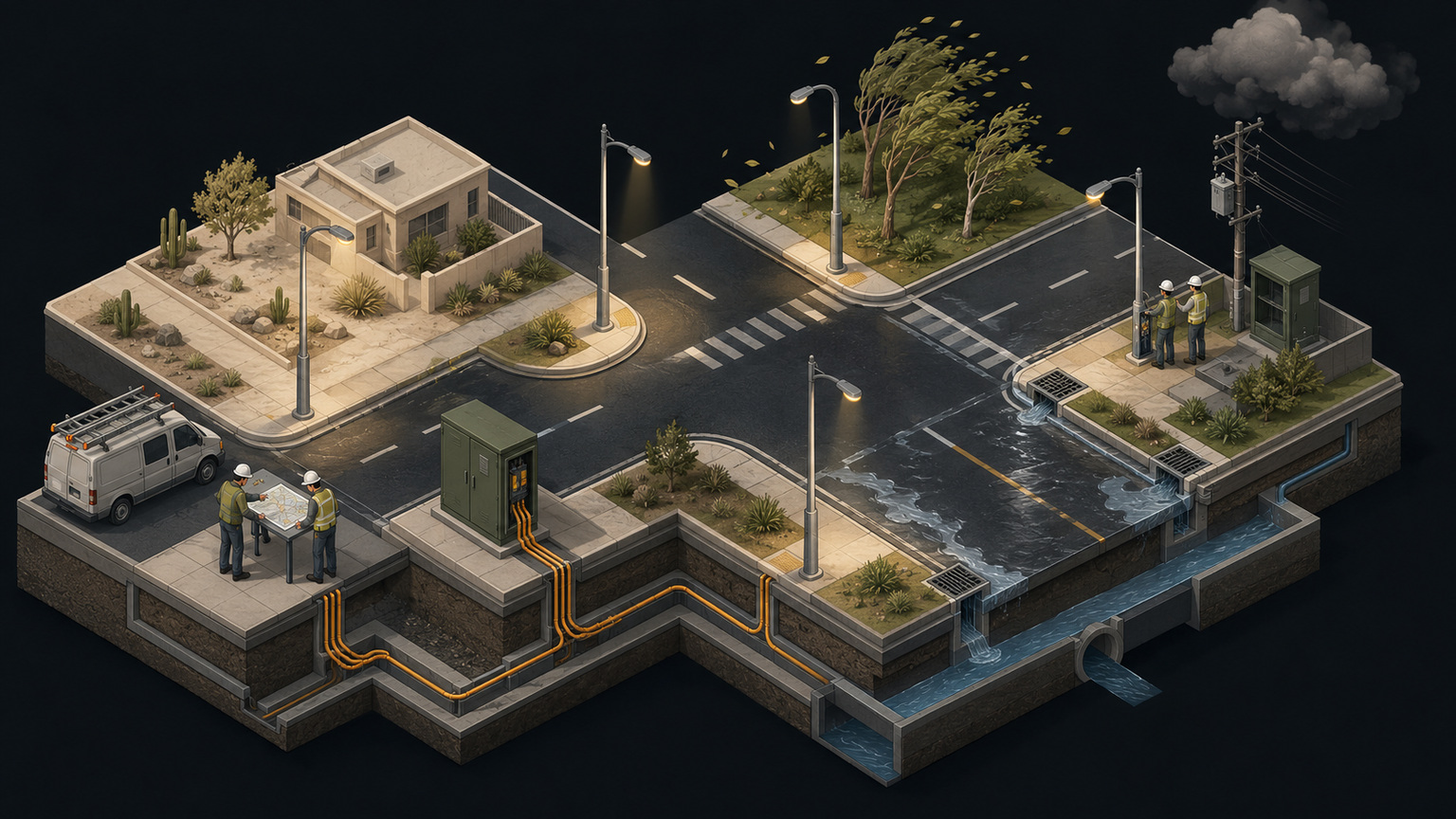
Climate-resilient streetlights are planned as a complete system, not selected from a single product attribute. For cities and transportation agencies, that means evaluating the luminaire, its support and mounting, electrical distribution and protection, controls, asset records, and recovery process against local hazards.
A resilient specification does not guarantee that an asset will withstand a particular event. It gives the agency a disciplined way to define exposure, request current evidence, assign technical review, and restore service safely after disruption.
Key takeaways
- Begin with local heat, wind, water, electrical-event, and grid-disturbance exposure rather than a generic “all-weather” requirement.
- Evaluate the streetlight system, including the pole, mounting, wiring, controls, and operating workflow, not just the luminaire.
- Treat ratings and manufacturer documents as inputs to review. One rating does not establish site suitability, installation suitability, or flood resilience.
- Build recovery priorities, inspection records, and document control into procurement before an event occurs.
- Use connected asset-management functions as operational tools only after confirming the configuration, communications, and agency workflow.
Plan climate-resilient streetlights around local hazards and service objectives
“Climate resilient” is most useful when it describes a decision process. The Federal Highway Administration’s resilience framework identifies vulnerability assessment, planning, asset management, project development and design, and operations and maintenance as related parts of transportation resilience. That framework offers a practical starting point for roadway lighting, even though it is not a luminaire specification or a local design requirement.
For a streetlighting program, the first question is not “Which fixture is resilient?” It is: what conditions can interrupt the required lighting service at this location, and what evidence will the agency use to evaluate them? The answer will differ among a coastal road, a high-wind corridor, a heat-exposed arterial, a flood-prone underpass approach, and a neighborhood served by an overhead electrical system.
Separate the hazard from the consequence. Heat and direct sun may affect the equipment environment. Wind may affect the luminaire, arm, pole, foundation, and their interfaces. Water exposure may involve rainfall, standing water, drainage, or a post-flood inspection issue. Electrical events may involve upstream distribution, protective devices, controls, or utility conditions. A grid disturbance can make a physically intact light unavailable until power and communications are restored.
Map assets and dependencies before selecting equipment
An asset inventory should make the lighting system visible as a network of dependencies. At minimum, identify the roadway segment, luminaire and mounting configuration, pole or support type, circuit or service relationship, control arrangement, and the records used to maintain it. This is not an electrical design exercise in an editorial article; it is a way to make procurement questions traceable to the actual asset and location.
The inventory should also distinguish assets that must be restored first from those that can follow a normal maintenance sequence. An agency may set these priorities through its own operating procedures, roadway function, emergency plans, utility coordination, and engineering judgment. The article does not establish a priority order for any jurisdiction.
Set a service-recovery objective with operations and utility teams
Resilience includes recovery, so the desired service state should be explicit. Operations staff may need an answer to questions such as: Which locations need condition information first? Who receives a fault report? What field inspection is required before an asset returns to service? Which records document the decision?
Answering those questions before procurement prevents a common gap: a product submittal may describe equipment, while the agency still lacks a workflow for verification, triage, or documentation after a widespread event. The workflow should be coordinated with the responsible utility, electrical and structural reviewers, roadway operations staff, and the authority having jurisdiction where applicable.
Specify the full streetlight system, not only the luminaire
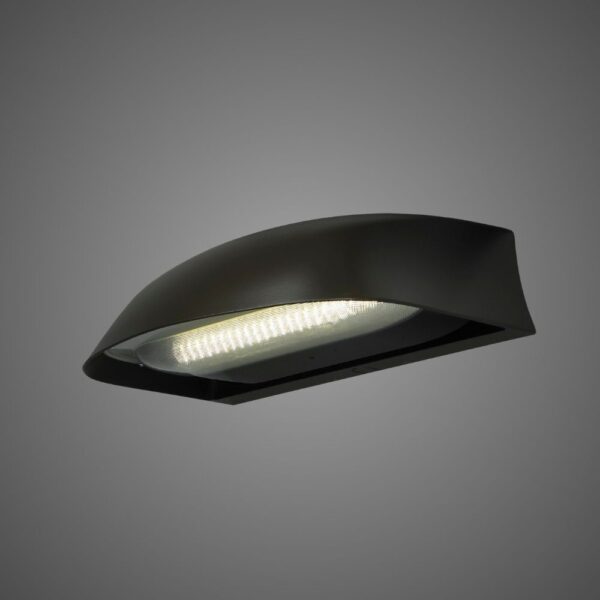
The lighting asset at the roadside is a system boundary. It includes the luminaire, mounting hardware, arm and pole or other support, foundation or attachment interface, conductors and protective equipment, controls and communications where used, and the records that identify the configuration. A weakness or unanswered question at any of these points can matter during an extreme-weather event or a restoration effort.
This does not mean every project needs the same design response. It means the procurement record should state what is being evaluated and who is responsible for confirming it. A manufacturer document may be relevant to a product attribute, while a qualified project team still needs to evaluate the installed configuration, local exposure, structural interfaces, utility service, and governing requirements.
For readers comparing pathways, LEOTEK’s outdoor lighting applications page is an application-level starting point. It should not be used as evidence for a model’s output, listing, warranty, control compatibility, environmental rating, or project fit.
Ask for evidence that matches the exposure
Instead of requesting a vague “weatherproof” product, create an evidence matrix. For each identified hazard, list the question, the exact document requested, the model or configuration it covers, the document revision, and the reviewer responsible for acceptance. This approach makes it easier to find a missing document before a purchase order or field installation.
The U.S. Department of Energy’s Solid-State Lighting program includes lighting-quality research on topics such as glare, flicker, and uniformity. That does not prescribe a roadway design or establish a product’s performance, but it supports defining measurable lighting-quality criteria in the project requirements.
For example, an agency can ask whether the proposed documentation addresses the expected environmental exposure, mounting arrangement, electrical protection approach, and control architecture. The appropriate answer may be a model-specific specification, installation instruction, test record, listing information, structural review, electrical review, or a project drawing. This framework does not substitute for any applicable code, standard, utility rule, or engineering determination.
Why one rating does not answer every resilience question
An enclosure rating can be relevant to water and dust exposure, but it is not a blanket finding for flood exposure, submersion, drainage, mounting, wiring, or post-event condition. Readers who need foundational context can review LEOTEK’s guide to IP ratings; that guide does not establish a current rating for any specific product.
The same principle applies to effective projected area (EPA), a concept used in fixture and pole planning. LEOTEK’s EPA explainer can orient a reader to the term, but EPA alone does not establish that a pole, arm, foundation, or mounting arrangement is suitable for a specific wind condition. The responsible structural and project reviewers need the complete installed-system context.
Address heat, wind, water, and electrical events with verification questions
A resilient roadway-lighting requirement is more actionable when every hazard is paired with verification questions. The questions below help an agency organize a review. They are not installation instructions, ratings, code advice, or a substitute for qualified engineering and jurisdictional review.
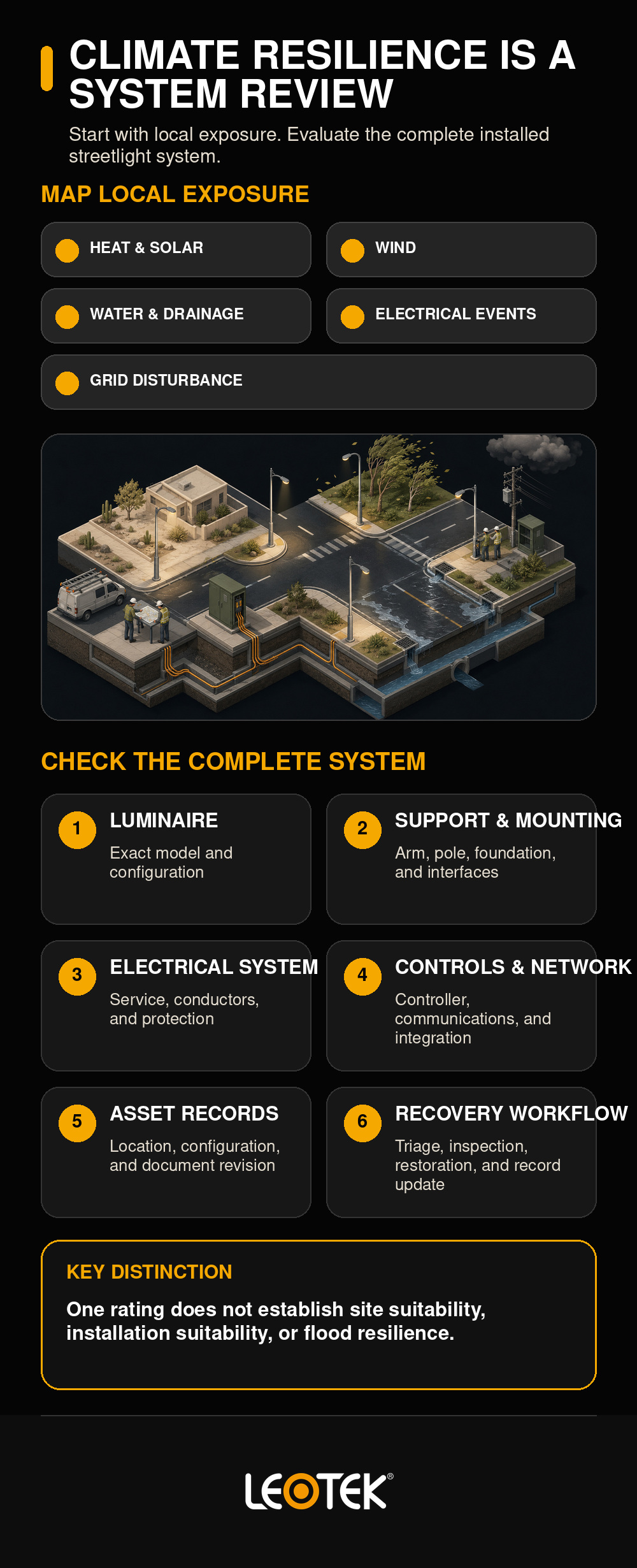
Heat and solar exposure
For heat-exposed locations, establish the relevant environmental conditions before comparing product documentation. Confirm that the evidence is current, applies to the exact model and configuration, and is reviewed against the project’s location and installation conditions. Do not infer a temperature range, life expectation, or performance outcome from a family page or from a different configuration.
Also consider the operational record. A program that can identify the installed configuration and its document revision is better positioned to investigate a condition report than one that relies only on a general product name. This is an asset-management practice, not evidence that any particular product will perform in a given climate.
Wind, mounting, and structural interfaces
Wind exposure is a system question. The luminaire, mounting hardware, arm, pole, foundation, and surrounding site conditions may all be relevant. A procurement team should ask which documents apply to the proposed assembly and which structural professional or authority is responsible for reviewing the project-specific arrangement.
Avoid transferring an engineering value from one product, pole, or installation to another. Likewise, do not present a wind-related attribute as a statement of storm survivability. The useful editorial point is narrower: the proposed configuration needs evidence and project-level review, and that evidence should remain connected to the asset record.
Water exposure, drainage, and post-event inspection
Water is not a single condition. Rainfall, spray, standing water, inundation, drainage patterns, and access for inspection can create different questions. Define the expected exposure and identify which project parties will evaluate the luminaire, electrical equipment, support system, and any affected controls after an event.
If a site has experienced flooding or another event that could affect electrical or structural components, return-to-service decisions should follow the applicable agency process, utility requirements, manufacturer documentation, and qualified review. The purpose of a pre-event plan is to ensure that staff know what record to consult and who owns the decision, not to make an editorial checklist stand in for a field assessment.
Electrical events and streetlight surge-protection coordination
Electrical events, including lightning-related conditions, can involve more than the device at the top of the pole. The relevant system may include service equipment, circuit protection, grounding and bonding arrangements, controls, communications equipment, and utility-side conditions. Define the project’s review boundary and require current evidence for the exact equipment being considered.
Do not describe a luminaire, controller, or protection component as surge-proof or grid-independent without direct, scope-specific evidence. A product feature alone does not establish coordination across the installed electrical system. Electrical design, protective-device selection, installation, and inspection remain project- and jurisdiction-specific work.
Plan for grid disturbances and storm recovery
When a disturbance affects many assets, the first operational challenge is often visibility: what is known, what needs inspection, what can be safely restored, and who needs the information? A recovery plan should connect field reports, asset records, maintenance dispatch, utility coordination, and documentation of the final status.
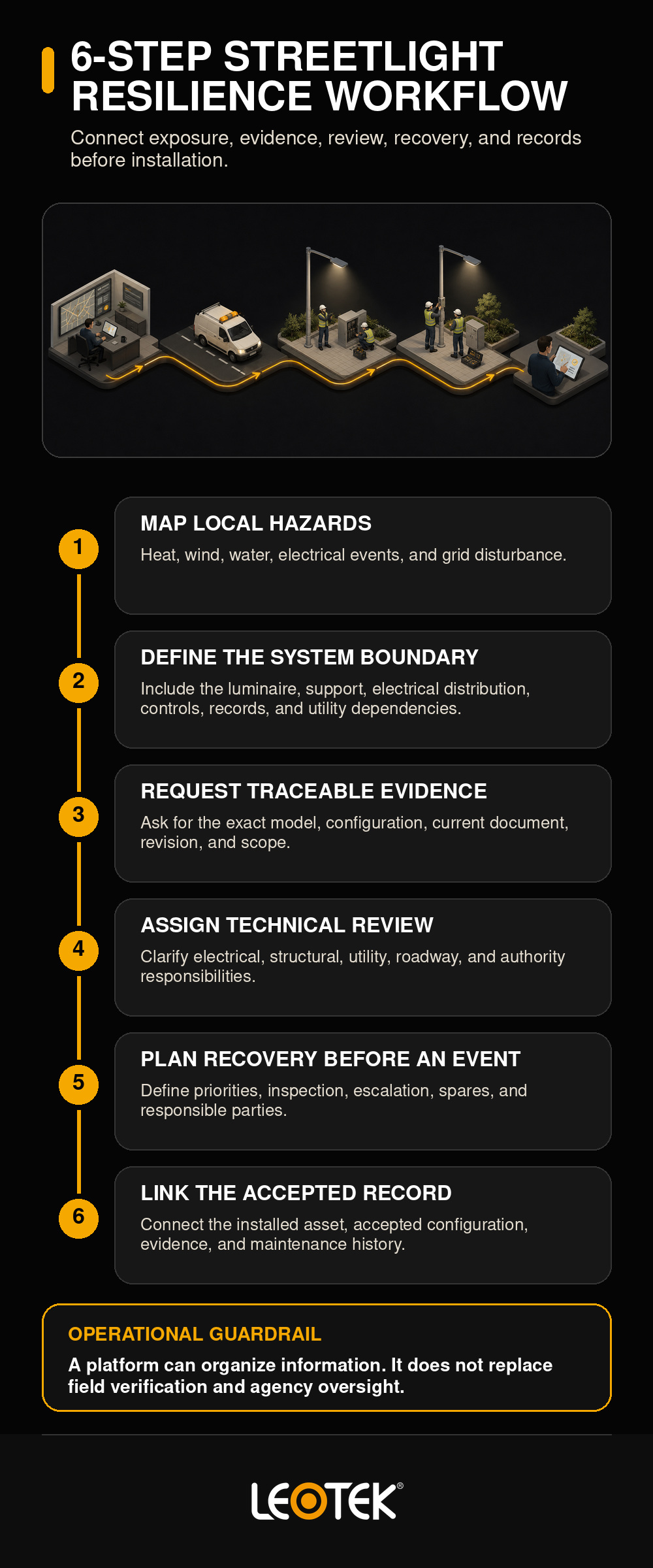
The plan can define a simple sequence: receive a report, triage the asset and location, inspect under the agency’s applicable safety process, verify the required conditions, restore service through the responsible parties, and update the record. Each agency should adapt that sequence to its procedures, workforce, utility relationships, and authority requirements.
Use asset data to target the first response
Current asset information can make the first review more focused. Useful records may include location, asset identifier, installed configuration, circuit or control relationship, known condition, and the document set associated with the asset. The appropriate data fields and retention practices are agency decisions and may have security or policy implications.
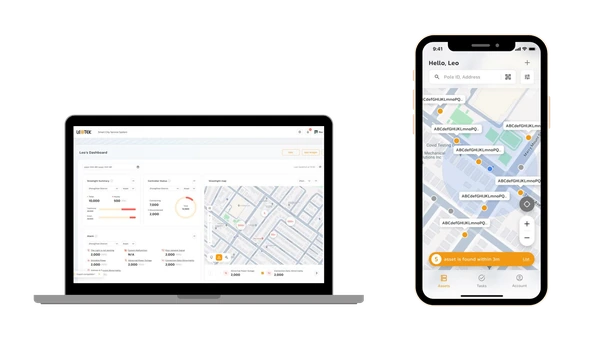
Connected systems can support some operational workflows, but their value must be evaluated in context. LEOTEK states that its LEOLink Solutions offering supports functions such as remote switching and dimming, schedules, fault notifications, energy tracking, reporting, maps, alarms, and asset management. These are first-party stated functions, not a guarantee of service continuity, fault accuracy, cybersecurity, or storm recovery performance. Agencies should confirm the exact controller, communications, integration, data-governance, and operational requirements for their project.
Define the return-to-service record
The restoration record should show more than that a light appears to be operating. It should connect the asset to the inspection or verification process required by the agency, the condition found, the work performed by the responsible party, and any follow-up documentation. This record helps operations teams distinguish an immediate restoration action from a closed technical review.
For connected assets, document whether a field condition, a control state, and an asset-management status describe the same configuration. A management platform can organize information, but it does not eliminate the need for appropriate field verification and agency oversight.
Build resilience into procurement and lifecycle management
Procurement is where a resilience objective becomes testable. A requirements matrix can connect each hazard to the evidence requested, the proposed model and configuration, the document revision, the reviewer, and the record that will be retained. It also helps an agency avoid treating a marketing description as a substitute for a specification, listing, test record, or project review.
Questions for submittal and document review
Use questions that require a traceable answer:
- What local exposures and service objectives does this requirement address?
- Which exact product configuration and installation arrangement does each document cover?
- Which current documents address the relevant environmental, electrical, mounting, and control questions?
- Which assumptions need confirmation by the electrical, structural, utility, or roadway project team?
- What asset data, spares, inspection records, and escalation contacts are needed for recovery?
- Who accepts each item, and how will the accepted revision remain linked to the installed asset?
For model-specific specifications, submittals, warranty research, and other technical evidence, direct readers to LEOTEK technical documents. The resource hub is a verified route to documentation, but each linked item still needs review for its date, revision, model, and scope.
Coordinate the parties who own different risks
No single team owns every element of roadway-lighting resilience. Procurement staff may manage document requirements; lighting and electrical professionals may evaluate equipment and distribution; structural professionals may review supports and interfaces; utility staff may clarify service dependencies; operations teams may define restoration needs; and agency leadership may set priorities. Clarifying those roles early reduces the chance that a critical question has no owner.
Lifecycle management should preserve the link among the installed asset, the approved configuration, the documents used to evaluate it, and the maintenance history. That connection is especially valuable when a storm, flood, or grid event requires quick but accountable decisions.
A practical pre-procurement checklist
Before finalizing a resilient roadway-lighting requirement, confirm that the project team can answer the following:
- Hazards: Have local heat, wind, water, electrical-event, and grid-disturbance exposures been identified without assuming one universal condition?
- System boundary: Does the scope include the luminaire, support and mounting, electrical distribution, controls, records, and relevant utility dependencies?
- Evidence: Are current, exact model- and configuration-specific documents requested where needed, with their revisions recorded?
- Review: Are electrical, structural, utility, roadway, and authority responsibilities assigned for the questions they own?
- Recovery: Are priority locations, inspection expectations, escalation paths, spares considerations, and record updates defined in the agency’s process?
- Documentation: Can staff connect the installed asset to its accepted configuration and the evidence used to evaluate it?
Climate-resilient streetlights are not a single label or a promise of uninterrupted service. They are the result of site-specific hazard assessment, evidence-based procurement, coordinated technical review, and a recovery workflow that treats the lighting system as an operating public-infrastructure asset.
Frequently asked questions
What makes a streetlight climate resilient?
A climate-resilient streetlight program evaluates the whole lighting system against local hazards: the luminaire, mounting and support, electrical distribution and protection, controls, asset records, and recovery process. It requests current evidence for the exact proposed configuration and assigns the appropriate project reviews. It does not rely on a single product label or rating.
Is an IP rating enough to establish streetlight flood resilience?
No. An IP rating can be relevant to an enclosure’s stated water and dust exposure characteristics, but it does not by itself determine flood exposure, submersion, drainage, wiring condition, installation suitability, or post-event return-to-service requirements. Evaluate the full system and the site-specific condition with the responsible reviewers.
What should a municipality ask for in a resilient streetlight submittal?
Ask for documents that match the local hazard and the exact proposed model, configuration, and installation context. Record the document revision, identify the responsible reviewer, and separate product evidence from project-specific electrical, structural, utility, and jurisdictional decisions. Also define how the installed asset and accepted documents will be tracked after commissioning.
How can connected asset management support storm recovery?
Connected asset-management tools may help organize reports, asset information, schedules, alerts, and fault workflows. The actual benefit depends on the deployed controller, communications, data, integration, agency process, and field verification. A platform should be evaluated as part of the operating workflow, not as proof of resilience or guaranteed recovery performance.
References
- Federal Highway Administration, resilience framework; accessed July 29, 2026.
- LEOTEK, outdoor lighting applications; accessed July 29, 2026.
- U.S. Department of Energy, Solid-State Lighting; accessed July 29, 2026.
- LEOTEK, guide to IP ratings; accessed July 29, 2026.
- LEOTEK, EPA explainer; accessed July 29, 2026.
- LEOTEK, LEOLink Solutions; accessed July 29, 2026.
- LEOTEK, LEOTEK technical documents; accessed July 29, 2026.