





A warranty describes a commercial commitment. A service-life estimate describes expected operation under stated assumptions. An optical-maintenance claim describes an output threshold and duration. Treating those as one number makes a lifecycle comparison less reliable.
The reviewed IL6-P3 and SPC sheets illustrate the distinction: they state a five-year limited warranty separately from a 70%-of-initial-output claim at 100,000 operating hours. (LEOTEK IL6-P3 10-28 Vdc specification; LEOTEK SPC 80-135 Vac specification)
Read the complete warranty
Obtain the current terms for the supplied configuration. Identify the starting point, covered items, required claim process and stated remedy. Do not infer the complete contract from a short data-sheet phrase.
Ask whether any relevant costs are included in the actual remedy. Replacement equipment, labor, access equipment and traffic control should not be assumed to have identical coverage. Keep the written answer with the project cost assumptions.
Read the performance statement on its own basis
For a maintained-output duration, retain the measured quantity, initial reference, operating conditions and substantiation method. It is not an installed-life guarantee merely because it is expressed in hours.
The reviewed sheets use an optical-maintenance statement, but they do not make every possible module failure an optical endpoint. Driver, lens, sealing, connection or assembly questions need the relevant evidence rather than an assumed lifetime from one number. (LEOTEK IL6-P3 10-28 Vdc specification; LEOTEK SPC 80-135 Vac specification)
Use field records for the field question
A maintenance history can show replacement dates, observed conditions and the agency's reasons for intervention. Keep the population and observation period with any result. A few examples do not establish a universal failure distribution.
Do not present an unacquired research report or a manufacturer's general hours statement as a measured replacement interval. A lifecycle model should label its planning assumptions and be updated when actual service data become available.
An alarm record is different from a failed-part finding
Figure 28 shows a malfunction monitoring unit (MMU) in a TS2 cabinet. The handbook describes monitoring of fault conditions at the cabinet level. That makes an MMU event useful evidence for a service investigation, but it does not by itself identify a failed LED module.
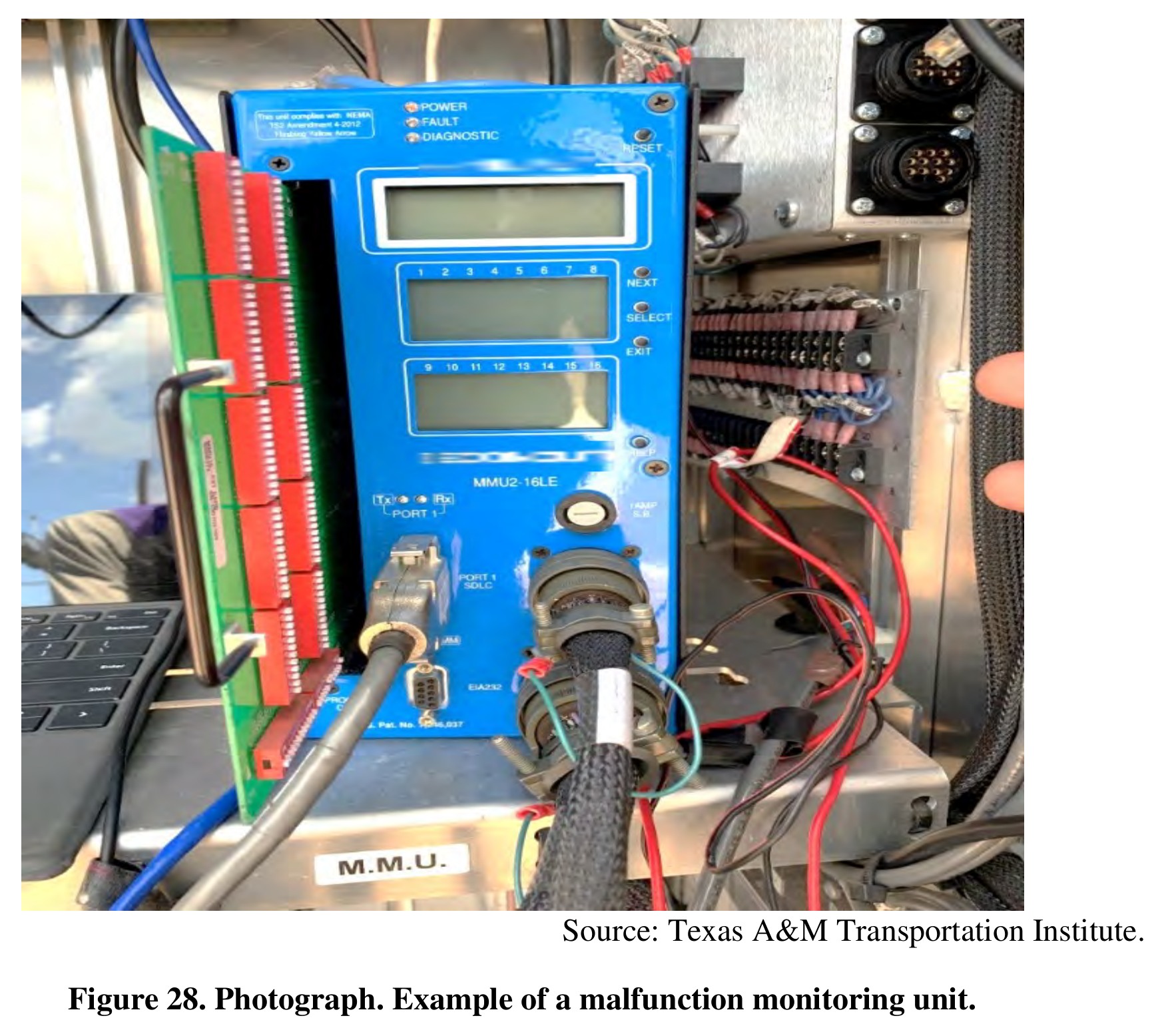
For a warranty review, keep the event time, affected channel, operating state, installed module identification and the technician’s diagnostic findings together. An alarm, a dark indication and a confirmed defective part are different records. The diagnosis is what connects the observed symptom to a supported remedy.
The pictured unit is a reference example, not a compatibility claim or a LEOTEK test result. The actual cabinet configuration and agency procedures govern fault response and restoration. A photograph of monitoring hardware also cannot establish a module’s expected service life.
Compare the total exposure
Two offers with similar warranty periods can leave different residual costs or documentation needs. Compare the written remedies and the same installation-cost boundary before ranking them.
For a supplier inquiry, provide the offered model, service condition and cost or coverage question. Request the actual warranty document and the supporting performance information separately.
A free replacement part can still produce an expensive service event
Consider an illustrative service event with a covered replacement module. Assume the owner still incurs $180 for a field visit, $120 for access and $130 for traffic-control arrangements. Those invented values total $430 before any uncovered equipment, shipping or administrative cost. They are not LEOTEK rates, industry averages or statements about the actual warranty. They show why a zero-price part and a zero-cost failure are different economic outcomes.
Now suppose one proposal costs $20 more per installed item and the agency evaluates 100 items. The initial premium is $2,000. At the assumed $430 residual cost per event, avoiding five such events would offset $2,150 of expenditure on an undiscounted basis. This is a break-even scenario, not evidence that either product will avoid five failures. Actual comparison needs documented event rates, cost boundaries and timing.
A lifetime claim is not a failure distribution
A duration associated with maintained optical output describes a particular performance statement. It does not reveal how many complete installed units will require service in each year. A warranty term does not supply that distribution either. Treating either number as a universal replacement interval can make a lifecycle model look precise while leaving its most important assumption unsupported.
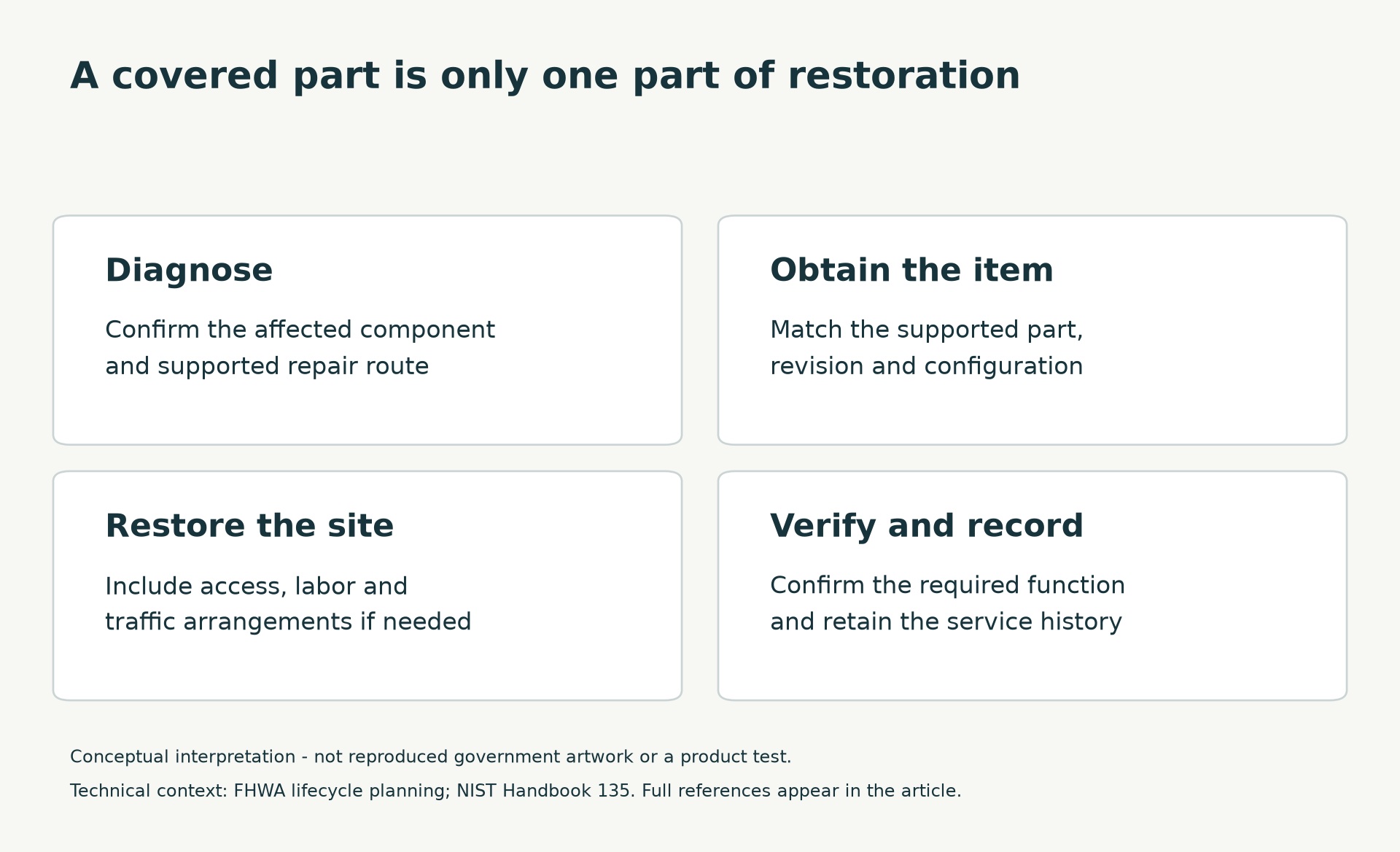
Build a maintenance record around actual interventions. Retain the installation population, exposure period, failed component, diagnosis, action, cost and whether the event produced a warranty recovery. Units still operating at the end of the observation period also matter; a list containing only failures cannot describe the full installed population. Unknown causes should remain unknown rather than being assigned to the most familiar component.
FHWA's lifecycle-planning chapter discusses lifecycle planning for traffic-signal assets. Its framework supports comparing maintenance and replacement strategies over time. It does not provide a universal service-life prediction for the LEOTEK modules discussed here. The agency's field record is needed to connect that planning framework to its own installations.
Compare costs on the same date as well as the same boundary
An expense paid several years from now and an initial purchase cost occur at different times. Discounted lifecycle analysis brings them to a common basis. For an explicitly assumed real discount rate of 3 percent, a $430 cost at the end of year five has a present value of about $371: $430 divided by 1.03 to the fifth power. The rate is an illustration, not the required federal or agency rate.
NIST Handbook 135 explains lifecycle-cost methodology in the federal energy-management context. A municipal signal project should use its governing financial assumptions and consistent treatment of inflation, discounting and the analysis period. Do not copy the example rate into a bid evaluation without that review. Its purpose is to reveal the timing assumption, not prescribe public-finance policy.
A useful sensitivity comparison changes one uncertain input at a time. Try a higher field-visit cost, a longer parts delay, or a different assumed number of interventions. If the preferred offer changes after a small adjustment, identify the missing evidence that would reduce uncertainty. Reporting only one attractive payback number conceals this decision risk.
What belongs beside the warranty in a purchasing discussion?
Keep the actual written remedy next to the planning model. Identify whether the model includes labor, access, traffic control, replacement equipment, shipping and temporary measures. Then identify which of those costs the written terms actually address. A cost excluded from coverage is not necessarily a product defect; it is an exposure the buyer needs to plan for.
The maintenance plan should also address spare parts and claim turnaround. A covered part that is unavailable when needed can create a different operational outcome from an immediately available spare. This is a project-planning question, not a promise about supplier turnaround. Request the relevant support commitment explicitly.
The most useful comparison therefore has three separate records: the supplier's contractual remedy, the configuration-specific performance evidence and the owner's lifecycle assumptions. When those records remain distinct, an engineer can explain why a longer warranty might matter, when repair logistics dominate, and which conclusion is still dependent on unverified field assumptions.
The useful denominator is installed exposure
Ten warranty claims can sound alarming or reassuring depending on the fleet behind them. Ten claims among 100 recently installed modules describe a different situation from ten claims among 10,000 modules accumulated over several installation years. Begin with the installed population, installation dates and observation period. Then distinguish the number of affected modules from the number of claims, shipments and repeat service visits.
Consider a hypothetical group of 200 modules observed for two complete years. Eight modules require one replacement each. The simple affected-unit fraction is 8/200, or 4 percent over that observation period. It is not automatically a 2-percent annual failure probability. That shortcut assumes a pattern over time that the count alone does not establish. If some units entered service later, even the shared two-year denominator would need correction.
For purchasing, this means asking what the field record actually measures. Was a return confirmed defective, replaced before diagnosis, damaged by an external event, or removed during unrelated work? A warranty shipment is an administrative event; an optical or electrical failure is a technical finding. Linking the records can improve the analysis, but treating them as identical can lead to a poor comparison between products or installation groups.
Availability can depend more on the spare than on the claim decision
A written remedy and the restoration path run on different timelines. In an illustrative scenario, diagnosis takes one day, internal claim review takes five days and replacement delivery takes another seven. A stocked compatible spare may allow restoration before the claim is resolved. Without that spare, the owner needs a different restoration arrangement. The example does not predict any manufacturer's claim processing time; it shows why the two questions should be discussed separately.
The spare has to match the installed requirement. Keeping the right diameter while overlooking voltage, indication or accepted configuration does not establish an executable replacement plan. Record the spare's ordering identity and any required review for alternatives. The inventory and materials-management functions discussed in FHWA's asset-management primer, Chapter 4 provide useful context for connecting those records to work management.
There is a cash-flow question as well. The owner may pay field costs immediately while a product remedy arrives later. If the proposed lifecycle comparison assumes immediate reimbursement of every expense, it can overstate the warranty's economic value. Model only the costs the written terms actually cover, and show the timing assumptions. Use NIST Handbook 135 for the general discipline of comparing costs over a consistent study period, without adopting an illustrative rate as an agency requirement.
A longer claim needs a clearer measurement definition
When a document describes retained optical output after a stated number of hours, ask how that value relates to the offered item. Is it a tested condition, an extrapolation, a design statement or a warranty threshold? Which starting value and operating conditions define the comparison? These questions do not imply that the claim is invalid. They establish what a buyer can reasonably conclude from it.
It is especially important not to substitute that optical statement for the life of the entire installed system. A module can be affected by electrical connections, installation damage or an external event before an optical-maintenance threshold becomes relevant. Conversely, a unit may remain operational after its contractual warranty ends. The remedy boundary and the engineering performance boundary should remain visible throughout the discussion.
Make the bid comparison useful to maintenance
Ask the maintenance team to review one realistic removal-and-replacement scenario before award. Identify the information needed to select a spare, document the removed unit and preserve the claim record. Check who retains the failed item and who authorizes its disposition. Avoid asking the field crew to recreate installation details that procurement could have captured when the equipment was new.
A well-supported purchase decision can then explain three things plainly: what the warranty promises, what the performance evidence supports, and what restoration costs remain with the owner. The most useful comparison may not be the one with the longest number on its cover. It is the one whose assumptions still make sense when a module needs attention on a busy approach and the responsible staff need an answer immediately.
Frequently asked questions
Does a five-year warranty mean a five-year service life?
No. The warranty period and installed service life answer different questions.
Does a 100,000-hour claim extend warranty coverage?
Not unless the written terms actually say so. The reviewed data sheets state separate claims. (LEOTEK IL6-P3 10-28 Vdc specification; LEOTEK SPC 80-135 Vac specification)
Can access and traffic-control costs be assumed covered?
No. Read the actual remedy and document which costs remain in the owner's lifecycle calculation.
Sources
- LEOTEK IL6-P3 10-28 Vdc specification. Revision July 1, 2019; drawing page 1, model table page 2
- LEOTEK SPC 80-135 Vac specification. Revision November 13, 2018; drawing page 1, model and standard entries page 2
Additional research and calculation basis
- FHWA, Applying Transportation Asset Management to Traffic Signals, Chapter 6; lifecycle planning
- NIST Handbook 135, 2022 edition; lifecycle-cost methodology, not a prescribed municipal discount rate
Cover image: AI-generated editorial illustration for LEOTEK. The generic scene is not a verified installation, product photograph or test record. Technical figures and tables carry their own source credits.