



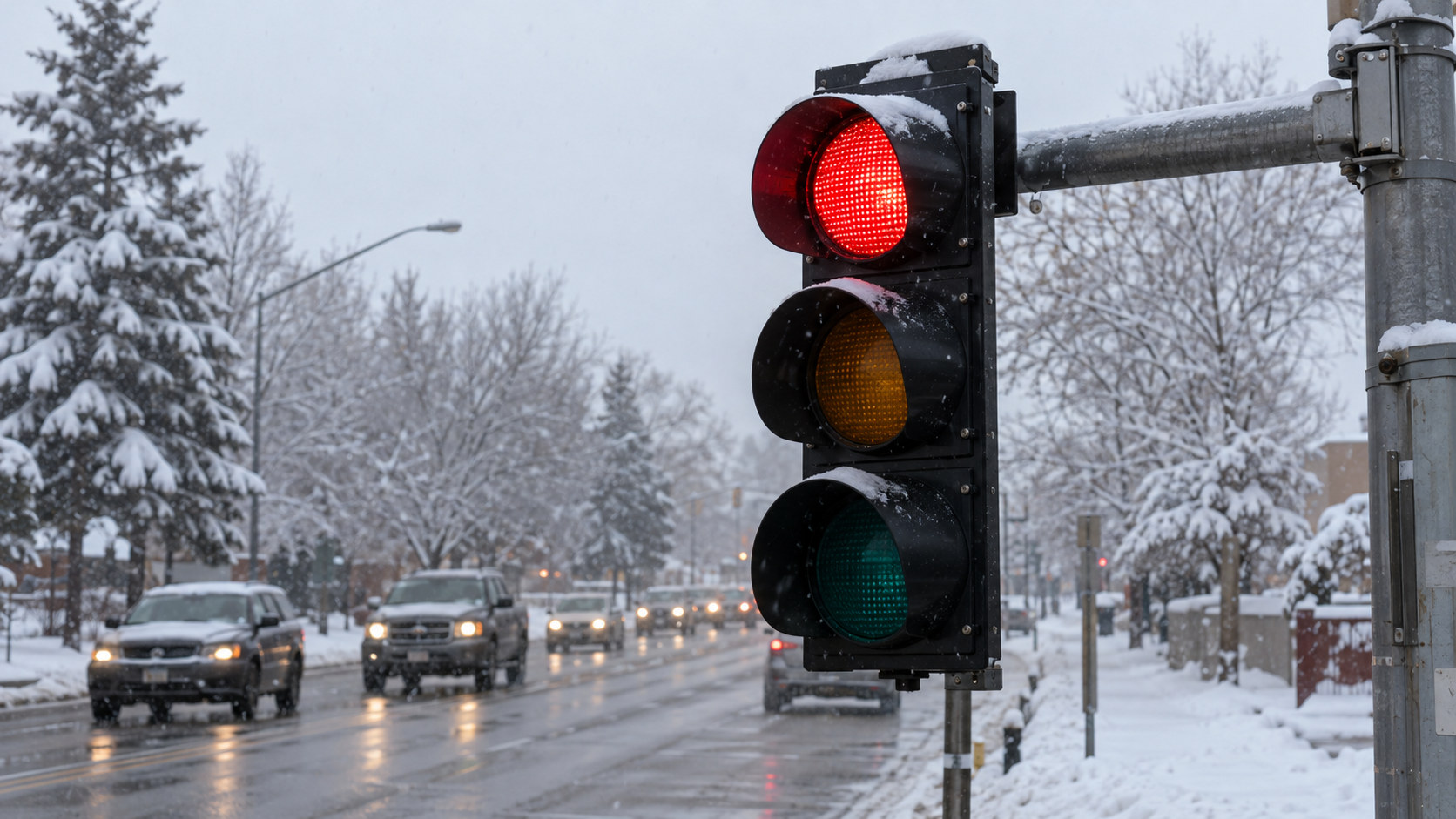
A module can remain electrically operational while its indication is partly hidden by snow. That is why an operating-temperature range and winter visibility should not be treated as the same requirement.
The reviewed IL6-P3 and SPC sheets publish an operating range of -40°C to 74°C. Those are manufacturer values for the reviewed configurations, not a guarantee of an unobscured indication in every weather condition. (LEOTEK IL6-P3 10-28 Vdc specification; LEOTEK SPC 80-135 Vac specification)
Ask what the rating describes
Identify the temperature location, operating state and supporting method. A storage range, component rating and complete module operating range are different statements.
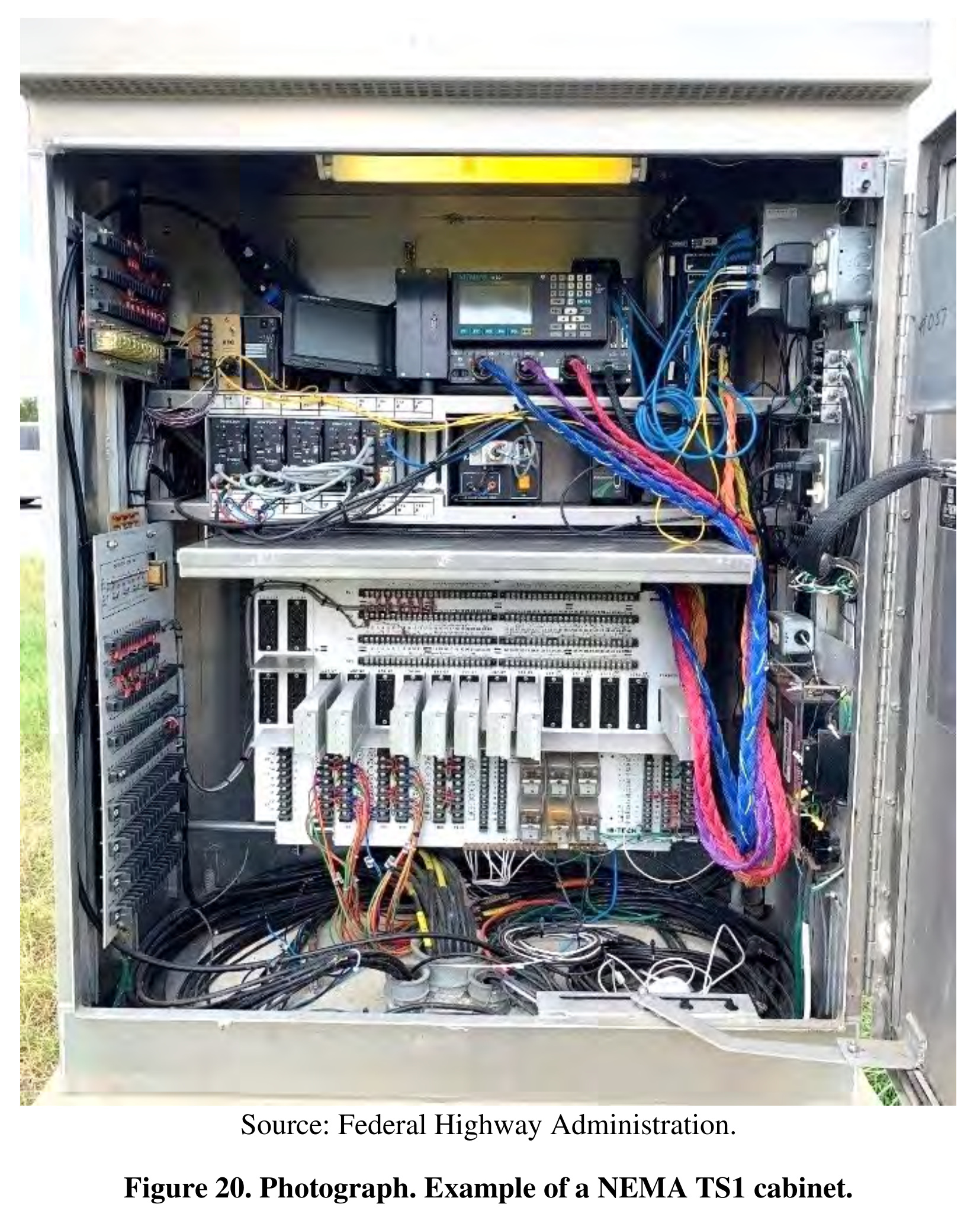
This FHWA example shows equipment inside a NEMA TS1 cabinet. It gives a temperature-rating review a concrete boundary: a controller component, an LED signal module and the cabinet installation are different items. Ask where the temperature was measured, what was operating and which performance checks covered that item.
The cabinet photograph is not a thermal test or a LEOTEK compatibility record. A cabinet-family label does not establish the operating limits of the proposed module.
Check required performance across the conditions
Request the applicable optical and electrical evidence over the conditions required by the project. Simply repeating the two endpoint temperatures does not show what was measured or which acceptance criteria were evaluated.
Keep temperature cycling, moisture exposure and operating tests distinct. A published operating range does not automatically establish completion of every environmental qualification.
Use the snow research as operational context
FHWA's 2014 snow-conditions investigation collected information from eight agencies and twelve storm events. It examined obscuration and reported countermeasures; it was not a universal qualification test of current LEOTEK modules. (FHWA LED-signal snow investigation (2014))
The report's weather observations should not be converted into a precise temperature at which every signal will become obscured. Wind, precipitation and exposure belong to the event context. The report also describes attempts such as manual cleaning and deicing; those historical examples do not establish current compatibility or a recommended treatment for an offered module.
| Context | Reported information | Interpretation |
|---|---|---|
| Study coverage | Eight agencies; twelve storm events | Historical selected cases, not a representative incidence survey |
| Air temperature | 30-32 degrees F in the anecdotal review | Observed storm conditions, not a product operating limit |
| Sustained wind | 10-38 mph | Reported event range, not a trigger for automatic treatment |
| Wind gusts | 17-48 mph | Reported event range; direction and exposure also matter |
| Relative humidity | Typically 88-93% | Anecdotal summary, not a universal icing threshold |
Historical observations from 12 storm events involving eight agencies, not universal onset thresholds.
Source: FHWA-HOP-13-010, January 2014; PDF pages 13-14 and 16-18 / printed pages 9-10 and 12-14. Read the original government source.
Event selection focused on reported lens-obscuration problems. The report says individual storms differ and precise prediction is not practical. These observations do not certify a module or establish a treatment.
Plan the two reviews separately
For product selection, obtain the documented operating and environmental evidence. For winter operation, review the agency's maintenance procedures, local exposure and approved countermeasures. That division keeps a broad 'all-weather' claim from replacing two different technical discussions.
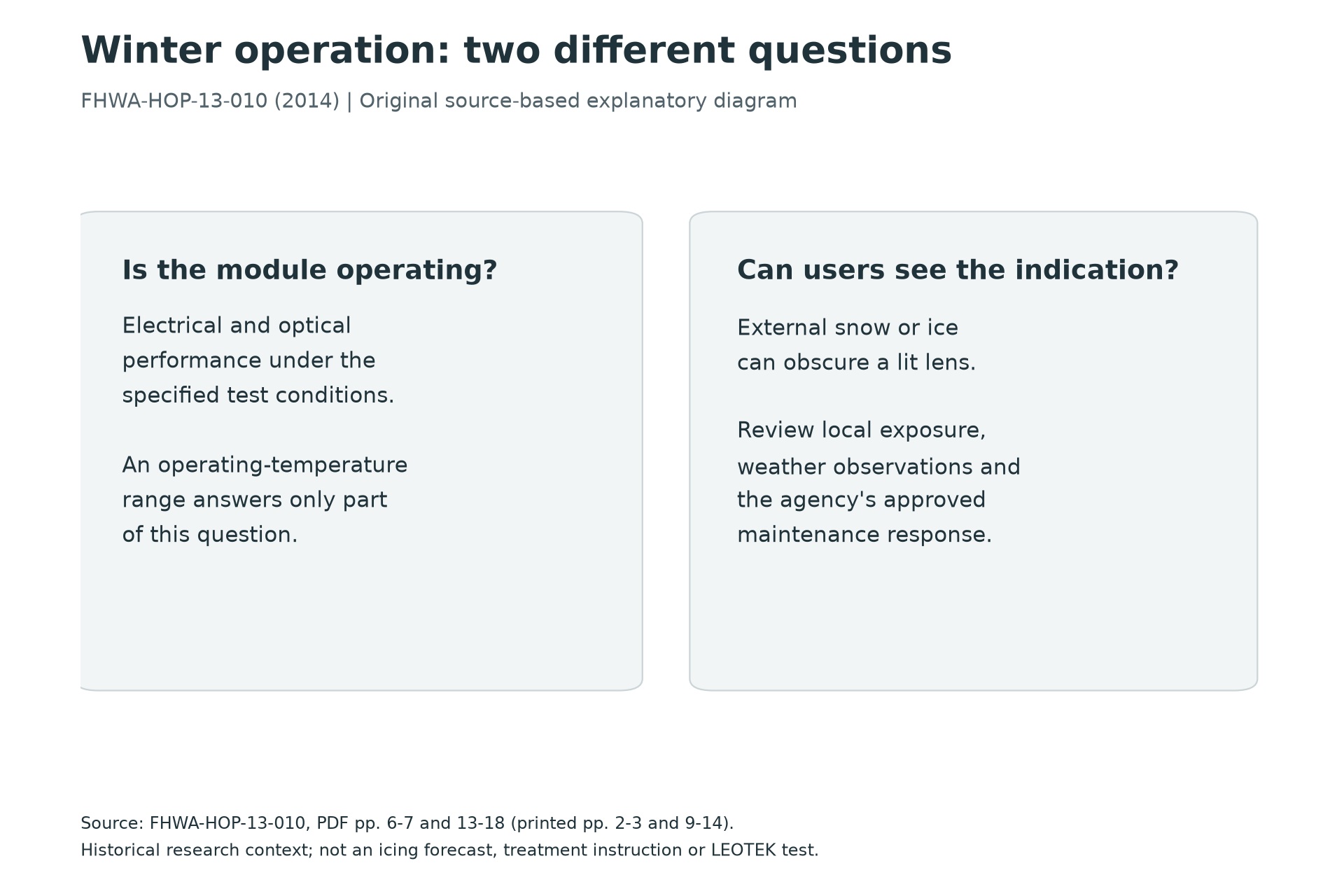
A temperature rating describes only part of the exposure
Ambient air temperature, the temperature of a component inside an enclosure, and the temperature of the visible lens surface are different variables. A data sheet may state a permitted ambient range. That statement does not, by itself, provide a measured temperature for every internal component or establish that the lens will clear frozen precipitation. The useful follow-up is to identify what was measured and what performance was checked at that condition.
Consider two illustrative operating situations. In the first, the surrounding air is very cold but dry, and the lens is clear. In the second, the air is near freezing while wind-driven wet snow accumulates on the face. The first situation can be within an electrical operating range while the second creates a visibility problem. Calling both situations low-temperature operation loses the mechanism that matters to the maintenance response.
FHWA's snow-conditions report was prepared around the LED signal snow-obscuration problem. Its workshop and event information provide operational context rather than a universal pass/fail envelope. The selected storm conditions reproduced in this article are observations from that work. They should not be turned into a rule that obscuration always begins at a particular temperature or wind speed.
Why a laboratory pass and a winter inspection can both be necessary
An environmental test exposes equipment to specified conditions and evaluates a defined result. A field inspection observes an installed system under the actual combination of weather, orientation, maintenance state and surrounding conditions. These are complementary evidence types. A test report needs its method and acceptance criterion; a field observation needs its location, time and the condition actually seen.
The historical NYCDOT Specification 65D illustrates how detailed an agency requirement can become, including environmental exposure and a blowing-rain method. It is a 2017 pedestrian-module specification, not a current universal vehicle-module requirement. Its value here is the documentation pattern: exposure, test method and acceptance belong together. A statement that a module is weather tested leaves that pattern incomplete.
For an illustrative review, create separate entries for electrical operation across the stated temperature range, optical performance under the relevant test conditions, and visibility during the local winter conditions of concern. The available evidence may be different for each entry. A module's normal operation after a cold soak cannot establish that snow never blocks its lens.
A winter event record should explain the visibility condition
Record the affected indication, orientation, observation time, precipitation type, apparent accumulation, available weather observations and the agency response. Distinguish a lens that is obscured from an indication that is electrically dark. Photograph the scene from a safe, agency-approved observation position and keep the image's purpose specific. It is a record of that event, not a replacement for an optical measurement.
The distinction improves later analysis. If all obscured signals are recorded simply as lamp failures, an agency may replace functioning modules while missing a recurrent exposure pattern. If all electrical faults during a storm are labeled snow problems, the opposite error occurs. A useful dataset preserves both the observed symptom and the confirmed diagnosis, including when the diagnosis remains unknown.
Compare mitigation with the actual problem, not the label
Any proposed winter mitigation needs a defined outcome: reduced accumulation, a supported response procedure, improved detection of obscuration, or another specifically documented function. Its energy use, maintenance burden and compatibility also belong in the review. This article does not establish that a heater, visor or other accessory is effective for a particular installation.
The technical surprise is that efficient operation and clear winter visibility are not the same performance variable. A project can legitimately require evidence for both without treating either as a contradiction. Use the manufacturer's actual operating specification for the exact module, FHWA's snow-conditions report for the scope of the reported winter issue, and the responsible agency's requirements for acceptance and response. That approach gives the owner an operational plan rather than an unsupported promise that a broad temperature range covers every weather condition.
Diagnose a winter complaint before assigning the remedy
The report that a signal disappeared during a storm can describe several different conditions. The module may be unpowered, the indication may be electrically active behind an obscured lens, or the observer may have lost the view through blowing precipitation. These possibilities can coexist. Start by preserving what was observed and what was subsequently confirmed; do not convert the initial complaint into a component-failure diagnosis.
An event record might distinguish a remote alarm time, a resident's report, the crew's arrival and the later inspection. Those times need not describe the same state. If snow moved or melted before inspection, a clear lens at arrival does not prove there was no earlier obstruction. Equally, a photograph of an obscured lens does not establish an internal electrical defect. Keep the observation and the inference in separate fields.
The selected conditions in FHWA's snow-conditions report are useful for generating questions about the event: precipitation, wind, temperature and exposure. They are not a predictive formula stating that every signal will become obscured at a particular temperature. An agency considering a mitigation needs to connect its own problem records to the proposed intervention rather than borrowing one storm's conditions as a universal design threshold.
Name the component before applying its temperature rating
The annotated cabinet example separates the controller, power supply, bus interface units, load switches, malfunction monitoring unit and field terminals. A winter complaint can involve this installed system as well as the signal module exposed outside the cabinet.
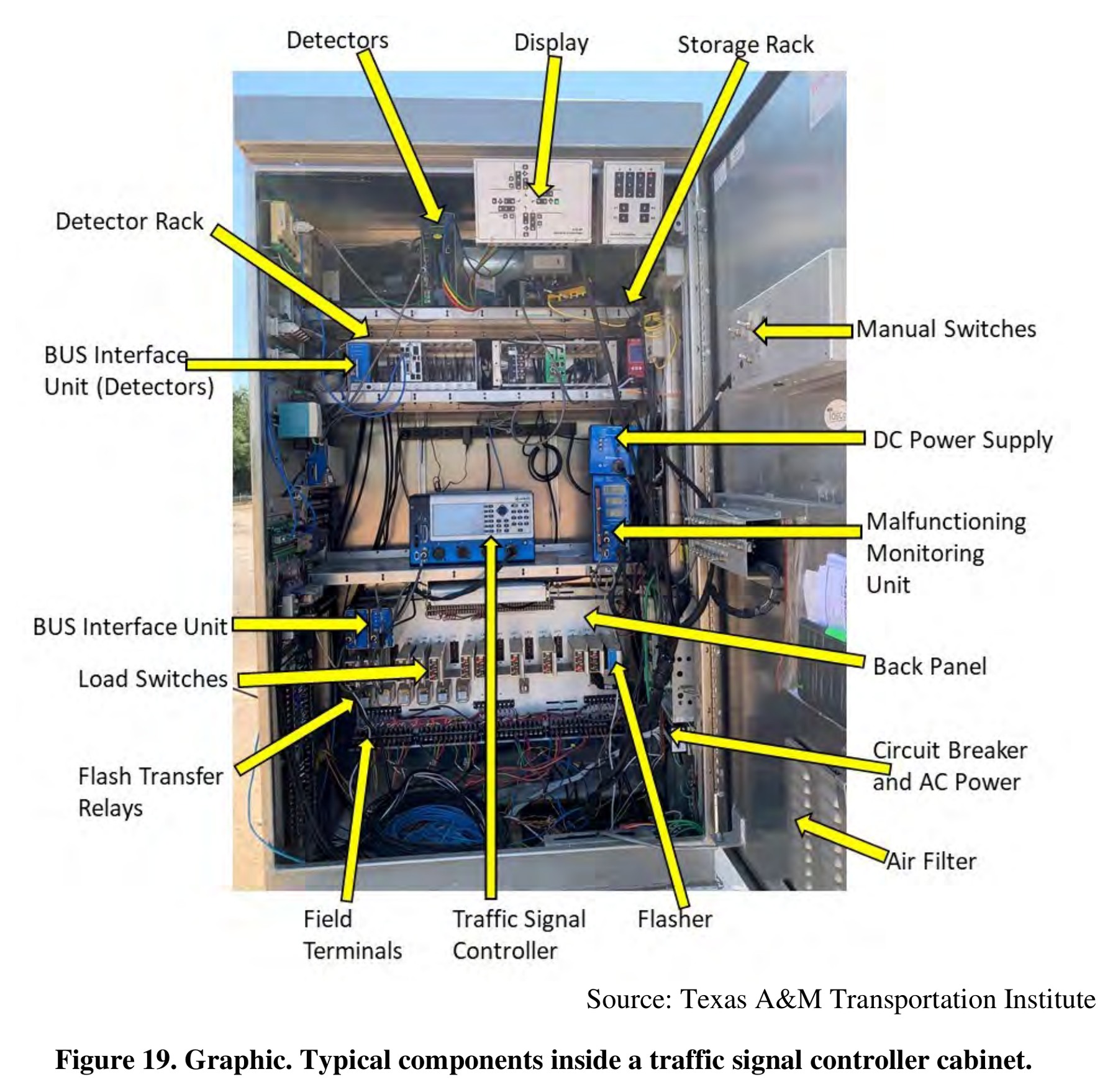
Use the labels to make the test boundary explicit: which component was tested, where was the temperature measured, and what operating state was recorded? A rating for the LED module does not establish the environmental performance of every item shown here.
The yellow arrows identify components; this is not a wiring diagram. In particular, the label “DC Power Supply” inside the cabinet does not establish the supply delivered to every field signal module. Match the ordered module, actual circuit and approved wiring documentation before interpreting an electrical or environmental claim.
Ask how long the test held the condition
An operating-range label is a boundary statement; the underlying evidence explains how performance was evaluated. Ask about stabilization, exposure duration, power state and the measurements taken during or after exposure. A test of whether a unit starts at a cold temperature asks a different question from a test of optical performance during sustained operation. Neither can be inferred solely from the other.
There is also a distinction between the input condition and the acceptance criterion. The chamber temperature identifies the imposed environment. The pass condition might concern operation, damage or another specified outcome. To understand the result, the reviewer needs both. A summary saying passed environmental testing is too compressed to explain which project question was actually answered.
The historical NYCDOT Specification 65D specification illustrates why agency requirements need to be read in context. Its stated temperatures, environmental methods and outcomes belong to that document and product category. They should not be turned into a claim that a current LEOTEK configuration passed that exact test. Ask for configuration-specific evidence when the project requires it, and identify the governing document's edition rather than merging several specifications into an invented requirement.
Compare mitigation as an operating commitment
Suppose an agency is comparing a hypothetical added mitigation with an inspection-and-response approach. The comparison should include installation, power where applicable, maintenance, access and the ability to confirm continuing function. A device added to address one exposure introduces its own support obligation. A response plan likewise has costs and depends on staffing, travel conditions and the ability to identify affected locations.
There is no meaningful financial comparison without a common problem definition. Estimate how often the relevant condition has been observed, how long it lasted and which locations experienced it. Separate the measured history from assumptions about future storms. A trial should specify the outcome it seeks to change and the observations needed to evaluate that change. A small sample of quiet weather cannot establish performance during the event that motivated the project.
The useful outcome is a documented decision about the local exposure, supported by the module's actual ratings and an operational plan. An extreme-temperature number can be a necessary procurement criterion. It becomes misleading when it is made to answer unrelated questions about snow accumulation, visibility, water entry and the agency's restoration capability all at once.
Frequently asked questions
Does -40°C operation mean snow cannot block the lens?
No. Electrical operation and external lens obscuration are different conditions. (FHWA LED-signal snow investigation (2014))
Are storage and operating temperatures interchangeable?
No. Read the stated condition and obtain the relevant evidence for energized operation.
Does the FHWA report establish a current LEOTEK snow-clearing claim?
No. It is a historical investigation of events and countermeasures, not an exact-model product test. (FHWA LED-signal snow investigation (2014))
Sources
- LEOTEK IL6-P3 10-28 Vdc specification. Revision July 1, 2019; drawing page 1, model table page 2
- LEOTEK SPC 80-135 Vac specification. Revision November 13, 2018; drawing page 1, model and standard entries page 2
- FHWA LED-signal snow investigation (2014). FHWA-HOP-13-010, January 2014; historical agency/event observations and countermeasures, not a current-model qualification
Additional research and calculation basis
- FHWA-HOP-13-010, LED Traffic Signal Snow Conditions report (January 2014)
- NYCDOT Specification 65D (June 2017); historical pedestrian-module environmental requirements
Cover image: AI-generated editorial illustration for LEOTEK. The generic scene is not a verified installation, product photograph or test record. Technical figures and tables carry their own source credits.