













An approved-products claim is useful only when the buyer can find the entry and connect it to the proposed item. Start with the agency, product category and model shown in that record. A claim that stops at 'DOT approved' leaves the approval unidentified.
Florida's Product Certification Handbook is an example of an agency-specific process. Its procedures should not be treated as a national approval system or substituted for another agency's requirements. (FDOT Product Certification Handbook)
Identify the approving authority
Ask which agency maintains the list and which project requirement calls for it. Then obtain the current entry from the agency's source. Keep the retrieval date and any limitations with the submittal.
A supplier's product page can help locate a model, but it is not the authoritative substitute for an agency's current status. Historical approval language also needs its date and scope retained.
Match the item the record describes
Compare the manufacturer, model, indication, size, voltage and relevant options. A module, complete head and controller assembly are different product boundaries. If the listing uses a broader family identifier, request the documentation explaining which variants it includes.
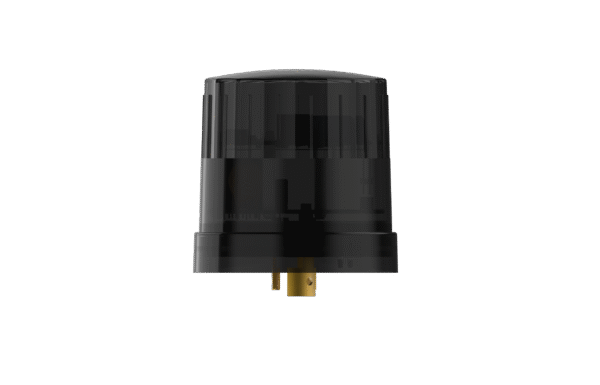
LEOTEK's IL6-P3 sheets illustrate why that comparison matters: AC and DC variants have different model codes and entries. Do not infer that an approval statement attached to one electrical version establishes the status of another. (LEOTEK IL6-P3 10-28 Vdc specification; LEOTEK IL6-P3 80-135 Vac specification)
Do not make an APL do every job
The listing and the technical submittal should tell a consistent story. An approved-products entry does not eliminate a requirement to deliver the ordered configuration or follow the project's drawings and installation requirements.
Funding-related domestic-preference documentation is another decision. Keep the applicable contract and supplier records with that review rather than assuming an APL entry settles domestic eligibility. FHWA maintains separate Buy America guidance. (FHWA Buy America guidance)
Close unresolved details before release
A short release note is enough: agency record found, offered item matched, limitations checked, and any open question assigned for resolution. If the match is not established, hold that conclusion open. Do not turn a missing entry into a claim that the manufacturer has no approvals anywhere.
The suffix can be the most important part of the model number
Imagine an illustrative bid review in which the agency entry shows one model family, the quotation includes an additional suffix, and the delivered carton carries a third code. The base name looks familiar in all three places. The technical question is what changed: voltage, indication, lens, monitoring function, revision, or merely an administrative identifier. Guessing from a shared prefix is a weak basis for releasing the order.
Build a small comparison with one column for the agency record, one for the offered item and one for the delivery identification. A mismatch should lead to the manufacturer's explanation and the agency's required disposition. Keep the explanation with the purchase, because a later receiving inspector may not have attended the original clarification meeting. The value is traceability through time, not another compliance slogan.
Agency resources also demonstrate why the word approved needs a named object. Caltrans publishes separate authorized-material resources for vehicle LED modules and pedestrian LED modules. That separation is useful context for a review: a vehicle module, pedestrian module and complete assembly should not be treated as one interchangeable category. This article does not assert that a particular LEOTEK model currently appears on either list; the actual entry must be checked for the order under review.
Approval is a dated record, while purchasing is a sequence of events
The buyer may review a list in January, receive a revised quotation in March, and accept delivery later. Preserve the date and scope of the record used for the decision. If the offered configuration changes, revisit the match. A saved page is evidence of what the reviewer saw; it is not a promise that an agency's listing will remain unchanged throughout the project.
The same reasoning applies to an agency's handbook. FDOT's Product Certification Handbook describes an agency-specific certification process. Its workflow is useful for understanding the distinction between a supplier's evidence and the authority's decision. It should not be imported into another state's procurement as though it were a nationwide approval procedure. Contract-specific questions belong with the responsible agency.
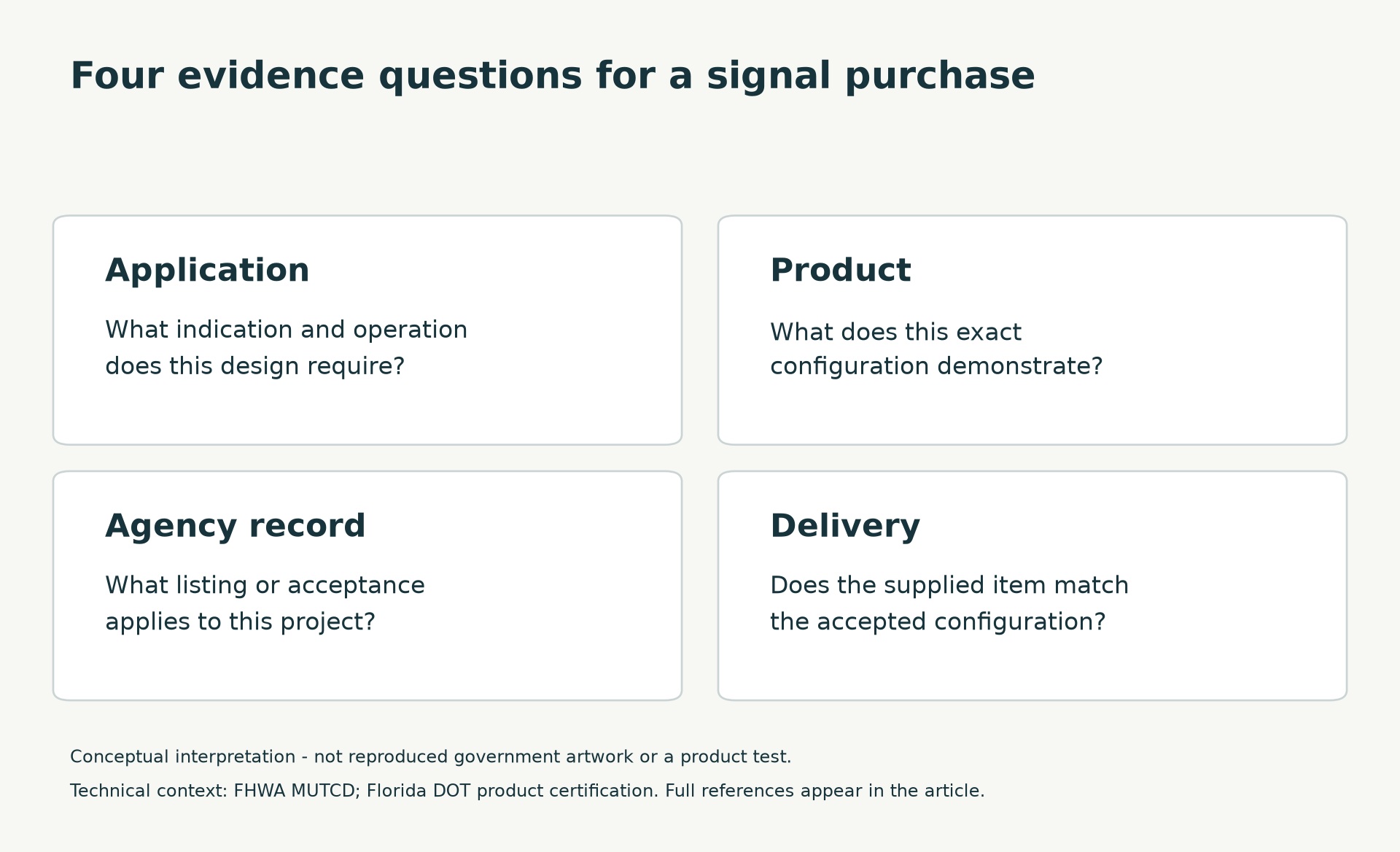
An effective record answers four practical questions: which source was checked, what item it described, why the offered item was considered within scope, and who resolved any ambiguity. A screenshot with a highlighted brand name answers only the first part. A family-level listing accompanied by a documented configuration explanation may be more useful than a collection of unrelated certificates, but the agency must determine what it accepts.
Receiving inspection is the second half of the approval review
The approved item and the delivered item can diverge after an otherwise careful bid evaluation. A substitute may be proposed because of availability, a label may use a shortened code, or an accessory may differ from the accepted package. The response should be proportional to the difference. First establish what changed and which requirement it affects; then obtain the required approval before treating the substitute as equivalent.
Consider an example with a quoted AC module and a carton labeled for a DC variant. Similar diameter and color do not resolve the electrical discrepancy. The receiving team needs the accepted order code and the manufacturer's identification record, not reassurance that both belong to the same product family. This is an illustrative mismatch, not a reported LEOTEK delivery problem.
A useful handover therefore includes the accepted submittal identifier, purchase-line description, model and revision, relevant agency record, and the person authorized to resolve substitutions. This connects the engineer's conclusion to the warehouse and field crew. It also makes future replacement easier: the maintenance team can distinguish the installed item from an earlier alternative that was considered but never accepted.
The strongest APL discussion ends with a release decision the next person can understand. It may be accepted as offered, accepted with a documented condition, or held pending clarification. Those are more actionable outcomes than a blanket statement that the brand is DOT approved. Use the current agency source for the listing itself and the supplier's configuration-specific records for the physical item.
Build the comparison around differences, not document volume
A hundred-page submittal can conceal the one difference that matters. A more useful starting point is a short exception list: the required item, the offered item, and every unresolved difference between them. For each difference, identify the document that would settle it. A voltage discrepancy needs electrical identification; a family-name discrepancy needs a configuration explanation; an expired or missing listing needs a response from the responsible authority. Another generic brochure will not answer all three.
Consider a hypothetical order for 120 red modules. The quotation matches the accepted family, but 20 units are available only in an alternative configuration. Combining both configurations under one purchase line makes receiving easier on paper and harder in practice. Separate the quantities and identification before release. If the agency accepts the alternative, retain that acceptance against its own line. If it does not, the decision should be visible before the mixed shipment reaches the warehouse.
The same method helps when documentation uses different naming conventions. A packaging code may legitimately differ from the engineering model number. Ask for the relationship in writing and retain an example of the actual label. The point is not that every character must always match every document. It is that a reviewer must be able to follow the relationship without reconstructing an undocumented conversation. That becomes especially valuable when personnel change between design, purchasing and installation.
Decide what happens when the evidence changes
Procurement reviews tend to focus on the first approval and overlook the last revision. A changed delivery date, discontinued option or manufacturer revision can reopen an earlier conclusion. Establish a practical trigger: when the offered model, electrical configuration or other accepted characteristic changes, the responsible reviewer decides whether the existing evidence remains sufficient. This is a proposed purchasing control, not a new national approval rule.
Do not confuse an agency's updated online entry with a complete explanation of an existing contract. Preserve the original basis, identify the changed information, and ask the contracting authority how it affects the order. A warehouse inspector should not be expected to settle contract interpretation from a search result. Equally, an earlier screenshot should not be used to dismiss an unresolved change in the current record.
There is a useful distinction between requesting clarification and granting equivalence. A supplier can explain that two codes identify the same construction. The party authorized under the project must determine whether that explanation satisfies the requirement. Keeping those roles visible prevents an email about availability from quietly becoming an engineering acceptance. Oregon DOT's specifications chapter provides agency-specific context for connecting specifications, bid items and estimates; the actual decision route still belongs to the project.
Keep enough evidence to make the next replacement easier
The installation record should carry forward the accepted configuration, not just the brand. For a future failure, maintenance needs to know what was actually installed, which item is compatible, and whether an earlier substitute was rejected or accepted. Retaining every rejected brochure without identifying the selected configuration can make the archive less useful than a short, well-indexed record.
A practical handover can link the installed asset to its purchase line, accepted submittal, model photograph and relevant agency record. Record the installation date separately from the approval-list retrieval date: they describe different events. If several intersections share one purchase, connect the deployed quantities to their locations rather than assuming all cartons went to the same project. This is consistent with the inventory and materials-management questions discussed in FHWA's asset-management primer, Chapter 4.
The commercial benefit is reduced uncertainty when time is short. A buyer seeking an urgent replacement should be able to distinguish a compatible stocked spare from an alternative still requiring review. The APL entry remains important, but its value increases when it is connected to the item, quantity and location that the agency actually owns. That connection is what turns an approval check into a maintainable purchasing record.
Frequently asked questions
Does approval in one state establish approval everywhere?
No. Review the responsible agency and the actual record for the project. (FDOT Product Certification Handbook)
What if the model number has an extra suffix?
Determine what the suffix changes and obtain evidence that the listed scope covers it. Do not ignore the suffix or declare it unacceptable without review.
Can a manufacturer brochure replace the current list?
Use the agency's current record for the listing conclusion. A brochure is supporting context.
Sources
- FDOT Product Certification Handbook. Effective May 1, 2026; agency-specific process; chapter revisions differ
- LEOTEK IL6-P3 10-28 Vdc specification. Revision July 1, 2019; drawing page 1, model table page 2
- LEOTEK IL6-P3 80-135 Vac specification. Revision December 12, 2018; drawing page 1, model table page 2
- FHWA Buy America guidance. Construction Program Guide and linked current rules/Q&As; accessed October 17, 2026; project applicability requires its governing documents
Additional research and calculation basis
- Caltrans authorized-material resource for vehicle LED modules; verify the current entry
- Caltrans authorized-material resource for pedestrian LED modules; verify the current entry
- Florida DOT, Product Certification Handbook; agency-specific process
- FHWA, MUTCD 11th Edition with Revision 1 (December 2025)
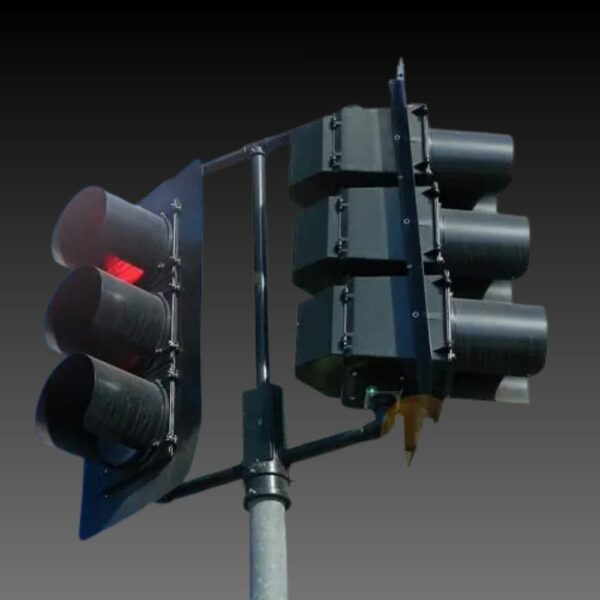
Cover image: AI-generated editorial illustration for LEOTEK. The generic scene is not a verified installation, product photograph or test record. Technical figures and tables carry their own source credits.