







A useful MUTCD review should change a decision: the indication size, the display arrangement, the countdown sequence or the evidence requested with a submittal. Simply adding 'MUTCD compliant' to a product description leaves those decisions unresolved.
FHWA identifies the 11th Edition with Revision 1, dated December 2025, as its current official publication. For a project, also identify the agency's applicable manual, supplement and contract documents. Then take the relevant provisions into the design and product comparison. (FHWA current MUTCD edition)
New vehicle signal faces: start with the 12-inch rule
Section 4E.02 requires 12-inch indications for all arrows. For circular indications in new signal faces, 12 inches is also the rule, subject to the section's listed exceptions for 8-inch indications. (MUTCD Section 4E.02)
The exceptions are bounded applications, not a general choice between two catalog sizes. For example, the low-speed provision also requires the face to be less than 120 feet from the stop line. A summary that keeps the speed condition but drops the distance condition can lead to the wrong selection.
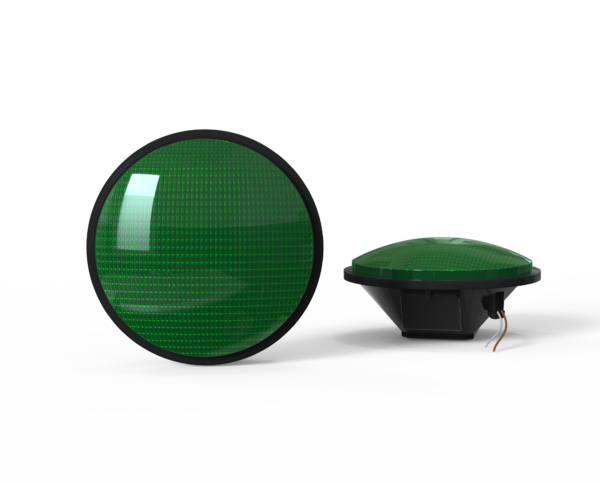
Resolve that application question before comparing the proposed module with the housing. Nominal lens size, outside diameter and overall depth describe different things. The LEOTEK IL6-P3 drawings provide separate values for them; none is the complete installed signal-head envelope. (LEOTEK IL6-P3 10-28 Vdc specification; LEOTEK IL6-P3 80-135 Vac specification)
| Module | Outside diameter (mm) | Body depth (mm) | Drawing overall depth (mm) |
|---|---|---|---|
| IL6-P3 8-inch circular | 212 | 68.5 | 111.3 |
| IL6-P3 12-inch circular | 305.4 | 107.1 | 157.2 |
Dimensions transcribed from the reviewed IL6-P3 drawings; units are millimetres.
Source: LEOTEK IL6-P3 AC and DC sheets, page 1. Original source 1, Original source 2
Module inserts only. These are not complete signal-head, visor or bracket dimensions. Nominal diameter does not establish a permitted application.
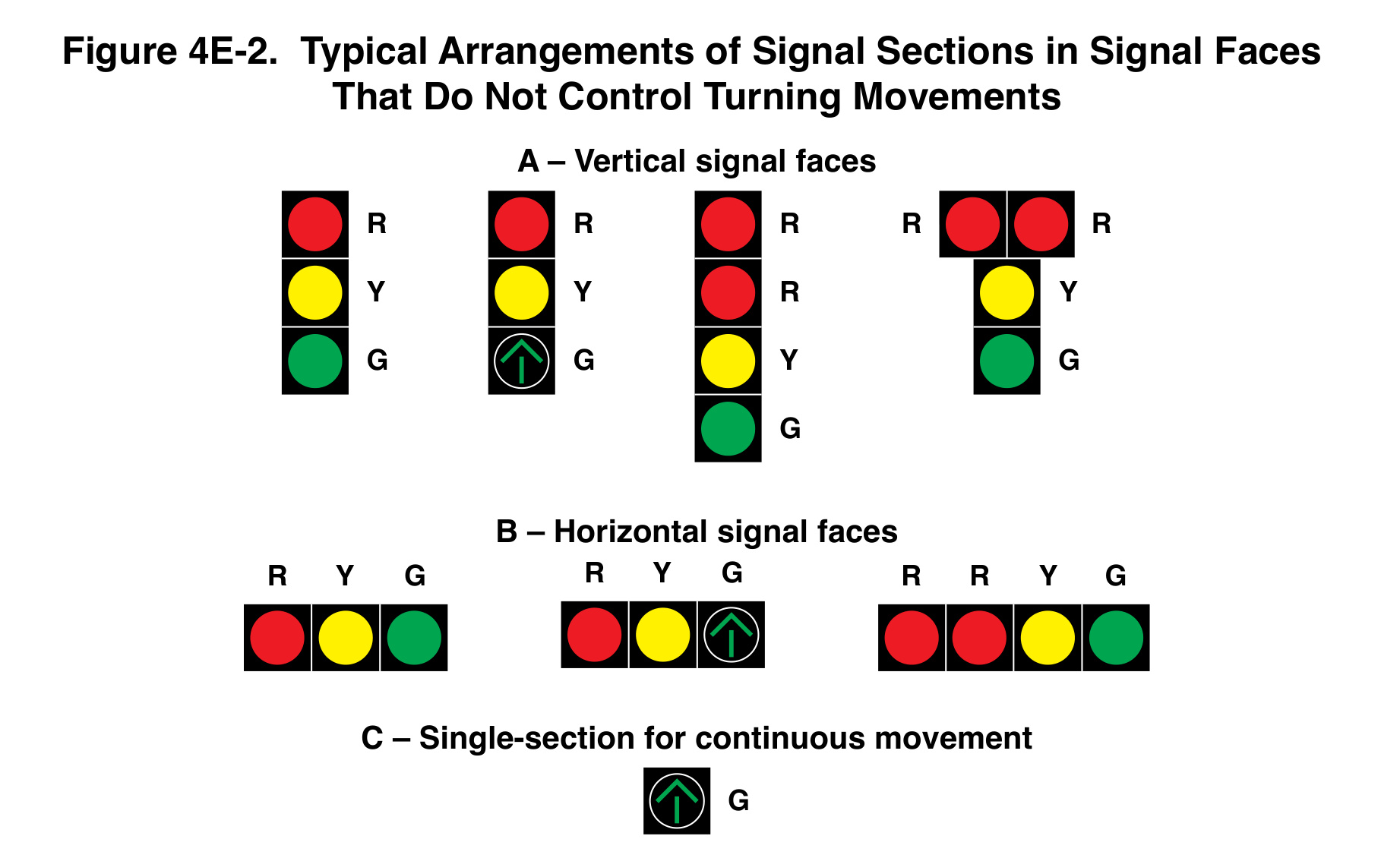
The vertical and horizontal examples preserve the relative positions of the red, yellow and green indications while using different face arrangements. The single-section example has a separate continuous-movement application. These are arrangement illustrations, so their apparent proportions should not be used to select an 8-inch or 12-inch module. Establish the required indication size under Section 4E.02, then verify the offered module and complete housing dimensions separately.
Pedestrian displays: check operation as well as appearance
Section 4I.04 requires a countdown when the pedestrian change interval exceeds seven seconds, and permits one at seven seconds or less. The numbers operate with the flashing upraised hand. They are not used during WALK, and after zero the countdown remains dark until the next countdown starts. The section also addresses the specified concurrent-vehicle red-clearance interval. (MUTCD pedestrian control provisions)
Those rules belong in the sequence check. A countdown that looks bright and readable can still start or end at the wrong point. Compare it with the approved controller timing and the intended transition behavior; do not infer correct operation from a still photograph.
| Condition | Display | Provision | Paragraph |
|---|---|---|---|
| Pedestrian change interval >7 seconds | Countdown required | Standard | 4I.04.01 |
| Pedestrian change interval <=7 seconds | Countdown permitted | Option | 4I.04.02 |
| WALK interval | Countdown not used | Standard | 4I.04.06 |
| Flashing upraised hand | Countdown displayed simultaneously; counts remaining change-interval seconds | Standard | 4I.04.03, .05-.06 |
| After zero | Countdown remains dark until next countdown begins | Standard | 4I.04.05 |
| Specified concurrent-vehicle red-clearance interval | Countdown not used | Standard | 4I.04.06 |
| Pedestrian entry >100 feet from countdown | Numbers at least 9 inches high recommended | Guidance | 4I.04.08 |
| Change interval interrupted or shortened for preemption transition | Countdown should discontinue and go dark immediately | Guidance | 4I.04.10 |
A source-based operational summary. Standard, Option and Guidance are retained as distinct provision types.
Source: MUTCD Sections 4I.04.01-10, PDF pages 760-761 / printed pages 719-720. Original source 1
Not a controller timing plan or installation instruction. Change interval is not the total pedestrian clearance time. Apply the project's governing documents.
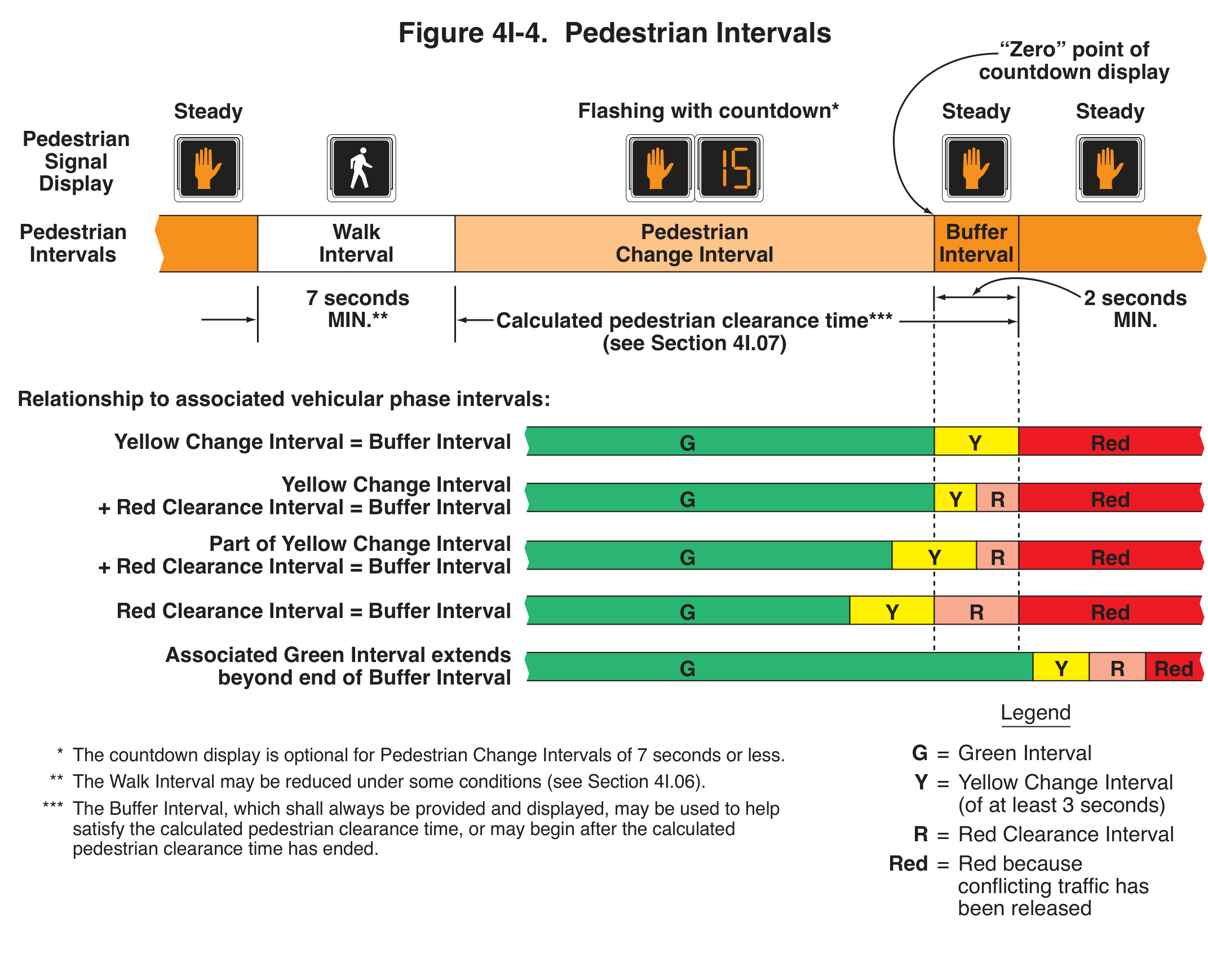
The countdown belongs to the pedestrian change interval, shown with the flashing hand. The zero point marks its transition to the steady-hand buffer interval. Notice that the calculated pedestrian clearance time is identified separately: it should not be treated as another name for the countdown interval. The lower examples show several possible relationships with the associated vehicle phases. Their legend and footnotes are essential to interpreting the colored bars; this figure is an operating explanation rather than a project timing plan.
Separate mandatory provisions from recommendations
The manual labels Standard, Guidance and Option provisions. Preserve those distinctions when turning them into a specification or FAQ.
For example, pedestrian symbols have a six-inch minimum under Section 4I.02. For a pedestrian entering the crosswalk more than 100 feet from the indications, the manual recommends symbols at least nine inches high. Countdown-number height has its own corresponding provisions in Section 4I.04. Describing every nine-inch provision as a universal mandatory minimum changes the meaning. (MUTCD pedestrian control provisions)
A module's family name does not answer these dimensional questions. For SPC, the reviewed AC sheet distinguishes the 455-by-405-mm envelope from the nine-inch countdown digits. (LEOTEK SPC 80-135 Vac specification)
High-speed approaches: review the complete face arrangement
Figure 4D-1 addresses approaches with a posted, statutory or 85th-percentile speed of 45 mph or higher. It shows one possible lane arrangement. Its first note directs the reader to Table 4D-1 when the number of through lanes differs, so the drawing should not be copied as a universal intersection layout.
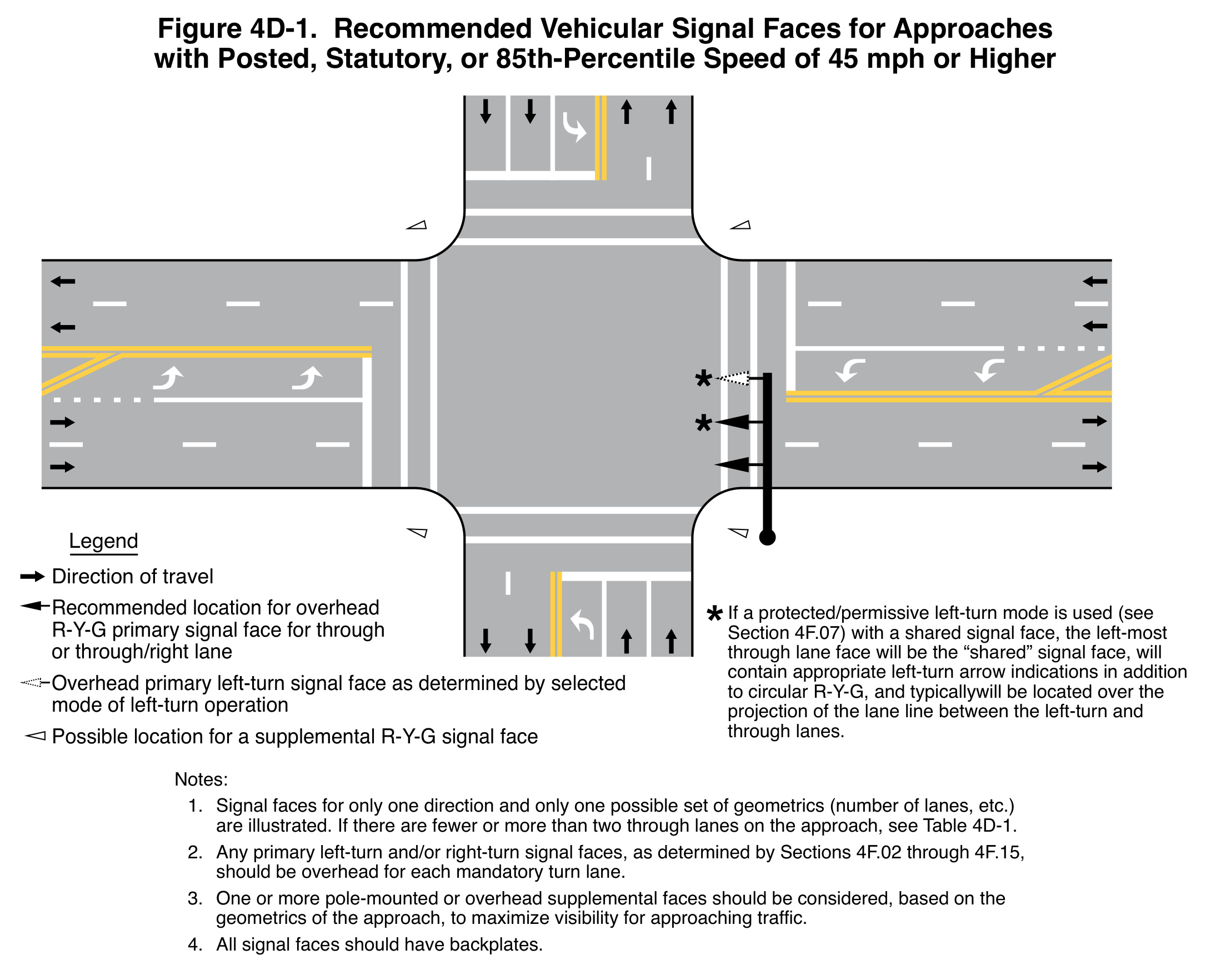
The figure’s notes connect turn-lane faces, supplemental faces and backplates to the approach geometry and visibility review. A useful drawing review therefore asks which movement each face serves and whether the proposed locations address the actual approach. Those installation questions remain even when the offered module has a complete specification sheet. Keep the distinction between the manual’s stated requirements and recommendations, and apply the governing agency’s project criteria.
Product evidence has a different job
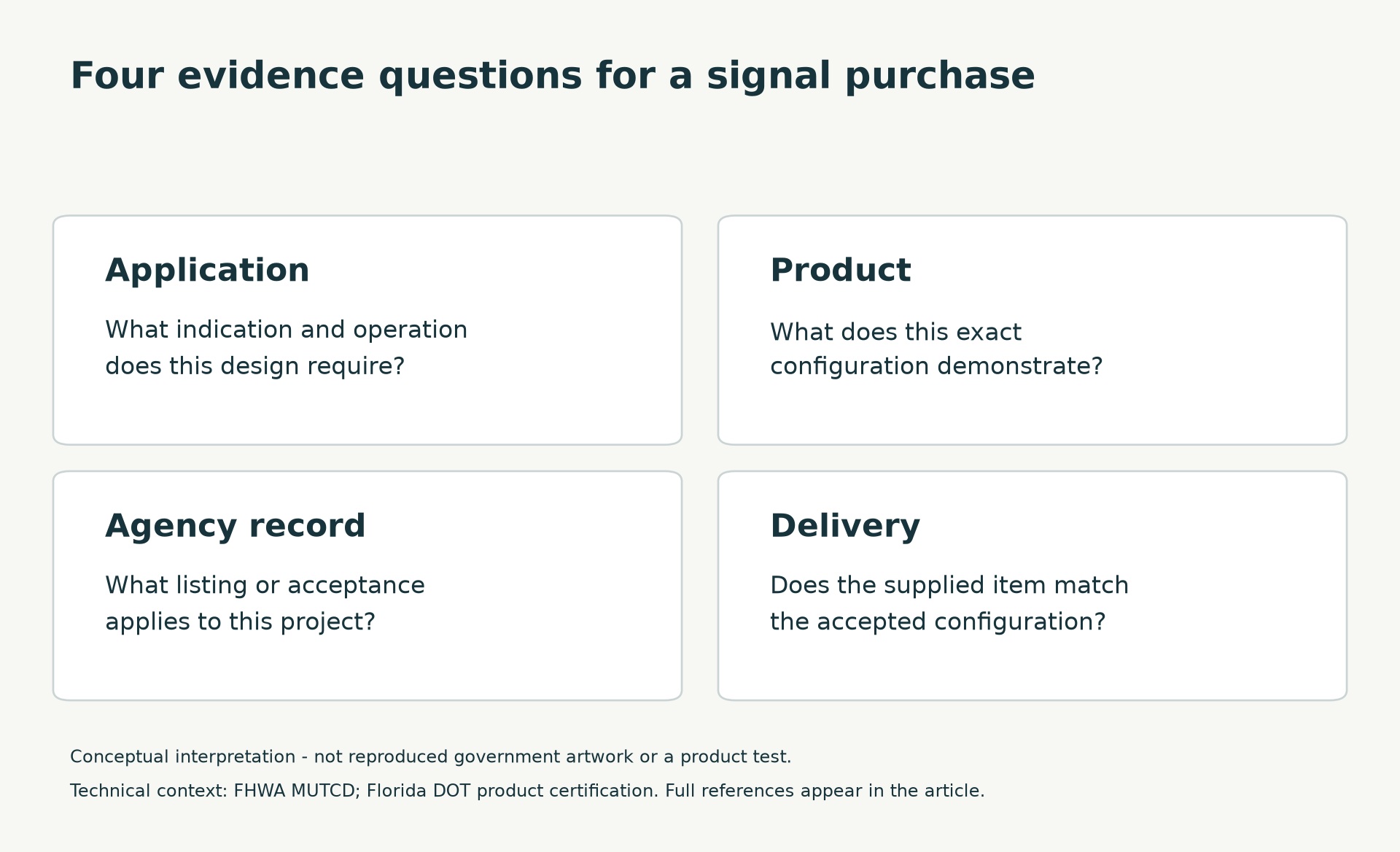
The MUTCD application rule and a component's performance record answer different questions. The first can establish the indication a design needs. A drawing establishes physical fit. The required optical, electrical and environmental records establish what is documented for the offered product. Agency acceptance, where required, needs its own current record.
An ITE edition reference deserves the same attention as an order code. The reviewed SPC sheet cites the August 4, 2010 pedestrian LED module specification; the MUTCD display-design provision refers to the 2011 ITE publication. Ask for evidence addressing the required edition instead of assuming the two dates are interchangeable. The older sheet alone does not settle that question. (LEOTEK SPC 80-135 Vac specification; MUTCD pedestrian control provisions)
Turn the review into a short, usable submittal
Keep the package organized around the decisions: the adopted design requirement; the indication and operating sequence; the offered order code; the dimensional drawing; the matching performance records; and the agency's acceptance route. Put a source beside each technical conclusion rather than repeating a general compliance paragraph after every section.
For LEOTEK product support, begin with the model, voltage, indication, options and the drawing or report in question. That gives the technical discussion something specific to resolve.
Why a technically impressive module can still be wrong for the project
Consider an illustrative replacement review. The purchasing record identifies an eight-inch red module, the supplier provides a dimensional drawing, and the proposed insert fits the existing opening. Those facts resolve a physical-fit question. They do not resolve whether the work is a maintenance replacement, a new signal face, or a design change requiring a different application review. The inexpensive part of the decision is the insert; the expensive consequence can be discovering the wrong design basis after equipment has been ordered.
The useful review therefore starts with the scope of work. Identify the applicable national provisions, agency adoption or supplement, and project requirements. Write the intended indication and installation on the same sheet. When those records disagree, the disagreement becomes an engineering action rather than a purchasing assumption. This is a proposed review method, not an additional MUTCD requirement or a description of a particular agency's approval process.
Four evidence layers then become easier to distinguish. The manual addresses use of traffic-control devices. The product drawing addresses the offered physical configuration. Optical and electrical records address specified component performance. The agency's acceptance record addresses its own procurement or project process. A strong result at one layer cannot repair a missing answer at another. The MUTCD and the separate agency design process illustrated in Oregon DOT's specifications chapter are useful starting points for organizing those documents.
Turn a countdown photograph into an operating question
A still image can show an orange hand and a number. It cannot establish whether the number started at the correct interval, whether it counted the intended remaining time, or whether it went dark at the required transition. Those are sequence questions. They need the governing operational provisions and observations through the relevant transitions, rather than a comparison of two attractive photographs.
Suppose a project has a pedestrian change interval longer than seven seconds. The countdown requirement is one decision. The digits, symbols, mounting, visibility, electrical configuration and approved timing are additional decisions. Increasing digit size does not correct an incorrect sequence; changing a module's voltage option does not determine the pedestrian clearance time. Keeping the decisions separate makes the reason for each requested record apparent to both the designer and the supplier.
For a review exercise, prepare a sequence sheet with the named controller intervals, the expected pedestrian indication during each interval, the countdown's expected state, and the observation result. Include the transition into and out of the change interval. Record the actual model and switch configuration used. This proposed documentation method translates MUTCD pedestrian control provisions into an inspectable discussion without pretending that this article is a timing plan or commissioning procedure.
A useful submittal has a place for unresolved questions
One practical improvement is to give every requirement a disposition: supported, not applicable with a reason, or unresolved with an owner. A file containing many PDFs can still be incomplete if nobody knows which report supports the offered configuration. Conversely, an explicitly unresolved edition or model-suffix question is manageable when it is assigned before procurement release.
For example, a specification may cite a particular ITE edition while the available product sheet cites another date. The correct next step is to request the relevant evidence and clarify the project requirement. It is not to silently replace one date with the other, nor to declare that the product fails every requirement. The distinction matters because a gap in the available documents and a demonstrated test failure are different findings.
This is where an experienced review adds value: it reduces ambiguity without inventing certainty. The final package should allow another reviewer to reconstruct the selected application, the exact item offered, the documents relied on, and any conditions still awaiting approval. An agency-specific bid-item and specifications chapter such as Oregon DOT's specifications chapter helps illustrate why design, documentation and procurement need to remain connected. It does not establish a universal national submittal format.
Put the unresolved decision on the drawing review agenda
Before procurement, ask the reviewer to finish one sentence: this item is acceptable for this application because the cited provision and supporting record establish the following facts. An answer that stops at a manufacturer name leaves the application unexplained. An answer that identifies the indication size, intended operation and configuration gives the purchaser something specific to buy.
Use the same exercise when the documents disagree. Record which requirement controls, who resolved the conflict and which drawing or submittal revision carries the decision. This brief explanation can prevent a later substitution from recreating the original ambiguity. It also keeps the article's checklists in their proper role: aids to a documented engineering review, rather than substitutes for the responsible designer's judgment.
Frequently asked questions
Does the MUTCD certify a particular LED module?
It supplies traffic-control-device application and operational requirements. A component claim still needs its applicable product evidence, and project acceptance remains a separate decision.
Are the latest national manual and the project's document set always identical?
Do not assume they are. Record the FHWA publication, applicable agency adoption or supplement, and contract requirements so the design review has an identified basis. (FHWA current MUTCD edition)
What should a practical MUTCD checklist contain?
The provisions that change the selected indication or its operation, their Standard/Guidance/Option status, and the separate evidence needed for the offered product. Avoid treating one family-level statement as the complete submittal.
Sources
- FHWA current MUTCD edition. Official current-edition page, checked October 17, 2026
- MUTCD Section 4E.02. 11th Edition with Revision 1, PDF page 718 / printed page 677
- MUTCD pedestrian control provisions. Sections 4I.01-4I.04, PDF pages 759-761 / printed pages 718-720
- LEOTEK IL6-P3 10-28 Vdc specification. Revision July 1, 2019; drawing page 1, model table page 2
- LEOTEK IL6-P3 80-135 Vac specification. Revision December 12, 2018; drawing page 1, model table page 2
- LEOTEK SPC 80-135 Vac specification. Revision November 13, 2018; drawing page 1, model and standard entries page 2
Additional research and calculation basis
- Oregon DOT, 2026 Signal Design Manual, Chapter 19: Specifications, Bid Items and Cost Estimate
- FHWA, MUTCD 11th Edition with Revision 1 (December 2025)
- Florida DOT, Product Certification Handbook; agency-specific process
- MUTCD pedestrian control provisions, Sections 4I.01-4I.04
Cover image: AI-generated editorial illustration for LEOTEK. The generic scene is not a verified installation, product photograph or test record. Technical figures and tables carry their own source credits.