















A citywide streetlight conversion is more manageable when it is treated as an asset, procurement, and operations program rather than a bulk fixture purchase. Start with a trusted baseline, phase work against transparent priorities, define evidence requirements before award, and hand complete asset data into operations at each phase close.
The sequence below is a practical roadmap, not a universal engineering or procurement standard. The responsible agency, qualified project team, and applicable jurisdiction should set the design, electrical, traffic-control, accessibility, environmental, and procurement requirements for the project.
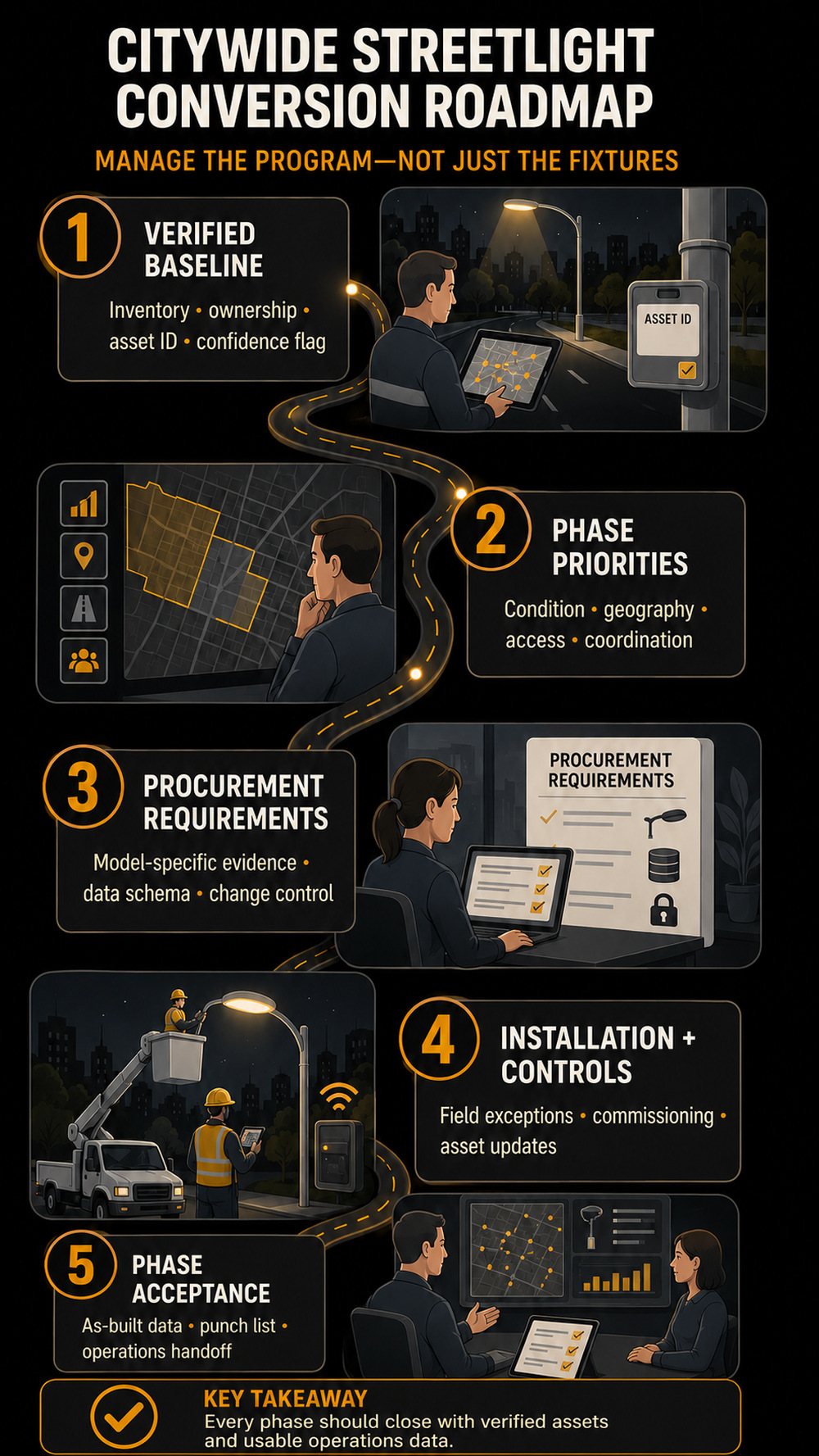
Use five repeatable steps:
-
Establish a verified baseline.
Build a reliable inventory of the existing streetlight system before defining the conversion scope. Record each asset’s location, fixture type, wattage, mounting configuration, pole condition, electrical service, control type, ownership, maintenance history, and known safety or performance issues. Field verification should be used to resolve missing, outdated, or conflicting records. This baseline becomes the foundation for budgeting, photometric design, procurement quantities, installation planning, energy calculations, and future asset management.
-
Set transparent phase priorities.
Divide the conversion into manageable phases using clearly documented criteria. Priorities may include public safety, fixture failure rates, energy consumption, maintenance burden, roadway classification, neighborhood equity, pedestrian activity, environmental sensitivity, planned construction, and opportunities to coordinate with other infrastructure work. Publishing the prioritization method helps agencies explain why certain areas are addressed first and allows progress to be measured consistently across the city.
-
Define procurement and data requirements.
Translate operational needs into measurable procurement requirements before issuing a solicitation. Specifications should address lighting performance, optical distribution, color temperature, glare control, electrical protection, control compatibility, expected service life, warranty coverage, testing, certifications, spare parts, and manufacturer support. The procurement documents should also define the asset data, submittals, installation records, commissioning evidence, and file formats that contractors must provide. Clear acceptance criteria reduce ambiguity and make competing proposals easier to compare.
-
Coordinate installation, controls, and records.
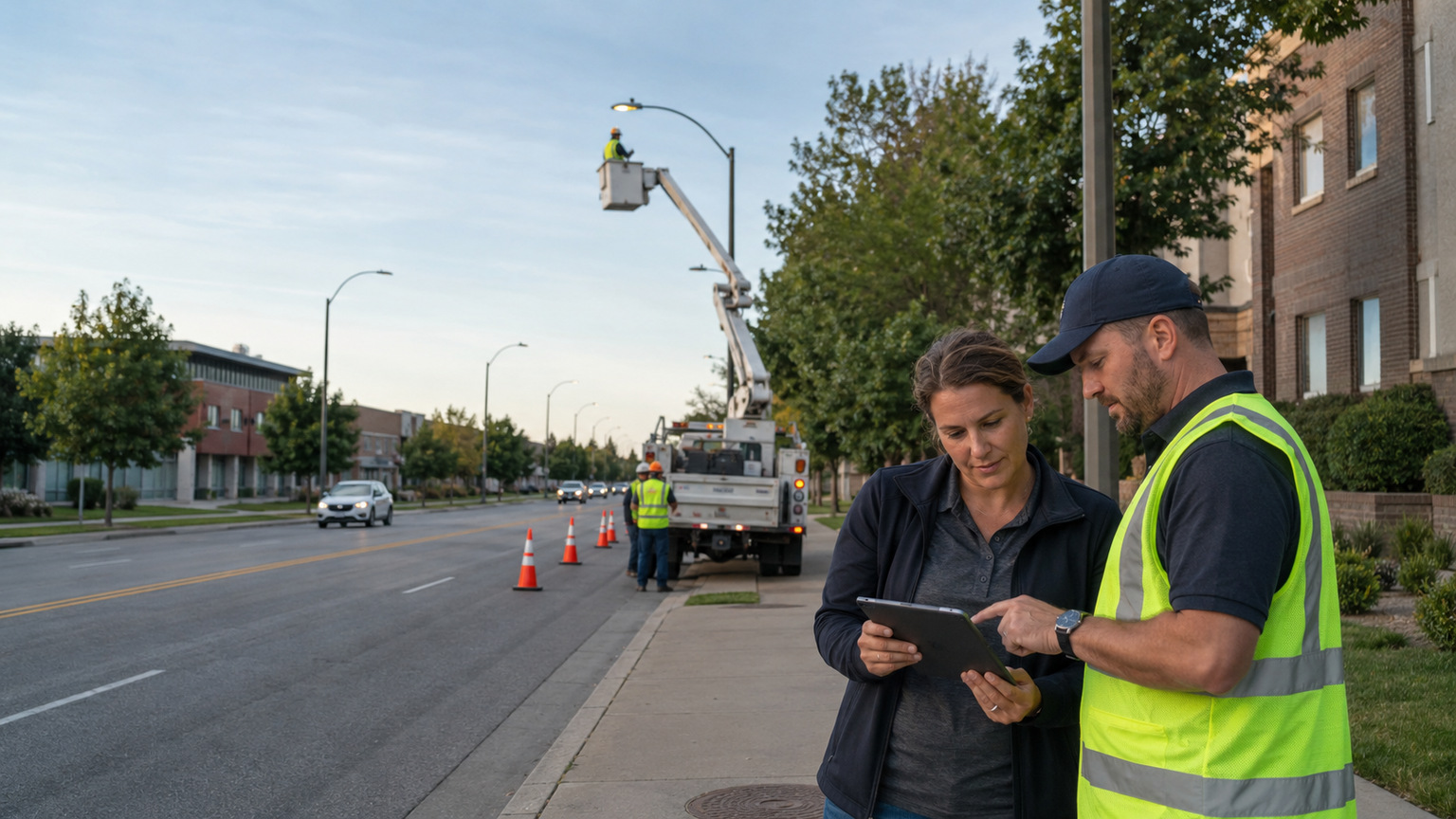
Treat field installation, networked controls, and asset-data updates as one coordinated workflow. Crews should work from approved asset lists and document the equipment installed at each location, including fixture model, wattage, control device, serial number, installation date, settings, and any field changes. Traffic control, utility coordination, resident communication, environmental restrictions, and access requirements should be planned in advance. If connected controls are included, device provisioning, communications testing, alarm verification, and integration with the management platform should occur alongside installation.
-
Verify performance and complete the operational handoff.
Close each phase with documented inspection, testing, and record reconciliation. Confirm that installed equipment matches the approved design and procurement requirements, controls communicate correctly, lighting performance is acceptable, deficiencies are resolved, and warranties and spare-parts obligations are recorded. Final asset data should be transferred into the agency’s asset-management and maintenance systems before the phase is considered complete. Lessons from each completed phase can then be used to improve specifications, schedules, field procedures, and community communication for the next phase.
Key takeaways
- Build an inventory with a stated confidence level before using it as a procurement baseline.
- Divide the citywide streetlight conversion into packages that reflect asset condition, geography, access, and local constraints, not just fixture count.
- Specify the evidence, data fields, and acceptance checks required at phase close before selecting a contractor or equipment.
- Decide early whether connected controls are in scope, then define commissioning and data-governance responsibilities alongside installation work.
- Preserve a usable as-built record so maintenance teams inherit verified asset information rather than a disconnected project spreadsheet.
Start with a program charter and a reliable baseline
The first deliverable is not a luminaire schedule. It is a program charter that identifies what the city is converting, who owns the decision points, and what information must be available to make those decisions. A useful charter establishes the limits of the program: city-owned assets, utility-owned assets, leased systems, decorative lighting, roadway lighting, and any locations that need separate treatment.
It should also name the roles that will review technical design, procurement, operations, finance, public communication, and field acceptance. That does not make the process slow. It makes later trade-offs visible. For example, a corridor may be easy to access but still require a different review path because its records are incomplete, its ownership is uncertain, or work must be coordinated with another capital project.
Build an inventory that can support decisions
A municipal lighting roadmap needs an asset record that is useful to both procurement and operations. Begin with available geographic information system records, maintenance records, utility information, and prior project files, then identify what must be verified in the field. Treat historic records as inputs, not confirmed conditions.
At a minimum, establish the fields the project needs for each asset, such as:
- location and a stable asset identifier;
- ownership and responsible operating party;
- pole, arm, and luminaire attributes recorded in available documents or field observations;
- apparent condition, access constraints, and known maintenance status;
- service or electrical information where available and appropriate for the project team to verify;
- existing controls status and any known communications dependencies; and
- a confidence flag showing whether the record was documented, field-verified, or still unknown.
The confidence flag matters. It prevents the team from treating a missing pole attribute or uncertain service record as a settled fact. It also gives planners a way to package verification work before an uncertainty becomes a field change, a schedule problem, or an unsupported assumption in a bid comparison.
Set success measures without promising outcomes
The program team can define completion measures without predicting savings or safety results. Examples include the share of in-scope assets with verified records, the share of installed assets with complete as-built data, punch-list closure time, or the number of exceptions resolved before phase close. These are project-management measures, not claims that a conversion will produce a particular financial, lighting, or public-safety result.
Where a project requires lighting criteria, the team should identify the governing agency criteria and the applicable editions of relevant resources before fixture selection. The Illuminating Engineering Society standards program describes its consensus-based standards and lighting resources. That is a starting point for identifying references, not a substitute for project-specific design review.
Prioritize phases using transparent decision criteria
Once the baseline is credible enough to plan from, the next question is not simply which fixtures are oldest. A phased LED upgrade should group work in a way that gives the city control over risk, field access, and learning.
Separate urgent repair or reliability work from planned conversion packages whenever the program rules allow. Emergency conditions often need a different response path than a scheduled replacement program. Combining them without a clear rule can distort the schedule, obscure the conversion baseline, and make it hard to compare what was installed with what was planned.
Choose phase boundaries that work in the field
A phase can be organized by geography, asset condition, access windows, corridor type, neighborhood considerations, or coordination with paving and utility work. The right combination is local. A city may choose a pilot or early package to test its data workflow and acceptance process, then use the findings to refine later packages. That is different from presenting the pilot as proof of a system-wide outcome.
Document urgent reliability, access, or other agency-defined risk concerns separately so they do not disappear inside a routine conversion package. The program can then assign the correct response path without treating every exception as evidence that the planned package has failed.
For each proposed package, record why it is grouped together and what is still uncertain. A simple decision table can make the work auditable:
| Phase decision | Evidence to review | Responsible role | Phase output |
|---|---|---|---|
| Confirm scope | Asset records, ownership information, exclusions | Program owner | Approved package boundary |
| Confirm field readiness | Access constraints, verification needs, coordination items | Field and operations leads | Field plan and exception list |
| Confirm technical requirements | Project-specific design and submittal requirements | Qualified technical reviewers | Procurement-ready requirements |
| Confirm closeout | Installation records, inspections, data delivery, punch list | Owner’s acceptance team | Accepted as-built dataset |
This table is an implementation aid, not a compliance checklist. Agencies should add their own authority, approval, and documentation requirements.
Preserve local review points
Roadway, neighborhood, and public-space conditions may call for different decisions about distribution, shielding, color characteristics, mounting, or controls. Those decisions should remain with the qualified project team and the applicable agency process. A citywide roadmap can identify when those reviews occur without declaring that one setting or configuration fits every street.
When readers need category-level orientation during that process, outdoor lighting applications provide a path to relevant lighting categories. Category pages should not replace exact model documentation, project photometry, or jurisdictional review.
Turn the roadmap into procurement-ready requirements
Procurement language is where a city turns its roadmap into enforceable expectations. The objective is not to prescribe a brand through broad claims. It is to make the required evidence, data deliverables, installation approach, and acceptance process clear enough that proposals can be evaluated on a comparable basis.
Define submittals and evidence before award
State what the proposer must provide for the specific equipment and configuration under consideration. Depending on the procurement, that may include current specifications, photometric information, configuration details, installation instructions, warranty terms, listing or compliance documentation where applicable, control-interface information, and the proposed asset-data schema. The city should require current, model- and configuration-specific evidence rather than assume that a product family or an educational article proves a particular requirement.
The same principle applies to structural, electrical, and installation questions. These require project-specific review by the appropriate professionals and authorities. A roadmap can assign the review and hold the related decision gate; it should not turn a general planning article into an engineering determination.
For teams gathering current source documents, product specifications and resources can be a useful technical-evaluation destination. Each document still needs review for the exact model, revision, scope, and project requirement.
Make data delivery part of the contract
Asset-data migration should be a deliverable, not a promise to reconcile records after the work ends. Define the identifier that follows each asset, required fields, permitted values, photo or attachment requirements if used, validation rules, submission format, and the owner of corrections.
It is also worth defining how field changes are recorded. An installer may encounter an asset that differs from the inventory, an access issue, or a condition that calls for a separate review. The contract should establish how that exception is documented, evaluated, approved, and reflected in the final record. That protects both the contractor and the agency from silently converting an unknown field condition into an undocumented scope change.
Plan bid evaluation and change control
The evaluation process should distinguish stated evidence from unverified assumptions. Evaluate proposals against the published requirements, and establish a change-control path for substitutions, field exceptions, and revised data. This does not require a single universal scorecard. It requires the agency to decide what evidence is necessary for its own procurement and to apply that standard consistently.
Plan installation, controls, and asset-data migration together
Installation is where the roadmap meets traffic operations, public communication, site access, inspection, and records. The phase work plan should identify who coordinates access and traffic control, who receives outage or work notices where required, who records field exceptions, and who can accept the finished work. These responsibilities should be assigned before crews mobilize, not inferred after the first exception.
Treat connected controls as a separate decision
Some projects will replace lighting assets without adding connected controls. Others may include controls, remote operations, or central management. The roadmap should not assume either path. Instead, it should make the decision explicit early enough to define the needed interfaces, data responsibilities, commissioning process, operating roles, and exception handling.
This is especially important when a project includes dimming. In a January 2024 U.S. Department of Energy study, The Energy and Operational Impacts of Using 0-10V Control for LED Streetlights characterized 23 LED streetlights that claimed 0-10V dimmability and reported variation in driver performance. The study supports a practical procurement question: what compatibility and acceptance criteria will the project use? It does not establish the performance or savings of a particular luminaire, control system, or city program.
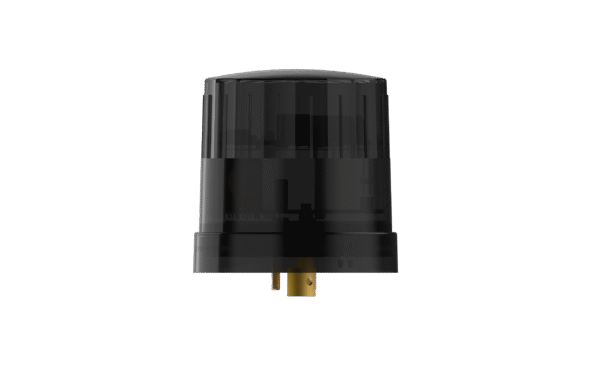
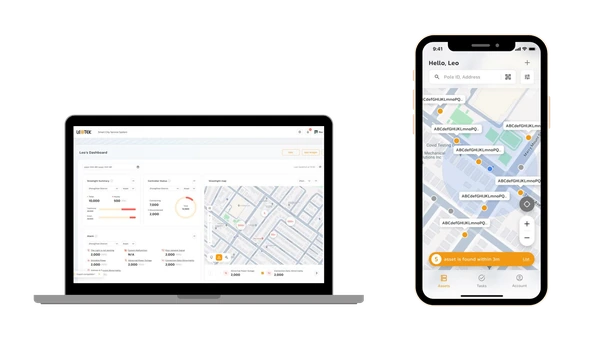
If connected operation is in scope, a city can evaluate LEOLink intelligent lighting system information alongside its own requirements. LEOTEK presents the solution as supporting functions including remote switching, dimming, scheduling, fault notification, energy tracking, reporting, maps, alarms, and asset management. Whether those functions fit a particular deployment depends on the selected configuration, interfaces, cybersecurity and data-governance requirements, and agency review.
Make commissioning and records part of the same handoff
Commissioning is not only a switch-on event. For a phase that includes controls, it can include the documented verification of the agreed interface, schedule or dimming behavior where applicable, asset identifiers, exception handling, and responsibility for unresolved items. For every phase, the owner should receive records that connect the physical asset, the installed configuration, the location, and the closeout status.
That record is what enables future operations to begin with an evidence trail instead of a search across spreadsheets, field notes, and purchase orders. It also provides the information needed to ask more precise questions when evaluating a RenAI roadway infrastructure management platform or another asset-management approach. The article does not assume that every conversion requires that platform or that an asset platform will deliver a particular outcome.
Verify each phase and improve the next one
A citywide streetlight conversion becomes more controllable when phase close is a formal decision point. The acceptance team can confirm that the installed configuration, location record, required documentation, operational status, and exceptions have been addressed according to the project requirements. A phase should not be treated as complete merely because installation activity has ended.
Use a closeout checklist that matches the contract
The checklist should be tied to what the agency actually required. Common categories include installation records, inspection status, approved field changes, asset-data completeness, outstanding punch-list items, and transfer of required documents. The goal is not to create paperwork for its own sake. It is to establish whether the owner has what it needs to operate, maintain, and audit the assets it has accepted.
Compare the completed package with the baseline, but keep the comparison factual. Record corrected locations, changed asset attributes, unavailable assets, and unresolved conditions. Do not turn a preliminary estimate or a single package observation into a citywide savings, reliability, safety, or environmental claim.
Carry lessons into the next package
Before release of the next phase, hold a short review of the exceptions that affected the prior package. Were inventory fields missing? Did a required approval arrive too late? Did the data format create rework? Were access or coordination constraints different from the plan? The answers can refine the next package without rewriting the entire program.
This is the practical value of phasing: it gives the organization planned opportunities to correct its process while preserving a documented record of why the roadmap changed.
Build a roadmap that remains useful after conversion
A citywide streetlight conversion program should leave the city with more than a completed installation count. It should leave clear ownership of the asset record, a workable maintenance-data process, and a way to evaluate future replacements or controls changes against documented conditions.
Assign a long-term owner for the data, define how maintenance changes are recorded, and retain the documents needed to understand the installed configuration. These steps are modest, but they make the municipal lighting roadmap useful when a future project team needs to investigate an outage, plan a corridor project, or review a replacement request.
For a defined roadway-lighting project or technical question, readers can contact LEOTEK. A productive inquiry starts with the same inputs that make the roadmap credible: scope, asset conditions, required documentation, and the decisions the agency needs to make.
Frequently asked questions
What is a municipal lighting roadmap?
A municipal lighting roadmap is a documented sequence for converting and managing streetlighting assets, including the baseline, priorities, procurement gates, field verification, and operations handover. This is an editorial planning definition, not a universal compliance framework.
What should a city inventory before a streetlight conversion?
Start with location, stable asset identifier, ownership, available pole and luminaire attributes, condition information, access constraints, existing controls status, and a confidence flag for each record. Add the project-specific fields needed for design, procurement, installation, and operations. Unknown information should be marked for verification rather than assumed.
How should a city decide what to convert first?
Use transparent criteria that reflect asset condition, geography, access, coordination needs, ownership, and local review requirements. Keep urgent repair work distinct from planned conversion packages when possible. The appropriate sequence depends on the city’s assets, responsibilities, and project constraints.
When should controls be included in a streetlight conversion?
Decide during roadmap development, before procurement requirements are finalized. If controls or dimming are in scope, define interface evidence, commissioning, operating responsibilities, cybersecurity and data governance, asset identifiers, and acceptance criteria. A city should not assume that every conversion needs connected controls.
What records should a contractor provide at phase close?
The contract should define the answer. A typical closeout package may include accepted asset records, installed configuration details, approved field changes, inspection or acceptance documentation, required technical documents, and the status of punch-list items. The exact requirements should match the agency’s procurement and operations process.
References
- U.S. Department of Energy, The Energy and Operational Impacts of Using 0-10V Control for LED Streetlights, January 10, 2024; accessed July 26, 2026.
- Illuminating Engineering Society, Standards; accessed July 26, 2026.
- LEOTEK, Applications for Outdoor Lighting; accessed July 26, 2026.
- LEOTEK, LEOLink Solutions; accessed July 26, 2026.
- LEOTEK, RenAI AI Roadway Infrastructure Management System; accessed July 26, 2026.
- LEOTEK, Resources and Documents; accessed July 26, 2026.