






An HPS-to-LED streetlight conversion should not be selected by wattage alone. The appropriate LED luminaire depends on the light needed on the actual roadway or area, the optical distribution and mounting geometry, existing electrical and control conditions, and a verified photometric and commissioning plan.
For a city or transportation agency, the practical question is not “What LED wattage replaces this HPS fixture?” It is “What configuration delivers the required result at this location, and how will we verify it?” That distinction helps avoid a replacement that looks acceptable in a fixture schedule but does not align with the documented project criteria at the curb, intersection, crosswalk, or adjacent property line.
Key takeaways
- Wattage is useful for inventory and energy analysis, but it is not a substitute for delivered-light design.
- Document poles, arms, mounting heights, spacing, circuits, controls, and existing conditions before selecting a luminaire.
- Use project-specific photometry to evaluate light placement, uniformity, glare, and spill in the applicable roadway context.
- Verify the submitted configuration, compatibility, installed condition, and control behavior before project closeout.
Why a wattage swap is not a streetlight design
A one-for-one replacement sounds straightforward: remove an HPS fixture, install an LED fixture, and compare the old and new wattage. That comparison may be a reasonable starting point for an asset inventory or an early budgeting exercise. It is not enough to establish how the replacement will light the pavement, sidewalk, intersection, or surrounding area.
The U.S. Department of Energy distinguishes between source efficacy and the performance of the device and fixture together. Fixture design, power supply, and the way light is delivered all affect the electricity consumed and the result in the application. The same DOE overview also notes that the compact, directional nature of LEDs can enable optical control. Those points are why a nominal wattage match cannot stand in for a lighting design. DOE’s LED Basics provides useful background on these distinctions.
Fixture watts, lumens, and delivered light answer different questions
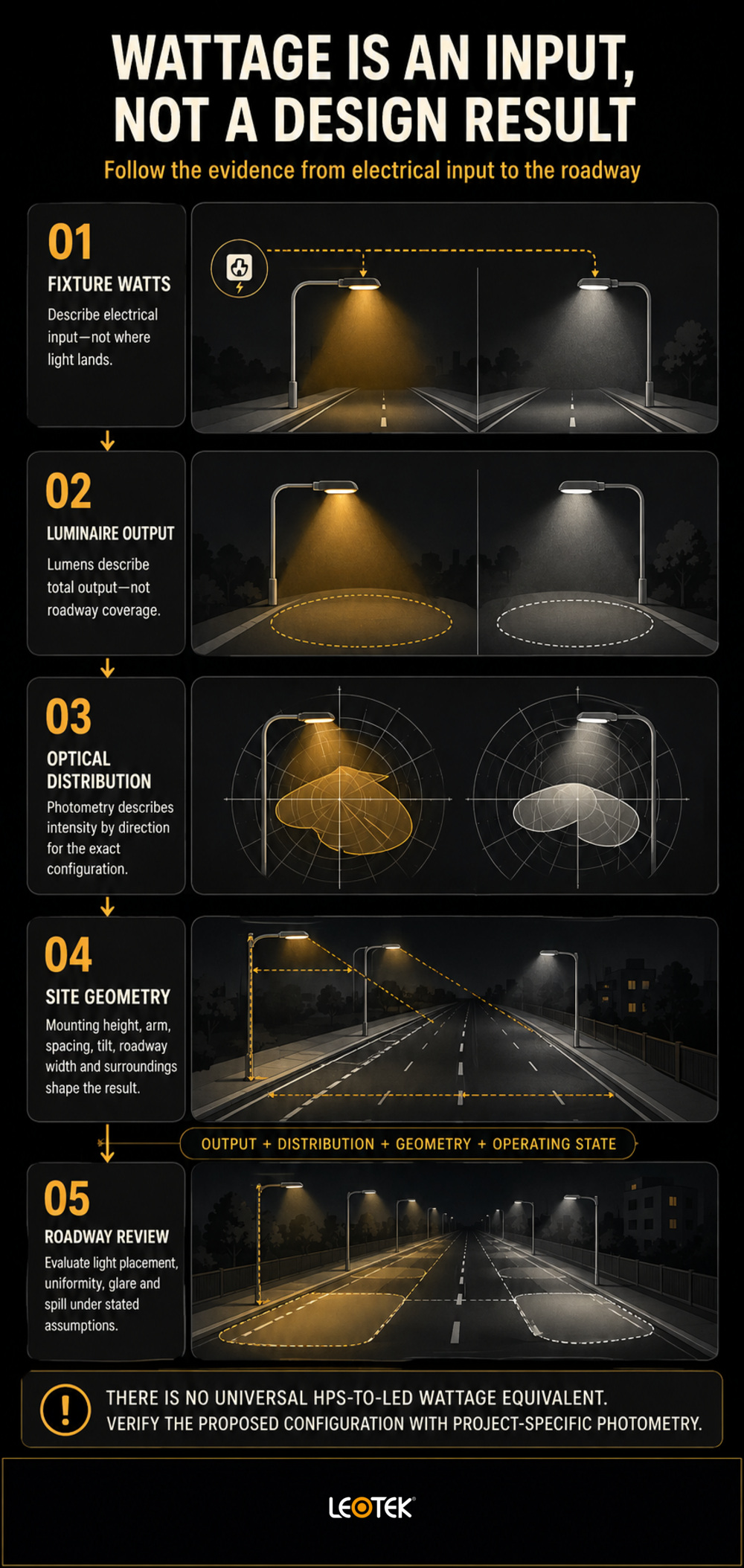
Fixture wattage describes electrical input. Lumens describe light output, but not where that light lands. A photometric evaluation examines how a particular luminaire, distribution, orientation, mounting height, spacing, and surrounding geometry work together.
That is especially important when replacing legacy equipment. Two luminaires can have different optical distributions even if their input watts or published output appear similar. One may place more light farther down a roadway, while another may be more appropriate for a different mounting arrangement or area. Neither outcome can be confirmed from a wattage table alone.
For readers who need a refresher on the measures involved, this guide to watts, lumens, and lux explains why lux depends on geometry and distribution. It should support, not replace, project-specific calculations.
Define the conversion objective before comparing fixtures
Before an agency compares replacement options, it should define the condition being evaluated. Is the location a roadway segment, an intersection approach, a crosswalk area, a parking facility, a trail connection, or another public-infrastructure setting? What local agency criteria, maintenance objectives, community concerns, and operating conditions apply?
The governing design basis may come from an agency, utility, owner, or applicable current lighting guidance. The Illuminating Engineering Society is an ANSI-accredited standards developer that produces consensus lighting resources, but the relevant edition and project criteria must be confirmed for the jurisdiction. Its standards overview is a starting point, not a substitute for the applicable design documents.
Start with an existing-condition inventory
A municipal LED retrofit is easier to evaluate when the existing installation is documented as a system rather than as a list of fixture watts. A usable inventory gives the design and procurement team the information needed to test an alternative against actual field conditions.
Record pole and mounting geometry
Start with the physical arrangement. Document pole locations, mounting heights, arm length and orientation, setback, span or spacing between poles, roadway width, lanes, medians, sidewalks, intersections, and nearby properties. Terrain, obstructions, trees, overhead infrastructure, and changes in alignment can also affect what a photometric model should represent.
These inputs matter because the luminaire does not operate in isolation. A distribution that is reasonable for one geometry may not place light as intended in another. Likewise, an installation near an intersection or pedestrian crossing may need a different evaluation from a midblock roadway segment.
The inventory should also identify equipment that constrains replacement options. That can include the pole and arm condition, access for maintenance, and project-specific structural review needs. If wind area or structural suitability is relevant, a qualified professional should evaluate the selected configuration and the actual support condition rather than relying on a generic fixture comparison.
Verify electrical and control conditions
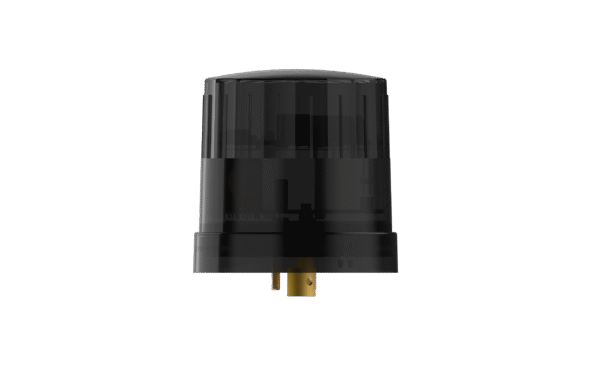
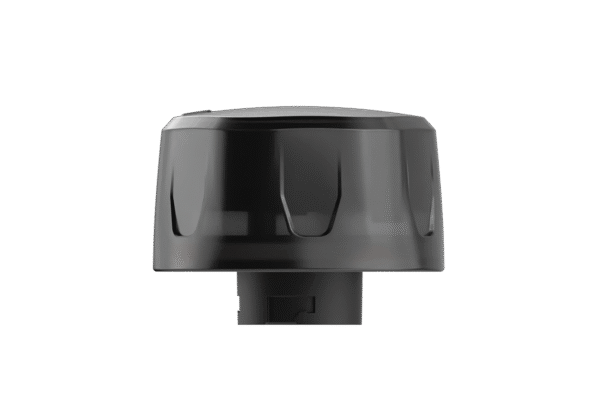
Document the incoming power, circuits, photocontrols, switching method, applicable surge-protection requirements, any dimming or networked-control interfaces, and the intended operating schedule. The goal is not to assume that a new luminaire will work with every legacy component. It is to identify what must be checked for the exact proposed configuration.
Controls deserve the same discipline as the luminaire selection. In a 2024 study of 23 LED streetlights that claimed dimmability through a 0-10V interface, DOE characterized variation in driver performance and discussed the need for more accurate and consistent dimming performance across a lighting system. That finding does not predict how any particular product will behave. It does support verifying the proposed driver, interface, controller, and expected operating behavior. See DOE’s 0-10V streetlight controls study.
Existing-condition records should be retained with the project file. They give reviewers a basis for comparing alternatives and give field teams a reference when installation conditions differ from the original assumptions.
Evaluate optics and photometry before selection
Photometry translates a fixture choice into expected light distribution in a modeled setting. It is the bridge between a product schedule and the actual road or area being illuminated. A project-specific photometric calculation should state its geometry, mounting assumptions, luminaire orientation, operating condition, and evaluation criteria.
Distribution and aiming determine where light goes
Optical distribution determines how light is directed from the luminaire. Mounting height, arm position, tilt, and pole spacing influence how that distribution reaches the task area and its surroundings. The result can affect pavement coverage, transitions between luminaires, and light that reaches outside the intended area.
Do not select a distribution simply because it appears in a common retrofit table. Match it to the project geometry and the documented design basis. For foundational terminology, LEOTEK’s explanation of IES light distribution types can help readers understand the concepts. It is not a design calculation or evidence that a particular distribution is right for a site.
Review more than average light level
A retrofit review should consider the complete set of conditions that apply to the project, including light placement, uniformity, glare, spill light, and color characteristics. A high average value alone does not establish a good result, particularly where drivers, pedestrians, residents, or adjacent uses are affected.
Correlated color temperature, or CCT, is one color-appearance descriptor. DOE notes that reducing color quality to CCT loses information, and that efficiency and color attributes can involve tradeoffs. CCT by itself does not establish visual comfort, glare, safety, or ecological suitability. Those questions must be evaluated in the setting and under the requirements that apply.
When public feedback is likely, it is useful to document the criteria and assumptions before installation. That makes the review more transparent than a debate over whether a replacement appears brighter or whiter than the equipment it replaced.
Plan for infrastructure compatibility and field realities
The calculations can be sound and still fail to describe the installed project if field constraints are not handled. A conversion plan needs a path from the selected configuration to an installation that can be documented and verified.
Do not assume control systems work alike
The proposed luminaire, driver, photocontrol, node, dimming interface, and central-management arrangement should be reviewed as a configuration. Verify the intended wiring and interface requirements against current manufacturer documentation. If the project uses schedules or dimming, define the expected behavior and the method for testing it during commissioning.
This is not a recommendation to add controls to every retrofit. It is a reminder that a control feature, when included, should be specified, installed, and accepted as part of the project rather than presumed from a product category or fixture label.
Confirm the physical and service conditions
Review dimensions, mounting method, electrical compatibility, service access, and any project-specific loading or support analysis for the selected configuration. Confirm that the submitted configuration is the configuration modeled. Small changes to a fixture, optic, mounting, or control component can change the basis for the review.
Also consider how crews will access and maintain the installation. Serviceability is not a promise of reduced maintenance cost; it is a planning question. The project file should identify the documents, tools, access conditions, and replacement procedures that the owner needs to manage the installed system.
For category-level exploration after the design questions are clear, readers can review roadway and area lighting options. Model-specific output, photometry, listings, controls, warranty, and compatibility still require current documentation for the exact proposed product.
Turn the conversion into a procurement and commissioning workflow
A disciplined workflow keeps the decision focused on evidence. It also gives procurement, engineering, operations, and installation teams a shared record of what was requested and what was delivered.
Request a project-specific submittal package
The exact package will vary by owner and procurement method, but a technical review often needs current cut sheets, photometric files and calculation assumptions, mounting details, electrical and control-interface information, applicable listing or certificate information, warranty terms, and document dates or revisions. Each item should identify the exact configuration under review.
Do not treat a family page, general certification explainer, or prior project as proof for the submitted product. Current documents may change, and some claims depend on the model, option set, jurisdiction, funding source, or installation. A technical-document review is the appropriate place to reconcile those details.
As a recommended review practice, compare the photometric file and calculation report with the offered configuration line by line. Confirm the assumed optic, mounting height, arm position, orientation, tilt, poles, spacing, and operating condition against the site inventory and procurement submittal. The review should also identify the document revision used for each critical input. This does not replace engineering judgment or agency requirements; it makes it easier to detect a mismatch before equipment is installed.
When alternatives are being considered, apply the same assumptions to each option. Comparing calculations produced from different geometry, orientation, or evaluation conditions can create an apparent difference caused by the inputs rather than the luminaire. Keep the calculation assumptions with the submittal so that procurement, installation, and acceptance teams are reviewing the same basis.
LEOTEK’s product specifications and resources page is a natural pathway for readers preparing that review. Verify the date, model, and revision of any document before relying on it in a procurement decision.
Pilot, inspect, and commission
For a multi-location conversion or a project with unresolved field conditions, a pilot can help evaluate the proposed approach under actual site conditions. The agency should decide the scope and acceptance method. The article does not prescribe a universal pilot or acceptance requirement.
As a recommended closeout practice, reconcile what was modeled, specified, delivered, installed, and tested. Where controls are part of the project, test the intended behavior. Where field conditions differ from the model, document the difference and route it through the agency’s engineering and acceptance process. Electrical installation and acceptance remain subject to qualified review and the authority having jurisdiction.
Questions municipalities should ask before approving an LED replacement
Use these questions to make a replacement discussion more specific:
- What roadway or area condition is the project intended to serve, and what criteria apply?
- What existing pole, arm, mounting, spacing, electrical, and control conditions have been verified?
- Which exact luminaire configuration and orientation are modeled?
- What photometric assumptions were used, and how do they address light placement, uniformity, glare, and spill?
- How will color characteristics be considered alongside the rest of the design, rather than as a standalone decision?
- What control interface is proposed, if any, and how will it be tested?
- Which current documents support the submittal, and what are their model numbers and revisions?
- How will the installed condition and any deviations be documented before acceptance?
These questions are planning prompts, not universal requirements. They help agencies move the conversation from a nominal wattage swap to a defined, reviewable scope of work.
Make the replacement decision from evidence, not a wattage table
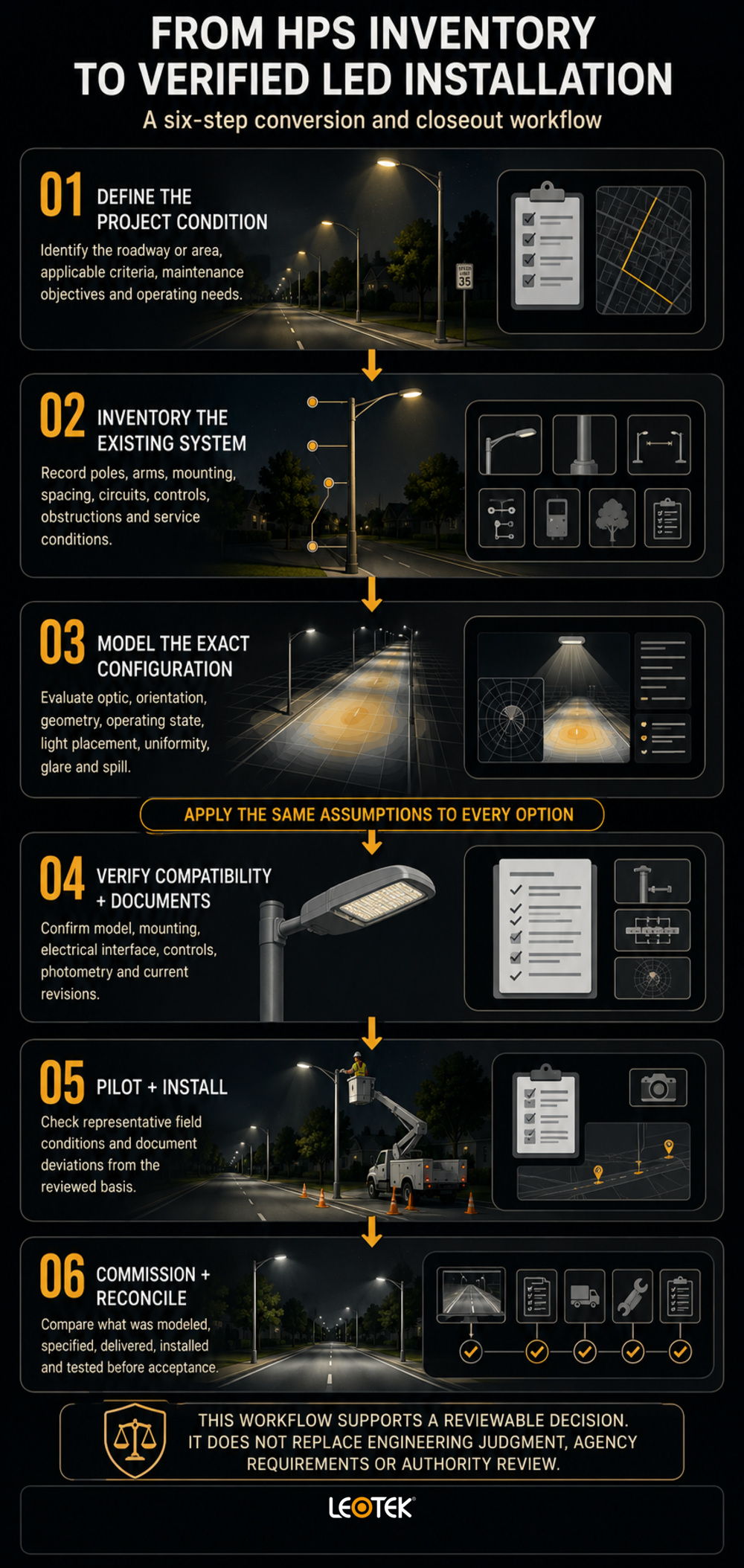
An HPS-to-LED streetlight conversion is most defensible when it follows a clear order: establish the project condition and criteria, inventory the existing system, evaluate the proposed configuration with project-specific photometry, verify compatibility and current documents, then inspect and commission what is installed.
That approach does not promise a particular energy, maintenance, or lighting outcome. It gives the owner a way to test whether the proposed LED streetlight replacement aligns with the documented location conditions and agency requirements. For a defined project question, discuss a roadway infrastructure project with the relevant site data, design basis, and technical documents in hand.
Frequently asked questions
What is the HPS-to-LED wattage equivalent for a 250-watt streetlight?
There is no universal replacement wattage. A comparable LED selection depends on the existing system, required lighting condition, optical distribution, mounting geometry, and the performance of the selected luminaire. Use wattage as one input, then verify the proposed configuration with a project-specific evaluation.
Do I need a photometric plan for an LED streetlight retrofit?
A project-specific photometric evaluation is the appropriate way to assess a proposed arrangement against the project’s applicable criteria. Whether it is required, and what it must include, depends on the owner, jurisdiction, procurement documents, and project scope.
Why can an LED streetlight look too bright after a retrofit?
Perceived brightness can be affected by distribution, aiming, mounting geometry, color characteristics, glare, and the surrounding context. Wattage alone cannot diagnose the condition. Review the modeled and installed configuration against the applicable design basis.
Can existing streetlight controls be reused with LED fixtures?
Compatibility should be verified for the exact luminaire, driver, interface, controls, and intended operating behavior. DOE’s study of a sample of streetlights claiming 0-10V dimmability found performance variation, which reinforces the need to document and test the proposed arrangement rather than assume interfaces behave identically.
References
- U.S. Department of Energy, LED Basics; accessed July 26, 2026.
- U.S. Department of Energy, The Energy and Operational Impacts of Using 0-10V Control for LED Streetlights, January 10, 2024; accessed July 26, 2026.
- Illuminating Engineering Society, Standards; accessed July 26, 2026.
- LEOTEK, Watts to Lumens; accessed July 26, 2026.
- LEOTEK, IESNA Light Distribution Types I, II, III, IV and V; accessed July 26, 2026.
- LEOTEK, Applications for Outdoor Lighting; accessed July 26, 2026.
- LEOTEK, Resources and Documents; accessed July 26, 2026.