



















What are streetlight CMS API requirements? A streetlight CMS API should define who can access which resources, the data available, how events and commands behave, and how changes are documented. Before integration begins, a city or transportation agency should test those requirements against its own operating, security, data-governance, and procurement workflows.
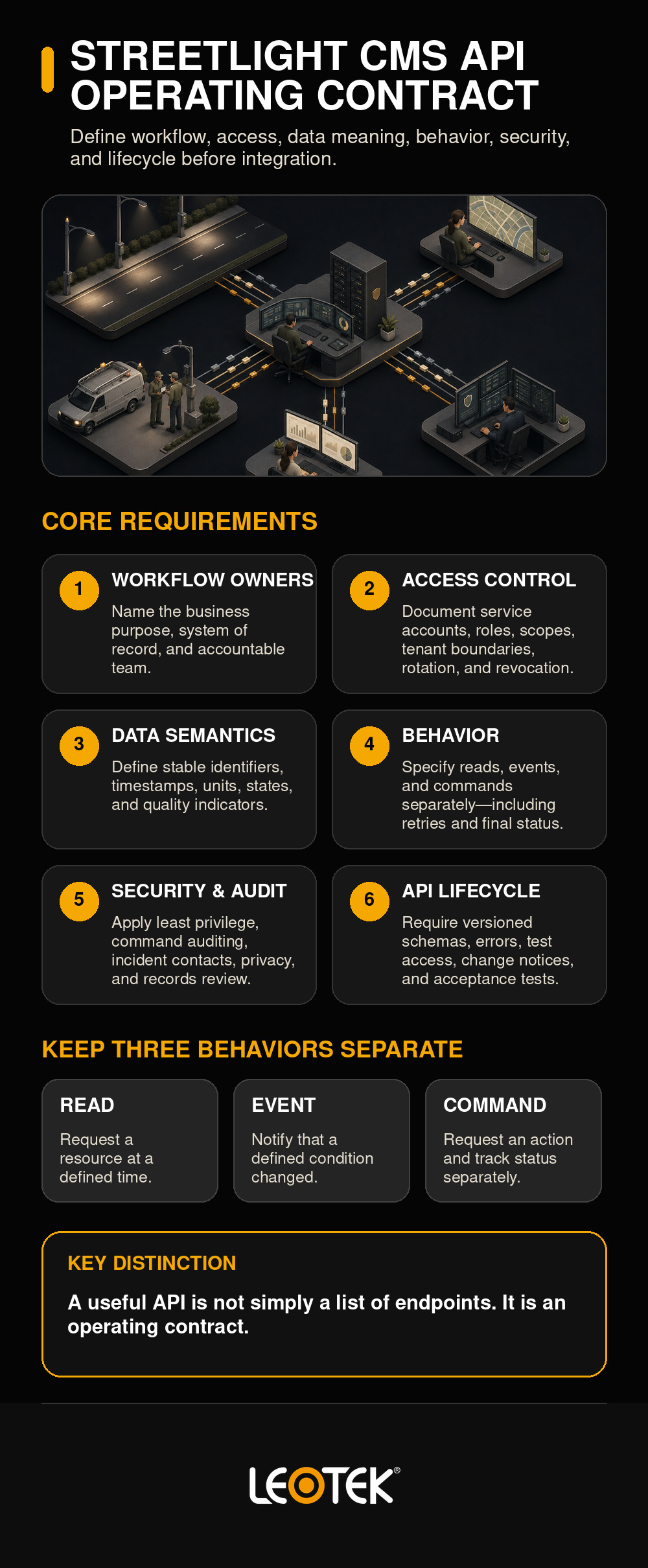
A useful API is not simply a list of endpoints. It is an operating contract between the lighting platform, the integration team, and the city systems that will use the information. That contract must be specific enough to prevent a work-order system from acting on an ambiguous alarm, a GIS record from drifting away from its physical asset, or an unauthorized user from issuing a lighting command.
Key takeaways
- Define the business workflow and accountable team before selecting data fields or endpoints.
- Require separate, documented behavior for reading data, receiving events, and issuing commands.
- Specify identifiers, timestamps, units, state definitions, authorization boundaries, and audit records as part of the streetlight CMS API requirement.
- Treat documentation, versioning, test access, and change notices as deliverables, not optional extras.
- Validate the final design through agency engineering, cybersecurity, privacy, records, and procurement review.
Start with the city workflow, not the endpoint list
The best integration begins with a narrow operating question. For example: should a lighting alarm create a maintenance ticket, appear on an operations map, enter a reporting dataset, or simply be available for staff to investigate? Those uses have different data, latency, access, and audit needs.
For a roadway-lighting program, a CMS may be one source among several. A GIS may hold the authoritative location and pole attributes. An enterprise asset-management or work-order system may track inspections and repairs. A reporting environment may combine energy data with billing or operating data. The CMS should not be assumed to replace those systems, and the integration should not assume that each system uses the same identifier or definition of status.
Name the systems and accountable teams
Create a short integration charter before discussing methods such as GET, webhooks, or message queues. It should identify:
- the system of record for each asset attribute;
- the operational owner of lighting alarms and command approval;
- the integration owner responsible for mappings and failures;
- the security team responsible for access approval and credential handling; and
- the business purpose for each data flow.
This step prevents a common problem: an integration exposes a field because it is available, then a downstream system treats it as a reliable operational signal without knowing its source, update cycle, or meaning.
Define the permitted decisions
For every proposed data flow, state the decision it may support. An asset identifier and location might support map reconciliation. An alarm code might support maintenance triage after the agency defines its meaning. A dimming command might support an approved operating plan. None of those examples means the CMS or integration automatically delivers an outcome such as savings, safety improvement, or predictive maintenance.
This framing also makes the boundary between monitoring and control clear. Reading status is different from changing a device state. A city may allow a reporting platform to read aggregated energy data while limiting control actions to a smaller group with a documented operational role.
Streetlight CMS API requirements: the core checklist
The following checklist gives agencies a practical starting point for an RFI, RFP, technical workshop, or implementation plan. It is not a substitute for a vendor-specific API reference or for agency review of the deployed architecture.
Authentication, authorization, and tenant boundaries
Ask the provider to document every supported authentication method, how credentials are issued and rotated, how service accounts are managed, and how access is revoked. The requirement should identify the identity provider or credential model that applies to each integration, rather than assuming that a user login is suitable for an automated service.
Authorization needs equal attention. The API contract should show which roles can read which resources and which roles can submit or approve commands. It should also explain how the platform prevents one agency, department, or integration from accessing another tenant’s data where tenancy applies.
This is more than a compliance checklist. The OWASP API Security Top 10 identifies broken object-level authorization, broken authentication, and broken function-level authorization as API risks. Ask for testable evidence that authorization is checked on the relevant object and action, not merely described in an access-control diagram.
At a minimum, require audit records for authentication events, permission changes, high-impact reads where appropriate, and every command attempt. Specify the fields in those records, the time basis, who can retrieve them, and the retention expectations that apply to the agency’s policy. Also define any API or export availability windows that the integration depends on.
Asset, status, telemetry, alarm, and energy data
Do not ask only whether the lighting management API can export data. Ask for a data dictionary and sample responses for the exact resources the city needs. A useful asset resource may include a CMS identifier, the associated controller or device identifier, current association to a luminaire or pole where modeled, location reference, and lifecycle state. Whether a field exists, is editable, or is authoritative must be stated by the provider.
For status and telemetry, define the business meaning of every state and measurement. A value such as offline, fault, dimmed, or command pending cannot be used safely until its trigger, update behavior, and clearing condition are documented. For energy data, specify units, interval boundaries, cumulative versus interval values, time zone, quality flags, and how corrected data is handled. Do not infer those details from a chart or a product page.
Ask the provider to explain whether data is current state, historical observation, estimated value, or derived calculation. This distinction helps an agency avoid treating a delayed synchronization as real-time operational visibility.
Events, webhooks, and polling behavior
There are three different integration patterns that should not be conflated:
- Read access lets another system request a resource at a defined time.
- Events or webhooks notify a receiving system that a defined condition occurred or changed.
- Commands ask the CMS to attempt an action and return a separately defined status.
If events are available, require an event catalogue. It should identify the event type, payload schema, source asset, event time, delivery time, ordering rules, retry behavior, duplicate handling, authentication of the receiver, and replay or recovery process. If polling is the only option, document supported filtering, pagination, maximum request rate, freshness expectations, and how a client detects changes without retrieving an entire fleet unnecessarily.
The contract should also state what happens when the receiving system is unavailable. An event delivery mechanism may retry, expire, retain messages, or require a client to reconcile by reading state; the city should not assume a behavior that has not been documented and tested.
Commands and the command-status lifecycle
Commands deserve a separate requirement because acceptance of an API request is not necessarily confirmation of a field action. For any permitted command, document the requester, authorization rule, target resource, allowable parameters, expected response, timeout behavior, idempotency approach, and audit record.
A city can ask the provider to define a lifecycle such as accepted, rejected, queued, issued, confirmed where field confirmation is available, failed, or expired. Those labels are examples, not a universal CMS standard. What matters is that the provider defines the statuses, transitions, timestamps, and finality rules, and that the integration can reconcile a command with later device or CMS status.
For high-impact control actions, establish whether human approval is required, whether a change window applies, and how rollback or cancellation is handled. Agency engineering and operations staff should validate any production control workflow before it is enabled.
Specify data quality and interoperability, not just field names
An API may be technically reachable and still be difficult to integrate if its data model is unclear. The requirement set should describe how a city maps CMS data to its own assets and how it will detect mismatches over time.
Identifiers, time, units, and state definitions
Require stable identifiers and explain whether they can change after replacement, relocation, reassignment, or controller swap. If the city has its own asset ID, document the cross-reference method rather than relying on a name or street address. Names are often useful to people but poor as durable integration keys.
Specify timestamps in an unambiguous format, the time zone or offset, clock-source expectations, and whether the time describes observation, ingestion, publication, or command completion. Define units and precision for measurements, and identify whether missing, zero, unavailable, and invalid values are distinct. A data dictionary should include enum definitions, valid ranges where applicable, and the treatment of historical corrections.
These requirements give GIS, asset-management, and analytics teams a shared basis for reconciliation. They also make it easier to design acceptance tests that compare a representative sample of field assets with CMS records without claiming that a single system is automatically authoritative.
Pagination, errors, rate limits, and idempotency
Ask for predictable behavior at normal and failure conditions. The API should document resource filtering, sorting, pagination, response-size constraints, rate limits, and the response supplied when a client exceeds a limit. It should distinguish a malformed request, an unauthorized request, a missing resource, a transient service issue, and a request that was accepted for asynchronous processing.
RFC 9110 defines shared HTTP semantics, including methods, status codes, conditional requests, and authentication concepts. A vendor API still needs its own precise contract: HTTP alone does not define the city’s asset model, command workflow, or service expectations.
For write or command operations, require an idempotency strategy where retries could create an unintended duplicate action. Document correlation IDs so both parties can trace a request through the CMS and the downstream integration. Require an error format that gives an integrator actionable information without exposing sensitive implementation details.
Make security and governance part of the integration requirement
Security and governance cannot be added after the data mapping is complete. They determine which integrations are permissible, what information is shared, who can act, and how an agency investigates an incident.
Least privilege, credential lifecycle, and auditability
Use least-privilege requirements: each integration should receive only the scopes and resources necessary for its documented purpose. Separate production, test, and development credentials. Require a documented rotation and revocation process, an owner for every service account, and a process for reviewing access after personnel or vendor changes.
The API inventory should include production hosts, supported versions, deprecated versions, and disabled endpoints. OWASP notes that incomplete API inventory and outdated documentation can create risk, including around deprecated versions and exposed debug endpoints. That makes version visibility and ownership practical security requirements, not paperwork.
Data ownership, privacy, and incident processes
Before sending data to another city platform, identify what data is being shared, the purpose, the owner, the retention requirement, and the handling of sensitive fields. A lighting CMS integration may not involve personal data, but an agency should not make that assumption for every connected-infrastructure architecture. Data governance, records obligations, and privacy policy are jurisdiction- and system-specific.
Define incident contacts and escalation paths for failed integrations, unexpected commands, credential compromise, data-quality defects, and interface changes. The operating agreement should say who diagnoses a CMS issue, who owns the integration layer, and how the city is notified. These are project requirements, not claims about any platform’s support commitment.
Require usable documentation and an integration lifecycle
Integration teams need documentation that can be read, tested, and maintained. A static endpoint list is rarely enough.
Machine-readable description, examples, and test access
Ask for a current, versioned API reference; authentication instructions; resource schemas; example requests and responses; error definitions; event payloads; rate-limit behavior; and a change history. The OpenAPI Specification describes a language-agnostic interface description for HTTP APIs that can help people and tools understand an API without inspecting source code or network traffic. Requiring an OpenAPI description can improve clarity, but it does not by itself prove interoperability or security.
Where feasible, ask for a non-production sandbox or another safe test method with representative schemas and clearly documented differences from production. The city should agree on test data, access boundaries, and acceptance criteria before connecting live systems.
Versioning, deprecation, and acceptance testing
Require a versioning policy that explains compatibility expectations, the deprecation process, advance notice, migration guidance, and how the provider communicates emergency changes. The contract should identify an owner on both sides who receives those notices, plus the provider’s technical support owner and escalation path for API questions, incidents, and change notices.
Acceptance testing should exercise more than a successful data request. Test authorization boundaries, asset-ID reconciliation, representative statuses and alarms, missed or duplicate events, command authorization and final status, retry behavior, failed requests, and a planned version change. Record expected evidence for each test so the result is usable in procurement and operations handoff.
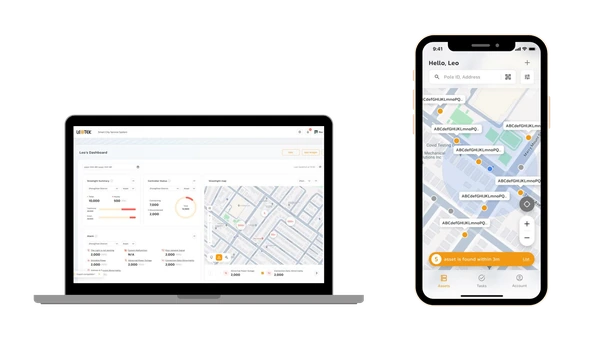
For readers assessing connected streetlight operations, LEOLink solutions and RenAI roadway infrastructure management describe connected-lighting and roadway-management capabilities. Those pages do not establish API availability, endpoint coverage, data-export behavior, external-system compatibility, or the security posture of a specific integration. Request current technical documentation for the exact proposed configuration.
Turn the checklist into a procurement-ready evaluation
Bring the agency’s operations, IT, GIS, asset-management, cybersecurity, procurement, and vendor teams into one requirements review. A short worksheet can keep the discussion concrete. For an accessible text equivalent to the matrix, evaluate access, asset data, events, commands, and lifecycle requirements against the evidence named in each row.
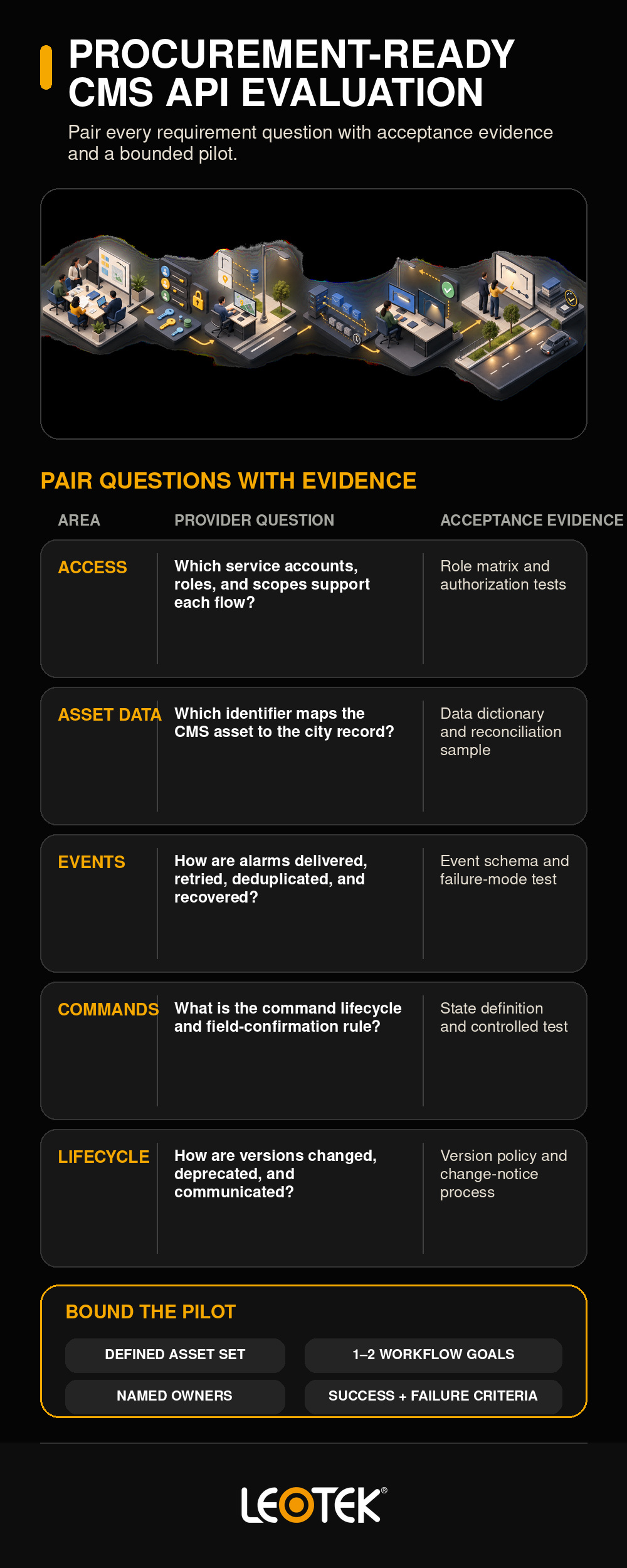
| Requirement area | Question for the provider | Acceptance evidence |
|---|---|---|
| Access | Which service accounts, roles, and scopes are required for each flow? | Role matrix and authorization test results |
| Asset data | Which identifier maps a CMS asset to the city asset record? | Data dictionary and sample reconciliation |
| Events | How are alarms delivered, retried, deduplicated, and recovered? | Event schema and failure-mode test |
| Commands | What is the command lifecycle and how is field confirmation represented? | Command-state definition and controlled test |
| Lifecycle | How are versions changed or deprecated? | Version policy and change-notice process |
Start with a bounded pilot: a defined asset set, one or two workflow goals, named owners, and documented success and failure criteria. A pilot should establish whether the API contract works for the city’s intended use; it should not be used to imply broad product compatibility or operating results beyond the tested scope.
When streetlight CMS API requirements are defined, use LEOTEK technical documents to locate current product and resource material relevant to the proposed configuration. For a defined roadway-infrastructure project or technical question, agencies can also contact LEOTEK. Confirm API details, configuration, data handling, and project requirements directly before specifying or deploying an integration.
FAQs
What data should a streetlight CMS API provide?
Start with the data needed for a documented workflow: stable asset identifiers, current state, defined alarms, applicable telemetry or energy data, timestamps, units, and data-quality indicators. Require a provider-specific data dictionary and do not assume every CMS exposes the same fields or meanings.
Should a city use webhooks or polling for streetlight events?
The answer depends on the workflow, receiving-system capability, volume, and recovery needs. If webhooks are used, specify authentication, payloads, retry, duplicate handling, ordering, and replay. If polling is used, specify filters, pagination, rate limits, freshness, and reconciliation. Test the chosen pattern under failure conditions.
How should a lighting command be represented in an API?
Treat it as a lifecycle rather than a single successful request. Define who may submit it, the target and parameters, the acceptance response, asynchronous statuses, timeout or expiry, confirmation where available, audit records, and retry or idempotency behavior. Agency operations and engineering teams should approve production control workflows.
Does an OpenAPI file prove that a CMS will integrate with city systems?
No. An OpenAPI description can make an HTTP API easier to understand and test, but compatibility still depends on the vendor’s actual resources, schemas, permissions, event behavior, command lifecycle, version policy, and the city’s own architecture. Validate the contract with representative data and acceptance tests.
References
- OpenAPI Initiative, OpenAPI Specification; accessed July 26, 2026.
- OWASP Foundation, OWASP API Security Top 10—2023; accessed July 26, 2026.
- Internet Engineering Task Force, RFC 9110: HTTP Semantics; accessed July 26, 2026.
- LEOTEK, LEOLink Solutions; accessed July 26, 2026.
- LEOTEK, RenAI AI Roadway Infrastructure Management System; accessed July 26, 2026.
- LEOTEK, Resources and Documents; accessed July 26, 2026.