


















Utility-owned vs. municipality-owned streetlights can create different responsibilities for assets, billing, maintenance, and upgrades. The better path is not decided by ownership alone: a city or agency needs to confirm the current tariff, asset inventory, governing agreement, and local procurement and regulatory requirements before it scopes a project.
Key takeaways
- Ownership and maintenance are separate questions. A municipality can own assets while contracting for operations and maintenance (O&M).
- Start with records, not assumptions: reconcile the field inventory, bills, tariff, and current service agreement.
- A purchase or transfer can change the project from a lighting upgrade into a broader asset, service, and contract transition.
- Put design authority, acceptance, outage work, warranty handling, records, and any controls-data responsibilities in writing.
For city public works teams, transportation agencies, and procurement staff, the practical question is not simply “Who owns the poles?” It is: who has authority to approve a change, who performs the work, what the utility bills for, and which party carries the responsibility after acceptance?
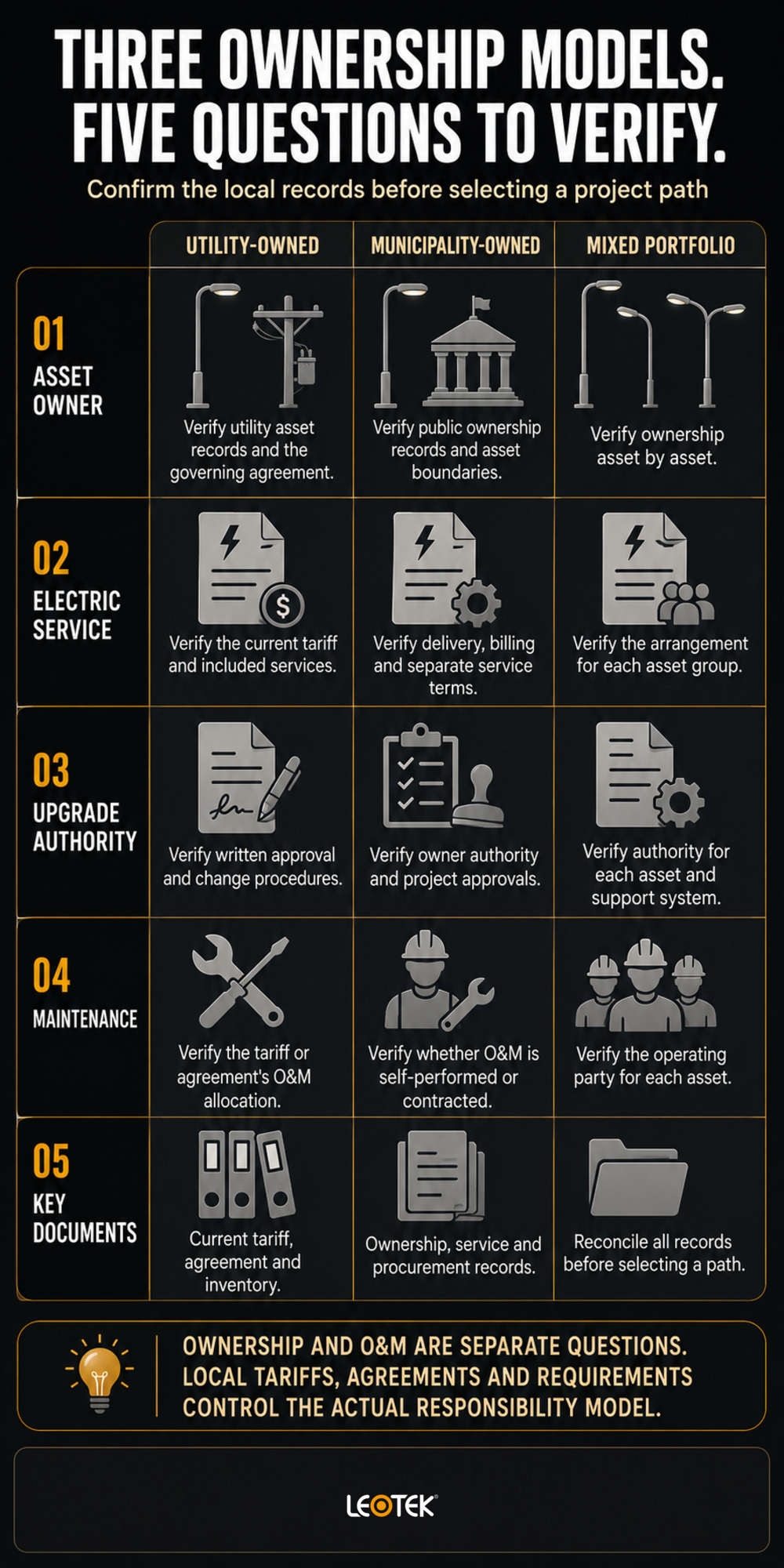
| Question to verify | Utility-owned system | Municipality-owned system | Mixed system |
|---|---|---|---|
| Asset owner | Verify the utility’s asset records and agreement. | Verify public ownership records and asset boundaries. | Verify ownership asset by asset. |
| Electric-service arrangement | Verify the current tariff and included services. | Verify delivery service, billing, and any separate service terms. | Verify the applicable arrangement for each group of assets. |
| Upgrade authority | Verify written approval and change procedures. | Verify the owner’s authority and project approvals. | Verify the authority for each asset and support system. |
| Maintenance responsibility | Verify the tariff or agreement’s O&M allocation. | Verify whether O&M is self-performed or contracted. | Verify the operating party for each asset. |
| Key documents | Verify current tariff, agreement, and inventory. | Verify ownership, service, and procurement records. | Reconcile all records before selecting a path. |
Every allocation in this table varies by jurisdiction and agreement. It is a comparison of verification questions, not a substitute for local utility, engineering, legal, procurement, or regulatory review.
Start with the ownership and service model
“Utility-owned” and “municipality-owned” are useful labels, but neither describes every operating detail. A lighting system can include legacy assets, annexed areas, decorative fixtures, or agency-owned corridors that are governed by different records and agreements. Treat ownership as an asset-level question until the inventory proves otherwise.
A locally supported comparison should account for tariff, financing, and lifecycle O&M responsibilities without turning those inputs into a universal cost formula. Local tariffs and agreements determine the actual allocation of charges and services. The DOE ownership-planning resource is a useful planning reference, but teams should confirm its current applicability before relying on it.
Utility-owned streetlights
Under a utility-owned model, the utility may own the luminaires and may provide some combination of design, installation, operation, maintenance, and electric service under a tariff or service arrangement. The scope must be read from the current documents. A monthly streetlighting charge may not mean the same thing in every utility territory, and an apparently similar fixture can be covered by a different schedule or service level.
Ask for the tariff that applies to each asset class, its effective date, and the associated service terms. Then identify what is included: energy delivery, fixture replacement, routine maintenance, outage response, conversion work, or something else. Do not assume that a utility-owned arrangement gives the utility exclusive authority over every project decision, or that every request can be handled as ordinary maintenance.
Municipality-owned streetlights
When a municipality owns the lighting assets, it may procure equipment, construction, and O&M directly while continuing to receive electric delivery from the utility. That does not mean municipal employees must perform every task. Ownership and O&M responsibilities should be confirmed separately in local agreements; the ACEEE public-outdoor-lighting toolkit is background information, not a substitute for those documents.
For a municipality-owned system, the contract package should make the operating model explicit. It should distinguish who owns fixtures, poles, arms, circuits, controls, and records from who is responsible for maintenance, emergency coordination, warranty claims, and field acceptance. Those responsibilities can be assigned to different parties, subject to local law and procurement requirements.
Mixed systems deserve their own inventory
Some portfolios may not fit cleanly in one column. A city may have purchased some assets, inherited others, or rely on different arrangements for local streets, public spaces, and transportation facilities. A project team should not carry a single ownership assumption from a billing report into a construction scope.
Build an inventory that can be reconciled to the bill and agreement. At a minimum, capture the asset identifier, location, fixture type, pole or support relationship where relevant, serving account or tariff, indicated owner, operating party, condition, and records source. Field verification may be needed when the physical system and the records do not align.
How ownership changes project authority and responsibilities
Ownership changes the questions a project team must resolve. It does not supply the answers. The agreement, tariff, property rights, engineering requirements, and procurement rules remain controlling.
Upgrade scope and acceptance
Before specifying an LED conversion, controls retrofit, or replacement program, identify who may authorize each part of the work. The scope can involve more than a luminaire: brackets, poles, conductors, controls nodes, meters, service points, communications equipment, and asset records may each have a different owner or approval path.
The agreement should state who approves the design and substitutions, who has access to the work area, which party coordinates outages, and what constitutes acceptance. It should also define the record that will be updated at closeout. These details reduce the risk that a completed field change remains unclear in the maintenance system or billing record.
For readers assessing roadway and area-luminaire options after this ownership review, outdoor lighting applications can be a useful product-navigation starting point. It is not evidence of a particular fixture’s performance, listing, warranty, or suitability for a local project.
Maintenance and outage obligations
Maintenance is often the first operational concern, but it should not be treated as an implied service. Define routine maintenance, failure reporting, emergency conditions, dispatch authority, traffic-control coordination, inspection, materials, and warranty administration. The appropriate response process will vary with the agreement and the roadway context.
The same distinction applies to performance tracking. A contract can require records of reported outages, completed work, asset changes, and inspections without making a claim about a particular response time or outcome. Agencies should set service expectations through their own procurement and operating requirements, then verify that those requirements align with the service arrangement.
Controls, asset data, and cybersecurity
Connected lighting can add a second layer of responsibility. If a project includes controls, the parties should define who owns or can access the asset data, who administers users, how integrations are approved, and who maintains the communications and security requirements. Those provisions should be specific to the chosen architecture and the agency’s policies.
Avoid treating controls as a default part of every conversion. A controls scope needs its own functional, data-governance, and cybersecurity review. Likewise, an ownership transfer does not itself establish rights to historical data, system credentials, or communications infrastructure.
Compare tariffs, transfer terms, and lifecycle responsibilities
A strong ownership decision compares the complete responsibility model, not just the unit cost of a luminaire. The underlying documents should be current, local, and tied to the actual asset population.
Read the bill and tariff together
Begin with invoices and the current tariff, then map them to the field inventory. Identify each account, rate schedule, charge category, fixture class, and any separately billed service. Confirm the tariff’s effective date and whether it addresses the present equipment or a proposed conversion.
The goal is not to interpret a tariff in the abstract. It is to understand which party bills, supplies, and maintains which element of the system under the local arrangement. A city should obtain its own utility, legal, and procurement review before relying on a tariff for a budget or acquisition decision.
Treat a utility streetlight buyout as due diligence, not a shortcut
An acquisition proposal can introduce questions that a standard replacement project may not have: the condition and identity of the assets, transfer terms, remaining value where applicable, service transition, property or attachment rights, records handoff, and applicable approvals. The sequence and legal significance of those questions depend on the jurisdiction.
For an example of the type of utility-specific transfer documentation and tariff material a team may need to review, see National Grid’s streetlighting FAQ. It is not a nationwide process or a substitute for the current local utility documents.
Do not present a purchase as automatically available, financially favorable, or simpler to manage. A municipality should confirm the utility’s current terms and the requirements of its own governing bodies, counsel, procurement authority, and regulators before making a commitment.
Compare lifecycle responsibilities, not promised savings
The lifecycle view should include capital work, financing, electric delivery, O&M, outage work, controls, recordkeeping, disposal, and internal administration. It should also identify which costs are known, which are estimates, and which require a vendor, utility, or agency validation.
This approach avoids a common error: comparing a utility bill against an equipment purchase price while leaving out maintenance, transition work, and administrative obligations. It also avoids unsupported claims about payback or energy savings. Any local estimate needs a documented baseline, the proposed scope, a current tariff, and the assumptions used.
Build a contract and procurement checklist
The contract should make responsibilities observable. Vague references to “maintenance,” “conversion,” or “smart lighting” are not enough when work crosses ownership, service, and public-right-of-way boundaries.
Documents to assemble before selecting a path
Collect the following before comparing utility-owned and municipality-owned streetlights:
- Current invoices, account information, and the applicable tariff schedules.
- An asset and geographic information system inventory, with a source and date for each record.
- The current ownership, service, maintenance, and conversion agreements.
- Utility correspondence, notices, and any written conditions for a proposed change.
- Condition, outage, maintenance, and warranty records that affect the proposed scope.
- Pole, attachment, easement, and access records where they are relevant to the work.
- The agency’s procurement, engineering, legal, and regulatory requirements.
This is a planning checklist, not a statement that every document applies to every project. It helps a team identify the missing information before it treats a preliminary option as an executable scope.
Verify ownership before finalizing scope
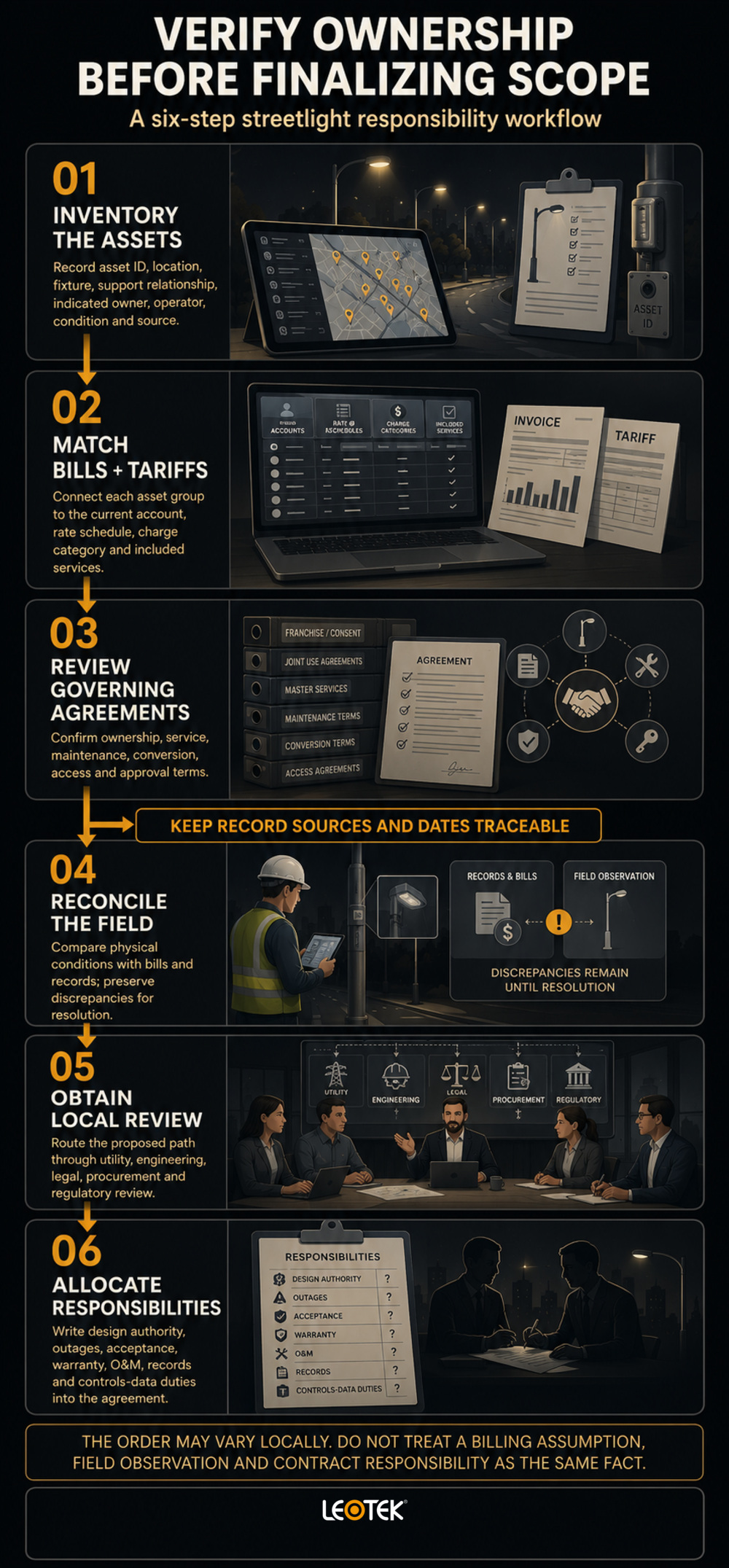
Use a short sequence to keep the project record aligned: inventory the assets; match the inventory to bills and the current tariff; review the governing agreement; reconcile discrepancies through field verification where needed; then obtain the local utility, engineering, legal, procurement, and regulatory input required for the proposed path. The order may vary locally, but skipping the reconciliation step can leave a project team with a scope that does not match the system it intends to change.
Keep a reconciliation record
A simple working record can help teams make gaps visible before award. For each asset or asset group, record the asset ID and location; indicated owner and operator; applicable account or tariff; agreement or record source; condition evidence and date; proposed approval path; and the unresolved item, if any. This is a planning template, not a mandated form. Its purpose is to keep a billing assumption, a field observation, and a contract responsibility from being treated as the same fact when they are not.
Terms to allocate explicitly
The governing agreement or procurement documents should address the asset boundary, design and specification authority, installation, field acceptance, warranty handling, maintenance workflow, pricing and change control, and records handoff. If controls are included, they should also address data access, user administration, integration responsibilities, and security requirements.
For roadway work, state who coordinates traffic control, outages, site access, and emergency escalation. For records, state what closeout data is required, who validates it, and which system becomes the source of truth. Those are operational requirements, not product claims.
When technical documentation is needed for a selected product family or component, use LEOTEK technical documents to locate current resources, then verify the document date, model, revision, and project applicability. Product documents do not replace a utility tariff, a purchase agreement, or legal review.
Questions to ask the utility and project team
Use this list to structure a working session before writing a streetlight conversion contract or issuing a procurement package:
- What evidence identifies the owner and operator of each asset in scope?
- Which tariff and service agreement apply today, and what services do they include?
- What field inventory and condition information has been reconciled to the bills and records?
- Who can authorize upgrades, replacements, controls, and changes to supporting infrastructure?
- If ownership changes, what transfer, service, property, regulatory, and records requirements must be verified locally?
- Who performs and pays for routine maintenance, emergency work, traffic control, warranty administration, and asset updates?
- What acceptance criteria and closeout records will establish that the project is complete?
- If connected controls are proposed, who governs data, access, integrations, and cybersecurity requirements?
- Which approvals are required from the utility, agency, procurement authority, or other local bodies?
- What assumptions remain unverified, and who is accountable for resolving them before award?
The list does not replace engineering judgment, counsel, or utility coordination. It keeps the ownership discussion connected to a specific project record and responsibility map.
Choose a documented path, not a default
Utility-owned versus municipality-owned streetlights is a decision about control and obligations as much as equipment. A sound choice begins with verified ownership and service records, compares current tariff and lifecycle responsibilities, and sets project authority and maintenance expectations in the governing documents.
Once a team has defined its asset scope and technical questions, it may discuss a roadway infrastructure project with LEOTEK. That conversation should support project scoping; it does not replace the agency’s utility, engineering, legal, procurement, or regulatory review.
Frequently asked questions
Are streetlights owned by the utility or the city?
Either arrangement is possible, and a single jurisdiction can have a mixed portfolio. Verify ownership through the asset inventory, bills, tariff, and governing agreement rather than relying on fixture appearance or a general assumption about the system.
Can a city buy utility-owned streetlights?
It may be possible under the local utility’s terms and applicable law or regulation. A potential transfer should be evaluated against the current utility documents, asset records, local procurement requirements, and any required approvals. It is not a standard process or a guaranteed option.
Does municipal streetlight ownership mean city staff must maintain every streetlight?
Not necessarily. Ownership and O&M can be allocated separately. A municipality may use its own workforce, a utility arrangement, or a qualified service provider, depending on its agreements and procurement requirements.
Can one city have both utility-owned and municipality-owned streetlights?
Yes, a portfolio can include different documented arrangements. Verify ownership and operating responsibility for the specific assets in scope, then reconcile the inventory to the current tariff and governing agreement before defining the project.
What should be reviewed before a streetlight conversion contract?
Review the asset inventory, current tariff and bills, ownership and service agreements, condition records, proposed scope, O&M obligations, acceptance criteria, warranties, records handoff, and any controls-data requirements. Confirm applicable local procurement, utility, engineering, legal, and regulatory requirements before award.
References
- Lawrence Berkeley National Laboratory, Regulatory Issues and Approaches to Municipal LED Street Lighting Conversions; accessed July 26, 2026.
- ACEEE, Reducing Energy Use in Public Outdoor Lighting; accessed July 26, 2026.
- National Grid, Streetlighting Frequently Asked Questions; accessed July 26, 2026.
- LEOTEK, Applications for Outdoor Lighting; accessed July 26, 2026.
- LEOTEK, Resources and Documents; accessed July 26, 2026.