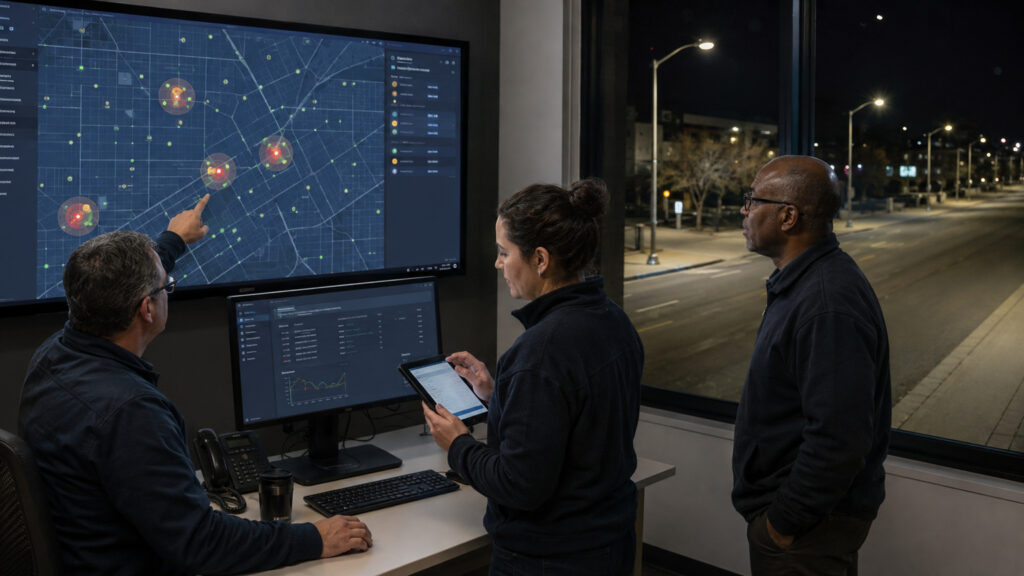






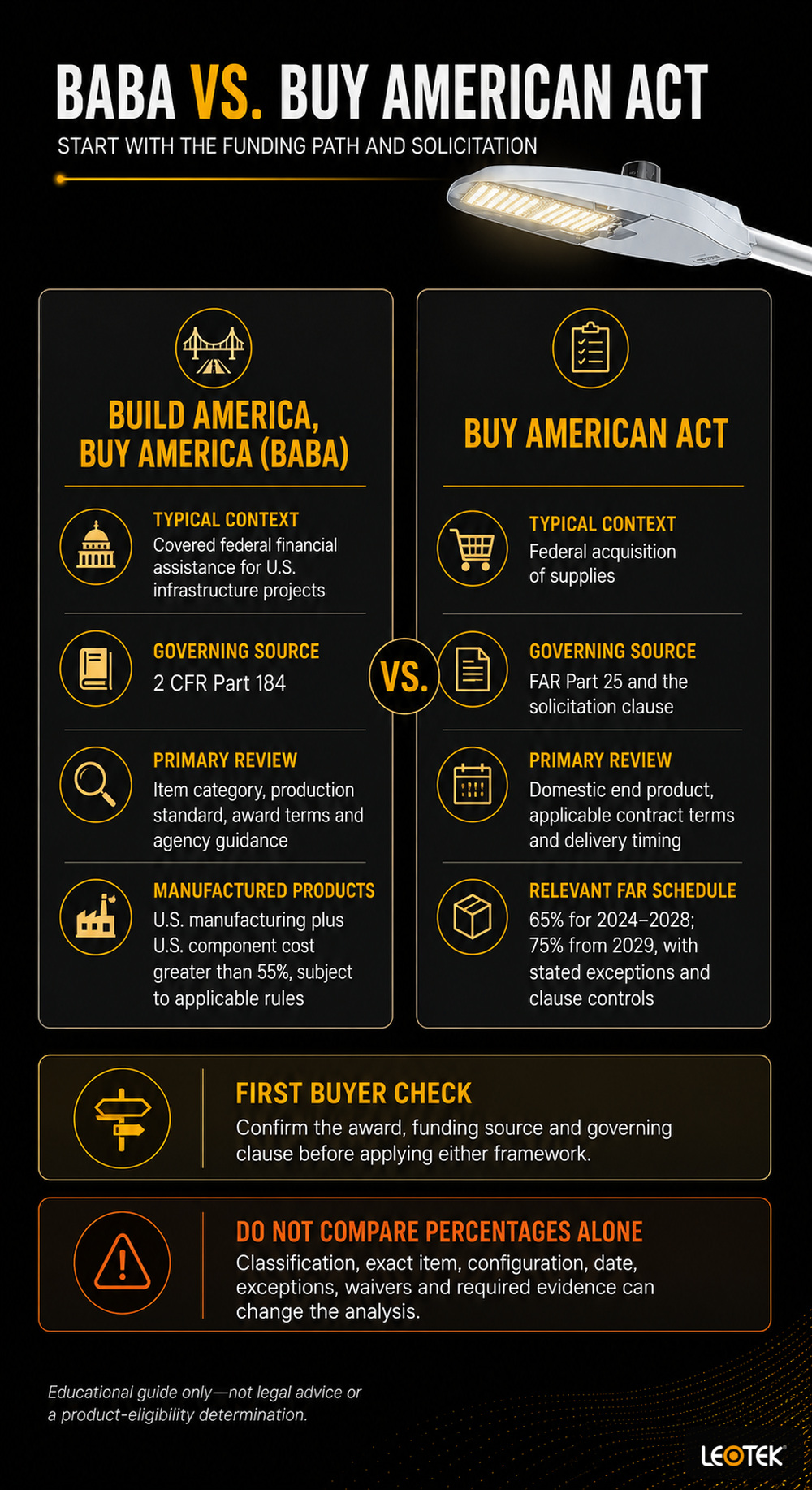
This BABA vs. Buy American guide explains why Build America, Buy America (BABA) and the Buy American Act are not interchangeable. For a public-lighting purchase, the right starting point is the award or solicitation: confirm the funding path and clauses, then evaluate the exact item and the documentation required for that project.
The distinction matters because a streetlight, pole, controller, or other bid item may be assessed under different domestic-content frameworks depending on the procurement. A supplier statement can be useful evidence, but it does not replace the governing terms, a project-specific classification, or the awarding agency’s determination.
Key takeaways
- Start with the funding source, award conditions, and solicitation clauses before asking whether a lighting item is BABA or Buy American compliant.
- BABA applies a Buy America Preference to covered federal financial assistance for U.S. infrastructure projects; the Buy American Act framework in the Federal Acquisition Regulation (FAR) addresses federal supply acquisitions.
- U.S. assembly, a general marketing statement, or an unrelated certificate does not by itself establish eligibility for a particular project.
- Review each line item against its exact model, configuration, category, date, and required evidence.
- Escalate unresolved interpretations to the awarding agency and qualified procurement or legal reviewers.
This article is an educational guide, not legal advice or a determination of product eligibility. Domestic-content requirements can turn on funding, agency rules, product classification, delivery timing, contract clauses, and waivers.
| Framework | Typical context | Primary review focus | First buyer check |
|---|---|---|---|
| Build America, Buy America (BABA) | Covered federal financial assistance for U.S. infrastructure projects | Applicable category and production standard | Award terms and agency guidance |
| Buy American Act in the FAR | Federal acquisition of supplies | Domestic end product and applicable contract terms | Solicitation clause and delivery timing |
Confirm the award or solicitation terms before applying this comparison. The table is an orientation tool, not a legal interpretation or an eligibility determination.
Sources: 2 CFR Part 184 and FAR 25.101.
Start with the funding path and solicitation
Public owners often use similar shorthand for different domestic-preference requirements. That shorthand can create avoidable risk when it appears in a lighting bid without the underlying clause, award condition, or funding information.
The first question is not, “Is this fixture made in America?” It is, “What requirement governs this specific purchase?” A federal agency’s direct purchase of supplies and a recipient’s federally funded infrastructure project can lead to different analysis paths. State or local rules, as well as agency-specific conditions, may also apply alongside federal requirements.
BABA and the Buy American Act operate in different settings
The BABA framework is implemented in 2 CFR Part 184. It states that, for federal awards for infrastructure projects, funds generally may not be obligated unless incorporated iron and steel, manufactured products, and construction materials are produced in the United States, subject to the rule’s terms and applicable waivers.
The FAR’s Buy American statute provisions apply to federal acquisition of supplies. FAR 25.101 describes the domestic-end-product test for manufactured end products and the conditions and exceptions in that acquisition framework. The names are similar, but the governing source, definitions, thresholds, and procurement context should not be assumed to be identical.
For a city or transportation agency, this means the funding notice, award agreement, and bid documents should drive the review. If the documents identify BABA, follow the applicable federal-award terms and agency guidance. If they identify a FAR clause or a Buy American Act requirement, review that clause and the federal acquisition context. If they use broad language such as “Buy America,” obtain clarification rather than selecting a rule based on the phrase alone.
A public-lighting scope can include more than the luminaire
A lighting project can include more than a luminaire. Bid schedules may separately list poles, brackets, controls, cabinets, wiring, or other items. The presence of multiple items does not prove that each has the same classification or evidence requirement.
That is why buyers should maintain a line-item view of the procurement rather than rely on one statement for an entire project. An item may be supplied in one form, then incorporated on site in another context. The applicable terms and the item’s status in the project determine the analysis, not the product category used in a catalog.
How BABA evaluates infrastructure-project inputs
Under 2 CFR Part 184, BABA’s Buy America Preference applies to federal awards where funds are made available for U.S. infrastructure projects. The regulation describes infrastructure broadly and specifically includes public infrastructure such as roads, highways, public transportation, utilities, and electrical transmission facilities and systems.
The same regulation says an incorporated article, material, or supply should be classified into a single category based on its status when brought to the work site. That categorization step is important because the production standard is tied to the category, not to a general claim that an item is “domestic.”
Confirm the category before discussing a percentage
Part 184 identifies four relevant categories: iron or steel products, manufactured products, construction materials, and certain cementitious or aggregate-related materials listed in the statute. For lighting procurement, the proper category is a project-specific question. A buyer should not label a complete product, a component, and a separately supplied material the same way without checking the award terms and the regulation.
The regulation defines a manufactured product as an article, material, or supply processed into a specific form and shape, or combined with other inputs to create a product with different properties. It also states that an article classified as an iron or steel product or construction material is not a manufactured product for that categorization. This is one reason a quick component percentage alone is not a complete BABA review.
BABA manufactured-product requirements for lighting are conditional
For a manufactured product, Part 184 defines “produced in the United States” as manufacturing in the United States plus U.S. components whose cost is greater than 55% of the total component cost. The definition also says another applicable law or regulation can establish a standard that meets or exceeds that threshold.
That qualification belongs next to the percentage, not in a footnote. A buyer still needs to confirm the item’s category, whether a different applicable standard controls, how the component costs are documented, and whether the award carries agency-specific requirements. The regulation provides instructions for determining component costs, but it does not make a generic supplier label a project-level determination.
Waivers are an agency process, not a bid assumption
Part 184 allows federal agencies to waive the Buy America Preference in specified public-interest, nonavailability, or unreasonable-cost circumstances. A recipient may request a waiver, but the regulation describes an agency process with written justification and review requirements.
In practical terms, do not assume that a waiver exists because an item is difficult to source or because a supplier references an exception. Ask for the applicable agency documentation and confirm whether it covers the project, item, period, and condition at issue.
How the Buy American Act framework differs
The Buy American statute’s FAR framework focuses on federal procurement of supplies and uses defined terms such as “domestic end product.” FAR 25.003 supplies the definitions used in this part of the FAR, including definitions for domestic end products, construction material, and component cost.
For manufactured end products that do not consist wholly or predominantly of iron or steel, FAR 25.101 describes a two-part domestic-end-product test: the item must be manufactured in the United States, and its domestic components must exceed the applicable threshold. The current FAR 25.101 text lists a 65% threshold for relevant items delivered in calendar years 2024 through 2028 and 75% for items delivered starting in 2029, with stated exceptions and an alternate-test provision for certain contracts.
Delivery timing and exceptions are part of the analysis
The delivery-year schedule is useful context, but it is not a stand-alone bid rule. FAR 25.101 addresses treatment of items that are wholly or predominantly iron or steel, commercially available off-the-shelf (COTS) items, exceptions, and contracts that span threshold increases. The solicitation and applicable clauses remain the operational source for a particular acquisition.
For that reason, a comparison table that simply pairs “BABA = 55%” with “Buy American = 65%” can mislead. It omits the classification question, the different contexts, and the qualifications built into each regulatory framework. A better buyer question is: what exact standard does this award require for this item at this point in the procurement?
Do not use product marketing as a substitute for the governing test
Manufacturers may describe domestic assembly, component sourcing, or product-specific compliance. Those statements can help a buyer identify documents to request, but they do not replace the project review.
A procurement evidence workflow for lighting bids
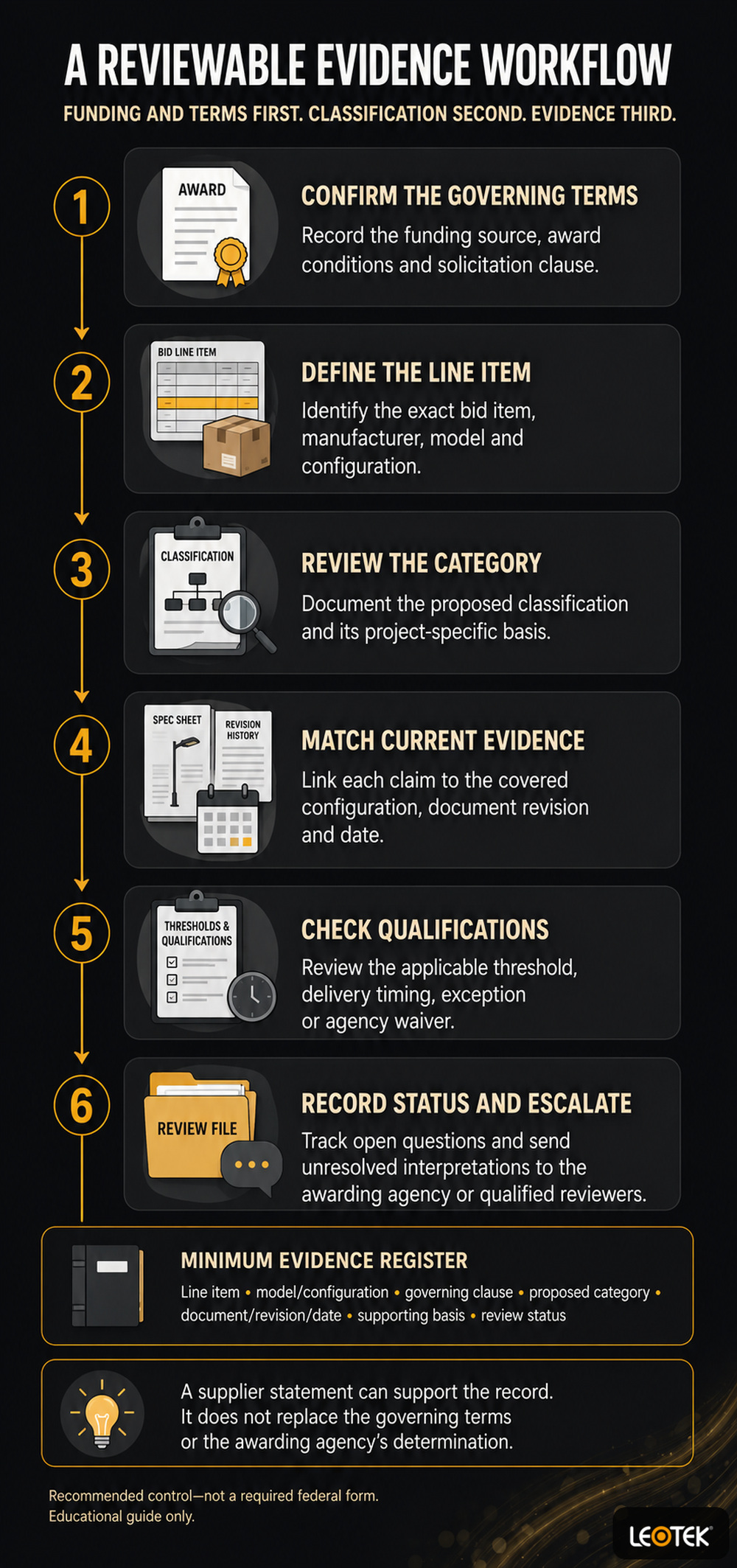
The strongest way to reduce ambiguity is to make evidence traceable. Create a register for each relevant line item before making a domestic-content representation part of a bid evaluation or submittal decision.
Build an item-by-item evidence register
Use a working register with fields such as:
| Field | Why it matters |
|---|---|
| Bid line item and description | Connects the review to the actual procurement scope. |
| Exact manufacturer, model, and configuration | Prevents a family-level statement from being applied to a different configuration. |
| Funding source and governing clause | Identifies the framework that must be evaluated. |
| Proposed classification | Records the category being considered and the basis for review. |
| Document name, revision, and date | Helps distinguish current evidence from a generic or outdated statement. |
| Supplier attestation, supporting basis, and component-cost basis where applicable | Separates a claim from the records used to support it. |
| Agency or procurement review status | Shows who must resolve open questions; it is not an eligibility conclusion. |
This is a recommended control, not a required federal form. Its purpose is to make it easier to spot gaps before award or installation, particularly when several products and suppliers are involved.
Questions to ask before treating a claim as proof
Before accepting a domestic-content representation, ask:
- What funding source, award term, and solicitation clause apply to this line item?
- Is the procurement governed by BABA, the FAR Buy American Act framework, another stated requirement, or a combination that needs agency clarification?
- What category applies to the item in the project’s incorporation context?
- What exact model and configuration does the supplier’s document cover, and when was it issued?
- What threshold, delivery date, exception, or waiver documentation is relevant to this procurement?
- Who at the awarding agency or procurement team has authority to resolve an ambiguity?
The answers should lead the evidence review. They should not be backfilled after selecting a product or accepting a broad compliance label.
Common mistakes that create avoidable risk
Several shortcuts are especially risky in public-lighting procurement.
Treating related labels as synonyms. BABA, Buy America, Buy American, domestic content, and U.S. assembly can appear in the same conversation while referring to different requirements or evidence. Anchor the discussion to the actual award or clause.
Using a family claim for a configuration. A claim about a product line, a prior revision, or a related accessory may not cover the exact model on the bid schedule. Match the evidence to the model, configuration, and date.
Focusing only on a percentage. A percentage does not answer the category question, the governing-framework question, or the question of whether the underlying calculation follows the applicable rule.
Assuming a waiver or exception applies. A waiver is not established by a supplier’s preference or a difficult sourcing situation. Confirm the awarding agency’s documentation and scope.
Confusing a certification explainer with product proof. A general article about certification, a catalog badge, or a broad marketing page does not establish a particular item’s domestic-content status.
Validate documents before finalizing a bid decision
Public-lighting buyers need current, exact documentation, not just a reassuring label. For a defined model or configuration question, use LEOTEK technical documents to locate current specifications and related resources, then compare them against the solicitation and project requirements. Confirm document revision, configuration coverage, and any required supporting calculation or attestation with the appropriate procurement and legal reviewers.
For a defined technical question that remains after reviewing the applicable documents, readers can contact LEOTEK about a defined technical question.
The practical goal is not to turn a procurement team into domestic-content counsel. It is to establish a disciplined handoff: funding and terms first, classification second, evidence third, and agency resolution where the record does not support a clear answer.
Frequently asked questions
Is Build America, Buy America the same as the Buy American Act?
No. They are related domestic-preference frameworks, but they operate in different statutory and regulatory contexts. BABA’s Buy America Preference is addressed in 2 CFR Part 184 for covered federal financial assistance and infrastructure projects. FAR Buy American provisions address federal supply acquisitions. The award or solicitation determines which requirement governs.
Does U.S. assembly make a lighting product BABA compliant?
No, not by itself. Under 2 CFR Part 184, the applicable item category and production standard must be evaluated for the exact project. For manufactured products, the regulation includes both U.S. manufacturing and a component-cost standard, subject to its stated qualifications.
What documents should a lighting buyer request from a supplier?
Request documents tied to the exact model and configuration, the applicable requirement or clause, and the project’s required evidence. Record document dates and revisions, and ask the awarding agency or qualified procurement and legal reviewers to resolve unclear classifications, calculations, or waiver questions.
Can a waiver change a BABA requirement?
Federal agencies may issue BABA waivers under the conditions and process in 2 CFR Part 184. Buyers should rely on the applicable agency documentation, rather than assume a waiver exists or applies to a particular item.
References
- Federal Acquisition Regulatory Council, FAR 25.003 — Definitions; accessed July 26, 2026.
- Federal Acquisition Regulatory Council, FAR 25.101 — General; accessed July 26, 2026.
- U.S. Government Publishing Office, 2 CFR Part 184 — Buy America Preferences for Infrastructure Projects; accessed July 26, 2026.
- LEOTEK, Resources and Documents; accessed July 26, 2026.