
















Not necessarily. An LED streetlight conversion can reduce fixture energy use, but whether a city realizes bill savings depends on whether its applicable streetlight tariff, ownership arrangement, inventory records, and billing method recognize the changed equipment or usage. Confirm the current rate schedule, charge components, conversion process, and post-installation bill reconciliation before treating an energy model as budget savings.
Key takeaways
- A lower-wattage fixture and a lower utility bill are related, but they are not the same result.
- The applicable streetlight tariff or utility streetlight rate, not a generic calculator, determines how charges are assessed.
- Ownership, rate code, fixture inventory, and the utility’s conversion process should be verified before procurement.
- Fixed, maintenance, equipment, and other charges may not change in the same way as energy-related charges.
- Keep an auditable record from the pre-conversion inventory through the first corrected bills.
Before you claim streetlight bill savings, verify these 6 items
- Applicable tariff and effective date: Identify the exact rate schedule or utility streetlight rate that applies to the account or assets, including its revision date.
- Ownership arrangement: Confirm whether the utility, city, or another party owns the affected equipment and maintains the billing record.
- Current inventory: Reconcile billed quantities, locations, asset IDs, and existing equipment categories before setting a baseline.
- Rate code and equipment classification: Ask which recorded classification controls billing after the change.
- Charge components: Obtain the utility’s explanation of the charges expected to change and those expected to remain.
- Conversion and reconciliation process: Document required approvals, the effective billing date, and how the first post-conversion bills will be checked.
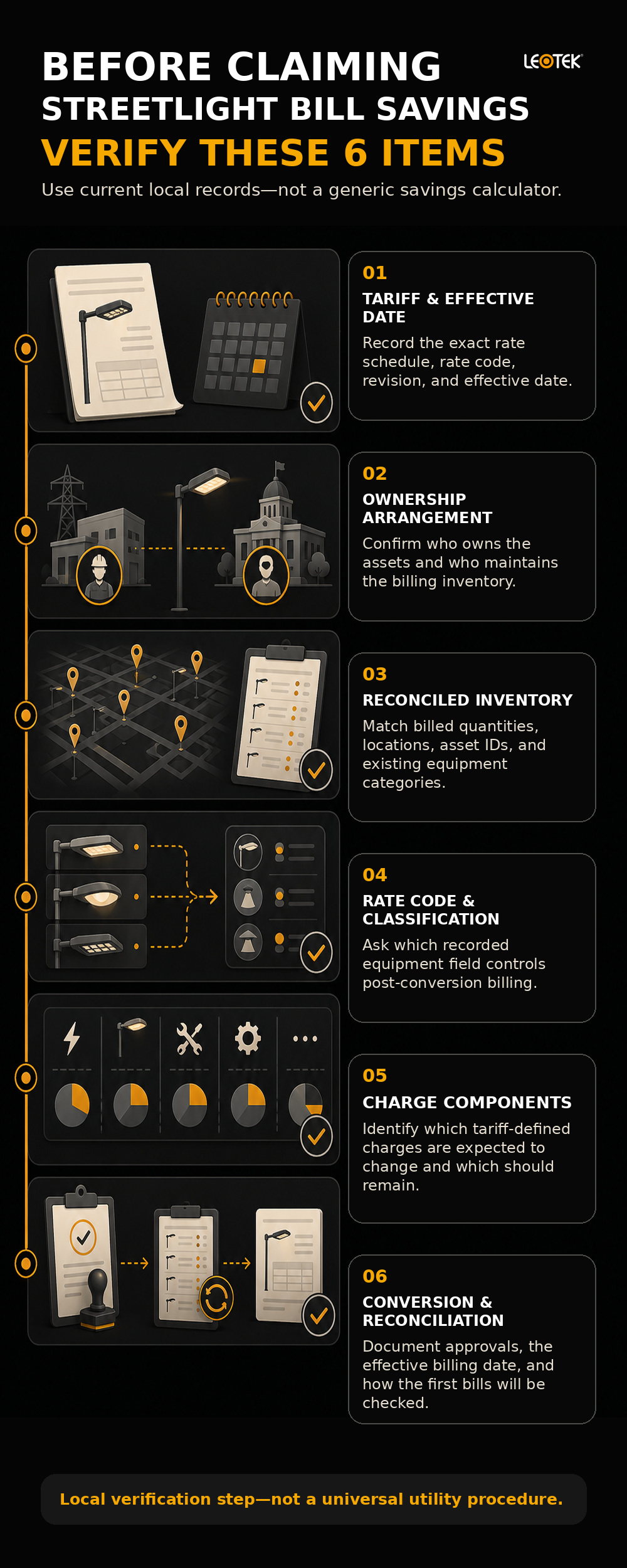
Each item is a local verification step, not a statement that every utility tariff uses the same terminology or procedure.
Why fixture energy savings and bill savings are not the same thing
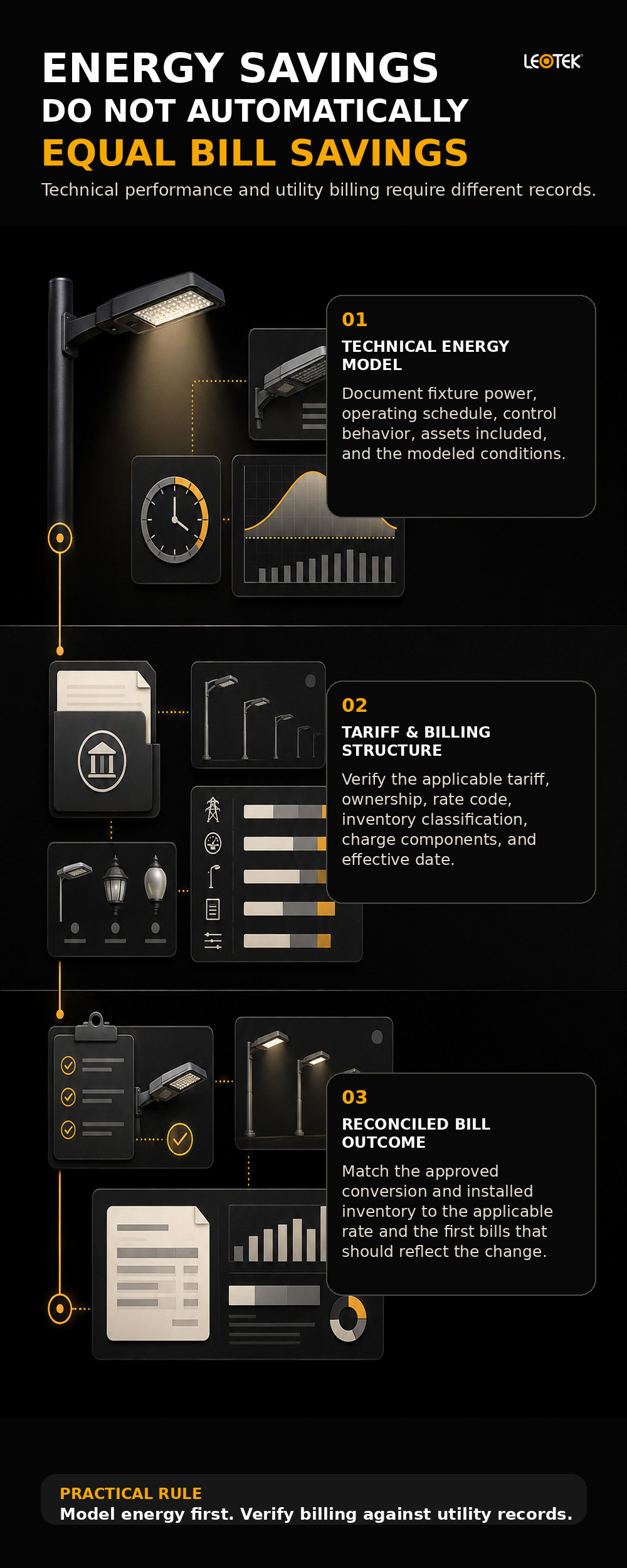
For a municipal streetlight program, there are two related but separate questions. The first is technical: how much energy will the proposed equipment use under documented operating conditions? The second is financial: how will the utility calculate the city’s charge after that equipment is installed?
An LED conversion may change connected load, driver behavior, schedules, or dimming capability. None of those changes alone tells a city which line items will change on its invoice. The answer depends on the applicable streetlight tariff or rate schedule, the service arrangement, and the utility’s accepted record of the installed inventory.
This distinction matters because a rate may be structured around more than energy. Depending on the local arrangement, a bill can include charges associated with equipment, maintenance, administration, or other tariff-defined elements. A city should not assume that every charge varies directly with fixture wattage, or that every rate contains the same components.
The practical rule is simple: use an engineering energy model to test equipment assumptions, then use the current tariff and utility process to test the billing assumption. Both records belong in the project file.
Start with the ownership and billing model
Before comparing luminaires or estimating municipal energy savings, establish who owns the assets and how service is billed. That information shapes which documents control the work and who must authorize an inventory change.
Utility-owned streetlights
In a utility-owned arrangement, the utility may maintain the asset inventory and assign equipment to a tariff-defined rate category. A municipality should confirm the current inventory record, the applicable rate schedule, and the utility’s process for approving or recording a conversion.
Do not assume that an upgrade automatically changes the billed category on the date of installation. Ask what documentation the utility needs, who submits it, when a rate change becomes effective, and how the city will see the change on a bill. The local tariff and service agreement govern the answer.
Customer-owned streetlights
Where the city or another customer entity owns the equipment, the service arrangement may be different. Billing can depend on a meter, an unmetered-service methodology, or another documented arrangement. The city still needs to identify the applicable rate schedule, the recorded equipment, and the operating assumptions used for billing.
Customer ownership does not eliminate the need for tariff review. It changes the questions. For example, the city may need to verify how the utility recognizes an equipment change, whether it requires a service update, and whether the proposed controls or operating schedule affect the billing method.
In either model, avoid using a generic ownership label as a conclusion. Confirm the arrangement for the actual jurisdiction, account, and asset group.
Read the streetlight tariff line by line
A streetlight tariff, often published as a streetlight rate schedule, is the utility’s rate document for a defined service. It may include eligibility conditions, definitions, charge components, equipment classifications, effective dates, and administrative requirements. The title and layout vary by utility, so a city should review the actual current document rather than relying on another jurisdiction’s example.
Identify the rate schedule, effective date, and eligible equipment
Start with the exact tariff name or rate code shown on the account or utility inventory. Record the effective date and version. A rate schedule that was current during project planning may not remain current when installation or billing begins.
Then determine how the tariff identifies equipment. It may use a lamp or fixture description, wattage band, ownership type, service class, or another classification. The project team should ask the utility which field controls the post-conversion rate assignment and how the change must be documented.
This is also the point to separate a product evaluation from a billing determination. A streetlight’s specifications, photometry, controls, and configuration need their own technical review. The utility tariff is not a product specification, and a product data sheet is not a utility rate decision. Readers evaluating roadway equipment can explore outdoor lighting applications, but the local tariff remains the source for local billing treatment.
Separate energy-related charges from fixed and service charges
Do not assume that a monthly streetlight charge is one energy number. Read the tariff’s definitions and charge table closely. Identify which line items, if any, the utility classifies as energy charges, maintenance charges, fixed charges, or other tariff-defined charges.
That review produces a more useful procurement question: Which specific charges are expected to change after this conversion, and which are expected to remain? Ask the utility to answer against the rate schedule in effect for the project. If a utility provides a written conversion estimate, retain the tariff version and the assumptions that accompany it.
The same discipline applies to tariff riders, adjustments, taxes, and locally applicable charges. A city should not omit them from a budget forecast simply because a fixture wattage changes. Conversely, it should not assume that a charge will persist or disappear without confirming its tariff treatment.
Check the conversion and inventory-update procedure
A city may have a sound equipment plan and still miss the expected billing change if the utility record is not updated. Before issuing a purchase order, identify the required conversion paperwork, asset identifiers, responsible parties, approval steps, and expected effective date.
The project file should make it possible to trace a billing quantity back to a location and a documented equipment change. That traceability helps the city resolve a mismatch without guessing whether the problem is an installation record, a utility inventory record, a rate assignment, or the original forecast.
Build a savings forecast the utility can reconcile
An energy forecast is a decision tool, not a guarantee. The strongest forecast makes its inputs visible and separates technical assumptions from tariff assumptions.
Reconcile the fixture inventory before procurement
Build one controlled inventory before the conversion begins. At minimum, include the asset or account identifier, location, ownership arrangement, current rate code, existing equipment description, proposed equipment description, billing quantity, operating or control assumption, and the record that supports each field.
The goal is not to create paperwork for its own sake. It is to make sure the planned fixture count matches the billed fixture count. If an account shows a different quantity or category than the field inventory, resolve that difference before using the account as the baseline for projected municipal energy savings.
For a large program, assign an owner and date to each unresolved record. A city can then distinguish an open data-quality issue from a confirmed financial outcome. Do not turn an incomplete inventory into a precise savings claim.
Test the assumptions behind wattage and controls
Wattage is an important input, but it is not the entire operating model. If a forecast includes dimming or controls, document the scheduled hours, control logic, expected dim level, and the device behavior on which the model depends. Then confirm whether the utility’s billing method recognizes those assumptions.
The U.S. Department of Energy’s 2024 study, *The Energy and Operational Impacts of Using 0-10V Control for LED Streetlights*, characterized 23 LED streetlights that claimed 0-10V dimmability and found variation in market-available LED-driver performance. That does not establish a savings percentage for any project. It does support a more careful practice: validate dimming assumptions rather than treating a claimed interface as proof of a delivered energy or cost outcome.
For broader technical context, the DOE Solid-State Lighting program publishes research resources on energy-efficient lighting. Use those resources to frame questions, not to substitute for the actual tariff, project design, or utility confirmation.
Keep a bill-reconciliation trail after installation
After installation, compare the approved conversion record with the installed inventory, the rate schedule version, and the first bills that should reflect the change. It also creates a usable record for a future municipal streetlight audit. Document the date each record was received and the period covered by each invoice.
If the bill does not match the forecast, treat the difference as an investigation trigger. It may reflect a timing issue, an incomplete inventory update, a different rate assignment, a charge that was modeled incorrectly, or another project-specific condition. It is not, by itself, proof that the equipment or utility made an error.
This record also makes future audits easier. The city can show which assumptions were used, which rate document applied, and how actual billing was reconciled instead of relying on a retrospective estimate.
Questions to send the utility before approving an LED conversion
Use the following questions as a starting point for a project-specific discussion. They are not a substitute for reading the tariff or obtaining qualified legal, engineering, and procurement review.
- What is the exact streetlight tariff or rate schedule, rate code, and effective revision for the affected account or assets?
- Who owns the affected streetlights, and who is responsible for maintaining the billing inventory?
- What fixture quantity, equipment category, and rate assignment does the utility currently have on record?
- Which tariff-defined charges does the utility expect to change after the proposed conversion?
- Which charges does the utility expect to remain, and why?
- What conversion forms, equipment details, asset IDs, field verification, or approvals are required before billing can change?
- On what date or billing cycle would an approved change take effect?
- How does the applicable billing method treat schedules, dimming, or other controls, if they are part of the project?
- What maintenance or service responsibilities change, if any, after the conversion?
- What post-installation report or contact should the city use to validate the updated inventory and first bills?
Ask for answers in a form the project team can retain with the procurement record. Where a tariff does not address a question directly, document the utility’s written interpretation and the date received.
Where connected streetlight data can help, and how to use it responsibly
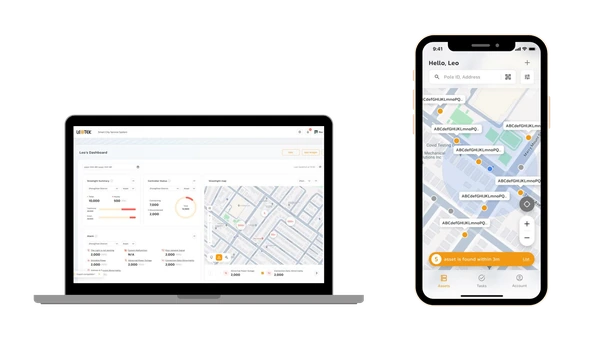
Connected streetlight systems can help a city organize operational information when the selected system and deployment support those functions. LEOTEK describes its connected streetlight management offering as including remote switching, dimming, scheduling, fault notification, energy tracking, reporting, maps, alarms, and asset management. Those are first-party descriptions of platform functions, not a promise of savings or a statement about a particular utility’s billing rules.
For tariff work, the useful question is whether operational records can support the city’s inventory and assumptions. A schedule record, asset identifier, alert history, or energy-tracking report may help the team compare field operations with its forecast. It does not replace the utility’s rate schedule, conversion approval, or invoice.
Keep these systems in their proper roles. The tariff establishes the billing terms. The field inventory establishes what is installed. Operational data can help verify assumptions. Together, they create a stronger municipal record than any single source alone.
Make the next step evidence-based
Once the city has confirmed its tariff and conversion process, equipment selection can proceed with a clearer financial baseline. For a defined technical evaluation, the product specifications and resources hub can help readers locate official documents. Verify the applicable model, configuration, document date, and revision before using any document in procurement.
For related background on watts, lumens, and lux when evaluating outdoor lighting, see this guide. It should complement, not replace, this article’s tariff-first review.
LED Streetlight Conversion and Utility Bill FAQs
Answers to common questions about streetlight tariffs, energy savings, ownership, billing records, dimming, and post-conversion reconciliation.
Will an LED streetlight conversion automatically lower utility bills?
No. An LED streetlight conversion can reduce fixture energy use, but utility bill savings depend on the applicable streetlight tariff, ownership arrangement, billing method, recorded equipment classification, and utility conversion process. The city should confirm which charges will change before treating projected energy savings as budget savings.
What is a streetlight tariff?
A streetlight tariff is a utility rate schedule that defines how an eligible streetlighting service is billed. It may identify ownership arrangements, equipment classifications, energy-related charges, maintenance charges, fixed fees, service conditions, and procedures for updating installed equipment.
Why can LED streetlights save energy without reducing the bill by the same percentage?
Fixture energy use may represent only one part of a streetlight bill. The applicable tariff may also include fixed, equipment, maintenance, service, administrative, or other utility-defined charges. These charges may not change in direct proportion to the reduction in luminaire wattage.
How does streetlight ownership affect LED conversion savings?
Ownership can affect who maintains the asset inventory, approves the conversion, performs maintenance, and updates the billing classification. Utility-owned and municipality-owned streetlights may follow different service and billing arrangements, so ownership must be verified for the actual assets included in the project.
What should a city verify before forecasting streetlight bill savings?
Verify the applicable tariff and effective date, ownership arrangement, billed fixture inventory, current rate codes, equipment classifications, charge components, required conversion documents, billing-effective date, and post-installation reconciliation process. Each assumption should be supported by a dated record.
Can dimming and smart streetlight controls reduce utility charges?
Dimming and scheduling can reduce energy consumption under documented operating conditions, but whether they reduce utility charges depends on the local tariff and billing method. The city should confirm whether the utility recognizes actual consumption, scheduled operation, connected load, or another billing basis.
Who should verify the streetlight inventory before conversion?
The municipality should assign responsibility among the asset owner, utility representative, project manager, engineering team, and operations staff. The objective is to reconcile billed quantities, locations, asset identifiers, fixture types, ownership, and rate classifications before establishing the financial baseline.
When should the utility update the streetlight rate after conversion?
The effective date depends on the utility’s tariff, approval process, inventory-update procedure, and billing cycle. A city should obtain written confirmation of the required documentation, responsible party, approval date, and billing period in which the revised classification should appear.
How should a city reconcile utility bills after an LED conversion?
Compare the approved conversion record, installed asset inventory, applicable tariff, effective rate codes, and first post-conversion bills. Investigate differences in fixture quantities, classifications, effective dates, charge components, or missing inventory updates before concluding whether the forecast was accurate.
What records should a municipality keep after converting to LED streetlights?
Retain the applicable tariff and effective date, baseline inventory, post-conversion inventory, rate codes, utility approvals and correspondence, equipment documents, installation records, energy assumptions, controls settings, and the bills used for financial reconciliation.
References
- U.S. Department of Energy, The Energy and Operational Impacts of Using 0-10V Control for LED Streetlights, January 10, 2024; accessed July 26, 2026.
- U.S. Department of Energy, Solid-State Lighting; accessed July 26, 2026.
- LEOTEK, Applications for Outdoor Lighting; accessed July 26, 2026.
- LEOTEK, LEOLink Solutions; accessed July 26, 2026.
- LEOTEK, Resources and Documents; accessed July 26, 2026.
- LEOTEK, Watts to Lumens; accessed July 26, 2026.