

























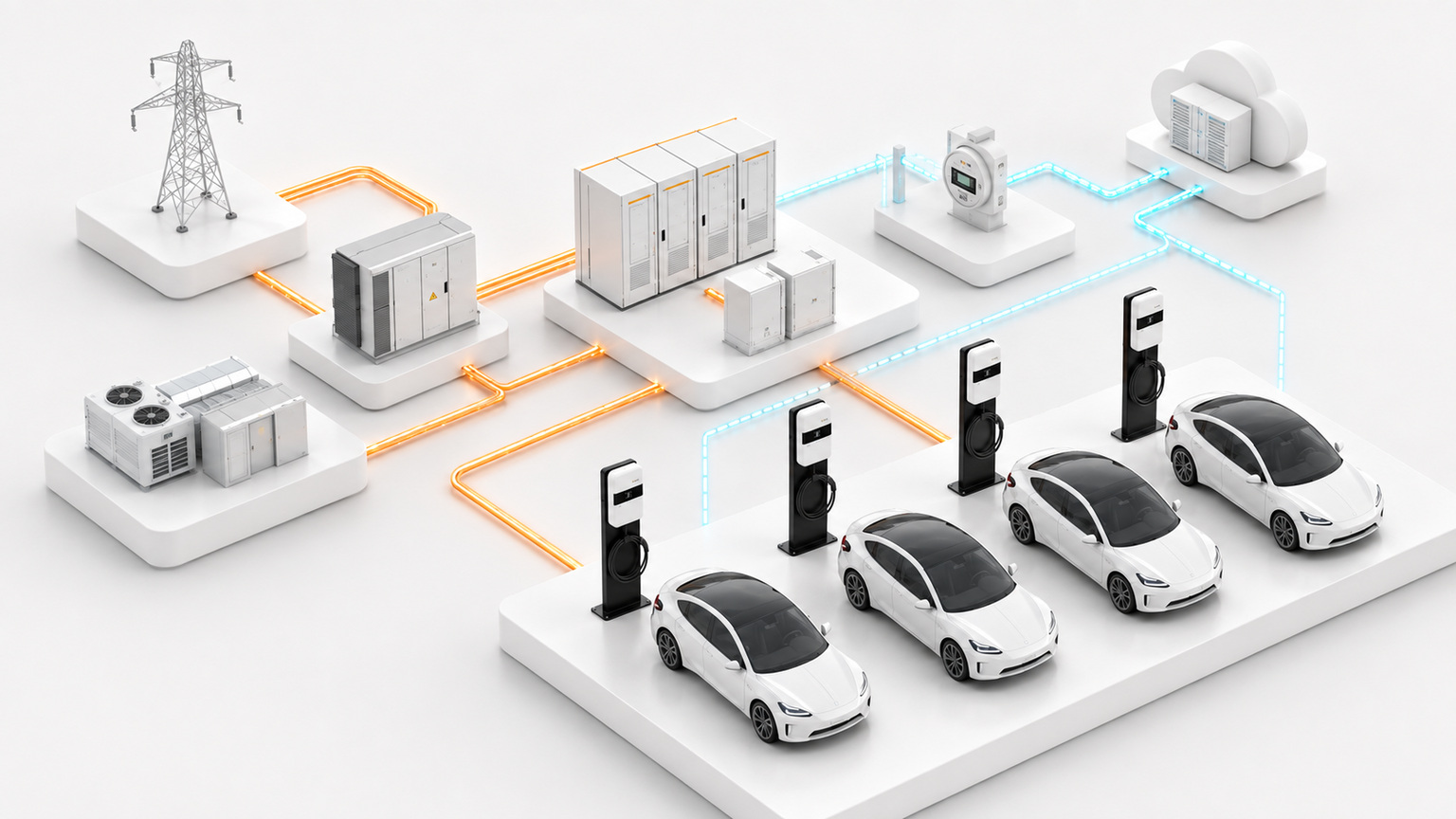
EV charging demand charges can affect a site’s electricity bill when its tariff includes a charge tied to the highest measured demand during a billing period. Charging schedules, simultaneous sessions, and other facility loads can influence that peak, but the applicable utility tariff, meter interval, and site conditions determine the actual bill.
For a municipal property, fleet depot, public parking facility, or transportation-agency site, this is an operating question as much as an equipment question. A charger’s rated output does not by itself predict a monthly bill. The useful starting point is to understand how the site uses electricity, what the tariff measures, and which charging-service commitments cannot be compromised.
Key takeaways
- Energy charges and demand charges measure different parts of electricity use: energy is generally measured in kilowatt-hours (kWh), while demand is measured in kilowatts (kW).
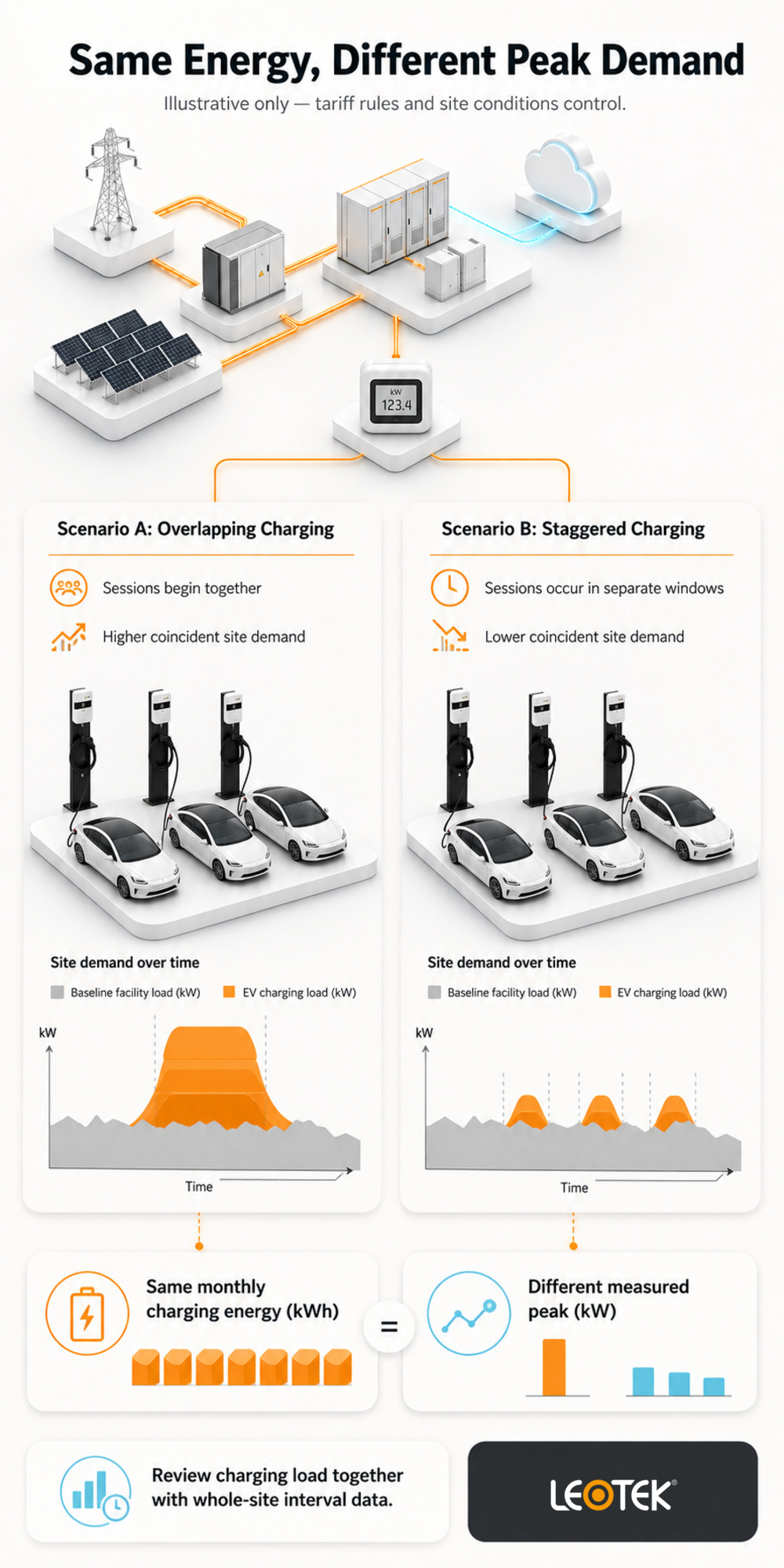
- A site with the same monthly charging energy can have a different bill if its highest demand occurs at a different time or reaches a different level.
- Overlapping charging sessions and coincident building, fleet, or facility loads can matter more than a charger’s nameplate rating alone.
- Managed charging may be worth evaluating, but it is not a universal bill-reduction guarantee. Tariff terms, service needs, site load, and control capabilities all matter.
| Term | Meaning |
|---|---|
| Energy charge | Cost tied to electricity consumed, generally measured in kWh. |
| Demand charge | Where applicable, a tariff component tied to the site’s highest measured demand. |
| Site operation | Charging timing and overlap with other loads that can influence measured demand. |
How EV charging demand charges differ from energy charges
The exact bill structure varies by utility, service class, location, and tariff. Separating energy from demand helps teams ask better questions before they forecast operating cost.
kWh records energy; kW captures the rate of demand
An energy charge is generally tied to the amount of electricity consumed over time, measured in kWh. If a charging site delivers more energy over a month, its energy use can rise even when its highest demand does not change.
Demand measures the rate at which the site draws power at a point in time, expressed in kW. Where a tariff includes demand charges, the billing demand may be based on the highest measured demand in the billing period. The U.S. Department of Energy’s Alternative Fuels Data Center notes that these charges are typically based on the highest 15-minute average use recorded during that period.
“Typically” matters. A billing interval, demand definition, seasonal rule, minimum bill, or ratchet can differ by tariff. A site host should not apply a 15-minute assumption or a demand-charge formula to a local bill without confirming the tariff language with the serving utility.
Why the billing interval and tariff language matter
Two sites can use a similar number of kWh for vehicle charging and still incur different electricity costs. One may spread charging over lower-load periods, while the other may create a short period of higher coincident demand. The tariff may also distinguish time periods, use a particular demand measurement method, or carry prior demand into later billing periods through a ratchet provision.
That is why “electricity rate” is usually too broad a label for an operating-cost model. The team needs the applicable service schedule, not just an average price per kWh. It should also establish whether charging is behind an existing meter, on a separate meter, or part of a new service arrangement. Those conditions can change both the data available and the questions the utility needs to answer.
How site operation can change the measured peak
Site operation can affect EV charging peak demand because charging rarely occurs in isolation. At a public facility, charging may overlap with HVAC, lighting, pumps, kitchen equipment, or other loads. At a fleet site, vehicle return times and next-shift requirements can concentrate charging in a narrow window. At a parking location, driver behavior and access rules can affect when sessions begin and how long they run.
Concurrent charging sessions and other facility loads
The practical issue is coincidence: what else is drawing power when a vehicle begins or continues charging? A single charging session may be manageable within the site’s normal load profile, while several sessions beginning near the facility’s own peak may produce a different result.
An illustrative load chart can make this relationship clear: show a baseline facility load, charging sessions added at different times, and the resulting total site demand. Label the chart as illustrative. It should not show a dollar outcome or imply that a particular operating pattern will produce the same result elsewhere.
Charging windows, dwell time, and operational constraints
Charging windows are operating decisions, not merely calendar settings. A site may have predictable dwell time, such as overnight fleet parking, or less predictable arrivals at a public facility. It may need to prioritize certain vehicles, accommodate access rules, or maintain a minimum state of readiness. Document which vehicles must be ready, whether public charging must remain available, and whether charging can safely coordinate with other loads.
The DOE’s procurement and installation guidance recommends engaging the utility on installation needs, electrical service and equipment upgrades, pricing, and rate implications. That engagement is useful before commissioning and remains useful when operating patterns change.
Why charger nameplate power is not a monthly bill forecast
Nameplate power can be relevant to site planning, but it is not a bill forecast. Actual charging demand depends on whether a unit is in use, the vehicle, the session, any site-level limits, other loads, and the tariff’s measurement rules. Conversely, a lower-power charging configuration is not proof that a site will avoid demand charges.
The Alternative Fuels Data Center says that direct-current fast charging is more likely to trigger demand charges than Level 1 and Level 2 charging. That is a planning consideration, not a universal outcome. The local tariff and the site’s measured demand still control.
A tariff-review checklist for municipal and commercial charging sites
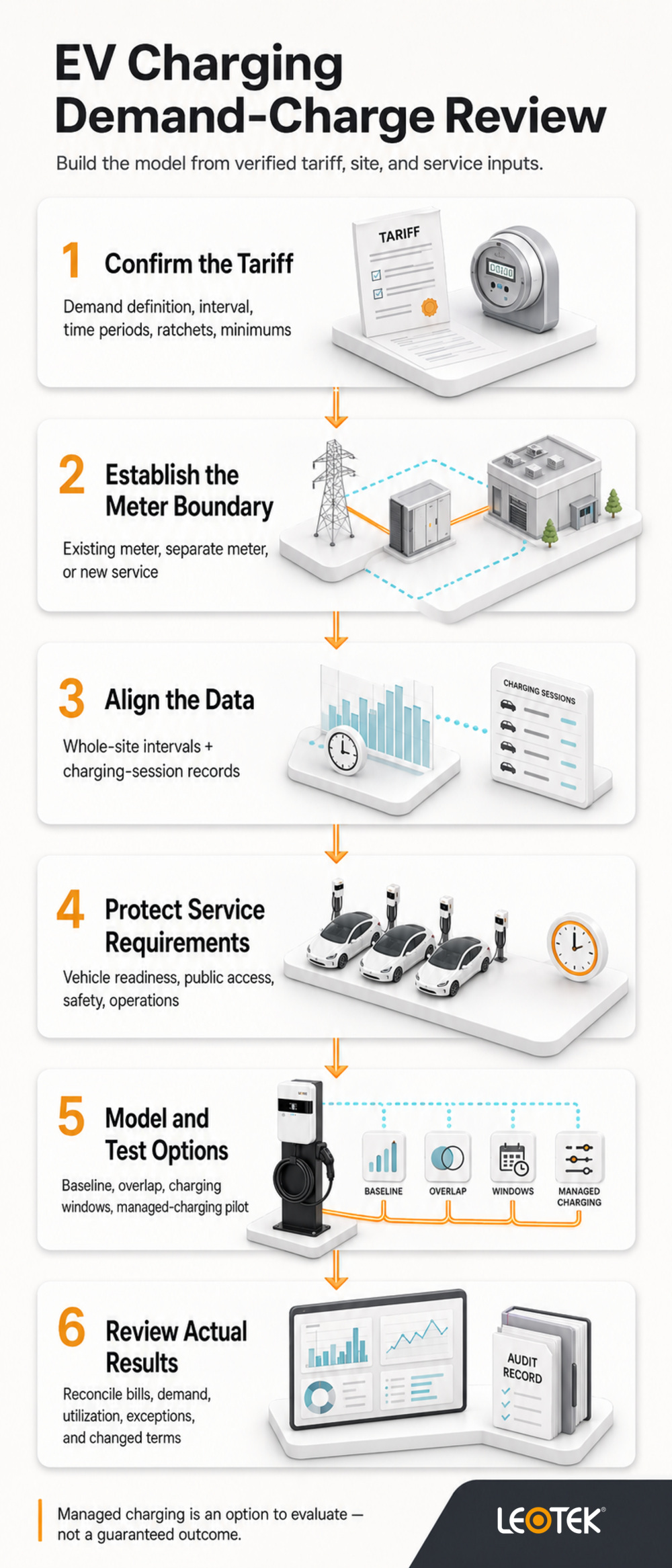
A credible operating-cost model begins with inputs that can be verified. The checklist below is intended to organize a discussion with the utility, facilities staff, operators, procurement personnel, and qualified technical professionals. It is not electrical, legal, or rate advice.
Confirm the tariff and billing-demand definition
Gather the current tariff, service classification, recent bills, and interval-data availability. Ask the utility or rate specialist to clarify:
- whether the rate includes a demand charge and how billing demand is measured;
- the measurement interval and the applicable billing period;
- time-of-use periods, seasonal provisions, and whether demand is assessed differently in certain windows;
- ratchets, minimums, riders, or other provisions that affect billed demand; and
- whether a new service, separate meter, or future expansion would change the applicable rate.
Do not substitute a demand-charge example from another utility or another customer class for this review. A model is only as defensible as its tariff inputs.
Compare charging data with whole-site interval data
Charging-session records can show when vehicles connect, how long sessions last, and how much energy is delivered. Whole-site interval data shows the total demand the meter sees. Both are needed to understand coincidence.
Where data is available, align the timestamps and review a representative period that includes normal operations and known peaks. Look for repeated patterns, such as fleet return periods, public-event loads, or seasonal facility demand. Treat unusual outages, construction activity, and one-time events separately so they do not silently become the baseline.
Networked charging infrastructure can provide site hosts with utilization data, according to the DOE’s operations guidance. Whether a particular system provides the needed fields, access, and retention is a project-specific question. Confirm it in current documentation and contracts rather than assuming it from a product category.
Involve operations and technical reviewers early
Rate review cannot be handed off only to finance or only to the electrical team. Fleet dispatch, parking operations, facilities, procurement, IT or network stakeholders, and the utility may each control information that affects the operating model. A change that looks attractive in a spreadsheet may not work if it compromises vehicle readiness, public access, safety procedures, maintenance windows, or contractual obligations.
Qualified electrical professionals and the authority having jurisdiction should address electrical design, code, permitting, and installation matters. The operating-cost article can help define the questions, but it does not replace project-specific engineering or utility review.
Managed charging is an option to evaluate, not a guaranteed outcome
Managed charging describes approaches that adjust charging in response to a schedule, a site limit, a grid signal, or another operating rule. The DOE explains that utilities can use managed charging to increase, decrease, or turn off charging to help meet grid needs. That description does not establish a particular site’s eligibility, interoperability, rate treatment, or bill savings.
Define service requirements before changing charging behavior
Start with the service outcome: which vehicles, users, or public functions have priority; what energy must be delivered; and by when. Then define constraints such as vehicle availability, charger configuration, site communications, contract terms, utility programs, and staff capacity to respond when something does not go as planned.
Managed charging is an operational policy with technical dependencies, not a purely technical toggle. A policy that reduces a short peak but leaves a priority vehicle unready has not met the site’s objective.
Test assumptions against actual data
Use a pilot or controlled operational review where appropriate. Compare planned charging behavior with interval data, session data, and service performance. Track exceptions, including late arrivals, unusual facility loads, and events that required staff intervention. Then revisit the tariff model with the observed data.
The goal is not to promise an outcome. It is to turn a general idea about EV charging load management into a site-specific decision supported by evidence. If a utility offers an EV-specific rate or program, review its current eligibility, rules, and trade-offs directly with that utility.
Build a defensible operating-cost model
For a commercial EV charging cost model, make the inputs visible. Separate tariff inputs from site-load assumptions, charging behavior, and non-electric operating costs. The DOE identifies electricity, maintenance, and applicable networking fees as operating-cost considerations for charging infrastructure. Keeping those categories separate prevents an electricity-rate discussion from becoming an incomplete total-cost claim.
For each assumption, record the source, date, and owner. Examples include the tariff effective date, the interval-data period, the estimated number and timing of sessions, operating constraints, and the maintenance or network terms under consideration. Mark an estimate as an estimate. Do not present it as a measured result.
After commissioning, revisit the model with actual interval and utilization data. Fleet composition, public use, facility load, and tariff terms can change. The DOE sources cited in this article were accessed July 29, 2026; confirm current utility terms before relying on a model.
For broader planning context, see EV charging and energy infrastructure. Readers comparing charging options can also explore the EV charger product family, while keeping product selection separate from tariff and site-operation analysis.
Questions to take to procurement and technical review
Before specifying equipment or changing operating rules, ask:
- Which tariff applies today, and what tariff could apply after expansion or a service change?
- What does the utility use to calculate billing demand, and are ratchets or seasonal provisions relevant?
- What do whole-site intervals show during the periods when charging is most concentrated?
- Which vehicles or public users have non-negotiable charging requirements?
- What data can the site access, retain, and reconcile across the meter, chargers, and operations team?
- Which operating rules can be tested without compromising service?
- Who validates electrical design, utility requirements, permitting, and project-specific compliance?
When the project moves to technical evaluation, use current product specifications and resources for the exact model and document revision. For a defined municipal, fleet, parking, or public-facility project with a specific technical question, readers may contact LEOTEK. Neither path replaces utility-rate review, qualified engineering, or jurisdictional approval.
Frequently asked questions
What are EV charging demand charges?
Where a utility tariff includes them, demand charges are a bill component tied to the site’s highest measured demand during a billing period. They differ from energy charges, which are generally tied to the kWh consumed. Verify the definition, interval, and terms in the site’s tariff.
Are demand charges the same as the price per kWh?
No. A per-kWh price relates to energy use. A demand charge, where applicable, relates to a demand measurement in kW. A site’s bill can include both, along with other tariff components.
Can Level 2 EV charging create demand charges?
It can contribute to a site’s measured demand if the applicable tariff includes demand charges. The outcome depends on the charging load, other site loads, the billing rules, and when charging occurs. Lower charging power does not establish that demand charges will not apply.
Does managed charging always lower the electricity bill?
No. Managed charging may be an option to evaluate, but its effect depends on the tariff, actual site load, charging-service requirements, controls, and operations. Validate assumptions with the utility and project team before forecasting a result.
What should a city or fleet operator ask its utility before installing chargers?
Ask about service capacity, installation and upgrade needs, applicable rates, billing-demand rules, interval data, time-based provisions, and any charging-specific programs. Then review the answers alongside fleet or public-access requirements and qualified technical advice.
EV charging demand charges are best understood as a site-operation issue governed by a specific tariff, not as a fixed characteristic of a charger. By reviewing the tariff, whole-site demand, charging behavior, and service requirements together, public-infrastructure teams can make a better-supported operating-cost decision.
References
- afdc.energy.gov, U.S. Department of Energy’s Alternative Fuels Data Center; accessed July 29, 2026.
- afdc.energy.gov, procurement and installation guidance; accessed July 29, 2026.
- leotek.com, EV charging and energy infrastructure; accessed July 29, 2026.
- leotek.com, EV charger product family; accessed July 29, 2026.
- leotek.com, product specifications and resources; accessed July 29, 2026.