















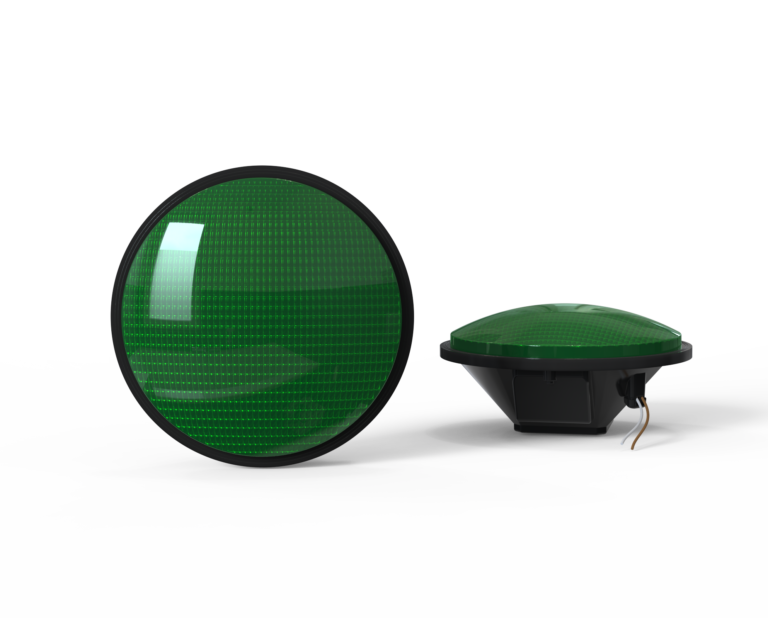


Calculate a streetlight product carbon footprint by defining the lighting service and life-cycle boundary, collecting model-specific activity data, applying documented emission factors, and disclosing the assumptions behind the total. A wattage comparison alone cannot describe the carbon footprint of an LED streetlight because materials, manufacturing, transport, maintenance, and end of life may also be within scope.
For city and transportation-agency teams, the goal is not to produce a single number as quickly as possible. It is to create a result that another reviewer can understand: what luminaire was assessed, which stages were included, what data and factors were used, and where uncertainty remains.
Key takeaways
- A streetlight product carbon footprint (PCF) measures climate-change impact for a defined product and declared life-cycle scope, typically reported in kg CO2e per declared functional unit.
- Start with a functional unit and a system boundary. A cradle-to-gate result is not interchangeable with a cradle-to-grave result.
- Use model-specific mass, power, operating-profile, maintenance, and transport data where available. Label scenario assumptions instead of presenting them as measured facts.
- Document the geography and year for electricity and other emission factors. U.S. electricity inputs should not be treated as a universal constant.
How to calculate a streetlight PCF
1. Define the decision and functional unit.
2. Declare the system boundary.
3. Build a life-cycle inventory for every included stage.
4. Select documented emission factors with compatible units.
5. Calculate each stage, then check the evidence trail.
- Disclose assumptions, exclusions, uncertainty, and review status with the total.
Define the decision, functional unit, and boundary
A PCF is a climate-change calculation for a product, grounded in life-cycle assessment (LCA) and documented for a stated functional unit and boundary. ISO 14067:2018 sets out requirements and guidance for quantifying and reporting a product carbon footprint consistently with LCA principles. That framing matters because an LED streetlight is not a single, uniform object. Its housing, optics, driver, LED modules, controls, packaging, operating schedule, and service plan can vary by configuration and project.
Before gathering any data, state the decision the calculation is meant to inform. A manufacturer may be screening a design. A procurement team may be requesting comparable environmental information. An agency may be estimating the climate impact of a specified luminaire within a larger streetlighting project. Those uses can require different boundaries and levels of review.
Choose a functional unit that describes the service
The functional unit states what the result represents. “One luminaire” may be adequate for an early product inventory, but it may not describe the service a roadway owner needs from the light.
A more useful functional unit can identify one specified luminaire configuration, the reference study period, and the operating conditions being modeled. It might also describe the intended lighting service, but it should not assume that every roadway has the same photometric requirements, operating hours, dimming schedule, or maintenance practice.
The unit must be consistent with the inputs. If the use phase covers a stated number of years, the maintenance and replacement assumptions must cover the same period. If the calculation compares two products, both results need compatible functional units. Otherwise, a difference may reflect the method rather than a meaningful difference in climate impact.
Declare the system boundary
The boundary says which life-cycle stages are included. Common labels are useful only when the article or report explains what they cover:
- Cradle-to-gate typically covers raw materials, components, and manufacturing up to the factory gate.
- Cradle-to-site may extend through delivery to the project site; include installation only when the study explicitly defines it as an included stage.
- Cradle-to-grave can include use, maintenance, replacements, and end-of-life treatment.
The GHG Protocol Product Standard describes product life-cycle accounting that can include raw materials, manufacturing, transportation, use, and disposal. It also cautions against treating product results as directly comparable without more specific product rules and compatible methods.
For that reason, do not describe a cradle-to-gate PCF as the product’s complete lifetime impact. Equally, do not add installation, poles, wiring, or civil work merely because they exist in a streetlighting project. Include them only when the declared scope calls for them, and identify them separately if they are not part of the luminaire product boundary.
Build a life-cycle inventory for the luminaire
An inventory is the evidence behind the calculation. It records physical flows and operational inputs before they are converted into kg CO2e. The best available inputs are specific to the exact luminaire configuration. Secondary database values can fill a gap, but the report should say where they were used and why.
Materials and components
Begin with a bill of materials or similarly traceable mass breakdown. For an LED roadway luminaire, the inventory may need the mass and composition of the housing, heat sink, optics or lens, LED modules, driver and other electronics, wiring, fasteners, seals, packaging, and any installed control node.
Do not infer the composition of a component from a product-family name, a photograph, or a general description of LED technology. If a supplier provides material data, record whether it is primary data for the component or a generic estimate. If recycled content, recycled-metal credits, or a particular allocation method is used, disclose the method rather than assuming it makes the product lower carbon.
Materials are only one part of a luminaire carbon footprint. A heavier product is not automatically higher impact, and a lighter product is not automatically lower impact. The relevant question is whether the masses, materials, and factors are documented within the same declared scope.
Manufacturing and transport
Manufacturing data can include energy used for assembly, testing, and packaging, plus the allocation method if a facility makes more than one product. If supplier-specific energy data are not available, identify the secondary data source and its geography and year. Do not guess a manufacturing location based on a brand, distributor, or point of sale.
Transport needs the same discipline. Record each included leg, mode, distance, shipment mass or load basis, and source. Inbound components, factory-to-distribution transport, and distribution-to-site transport are separate decisions. A report should not compress them into “shipping emissions” without explaining what that category contains.
For an agency reviewing a submittal, a useful request is simple: ask the manufacturer to identify the product configuration, materials data, manufacturing-energy basis, and included freight legs. This is more useful than accepting an unsupported embodied-carbon total.
Model use, maintenance, and end of life
Use-phase electricity often deserves close attention in a cradle-to-grave study, but it must be modeled rather than assumed. The calculation depends on the luminaire’s actual input power, operating hours, dimming schedule, control behavior, grid factor, and study period. Product efficacy or lumen output alone is not a use-phase energy model.
Calculate use-phase electricity emissions
Use a transparent structure:
use-phase emissions = input power (kW) × annual operating hours × reference study years × selected electricity-emission factor
This is an input framework, not a claim about a particular streetlight. It does not account for a particular control schedule, driver loss, or grid region until those values are documented.
For a U.S. assessment, select and cite an electricity-emission factor appropriate to the reporting geography and data year. The U.S. Environmental Protection Agency’s eGRID provides emissions and generation data for the U.S. power sector. Record the data set, geography or subregion, year, unit, and calculation date used in the study. If the project uses a different contractually required factor or accounting approach, disclose that choice and avoid mixing factors without explanation.
The same operating profile must apply across the calculation. If scheduled dimming is modeled, state the schedule and the power used in each period. If lighting controls are not part of the specified luminaire configuration, do not add their benefits to the result. A control system may change the operating profile, but it also has its own hardware and, potentially, maintenance inputs when included in the boundary.
Include maintenance and end-of-life scenarios carefully
Maintenance can include field visits, driver replacement, module replacement, cleaning, or other service events, but only when those activities are supported by a defined service plan, contractual evidence, or clearly labeled scenario. Do not turn a general warranty statement into a lifetime assumption, and do not assume that every product has the same replacement rate.
End of life is also a scenario, not an automatic credit. State whether the study models reuse, recycling, energy recovery, landfill, or another route. Identify how collection, treatment, and any recycling allocation are handled. A reader should be able to see whether end-of-life treatment is included, excluded, or estimated from a documented scenario.
Calculate the PCF and check the evidence trail
Once the inventory and boundary are set, apply factors consistently. The roll-up structure is:
PCF (kg CO2e / functional unit) = materials + component manufacturing + luminaire assembly + inbound/outbound transport + installation (if included) + use-phase electricity + maintenance/replacements + end of life
Include only the stages within the declared boundary. The basic pattern for each included stage is:
stage emissions = activity data × documented emission factor
Add the included stage totals only after checking that their units are compatible. A material mass may use kilograms, electricity may use kilowatt-hours, and freight may use a mass-distance basis. The factor source must match the activity unit. A conversion that is not documented can be a larger source of error than the arithmetic itself.
Use a calculation table, not a black box
A decision-ready worksheet or appendix should make the calculation inspectable. At a minimum, include the following fields:
| Life-cycle stage | Activity data needed | Evidence to retain | Reporting note |
|---|---|---|---|
| Materials and components | Mass and material composition | Bill of materials; supplier declarations | Identify primary versus secondary data. |
| Manufacturing | Energy and allocation basis | Facility or modeled process record | State geography, year, and allocation. |
| Transport | Distance, mode, and shipment basis | Freight record or scenario source | List included legs separately. |
| Use | Input power and operating profile | Specification, measurement, or stated schedule | State grid factor, geography, and year. |
| Maintenance | Service events and replacement parts | Service plan or scenario | Separate measured history from assumptions. |
| End of life | Treatment route and allocation | Contractual route or documented scenario | Do not imply a recycling credit without method disclosure. |
Quality checks should ask whether the exact product configuration is clear, every major stage has a source, and all exclusions are visible. If a data point is estimated, label it as an estimate. If a stage is outside scope, say so. Omitting these distinctions can make a precise-looking total misleading.
Interpret hotspots without making avoided-emissions claims
The result can help a team identify where better data or design attention may matter most. It should not be used to claim that a product avoids emissions, is carbon neutral, or is environmentally superior unless a separate, appropriately scoped comparison supports that statement.
This distinction is especially important for roadway infrastructure. A PCF describes the climate-change impact within the chosen product boundary. It is not a citywide greenhouse-gas inventory, a project’s full civil-works footprint, or proof that a particular lighting upgrade will achieve a specified reduction.
For broader lifecycle planning, LEOTEK’s sustainability approach is an approved reader pathway. It should not be cited as evidence of a model-specific PCF or environmental outcome.
Report a decision-ready result
The final total is only one part of a credible disclosure. Procurement and engineering teams need the method behind it, especially when the result will inform a specification, evaluation, or public sustainability statement.
Include a minimum disclosure set
Report the following alongside any PCF total:
1. Product name, exact configuration, and functional unit.
2. Reference study period and declared system boundary.
3. Included and excluded life-cycle stages.
- Activity-data sources and the share of primary versus secondary data where known.
- Emission-factor sources, versions, geography, year, units, and allocation choices.
- Operating profile, maintenance assumptions, and end-of-life scenario.
- Known data limitations, uncertainty, calculation date, and review or verification status.
This disclosure set helps a reviewer distinguish a screening estimate from a result intended for external use. It also helps prevent a product-level number from being reused for a different configuration or jurisdiction without reassessment.
Label the output clearly as a screening PCF, a verified PCF, or an EPD, because those forms of disclosure are not interchangeable.
Understand the role of an EPD
An environmental product declaration (EPD) is not simply a marketing label. The International EPD System describes an EPD as a verified and registered document that communicates life-cycle environmental information and is based on LCA and applicable product category rules (PCRs). It also states that an EPD does not itself imply environmental superiority over alternatives.
That is why teams should ask for the EPD’s declared unit, product configuration, PCR, system boundary, data validity, and verification information. A verified EPD may be appropriate when a project or procurement framework requests it. A screening PCF can still be useful for internal decisions, but it should be labeled as such and should not be presented as an EPD.
For model-specific documentation, use product specifications and resources to locate current materials. Confirm the exact model, document date, and revision before relying on a specification, warranty, or other technical record in a PCF study. For broader roadway-luminaire planning context, see municipal outdoor lighting.
Frequently asked questions
Is a streetlight PCF the same as a citywide streetlighting-project footprint?
No. A luminaire PCF covers the product and the declared life-cycle stages. A citywide project footprint may also include poles, wiring, controls, construction, traffic management, site conditions, and other project-specific activities. Keep the two boundaries separate unless the study explicitly combines them.
Can two luminaire PCFs be compared?
Only with care. The products should have compatible functional units, boundaries, reference study periods, product configurations, data sources, and allocation choices. A cradle-to-gate result should not be ranked against a cradle-to-grave result, and an EPD should be reviewed against its applicable PCR and declared scope.
Which electricity factor should a U.S. agency use?
Use the factor required by the governing reporting or procurement framework. When the study uses EPA eGRID or another factor source, document the geography, data year, unit, and version. The source selected must match the study’s purpose and boundary; it should not be chosen solely because it produces a preferred result.
Should installation and pole infrastructure be included?
Include them when the study’s declared scope and decision require them. For a luminaire-only PCF, poles, foundations, trenching, and wiring may be outside the product boundary. If they are included, report them as distinct stages and do not attribute their entire impact to the luminaire without a stated allocation approach.
What should a procurement team ask a manufacturer to provide?
Ask for the exact product configuration; the functional unit and boundary; a mass and material inventory; manufacturing and freight data or their documented proxies; input-power and operating-profile assumptions; maintenance and end-of-life scenarios; factor sources; and the calculation’s review or verification status. Those details allow an agency to assess the result rather than rely on an unsupported headline number.
Build the number around the evidence. This article is a methodology overview, not a product-specific PCF or an environmental product declaration.
A useful streetlight product carbon footprint is transparent about what it measures and what it does not. Define the service, declare the boundary, retain the source trail for every major input, and separate measured data from scenarios. That approach gives city and transportation-agency teams a stronger basis for lifecycle decisions than a wattage claim or an unqualified carbon figure.
For a defined project question, review the current technical documents first and use the stated configuration and operating conditions as the starting point. A PCF becomes more decision-ready when its assumptions can be inspected, updated, and matched to the roadway application under consideration.
References
- iso.org, ISO 14067:2018; accessed July 29, 2026.
- ghgprotocol.org, GHG Protocol Product Standard; accessed July 29, 2026.
- epa.gov, eGRID; accessed July 29, 2026.
- LEOTEK, sustainability approach; accessed July 29, 2026.
- EPD International, International EPD System; accessed July 29, 2026.
- LEOTEK, product specifications and resources; accessed July 29, 2026.
- LEOTEK, municipal outdoor lighting; accessed July 29, 2026.