










Embodied Carbon vs. Operational Carbon! What are the differences in Roadway Lighting?
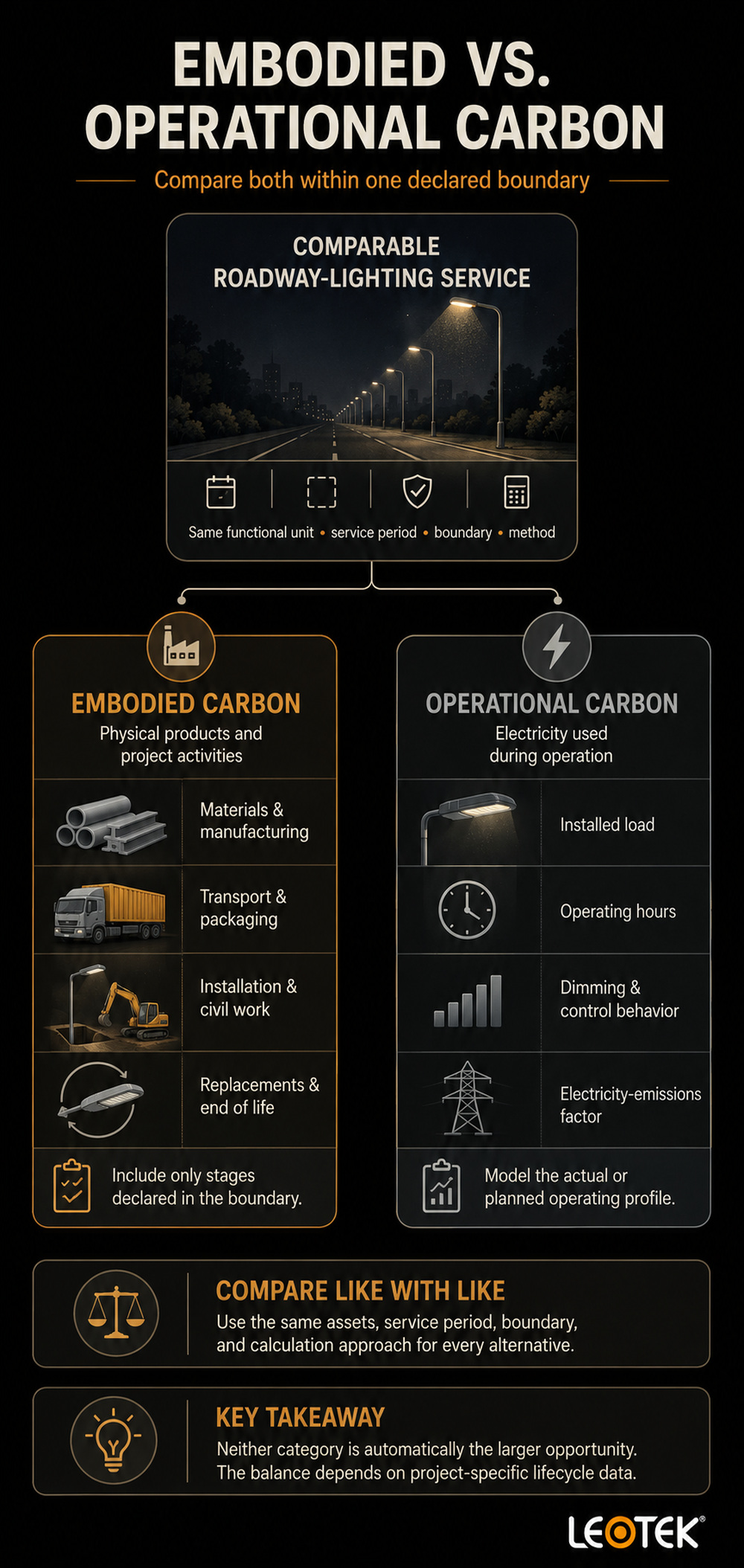
Embodied carbon is associated with making, delivering, installing, replacing, and eventually managing the end of life of roadway-lighting equipment within a defined assessment boundary. Operational carbon comes from the electricity used while the system operates; neither category can be assumed to be the larger opportunity without project-specific lifecycle data.
For cities and transportation agencies, an embodied carbon lighting assessment is useful only when every option under review uses the same service period, assets, operating profile, and electricity-emissions data.
Key takeaways
- Embodied and operational carbon describe different parts of a roadway-lighting lifecycle, not competing accounting systems.
- A defensible comparison declares its boundary, functional unit, service period, and data sources before comparing alternatives.
- Operational emissions depend on actual electricity use, control behavior, and the selected electricity-emissions factor.
- Product evidence, replacement assumptions, and construction scope can materially change a lifecycle result.
- Carbon should inform, not replace, photometric, maintenance, procurement, and agency-engineering decisions.
The difference between embodied and operational carbon
The distinction is simple in principle, but it becomes useful only when the assessment boundary is explicit. A roadway-lighting project can include a luminaire, driver, controls, pole, arm, foundation, wiring, installation work, maintenance activity, and end-of-life handling. An analysis should state which of those assets and stages it includes.
What belongs in an embodied-carbon boundary
Embodied carbon refers to lifecycle greenhouse-gas emissions associated with physical products and project activities before the lighting system is operating. Depending on the stated boundary, that can include raw materials, manufacturing, transport, packaging, installation, replacements, and end-of-life treatment.
The important qualifier is “depending on the stated boundary.” A luminaire-only comparison is not the same as a corridor-upgrade comparison that includes poles, foundations, wiring, controls, and construction. Neither is automatically wrong, but they answer different procurement questions.
When a declared boundary includes upstream products, transportation, or end-of-life treatment, the assessment should identify those stages explicitly rather than treating them as automatic inclusions. The GHG Protocol Scope 3 Calculation Guidance identifies purchased goods and services, transportation and distribution, and end-of-life treatment as value-chain categories; it does not prescribe a roadway-lighting boundary.
Life cycle assessment (LCA) is designed to make those choices visible. ISO 14040, accessed July 29, 2026, describes an LCA framework built around goal and scope definition, life cycle inventory, impact assessment, and interpretation. It does not provide a roadway-lighting result or certify a product; it is a framework for making the study design and its limitations clear.
For this type of assessment, an environmental product declaration (EPD), when available for the exact configuration, can be stronger product evidence than a generic sustainability statement. CIBSE’s lighting guidance notes that early embodied-carbon estimates may be useful when EPDs are not available, but it also states that such estimates do not replace EPDs. Its guidance is building-services focused, so it is a methodology reference rather than a U.S. roadway-procurement requirement. CIBSE TM65.2, accessed July 29, 2026, includes street-lighting among its examples.
How operational electricity use becomes a carbon result
Operational carbon is the greenhouse-gas impact associated with electricity used over the chosen service period. A planning calculation needs more than fixture wattage. It also needs operating hours, the dimming or control schedule, any verified driver behavior, and an electricity-emissions factor with a documented geographic and time basis.
The GHG Protocol Scope 2 Guidance, accessed July 29, 2026, standardizes how organizations measure emissions from purchased or acquired electricity, heat, steam, and cooling. That corporate-inventory framework is not identical to a product LCA, but it illustrates why electricity-related emissions require a documented accounting approach rather than a generic factor.
For U.S. projects, EPA’s Emissions & Generation Resource Integrated Database (eGRID), accessed July 29, 2026, provides electric-power emissions data, emission rates, generation, and resource-mix data. The selection of a dataset and factor should be recorded with the project location, reporting year, and accounting method. A national average inserted without context can obscure the decision an agency is trying to make.
Why boundaries and the functional unit matter
A useful functional unit describes the service being compared, not only the equipment being purchased. For example, a comparison might evaluate the lighting service delivered for a defined roadway segment over a stated number of years. The actual photometric and operational requirements must be established by the project team.
With compatible assumptions, the planning relationship can be expressed as:
whole-life emissions = declared embodied stages + electricity use over the service period × selected electricity-emissions factor + other declared lifecycle stages
This is a structure for organizing inputs, not a shortcut to a result. It does not establish a carbon footprint until the inputs, boundaries, and methods are documented. It also should not be confused with Scope 1, 2, and 3 categories, which organize an entity’s greenhouse-gas inventory rather than a roadway-lighting asset’s lifecycle.
Why roadway lighting requires a lifecycle view
Roadway lighting has long operating periods, public-service requirements, and infrastructure dependencies that make a narrow equipment comparison incomplete. The project team needs to know what is included, what is excluded, and which assumptions are likely to change the result.
Operating profile and electricity data are project inputs
An operational model should reflect the planned schedule rather than an assumed full-output, all-night profile. It should document when dimming occurs, whether a control strategy applies, and how actual driver performance affects the modeled load.
That detail matters because dimming performance is not uniform across every product. A 2024 U.S. Department of Energy study examined 23 LED streetlights that claimed 0–10V dimmability and found variation among market-available drivers. The study supports a narrow but useful lesson: use verified control and driver behavior when modeling an operating profile, rather than assuming that every dimming command produces the same result. It does not establish a universal energy, cost, or carbon saving for a roadway project. See DOE’s study of 0–10V control for LED streetlights, accessed July 29, 2026.
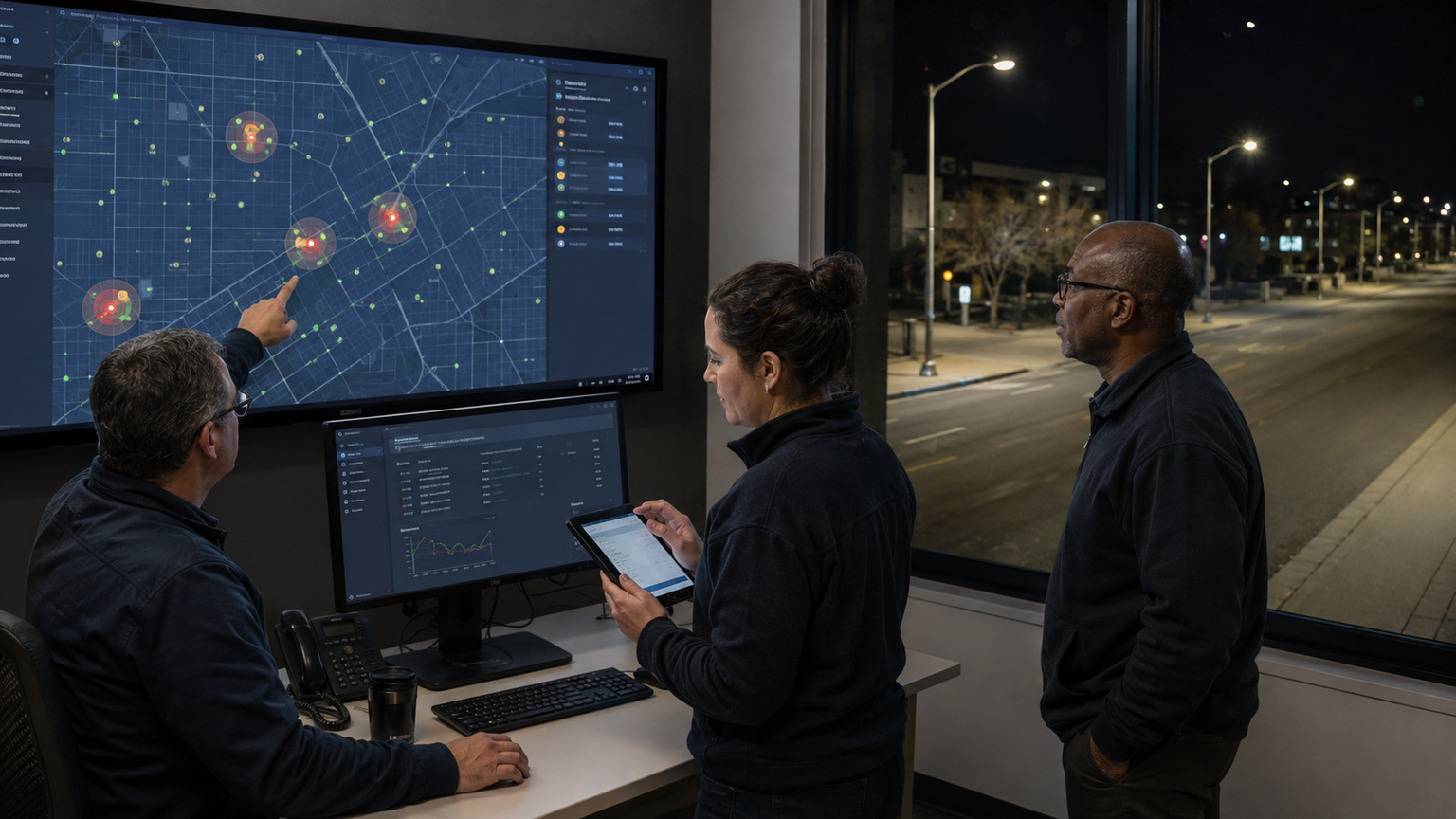
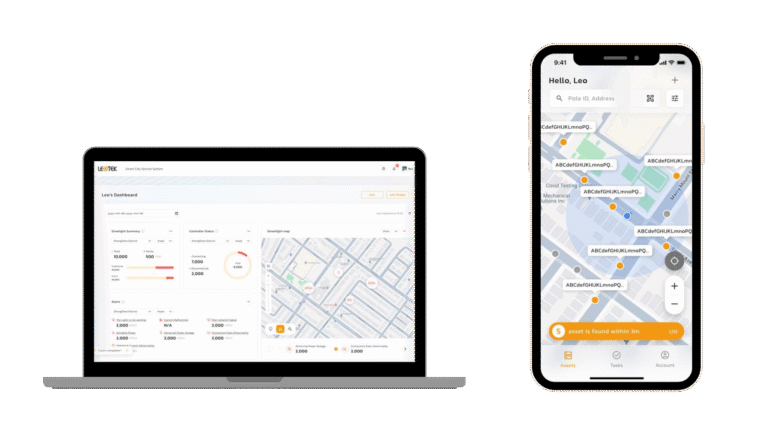
Where connected controls are part of the project scope, they should be treated as both operational inputs and physical equipment within the stated lifecycle boundary. LEOTEK describes LEOLink connected-lighting functions including remote switching, dimming, schedules, fault notification, energy tracking, reporting, maps, alarms, and asset management. Whether those functions change a particular project’s operational result depends on the deployed configuration, schedule, data quality, and baseline; this article does not assume a percentage reduction.
Assets outside the luminaire can change the comparison
In a luminaire replacement, the project boundary may be largely limited to equipment removal, replacement, and operation. In a new corridor or major modernization, poles, arms, foundations, wiring, communications equipment, traffic-control coordination, and construction activities may be relevant. The correct scope follows the decision question.
This is why agencies should avoid comparing an equipment-only footprint for one option with a broader installed-system footprint for another. The most sophisticated number is not necessarily the most useful one if the included stages differ. A short boundary statement is often more valuable than an unqualified claim that one product has “lower carbon.”
Service life, maintenance, and end of life are assumptions, not promises
Service period, repairability, component replacement, maintenance access, and end-of-life pathways affect both embodied and operational modeling. Those inputs should come from dated, configuration-specific documents, agency maintenance records, or transparent scenario assumptions.
Do not treat a warranty as a lifecycle result, and do not convert a claimed product life into a project outcome. The point of sensitivity analysis is to show how the conclusion changes if a replacement interval, operating schedule, or electricity factor differs from the base case.
Which reduction opportunity matters most?
There is no universal answer. The balance depends on the project boundary and the assumptions used. The analysis should identify the inputs that drive the result rather than treating “embodied versus operational carbon” as a fixed contest.
When operational emissions may deserve more attention
Operational emissions can be a major consideration when a system has substantial modeled electricity use over the assessment period and the selected electricity-emissions factor is comparatively high. Operating hours, actual load, dimming profiles, and control behavior all affect that calculation.
In that situation, an agency can test operational scenarios without claiming a savings outcome in advance. It can compare defined schedules, verify commissioning data where available, and document the selected electricity factor. The result remains conditional on the study period and system operation.
When upfront and replacement emissions may deserve more attention
Embodied and replacement stages may be especially important to examine when the project has substantial civil scope, frequent component replacement, or limited product-specific lifecycle evidence. The right response is not to assume the answer, but to request compatible evidence for the actual assets being compared.
For a product-level comparison, ask whether the result covers the same configuration, geography, lifecycle stages, and declared unit. For a system-level comparison, ask whether poles, wiring, controls, transport, installation, and maintenance are treated consistently. An EPD can improve the evidence base, but it still must be read for its product scope and assumptions.
A better question than “which one wins?”
The practical decision is: which inputs are both material to this project and controllable by the agency or supplier? A controls schedule, a replacement approach, a construction scope, or a product-documentation requirement may be more actionable than a single aggregate number.
That perspective also avoids a common error: treating lower wattage as proof of lower lifecycle emissions. Lower electricity use may reduce the operational term under a particular operating model, but it does not reveal the embodied boundary, product evidence, service period, or electricity factor. A lifecycle comparison needs all of those elements.
A practical lifecycle assessment workflow for agencies
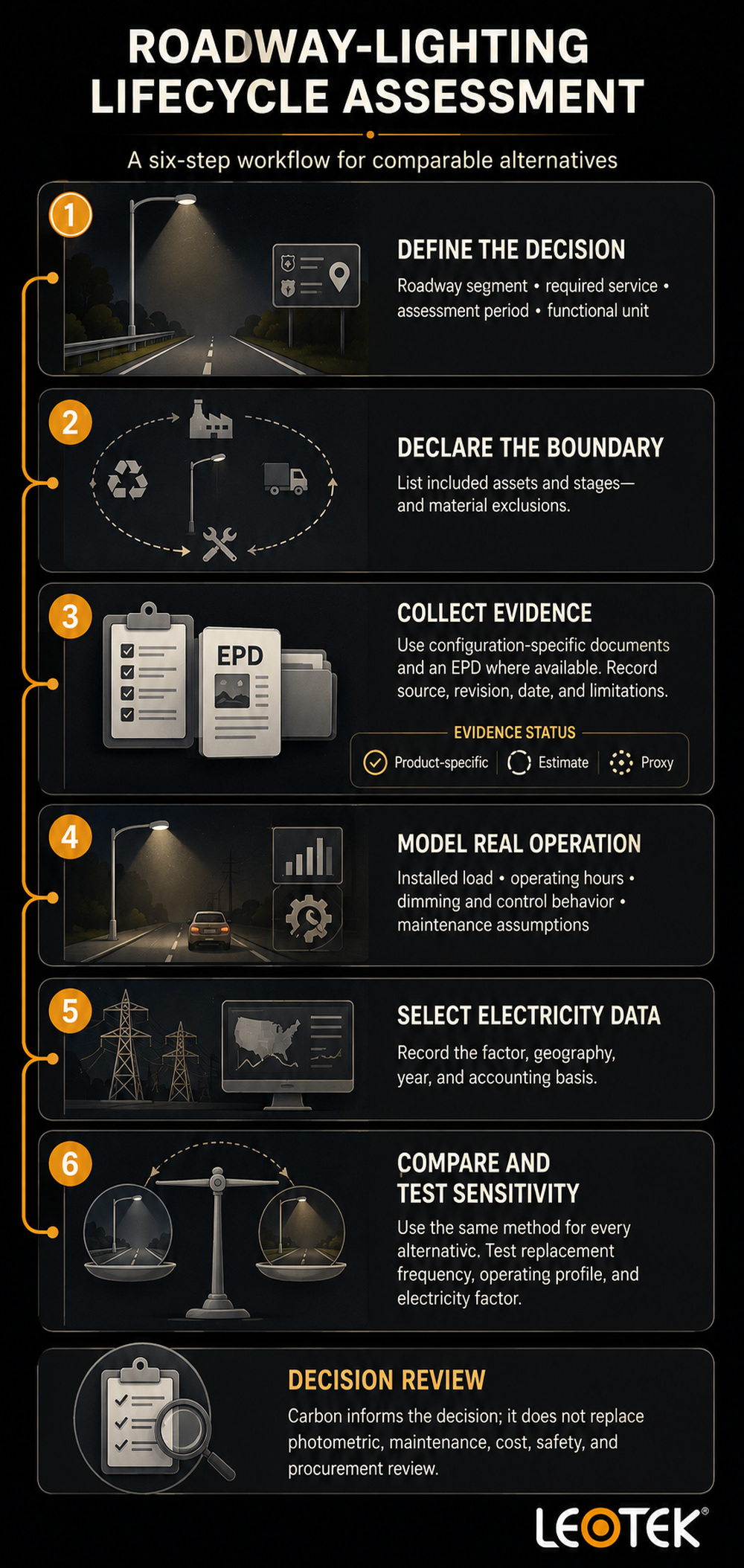
The following workflow is a planning approach for comparing alternatives. It is not a substitute for engineering design, procurement review, or a verified LCA.
1. Define the decision and comparison basis
State the roadway segment or asset group, required lighting service, assessment period, functional unit, and alternatives under review. Identify whether the scope is a luminaire replacement, a controls upgrade, or a broader infrastructure project. Do not assume that requirements for one setting apply to another.
2. Declare the lifecycle boundary
List the assets and stages included: products, packaging, transport, installation, poles, wiring, controls, maintenance, replacements, and end-of-life treatment. List material exclusions as well. This makes the result auditable and prevents a reader from mistaking a partial comparison for a whole-project result.
3. Collect evidence at the right level
Request configuration-specific product documents and an EPD where available. If an estimate is used instead, record the method, data source, geography, reference year, system boundary, and exclusions. LEOTEK’s Resources & Documents hub is an appropriate pathway for engineers and procurement teams seeking current product documentation; each document still needs model and revision review before it supports a project claim.
Record the quality of every input as well as its value. Product-specific, third-party verified information is not interchangeable with a category-page statement, a supplier estimate with an undisclosed boundary, or a generic industry average. If the comparison uses a proxy because exact data is unavailable, identify it as a proxy and apply the same evidence rule to every alternative. This gives reviewers a way to distinguish a preliminary screening exercise from a decision-ready assessment.
Data quality also has a time dimension. A product configuration, electricity factor, operating schedule, or maintenance practice can change after an earlier analysis. Preserve the document date or revision, the source access date, and the reason each assumption was selected. That record makes it possible to update the comparison without presenting a historical estimate as a current project result.
4. Model real operating conditions
Record installed load, operating hours, control schedule, dimming behavior, outages, and maintenance assumptions. Separate measured information from planning assumptions. Where a system has not been commissioned, label the profile as modeled rather than measured.
5. Select electricity-emissions data deliberately
Document the selected eGRID or other approved factor, its location, year, and accounting basis. If the decision may change under a plausible alternative factor, model that alternative as a sensitivity case instead of hiding it in a single average.
6. Compare like with like, then review sensitivity
Apply the same functional unit, service period, boundary, and calculation approach to every alternative. Then test the assumptions most likely to alter the outcome, such as replacement frequency, operating profile, or electricity factor. This is more useful for procurement than a precise-looking result built on unexamined assumptions.
Procurement questions that improve the evidence base
Before a roadway-lighting comparison is finalized, an agency can ask suppliers and project teams:
- Is a third-party verified EPD available for the exact luminaire configuration? If not, what method, geography, and boundary produced the estimate?
- Which components and stages are included or excluded: packaging, shipping, installation, controls, poles, wiring, maintenance, replacements, and end of life?
- What operating profile, driver behavior, and control schedule were modeled, and which inputs are measured versus assumed?
- What service period, repairability assumptions, and replacement scenarios are used?
- Which electricity-emissions dataset and factor are used, for what geography and year?
- Are photometry, glare, maintenance access, reliability, interoperability, cost, safety process, code, and procurement requirements being reviewed alongside carbon?
These questions make the information gap visible. They do not imply that a supplier can provide every document or that an unavailable EPD can be replaced by marketing language.
Turn a carbon comparison into a roadway-lighting decision
Lifecycle emissions are one decision criterion among many. A project can have a compelling lifecycle assessment and still require technical review of photometry, glare, maintenance access, controls interoperability, construction constraints, cost, and applicable agency requirements. Conversely, a product claim without a transparent boundary is not enough to establish a lifecycle advantage.
For a defined project, start with the service requirement and evidence checklist, then align the carbon comparison with the broader roadway and outdoor lighting applications under consideration. When the team has a specific documentation or technical question, it can contact LEOTEK to discuss a technical documentation or project question. That conversation should support, not replace, the agency’s engineering, sustainability, and procurement review.
Frequently asked questions
Is embodied carbon included in a streetlight’s carbon footprint?
It can be, if the assessment boundary includes product and project stages such as manufacturing, transport, installation, replacements, and end-of-life treatment. A footprint claim should state exactly which stages are included; a luminaire-only result is different from a corridor-level result.
Does lower wattage always mean lower lifecycle carbon?
No. Lower wattage may reduce modeled electricity use under a defined operating profile, but lifecycle carbon also depends on the selected electricity factor, service period, product and installation boundary, replacement assumptions, and evidence quality. It is a relevant input, not a complete result.
Can an EPD be compared directly across every luminaire?
Not automatically. Check that the EPDs cover comparable products, functional units, lifecycle stages, geography, data periods, and calculation rules. If those conditions differ, explain the limitation or seek a consistent assessment method.
What data is needed to calculate operational carbon for roadway lighting?
At minimum, document the installed load or modeled load, operating hours, dimming or control schedule, assessment period, and a selected electricity-emissions factor with its geography and year. Verify driver and control behavior where it materially affects the model.
References
- ghgprotocol.org, GHG Protocol Scope 3 Calculation Guidance; accessed July 29, 2026.
- iso.org, ISO 14040; accessed July 29, 2026.
- cibse.org, CIBSE TM65.2; accessed July 29, 2026.
- ghgprotocol.org, GHG Protocol Scope 2 Guidance; accessed July 29, 2026.
- epa.gov, Emissions & Generation Resource Integrated Database (eGRID); accessed July 29, 2026.
- U.S. Department of Energy, study of 0–10V control for LED streetlights; accessed July 29, 2026.
- LEOTEK, LEOLink connected-lighting functions; accessed July 29, 2026.
- LEOTEK, Resources & Documents; accessed July 29, 2026.
- LEOTEK, roadway and outdoor lighting applications; accessed July 29, 2026.