
















Streetlight energy metering should be judged by the decision it will support. Revenue-grade data is intended for a billing or settlement decision under the applicable utility, tariff, contract, and measurement requirements; operational data is intended to run, analyze, and maintain a lighting network. A connected system can provide useful operational energy reports without producing data that a utility or contract accepts for billing.
Key takeaways
- A dashboard label does not establish billing suitability; the governing utility, tariff, contract, and evidence do.
- Define the measurement boundary before comparing a luminaire report with a utility invoice.
- Request evidence for accuracy, test or calibration conditions, timestamps, data handling, and configuration changes for the intended use.
- Treat reconciliation as a controlled process, not a one-time comparison.
For cities, transportation agencies, utilities, and their contractors, the distinction is practical. The same streetlight network may feed an operations dashboard, a sustainability report, a maintenance workflow, and an invoice review. Those uses do not have the same measurement, evidence, or acceptance needs.
Start with the intended decision
The first question is not, “Does the system report energy?” It is, “What decision will this value support?” That question keeps a procurement team from applying a billing standard to a maintenance report, or from assuming that a useful trend report can replace the utility’s billing source.
Billing and settlement decisions
For billing or settlement, the relevant utility, tariff, agreement, regulator, and applicable measurement requirements determine what is acceptable. The project team should identify the official billing source, the meter or measurement point, the period being billed, and the party that accepts the data before relying on a network report.
“Revenue-grade” is therefore not a universal label that an agency can apply from a product brochure. It is a fitness-for-purpose conclusion supported by the applicable requirements and evidence for the specific measurement arrangement.
An agency may need to confirm the device identity, its installation location, the measurement boundary, documented test or calibration information, and the utility or contractual acceptance process.
This is especially important when the network owner, lighting-maintenance contractor, and electricity provider are different organizations. A useful operational record can inform an invoice review, but it does not by itself change the billing basis.
Portfolio reporting and planning
Portfolio reporting answers questions such as how energy use changes across a group of assets, whether operating schedules are reflected in reported trends, or which circuits deserve closer review. These uses can be valuable even when the data is not intended for billing.
The reporting method still needs a clear description. Teams should document which assets are included, the reporting interval, the units, the handling of missing records, and whether a value is measured, calculated, or estimated. Without that context, a year-over-year chart can appear more precise than the underlying data supports.
Reporting also needs a stable comparison basis. If a network changes its dimming schedule, asset inventory, firmware, circuit assignment, or aggregation rule, a trend may change for reasons other than actual energy use. Record those changes with the report rather than leaving future reviewers to infer them.
Operations and maintenance
Operational data helps operators ask focused questions: Is a group of luminaires following its schedule? Did a reported value change after a configuration update? Which assets merit a field check? It can support triage, fault context, and maintenance prioritization without becoming a billing meter.
That distinction protects both the operations team and the data. A value that is sufficiently timely and granular for an exception report may not have the measurement controls, traceability, or acceptance required for settlement. Conversely, a billing record may be authoritative for an invoice while offering too little asset-level detail to diagnose a network issue.
What streetlight energy data is actually measuring
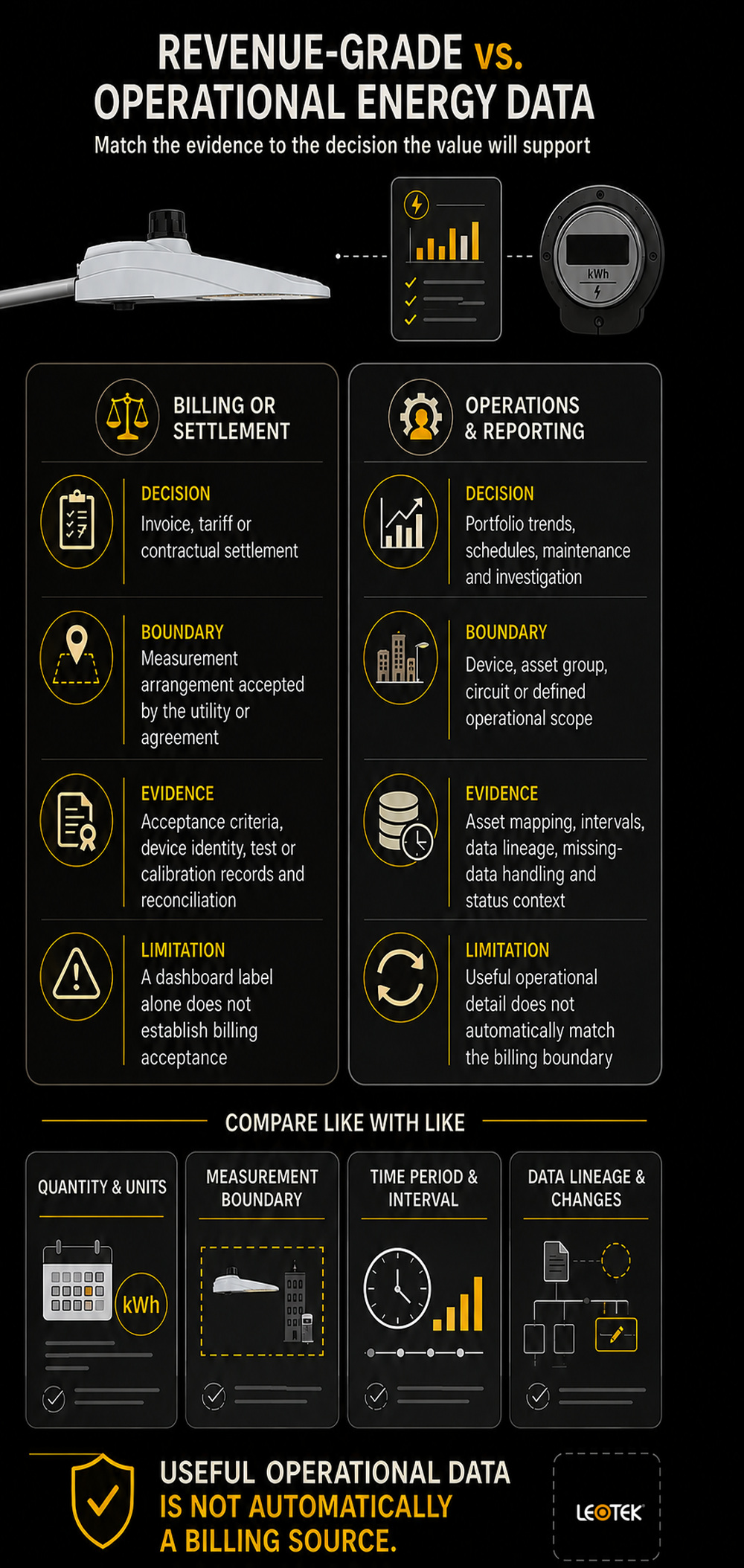
Before comparing two values, define the quantity, the time period, and the boundary. These details often explain why two legitimate records differ.
Power, energy, interval data, and demand
Power is the rate at which electrical energy is used at a point in time. Energy is the accumulated use over a period. An energy total may be paired with interval records that show how use was allocated across time. Demand is a separate concept that can be defined differently in an applicable tariff or contract.
In practical terms, “luminaire power measurement” may describe a device-level reading, while “streetlight energy metering” may refer to accumulated energy at a cabinet, feeder, or utility meter. Do not treat those phrases as interchangeable without checking the actual measurement method and boundary.
The U.S. Department of Energy notes that connected devices increasingly report data about operating conditions and that accuracy is important when use cases depend on that data. It also notes that reporting accuracy is often not specified or not well specified.
DOE identifies ANSI C136.50, ANSI C136.52, and ANSI C137.5 as standards addressing lighting energy-reporting requirements and test methods. Applicability and compliance must be verified for the specific device and project. DOE’s energy-reporting research is a useful starting point, not a substitute for current contractual or utility requirements.
Define the measurement boundary
The measurement boundary is the point in the electrical system that the reported value represents. A project may have one or more of the following boundaries:
- Luminaire or device: A reported value associated with one streetlight, controller, driver, or other device.
- Circuit or cabinet: A value that represents a group of loads downstream of a circuit or control cabinet.
- Feeder: A value measured at a distribution point serving a larger portion of the network.
- Utility billing meter: The meter or measurement arrangement designated by the utility or agreement for billing.
These boundaries can include different loads and losses. A device report may not include every component represented at a feeder or utility boundary. Likewise, a circuit-level measurement may cover multiple assets whose individual reports are incomplete or differently timed. The practical rule is simple: compare like with like before treating a difference as an error.
DOE’s connected-lighting research describes a test environment with dedicated streetlighting infrastructure and circuit-level power and energy metering for electrical-performance evaluation. That is a helpful reminder that the measurement point matters. It does not establish a universal streetlight billing architecture. DOE’s connected-lighting systems overview provides the underlying context.
Time, aggregation, and data lineage
The boundary is only part of the story. A comparison also needs aligned time periods and documented aggregation. Ask whether timestamps are synchronized, what interval is used, how time-zone or daylight-saving changes are handled, and whether late or missing records are flagged.
Data lineage describes how a displayed total was produced. It should make clear whether the value comes directly from a device, is aggregated from intervals, is estimated for missing records, or has been adjusted. Versioned records for firmware, settings, asset-to-circuit mapping, and reporting logic make later reconciliation more defensible.
A usable record specification can be modest but explicit. For each reporting and maintenance use, define the asset identifier, measurement point, units, interval, timestamp convention, status, missing-data flag, and configuration version. Then state who can access the record, how long it is retained, and how a correction is marked. This does not make the record suitable for billing; it makes the operational meaning of the record reviewable.
Revenue-grade evidence versus operational reporting evidence
The evidence should match the decision. A procurement team should not demand an undefined universal threshold, but it should demand clarity about what has been measured and what the evidence establishes.
| Intended decision | Typical measurement boundary | Evidence to request | Key limitation |
|---|---|---|---|
| Billing or settlement | The boundary accepted under the applicable utility or agreement | Applicable acceptance criteria, arrangement-specific measurement evidence, and reconciliation process | A dashboard value alone does not establish billing acceptance. |
| Portfolio reporting | Defined group of assets, circuits, or feeders | Inclusion rules, intervals, data lineage, and missing-data treatment | A trend can change when the inventory, schedule, or reporting method changes. |
| Operations and maintenance | Device, asset group, circuit, or other operational boundary | Asset mapping, timeliness, status context, and known limitations | Useful operational detail does not automatically match the billing boundary. |
What to request for a billing-use claim
For a billing or settlement use case, frame the following as evaluation questions:
- What tariff, contract, utility requirement, or other governing document applies?
- What exact device or meter provides the value, and where is its measurement boundary?
- What quantity, units, interval, and time basis are reported?
- What accuracy requirement applies under the relevant conditions, and what current evidence addresses it?
- What test, calibration, installation, or maintenance records are available for the arrangement?
- How are missing data, communications failures, estimated values, and corrections identified?
- How are configuration, firmware, and asset-mapping changes recorded?
- What export, retention, access-control, audit-trail, and data-governance provisions are needed?
- What reconciliation process will compare the data with the billing source?
- Who must accept the arrangement before it is used for billing or settlement?
These questions do not create a utility rule. They help an agency identify where project-specific engineering, procurement, legal, or utility review is needed before a billing-use decision.
What operational reporting can support
Operational reporting can be fit for purposes such as reviewing schedules, identifying outliers, checking status context, and prioritizing investigation. The value comes from timely, interpretable information tied to known assets and operating conditions.
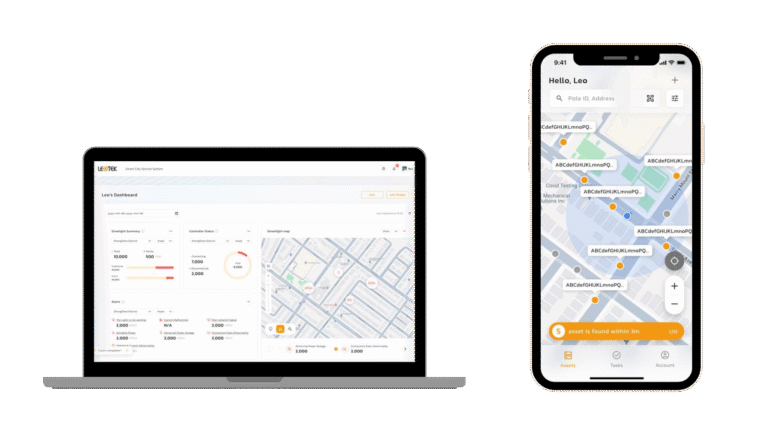
Connected-lighting platforms may expose these types of workflows. For example, LEOLink intelligent lighting system describes energy tracking, reporting, remote operations, alarms, and asset-management functions. Those first-party feature descriptions do not establish billing-grade accuracy, calibration, savings, or utility acceptance. A project team should evaluate the current documentation for the specific configuration it is considering.
Centralized reporting can also help organize the operational record. RenAI roadway infrastructure management describes roadway and streetlight management, reporting, and asset-management functions. It should be evaluated as a platform description, not as proof that a reported energy value meets a particular billing requirement.
A validation workflow for streetlight energy metering
A disciplined workflow avoids false precision and makes disagreements easier to investigate.
1. Define the use and acceptance criteria
State whether the output will inform billing, invoice review, portfolio reporting, operations, or a combination. Identify who owns the decision and which governing requirement applies. If the use is billing, obtain the utility or contractual criteria before selecting a measurement approach.
2. Map assets and measurement boundaries
Document the relationship among streetlights, controllers, circuits, cabinets, feeders, and the billing source. The map should show which assets are included in each reported total and which loads are outside the comparison.
3. Confirm the data specification
Record units, interval, timestamp convention, aggregation logic, device identification, and the treatment of gaps or estimates. Preserve the evidence supporting the claimed measurement performance, including its conditions and version.
4. Select a comparison period
Choose a period with known operating conditions and document relevant changes, such as schedule updates, maintenance events, asset additions, or communications interruptions. A comparison is more useful when both sources cover the same boundary and period.
5. Reconcile and investigate differences
Compare the records using the agreed method. If the values differ, first check boundary, timing, units, aggregation, mapping, and data completeness. Escalate to the appropriate engineering, vendor, contractor, or utility process only after those basic causes have been considered.
6. Retain the decision record
Keep the comparison method, source records, exceptions, corrective actions, and acceptance decision together. This creates a practical audit trail and prevents a later team from mistaking an operational report for a billing record.
How connected lighting fits into the decision
Connected lighting can provide a useful operational layer between field assets and agency workflows. Energy reports, asset status, schedules, and alarms may help staff see the network in context. The procurement question is whether those functions, data definitions, and evidence fit the agency’s intended use.
For a specific product or configuration, review current LEOTEK technical documents alongside the project requirements. Confirm the model, revision, measurement scope, and applicability rather than relying on a category page or dashboard description. Keep a record of any assumptions used in the evaluation process. For a live project, the relevant utility, qualified engineering team, procurement staff, and other responsible parties should validate the final arrangement.
Match the evidence to the decision
Streetlight energy metering is more useful when its purpose is explicit. Operational data can support informed monitoring and maintenance decisions. Revenue-grade use demands a stronger, project-specific evidence and acceptance chain. By defining the measurement boundary, documenting the data lineage, and reconciling against the right reference, agencies can use connected-lighting data without overstating what it proves.
FAQs
Is connected streetlight energy data automatically revenue-grade?
No. A reported value is not automatically suitable for billing because it is available from a connected system. Billing suitability depends on the applicable utility, tariff, contract, measurement arrangement, and supporting evidence.
Can luminaire-level data replace a utility billing meter?
Not by default. A luminaire-level report and a utility billing meter can have different boundaries, intervals, included loads, and acceptance requirements. The relevant utility or agreement determines whether an alternative measurement arrangement can be used for billing.
Why can a streetlight dashboard and utility invoice show different totals?
They may represent different measurement boundaries or time periods. Differences can also arise from aggregation logic, missing-data treatment, asset-to-circuit mapping, changes in configuration, or the loads included in each source. Compare the documented scope and timing before drawing a conclusion.
What documentation should an agency request for luminaire power measurement?
Request the measurement point, reported quantity and units, interval and timestamps, applicable accuracy or test evidence, calibration or maintenance records where relevant, treatment of missing data, configuration history, and the intended-use limitations. For billing use, also request the applicable acceptance criteria and reconciliation process.
References
- U.S. Department of Energy, Connected Lighting Energy Reporting; accessed July 26, 2026.
- U.S. Department of Energy, Connected Lighting Systems; accessed July 26, 2026.
- LEOTEK, LEOLink Solutions; accessed July 26, 2026.
- LEOTEK, RenAI AI Roadway Infrastructure Management System; accessed July 26, 2026.
- LEOTEK, Resources and Documents; accessed July 26, 2026.