










NEMA 7-Pin vs. Zhaga-D4i? Which one is best for my project? For a smart streetlight project, the NEMA vs. Zhaga decision should follow the installed equipment, documented control architecture, and service model, not whichever option sounds most advanced. NEMA 7-pin and Zhaga-D4i are different interface ecosystems, so a city should not assume that a controller, sensing module, luminaire, or management system can move between them without product-specific documentation.
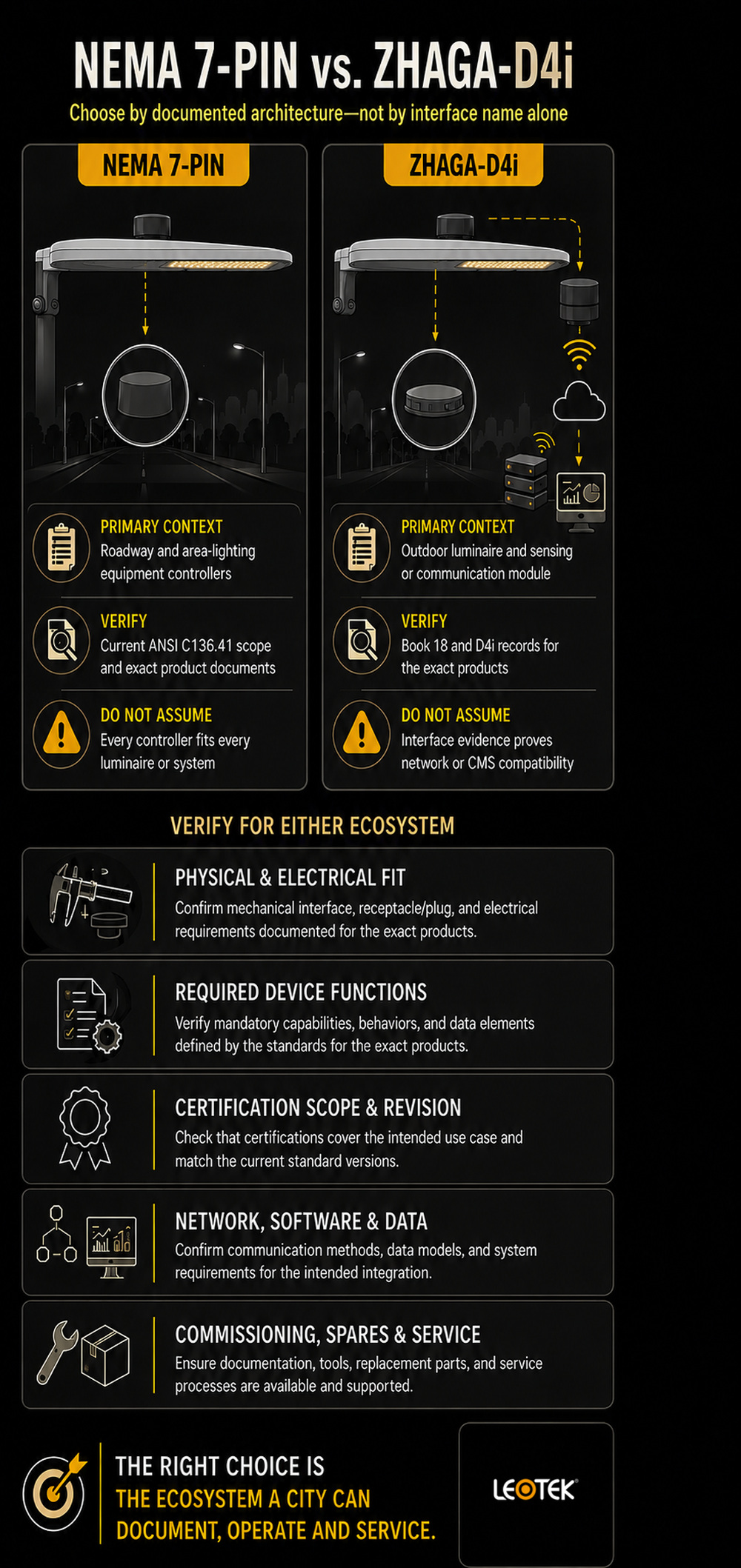
NEMA 7-pin and Zhaga-D4i are different smart streetlight interface ecosystems. NEMA 7-pin is associated with roadway and area-lighting controller receptacles, while Zhaga Book 18 concerns the connection between an outdoor luminaire and a sensing or communication module. Agencies should validate exact component and system compatibility.
Key takeaways
- A physical interface is only one layer of a connected-lighting system. The luminaire, controller or node, network, central management system, and field-service process still need separate review.
- A NEMA 7-pin streetlight interface belongs in the roadway and area-lighting controller context associated with ANSI C136.41. Verify the current standard and the exact product documentation before relying on pin-level or electrical details.
- Zhaga Book 18 describes an interface between an outdoor luminaire and a sensing or communication module. D4i relates to the digital lighting-control ecosystem, not a blanket guarantee of end-to-end compatibility.
- Certification and standards records are useful evidence, but they do not replace validation of the exact components, software, commissioning plan, data requirements, and agency acceptance criteria.
Start with the decision the interface must support
The NEMA 7-pin vs. Zhaga-D4i question is often framed as a choice between two sockets. That framing is too narrow for a municipal or transportation-agency project. An interface is the connection point between parts of a lighting system; it is not the whole system.
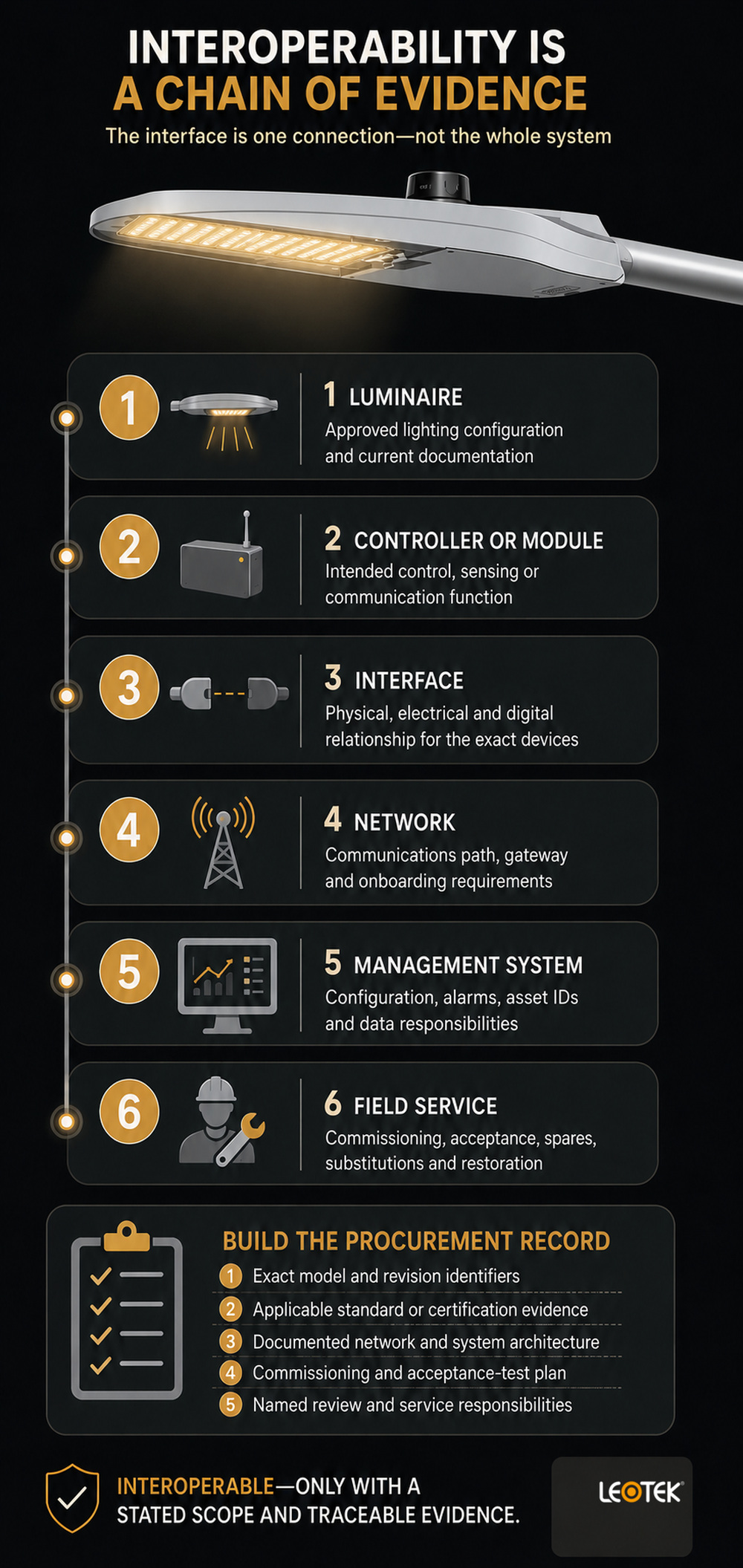
Before comparing interfaces, separate the layers of the proposed design. The luminaire creates the roadway or area lighting. A controller, node, or sensing/communication module may add a control or data function. The interface connects that device to the luminaire. The network carries communications, and the central management system is where a team may view, configure, or act on information. Each layer can introduce its own compatibility, operational, and procurement requirements.
That distinction matters during a retrofit. A field crew may be able to replace a device at the luminaire, yet the replacement can still be unsuitable if it does not meet the approved control strategy, network architecture, commissioning process, or asset-data requirements. Similarly, a new luminaire specification can accommodate a documented interface while leaving important questions about software, cybersecurity, and maintenance unresolved.
For broader context on how fixtures fit into a municipal program, see outdoor lighting applications. That application-level resource is not a substitute for a model-specific interface or electrical specification.
A practical definition of interoperability
Interoperability should be treated as a chain of evidence, not a label. A physical interface may establish one part of mechanical or electrical compatibility. A standardized control approach may establish another part. Neither fact alone establishes that the selected node will work with a particular network, gateway, management platform, data policy, or maintenance workflow.
The U.S. Department of Energy notes that connected-lighting interoperability involves challenges, limitations, and tradeoffs beyond the physical connection, including the role of application programming interfaces in system integration. Its discussion of connected-lighting interoperability is a useful reminder to ask where the interface scope ends and the system-integration responsibility begins.
For procurement purposes, use the phrase “interoperable” only with a stated scope. For example: compatible with the named luminaire and node under the cited document revision; certified under the named program; or validated with the named management system during an acceptance test. Avoid using the word as a substitute for evidence.
What a NEMA 7-pin streetlight interface is designed to address
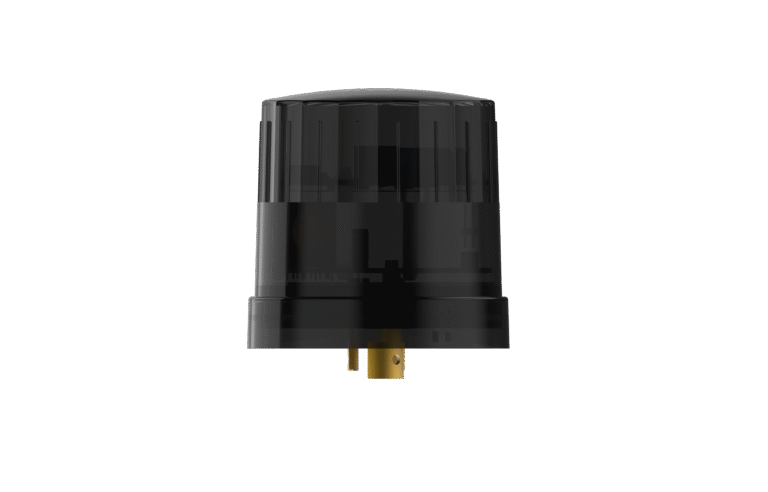
In North American roadway and area-lighting work, “NEMA 7-pin” commonly describes a controller-receptacle context associated with the ANSI C136.41 roadway and area-lighting equipment-controller standard. It is familiar to many agencies because it is tied to a long-standing category of luminaire-mounted controls.
That high-level description is deliberately narrower than a pinout. The exact functions, electrical conditions, controller behavior, and interchangeability relevant to a project depend on the current standard, the luminaire, the controller, and their documentation. A seven-pin receptacle should not be treated as proof that every controller is suitable for every luminaire or system.
The practical value of an established interface is often operational rather than promotional. An agency may already have approved equipment, stocking practices, service instructions, inventory records, or a replacement process built around it. Those conditions can be material to a retrofit decision, but they are local facts to document, not reasons to assume technical compatibility.
Questions for an installed NEMA-based fleet
For an existing fleet, begin with field evidence rather than a generic interface comparison:
- What receptacles and controller models are actually installed, and what document revisions govern them?
- Which lighting-control functions are approved for the corridor or service area?
- What does the existing central management system require for onboarding, configuration, alarms, and asset records?
- What has the agency approved for substitutions, spares, warranty handling, and field replacement?
- What acceptance test demonstrates that a replacement functions as required after installation?
These questions prevent a common mistake: treating a receptacle style as the complete compatibility requirement. They also keep a comparison article from drifting into wiring or installation advice. Electrical design, field work, and acceptance remain project-specific responsibilities for qualified personnel and the authority having jurisdiction.
What Zhaga-D4i adds to an outdoor-lighting design
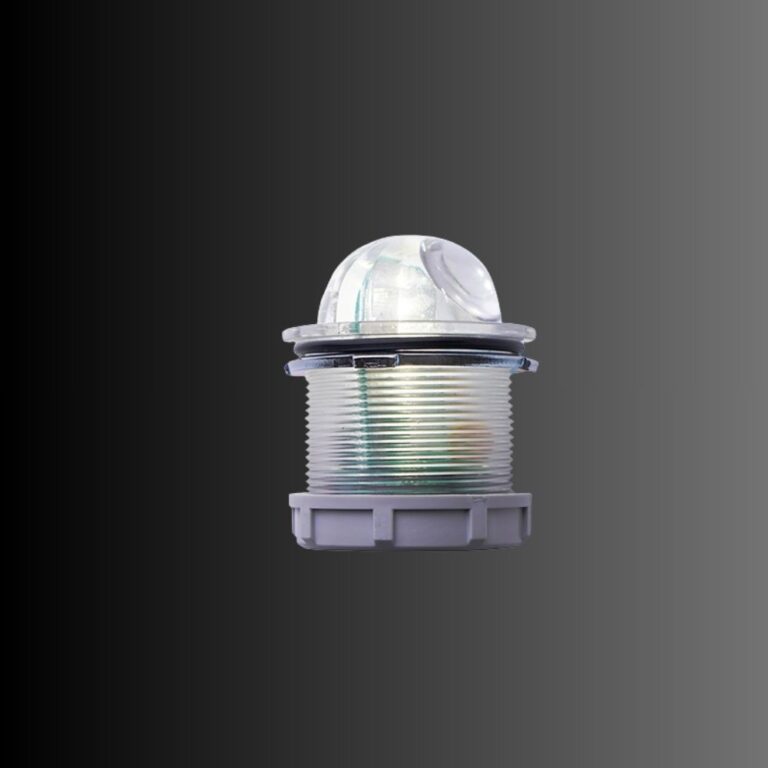
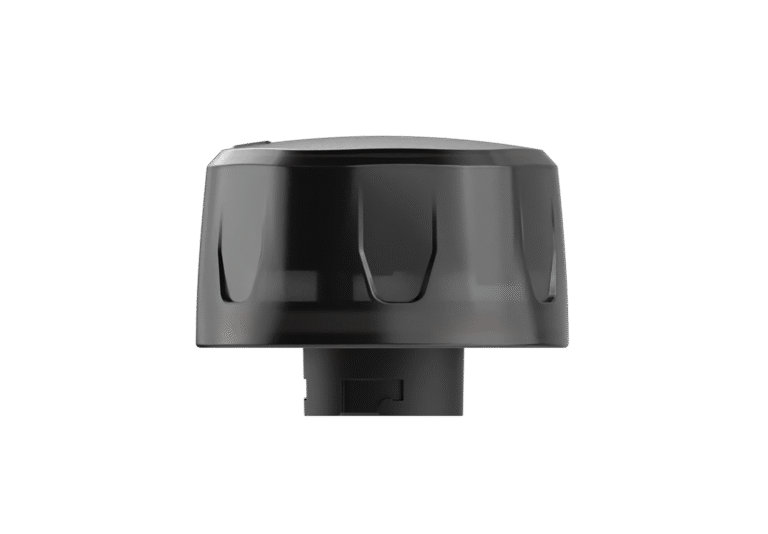
Zhaga is a lighting-industry organization that standardizes interfaces for luminaire components. Its Book 18 is described as a smart interface between outdoor luminaires and sensing or communication modules. That is the relevant starting point for a Zhaga-D4i outdoor-lighting discussion, not an assumption about a particular vendor device.
The Zhaga Consortium states that certification is issued after independent testing and that certified products can be traced in public databases. The DALI Alliance describes the Digital Addressable Lighting Interface (DALI) as an internationally standardized protocol for digital communication between lighting-control devices and presents D4i as enabling DALI for intelligent, IoT-ready luminaires. Together, those sources explain why specifiers may evaluate Zhaga-D4i for documented component-interface and digital-control evidence.
Still, the scope matters. Book 18 does not by itself establish what a particular sensor does, what wireless technology it uses, how long a product will remain available, or whether it will exchange data with a chosen central management system. Likewise, a D4i label is not a shortcut around driver configuration, software integration, commissioning, cybersecurity, or agency data-governance review.
Questions for a Zhaga-D4i specification
A sound specification requests evidence for the actual design rather than requesting a label in isolation. Confirm the exact luminaire and module identifiers, the applicable Book 18 and D4i certification records, the intended function of the module, and the current document revisions. Then validate how the design connects to the planned network and management environment.
Ask the supplier to show how commissioning, replacement, configuration control, and asset identification will work in the field. Ask the project team to identify who owns credentials, data, updates, and acceptance. Those questions are not objections to connected lighting; they are how a city converts an interface decision into an operable system.
NEMA vs. Zhaga-D4i: comparison for municipal evaluation
The following table, “NEMA 7-pin vs. Zhaga-D4i: evidence cities and transportation agencies should verify,” is a decision aid, not a performance ranking. It identifies the evidence an agency should require before selecting or substituting either interface.
| Evaluation area | NEMA 7-pin approach | Zhaga-D4i approach | What the agency should verify |
|---|---|---|---|
| Primary context | Roadway and area-lighting equipment controllers associated with ANSI C136.41 | Outdoor luminaires and sensing/communication modules under Zhaga Book 18, with D4i-related digital-control evidence | The current standard or program scope and the exact product documents |
| Physical and electrical fit | Do not infer from the pin count alone | Do not infer from a Book 18 reference alone | Exact luminaire, controller/module, receptacle, driver, and installation documentation |
| Device function | Depends on the selected controller and system design | Depends on the selected sensing/communication module and system design | The required functions and any configuration limits |
| Certification evidence | Request applicable product and standard evidence | Check the applicable Zhaga and D4i certification records for the exact products | Certification scope, product identity, status, and document revision |
| Network and software | Not established by the receptacle | Not established by the interface or certification alone | Network architecture, platform integration, data handling, and commissioning |
| Retrofit service | May align with an existing agency process | May be appropriate when the planned luminaire and module ecosystem is documented | Stocking, substitutions, field training, replacement method, and acceptance testing |
The table does not say that one approach is better. It shows why “NEMA 7-pin vs Zhaga-D4i” is a project-architecture question. A credible recommendation requires a documented baseline and named components.
When the installed base should carry more weight
For a retrofit, the installed base can be a legitimate decision factor. Existing luminaire types, approved controllers, service vehicles, spares, contract terms, and maintenance records may shape the lowest-risk path to a controlled replacement. The important point is to document those constraints and test the proposed configuration; familiarity is not a technical test.
This approach also protects lifecycle planning. A project may retain a familiar interface while improving documentation, asset records, acceptance procedures, or replacement controls. Conversely, a project may decide that a new interface ecosystem is warranted, but that decision should include a clear plan for legacy equipment and field service.
When a new specification can prioritize a defined architecture
A new installation gives the team more latitude to choose a documented architecture, but it does not eliminate verification work. Start with the operating requirement: which assets need control or monitoring, which data is needed, who will operate the system, and how will devices be commissioned and replaced?
Then specify evidence that maps to those requirements. The Department of Energy’s discussion of connected streetlighting systems notes questions around measurement accuracy, required functionality, maintenance, and electrical-service conditions. Those considerations should be addressed in a design review and acceptance plan rather than assumed away by the interface selection.
An interface can support serviceability only when the procurement documents also establish approved components, test methods, records, and responsibilities. Avoid calling an option “future-proof.” Technologies, standards, suppliers, and municipal requirements change; a documented replacement and validation process is more useful than a broad promise.
Write the interface requirement into the procurement package
An interface requirement should be specific enough to evaluate and flexible enough to avoid accidental claims. The following checklist gives procurement, engineering, and operations teams a common record to build before award or substitution approval.
Evidence to request
- Exact manufacturer, model, and revision identifiers for the luminaire, controller or module, driver, interface/receptacle, and any gateway.
- The applicable current standard, certification program, and public database record, where relevant to the proposed components.
- Manufacturer documentation showing the physical, electrical, and control relationship of the exact devices. Do not substitute a family page or marketing overview for this evidence.
- A description of the intended control and data functions, including which system component provides each function.
- Network and central-management requirements, including onboarding, configuration, asset identifiers, and data ownership responsibilities.
- A commissioning and acceptance-test plan that identifies what is tested, by whom, against which criterion, and how results are recorded.
- A field-service plan covering spares, approved substitutions, replacement procedures, warranty documentation, and configuration restoration.
- Project-specific cybersecurity, privacy, and data-governance requirements reviewed by the responsible agency teams.
- Clear review roles: procurement validates submittals, engineering validates the design, operations validates the service process, and IT/security validates network and data requirements.
How to review a submittal without overreading it
Review each document for the claim it actually supports. A luminaire cut sheet may identify an available receptacle or interface option, but it may not establish controller behavior, software integration, certification status, or a project’s approved network architecture. A certification record may confirm an evaluated product within a program’s defined scope, but it does not replace the model-specific installation instructions or an agency acceptance test.
Keep a simple evidence register that pairs each requirement with a document, revision date, exact product identifier, reviewer, and disposition. This makes changes visible when a supplier proposes a substitution or a component revision. It also gives operations staff a more useful handoff than a general statement that the system is “interoperable.”
If a proposed design uses a central management platform, include a controlled demonstration in the acceptance plan. The demonstration can verify the agreed configuration, asset identification, communications path, and documented operating functions for the installed equipment. It should not be used to extrapolate performance or maintenance outcomes beyond the project’s defined test criteria.
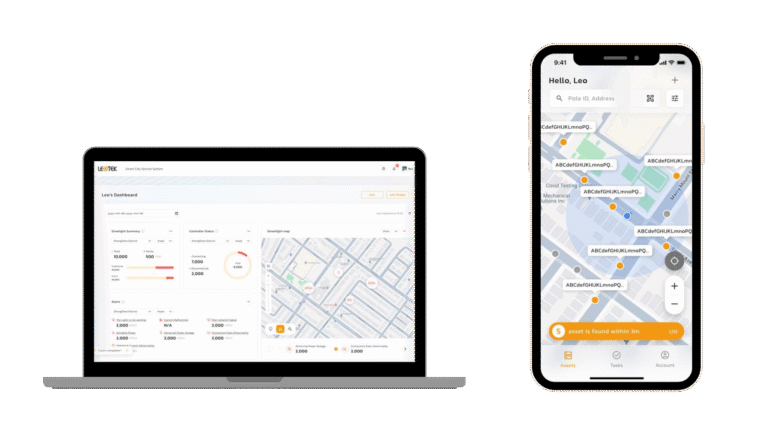
This is also the point to separate product documentation from platform claims. For example, LEOTEK describes its LEOLink intelligent lighting system as a connected-lighting solution with controllers and management-related functions. That does not establish that any LEOTEK luminaire or controller supports either interface discussed here. Confirm the exact configuration through current technical documentation.
Which smart streetlight interface should an agency choose?
For NEMA vs. Zhaga, the right choice is the interface ecosystem an agency can document, procure, commission, operate, and service within its specific roadway-lighting program. NEMA 7-pin may be central to an existing controller ecosystem. Zhaga-D4i may be appropriate for a documented outdoor-luminaire and sensing/communication-module architecture. Neither conclusion can be reached responsibly from the interface name alone.
Before finalizing a requirement, gather current model specifications, certification records where applicable, and the project’s integration and acceptance criteria. Teams evaluating an exact product configuration can start with LEOTEK technical documents and, for a defined project or technical question, contact LEOTEK.
FAQs
Is a NEMA 7-pin socket the same as Zhaga-D4i?
No. They should be treated as different interface ecosystems. A NEMA 7-pin reference belongs in the roadway and area-lighting controller context associated with ANSI C136.41, while Zhaga Book 18 concerns the interface between an outdoor luminaire and a sensing or communication module. The exact relationship between a device and a luminaire must be verified from current product documentation.
Can a controller be moved between the two interface types?
Do not assume so. Physical fit, electrical behavior, controls, configuration, and system integration can all matter. Review the exact manufacturer documents and the agency’s approved substitution process before specifying, purchasing, or installing an adapter or replacement device.
Does Zhaga-D4i certification make every smart-streetlighting system interoperable?
No. Certification can provide evidence within the defined interface and program scope. It does not, by itself, prove compatibility with every network, gateway, management system, data policy, commissioning process, or existing asset record. Verify those system-level relationships separately.
Which interface should a city specify for a retrofit?
Specify the interface ecosystem that matches the documented installed equipment, required controls, central-management architecture, service process, and acceptance criteria. Verify the exact luminaire, controller or module, documentation revision, and approved substitution process before procurement.
What evidence should an agency request before approving an interface?
Request current model and revision identifiers, applicable standard or certification evidence, physical and electrical documentation, the intended control and data architecture, and a commissioning and acceptance plan. Also confirm service responsibilities, replacement procedures, cybersecurity, and data governance with the appropriate agency stakeholders.
References
- Zhaga Consortium, Zhaga specifications and Book 18 overview; accessed July 26, 2026.
- DALI Alliance, DALI and D4i overview; accessed July 26, 2026.
- U.S. Department of Energy, Connected Lighting Interoperability; accessed July 26, 2026.
- U.S. Department of Energy, Connected Streetlighting Systems; accessed July 26, 2026.
- LEOTEK, Applications for Outdoor Lighting; accessed July 26, 2026.
- LEOTEK, LEOLink Solutions; accessed July 26, 2026.
- LEOTEK, Resources and Documents; accessed July 26, 2026.