



















Streetlight total cost of ownership is the present-value cost of buying, operating, maintaining, and eventually replacing a lighting system over a defined period. It compares alternatives that deliver the same required lighting service using the same documented assumptions.
Fixture price and nameplate wattage matter, but neither establishes the lowest municipal lighting cost. A useful comparison starts by defining the lighting service required, then applies the same study boundary and accounting method to every alternative.
Key takeaways
- Total cost of ownership, or TCO, compares modeled project costs over a stated period, not fixture price alone.
- Establish a documented baseline and compare alternatives that meet the same roadway-lighting requirements.
- Keep invoices, asset records, tariff data, and estimates separate in the model.
- Model controls, maintenance labor, access equipment, failures, financing, and end-of-life treatment explicitly when they apply.
- Test uncertain inputs with scenarios instead of presenting one result as a commitment.
What streetlight total cost of ownership measures
A streetlight TCO model, or streetlight lifecycle cost analysis, converts a sequence of project costs into a decision-ready comparison. The 20-year horizon is a planning choice, not a promise that every component will operate for 20 years. It gives the team a consistent time frame in which to compare an existing system, a replacement approach, or more than one procurement option.
At its simplest, the framework is:
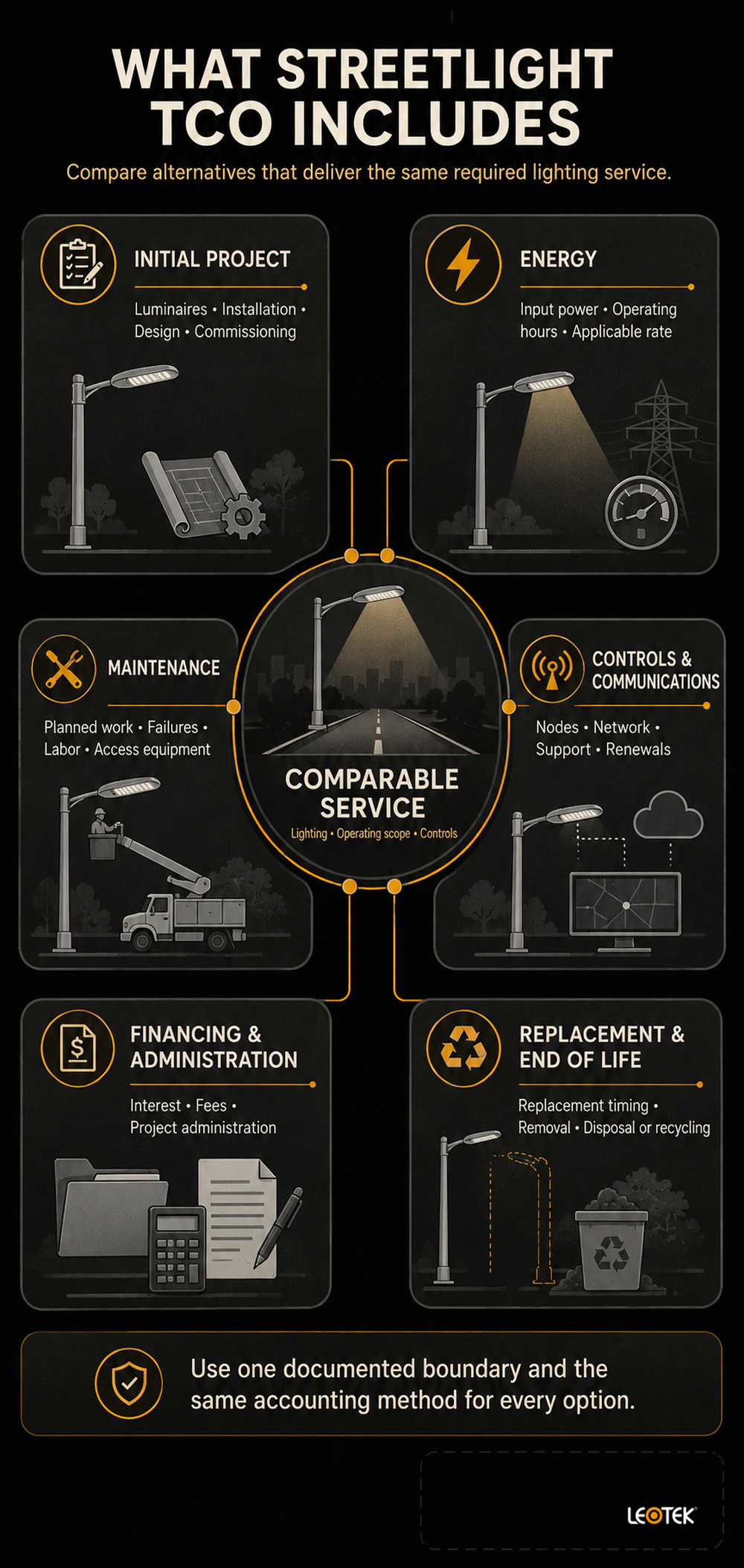
TCO = initial project cost + present value of energy + maintenance + controls and communications + financing and administration + replacement and end-of-life costs
The formula is a structure, not a universal calculator. Each term needs a stated basis. For example, energy cost depends on operating hours and the applicable utility rate structure. Maintenance cost depends on an agency’s work practices, access conditions, labor arrangements, and observed asset condition. A model that does not identify those inputs may still be useful for early planning, but it should be labeled as an estimate.
Present value without the finance jargon
Present value expresses costs that occur in different years in comparable dollars. An agency may use a policy-approved discount rate to convert future costs to a value at the start of the study. The model should state whether it uses nominal dollars, which include assumed escalation, or real dollars, which remove general inflation. Mixing the two approaches can distort a comparison.
This is not a recommendation for a particular discount rate or escalation assumption. Finance staff should set or confirm those policy inputs. The modeler’s job is to show where they are used and how much the result changes when they change.
What belongs in the boundary
The decision boundary should match the decision being made. A fixture-only purchase comparison may exclude costs held by another department, while a program business case may include design, commissioning, asset-data work, disposal, administration, and future replacements. Neither boundary is automatically right. The weakness is using one boundary for an existing system and a narrower one for its replacement.
Some agencies also evaluate incentives, taxes, outage risk, environmental impacts, or avoided work. Include those only when there is a documented method and the same method is applied to every option. Do not turn an unmeasured benefit into a cash-flow line simply because it is desirable.
Set the baseline before comparing alternatives
The baseline is more than a count of poles. It describes the service, assets, and operating conditions that the proposed option must match or improve under the project requirements. A lower-cost option that does not meet the same lighting design, control scope, or operating need is not a like-for-like TCO comparison.
Define the service requirement
Start with the assets and their setting: roadway segments, intersections, public spaces, operating schedules, mounting conditions, and the applicable lighting-design criteria. Record what the project requires from the system, including any dimming schedule, asset-management scope, or communications requirement.
This step keeps photometry in its proper place. Lighting performance is a project requirement to normalize before comparing costs, not a number to infer from lumens or watts alone. For teams evaluating categories and applications, municipal outdoor lighting is a useful starting point; current model documents are still needed for configuration-specific claims.
Build an input register
Create an input register before creating polished charts. The register should identify the source, date, owner, unit, and confidence level for every important value. It makes it possible to update the model when a tariff changes, a field survey corrects the asset count, or procurement receives a revised quote.
| Input | Preferred evidence | Questions to record |
|---|---|---|
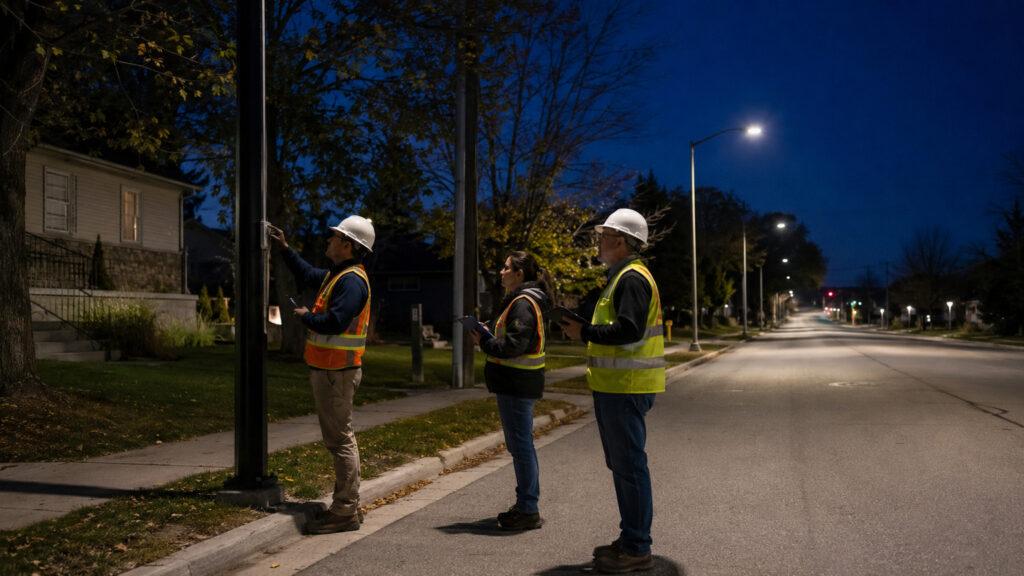
| Asset count and condition | Asset system, field survey, maintenance history | What is known, estimated, or pending verification? |
| Energy use and rate | Metering, bills, tariff documents | Which rate components and operating hours are included? |
| Installation and transition | Scope, bids, work orders | Are design, traffic control, disposal, and commissioning in scope? |
| Maintenance | Work orders, contracts, crew records | Are labor, materials, access equipment, and administration included? |
| Controls | Current proposal and service terms | Are nodes, network services, support, and renewals included? |
| Replacement and end of life | Contract terms and agency policy | When is replacement assumed, and who bears the cost? |
Use a confidence label such as measured, documented estimate, or planning assumption. That label is often more helpful in a review meeting than adding decimal places to a weak input.
Model the cost categories
Initial project and transition costs
Initial cost usually includes more than luminaires. Depending on the scope, it can include controls, installation labor, design, surveys, commissioning, inventory updates, mobilization, traffic control, disposal, and project administration. A city may also face transition costs when it changes maintenance arrangements or data systems.
Do not assume every retrofit has the same transition scope. The most credible approach is to map each line item to a project document, a quote, or a clearly identified planning assumption. If a proposed option uses a different mounting, controls architecture, or commissioning process, that difference belongs in the model rather than in a footnote.
Energy and demand charges
Energy cost is commonly calculated from input power, annual operating hours, and the applicable rate structure. The model should make all three visible. Where demand charges or other tariff components apply, include them only with a rate-supported method and apply that method consistently.
If the project assumes dimming, use the actual proposed schedule and control behavior rather than a generic savings percentage. A U.S. Department of Energy study, The Energy and Operational Impacts of Using 0-10V Control for LED Streetlights (2024), examined 23 LED streetlights that claimed 0-10V dimmability and found variation in market-available driver performance. Its practical lesson for a TCO model is straightforward: document the dimming and controls assumption, then validate it for the proposed system rather than treating dimmability as a uniform outcome. Read the DOE streetlight-controls study.
Labor, failures, and maintenance
Maintenance is often the category that turns a simple energy comparison into an operational decision. Separate planned work from reactive work. Planned work may include inspections and inventory updates; reactive work may include dispatch, crew time, access equipment, traffic control where applicable, materials, and closeout administration.
Use local history whenever possible. A failure rate borrowed from a brochure, a generic maintenance allowance, or a single difficult service call can be a starting hypothesis, but not a reliable forecast. The U.S. Department of Energy’s LED Basics, accessed July 26, 2026, notes that useful life and reliability involve more than lumen depreciation, including potential electronics failure and color shift. That supports evaluating the relevant luminaire, driver, environment, and maintenance plan rather than treating a published lifetime as a field guarantee.
The model should also show when replacements are assumed. One option might have a planned replacement event; another might use annualized failure assumptions. Both can be legitimate approaches when they are transparent, evidence-based, and consistent with the agency’s asset strategy.
Controls, communications, and data operations
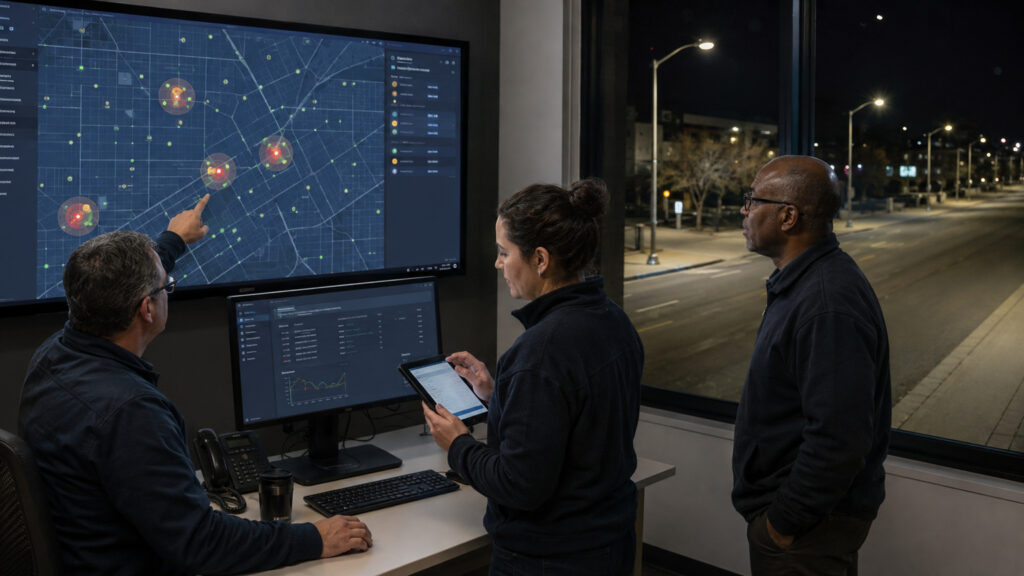
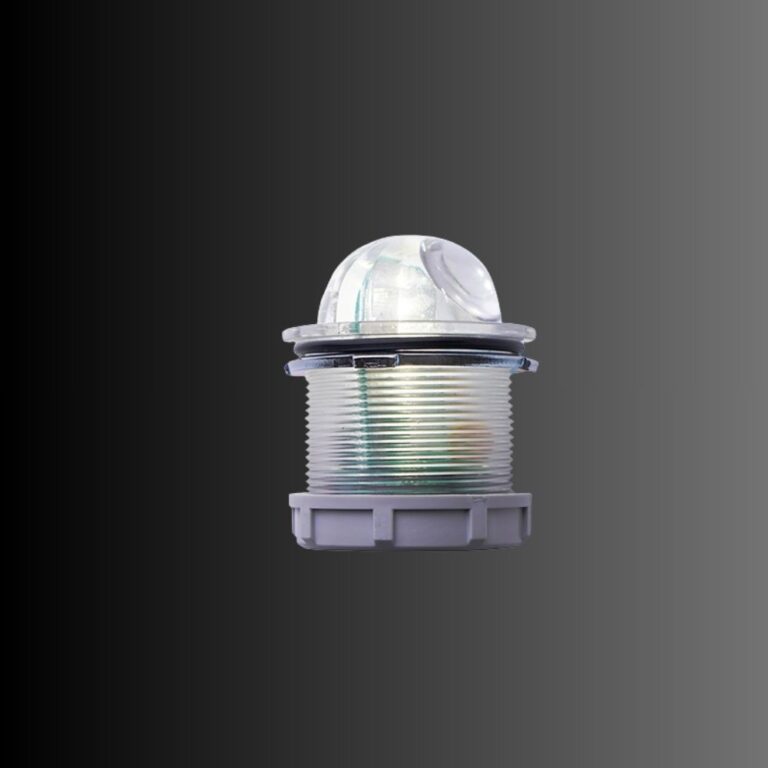
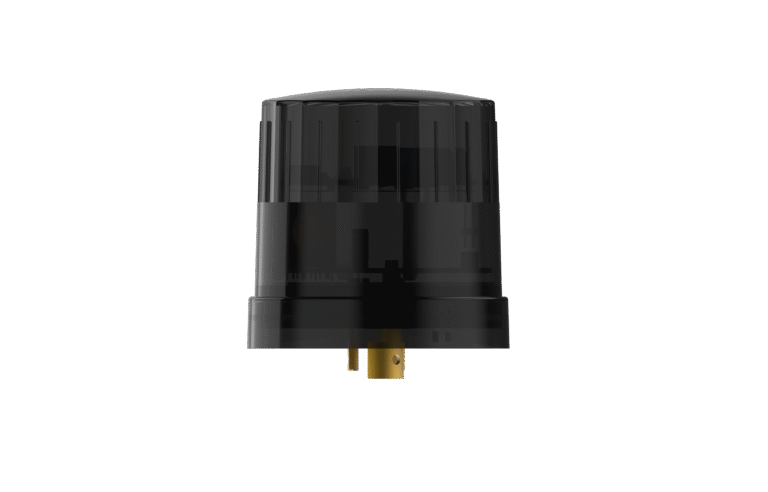
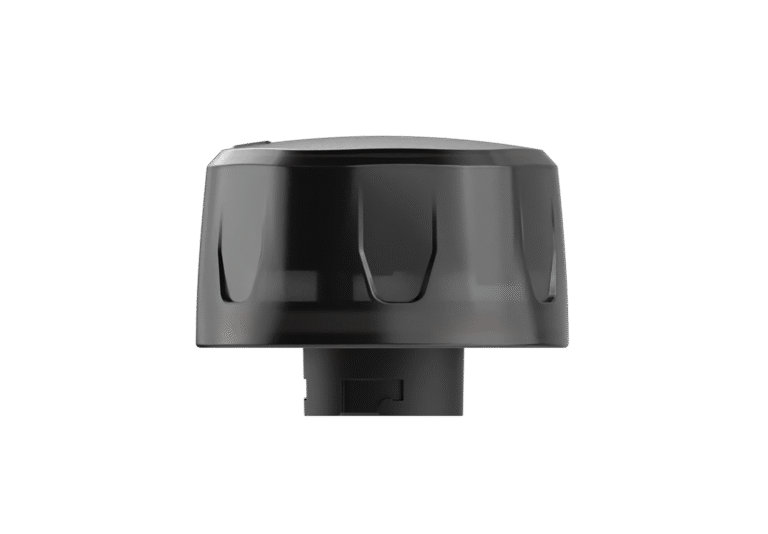
Connected lighting can change what belongs in the TCO boundary. Potential cost lines include controller nodes, gateways or networking, commissioning, licenses or subscriptions, support, cybersecurity and data-governance review, training, and renewal terms. These items should appear as separate rows, not be hidden inside an energy-savings assumption.
For example, LEOTEK describes remote switching, dimming, schedules, fault notification, energy tracking, reporting, maps, alarms, and asset management for its connected streetlight management offering. Its RenAI roadway infrastructure management page describes controller integration, remote control, scheduled dimming, fault detection, reporting, and asset management. Those are stated platform functions, not proof of a specific agency’s savings, compatibility, or operating result.
Ask the same questions of any controls proposal: What hardware is included? Who operates the system? What data, support, and renewal obligations exist? What field validation is required? A controls cost model is strongest when it captures both the operational work it may enable and the costs required to operate it responsibly.
Financing, administration, and end of life
Financing can matter when capital timing differs between alternatives. Treat interest, fees, payment schedules, and administrative costs according to the agency’s approved method. Do not compare a cash purchase with a financed option without disclosing that difference.
End-of-life treatment also deserves a line item. Include removal, disposal, recycling, residual value, or replacement costs only to the extent that the agency has a documented policy, contract term, or supportable assumption. The result should identify which of those inputs are known and which are scenario variables.
Calculate annual cash flow and present value
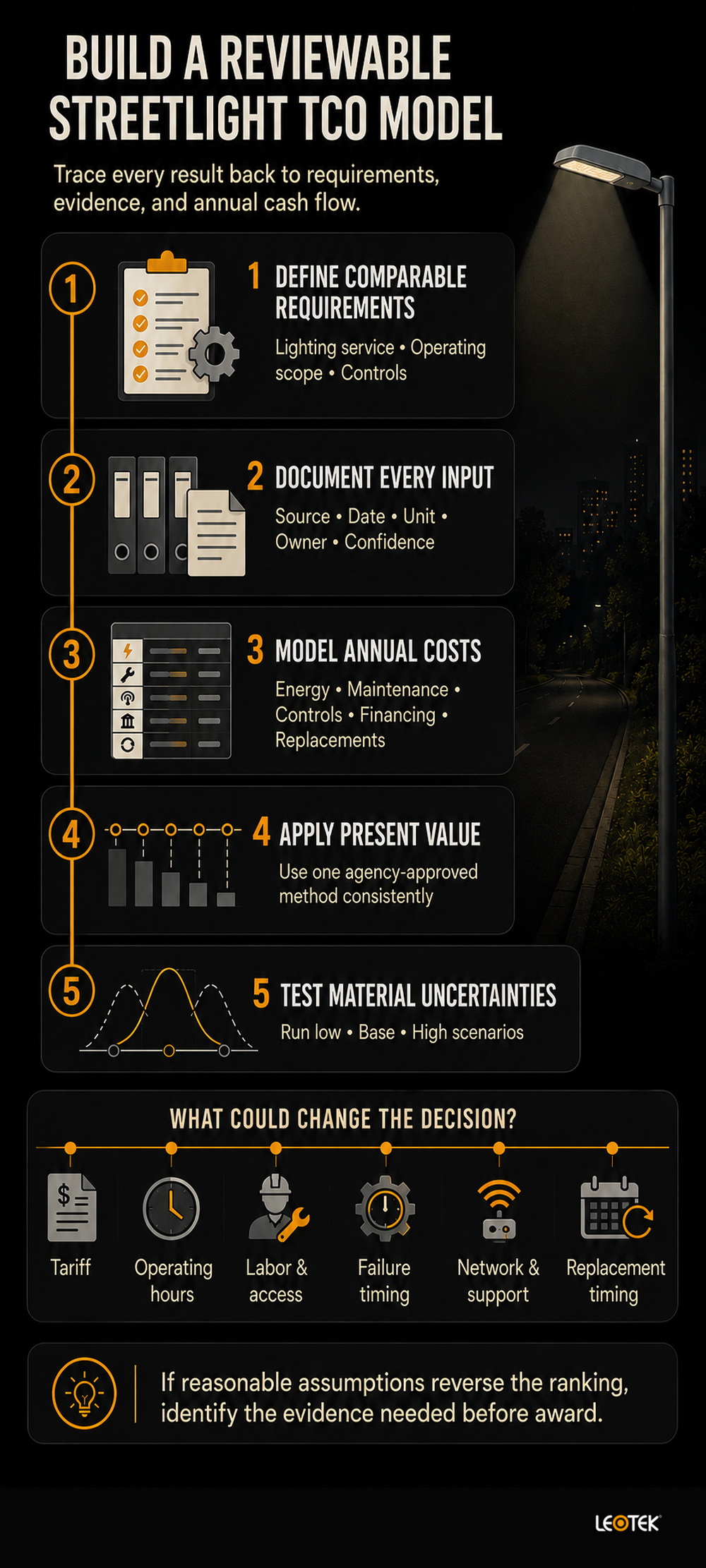
Use a five-step model workflow
1. Define comparable lighting and operating requirements.
- Document the source, date, unit, and confidence level for each input.
- Model annual energy, maintenance, controls, financing, and replacement costs.
- Apply the agency-approved present-value method consistently.
- Test low, base, and high scenarios for material uncertainties.
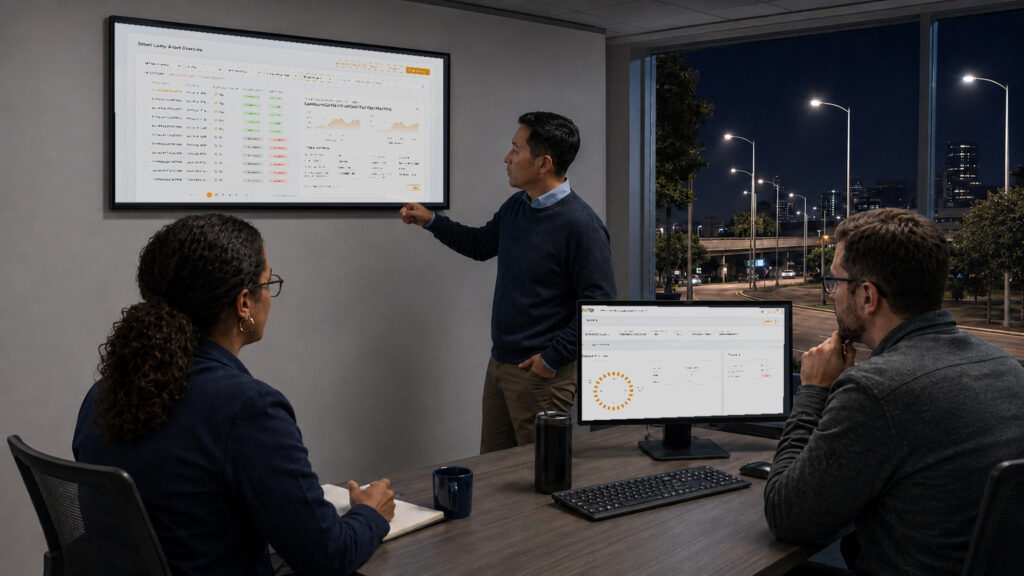
The most reviewable model uses annual rows. For each year, list initial or replacement capital cost, energy, maintenance, controls and communications, financing or administration, and any other included category. Then apply the selected discount factor to calculate present value. A reviewer should be able to trace the total back to those rows.
Use one transparent annual table
Avoid a single lifetime number with no trail back to the assumptions. A compact annual table allows finance staff to inspect discounting, operations staff to review maintenance logic, and procurement staff to see which obligations depend on contract terms. Keep source precision in the working model; round values only in a reader-facing chart.
An illustrative calculation can show the mechanics, but it must be labeled illustrative and must not imply a project result. For example, a model might calculate annual energy cost as modeled kWh multiplied by the applicable rate, then discount that annual cost according to the agency’s policy. It should not insert a generic tariff, wattage, or operating-hour value as if it applies everywhere.
Test scenarios, not just a base case
Scenario analysis is what makes a 20-year model useful when inputs are uncertain. Run at least a low, base, and high case for the variables most likely to change the conclusion. Typical candidates include tariff escalation, annual operating hours, labor or access-equipment cost, failure timing, dimming performance, network or support cost, replacement timing, and financing assumptions.
Then identify the variables that move the result most. If modest changes in labor cost reverse the ranking of two options, the decision should not be framed as a settled savings conclusion. It should be framed as a procurement and operations question: what evidence would narrow that uncertainty before award or deployment?
Make the model procurement-ready
A TCO model becomes more useful when it is treated as a review document, not just a sales or budget spreadsheet. Before relying on it, confirm the following:
- Comparable service: Do all options meet the same required lighting, operating, and controls scope?
- Dated inputs: Does each significant input identify its source and date?
- Configuration specificity: Are product, controls, warranty, and support assumptions tied to the actual proposed configuration?
- Complete costs: Are labor, access, commissioning, communications, administration, and end-of-life treatment included where applicable?
- Policy alignment: Have finance and procurement confirmed the treatment of discounting, escalation, and financing?
- Sensitivity: Does the model show which assumptions could materially change the decision?
Technical documents, warranty terms, and current specifications should be checked before a procurement decision. LEOTEK’s product specifications and resources hub is an appropriate place to begin that validation, but a linked document still needs a review for the correct model, revision, and project scope.
Common TCO mistakes to avoid
The most frequent mistake is comparing unequal service. Another is treating rated life as a guaranteed field-life or treating a scenario output as a commitment. Both can make a spreadsheet look more certain than its evidence supports.
Other avoidable mistakes include omitting labor and access costs, applying a generic savings claim to a local tariff and operating schedule, excluding controls support or communications costs, and mixing nominal and real dollars. A short assumptions log and a scenario tab are often more valuable than a more elaborate chart.
Use the model to frame a better project decision
Streetlight total cost of ownership is not a promise of savings. It is a disciplined way to compare alternatives, expose uncertainty, and decide what evidence the project still needs. When the service requirement, input register, annual cash flow, and scenarios are clear, the conversation can move from a lowest-price debate to a review of lifecycle obligations and operational risk.
For a defined roadway-lighting project, readers can review current documentation or contact LEOTEK with a specific technical or project question. Any final selection should still be validated through the agency’s engineering, procurement, financial, and applicable authority review processes.
Frequently asked questions
What costs should a streetlight TCO model include?
Include initial project and transition costs, energy, planned and reactive maintenance, controls and communications where applicable, financing and administration when relevant, and replacement or end-of-life treatment. The exact boundary should match the decision and be applied consistently to every alternative.
How do cities build a 20-year LED streetlight lifecycle cost model?
Cities can define a comparable service requirement, create annual cash-flow rows for each option, and convert future costs to present value using a policy-approved approach. The result depends on local inputs such as tariffs, operating hours, maintenance records, contract terms, and replacement assumptions.
Should a TCO model include controls and communications costs?
Yes, when the proposed scope includes connected lighting. Include equipment, commissioning, networking, services, support, renewals, and any required operating or governance work as explicit cost categories. Do not assume controls produce a fixed savings percentage without project-specific evidence.
How should a streetlight TCO model account for maintenance, failures, and truck rolls?
Use agency work orders, contracts, and asset records where available. Separate planned maintenance from reactive work, and capture labor, materials, access equipment, traffic control where applicable, and administrative effort. Test uncertain failure and service-cost assumptions with scenarios.
How do discount rate and escalation affect municipal lighting cost comparisons?
They change how future costs are expressed in today’s dollars. The model should state whether it uses nominal or real dollars, identify the source of the discount and escalation assumptions, and show sensitivity where those assumptions materially affect the outcome.
References
- U.S. Department of Energy, LED Basics; accessed July 26, 2026.
- U.S. Department of Energy, The Energy and Operational Impacts of Using 0-10V Control for LED Streetlights, January 10, 2024; accessed July 26, 2026.
- LEOTEK, Applications for Outdoor Lighting; accessed July 26, 2026.
- LEOTEK, LEOLink Solutions; accessed July 26, 2026.
- LEOTEK, RenAI AI Roadway Infrastructure Management System; accessed July 26, 2026.
- LEOTEK, Resources and Documents; accessed July 26, 2026.