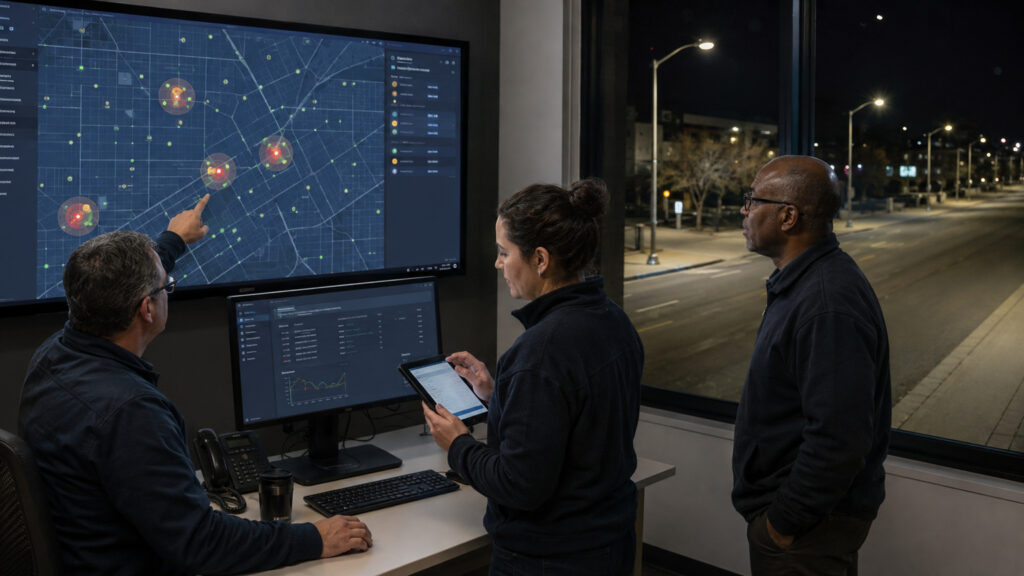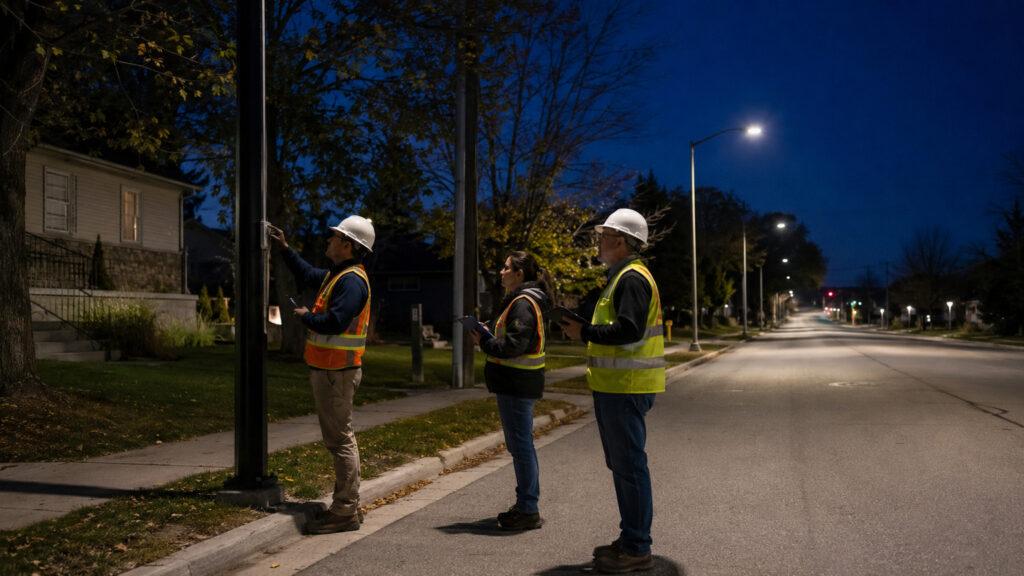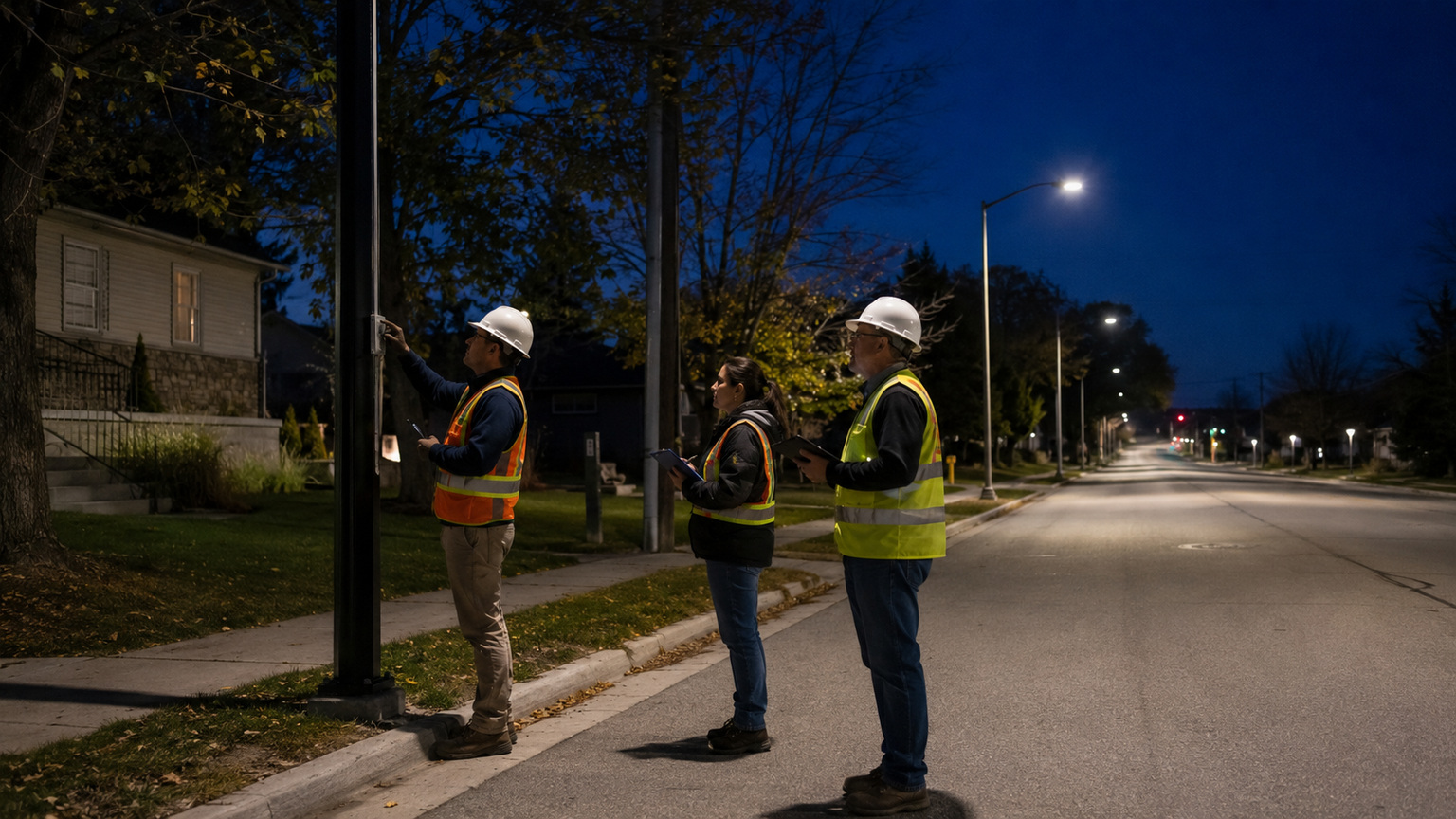

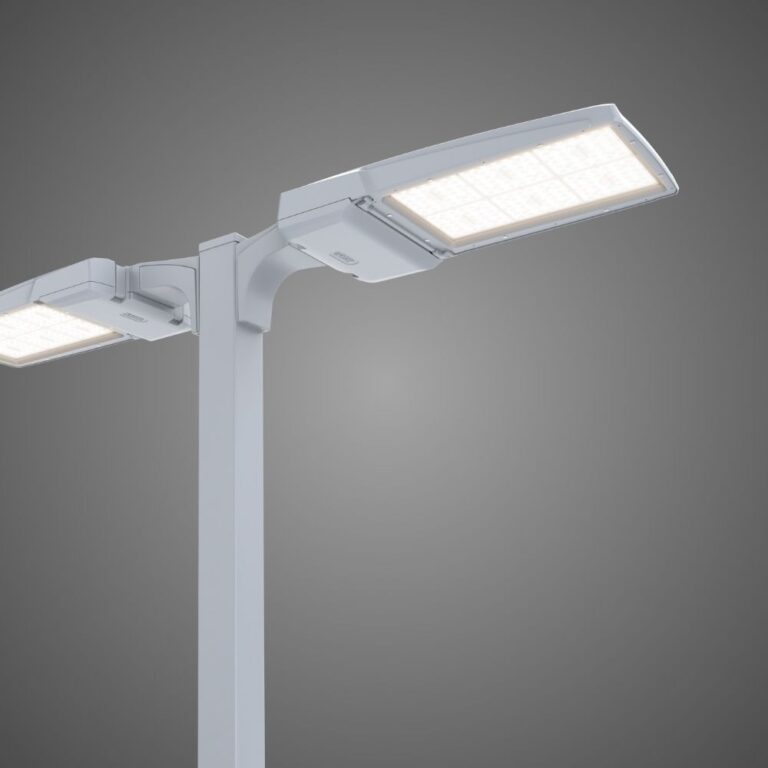















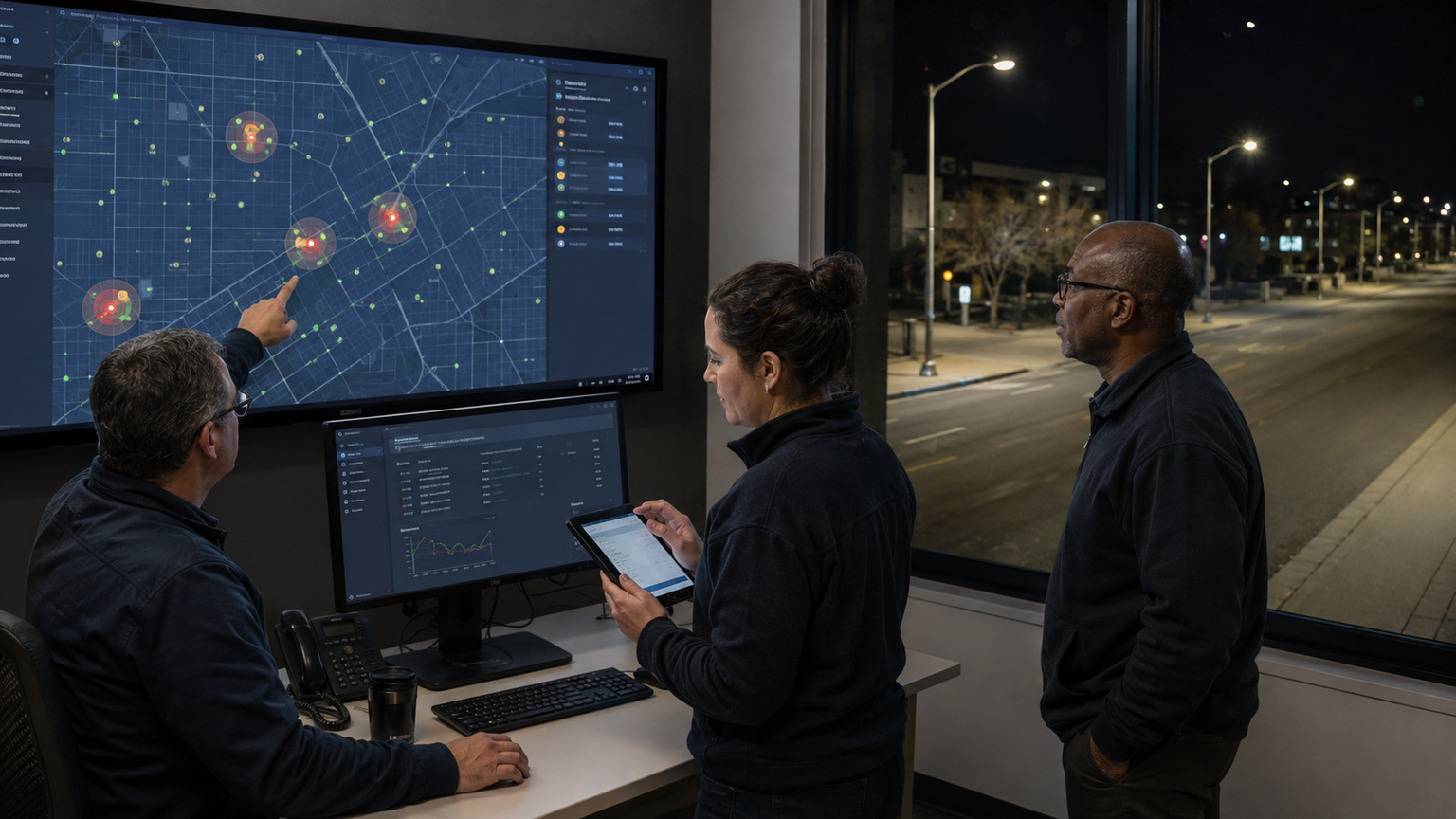
Streetlight alarm management is the process of validating, grouping, ranking, assigning, and closing connected-lighting alerts so teams can act first on the conditions with the greatest documented service impact and urgency. The useful priority is not the one that arrives most often; it is the one an agency can explain, assign, and review.
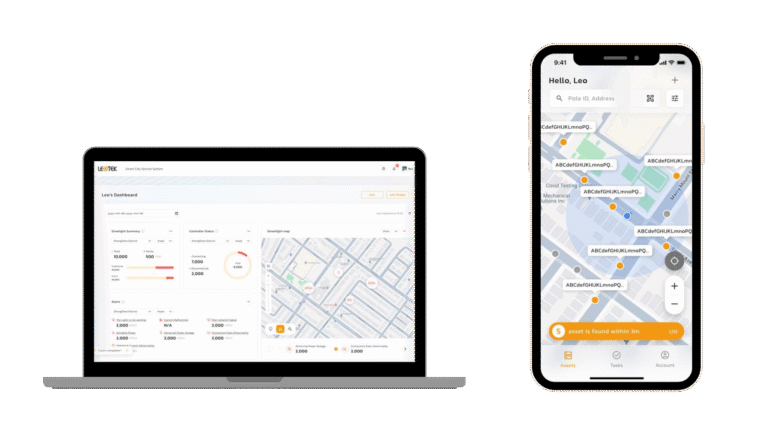
LEOTEK describes connected-lighting functions including status, alarms, reports, and asset information for its platform offerings. That visibility can change the operating challenge: an alert feed is not yet a maintenance plan. The following approach gives municipal and transportation-agency teams a practical way to turn smart lighting alerts into a controlled work queue without treating an alert as proof of a field failure or a universal safety classification.
Key takeaways
- Validate the signal before treating an alert as a fault or dispatch trigger.
- Separate technical condition, service impact, and response urgency when assigning a priority.
- Group duplicate and related notifications so the queue represents incidents, not alert volume.
- Record the priority rationale, owner, actions, and closure evidence for each escalated item.
- Set response targets locally with operations, engineering, cybersecurity, and work-management policies in view.
Why raw smart-lighting alerts do not equal work priorities
An alert is a system-reported observation. It may indicate a status change, a missed communication, a measured condition, or a rule threshold. It does not, by itself, establish the root cause, confirm that a luminaire has failed, or determine the correct field response.
That distinction matters in streetlight alarm management. A single asset may generate multiple notifications while a communications interruption may affect a group of assets. Conversely, one concise alert may represent a condition that deserves prompt review under an agency’s own operating policy. Counting alerts alone can give a distorted picture of the work that is actually pending.
Use four labels in the operating process:
- Alert: A notification generated by a connected-lighting system.
- Validated condition: A condition supported by available status history, context, or a defined investigation step.
- Service impact: The documented effect on the agency’s lighting operation, assessed under local criteria.
- Work action: The assigned investigation, remote action, field visit, work order, or monitoring decision.
These labels help maintenance staff, supervisors, and platform users discuss the same event without assuming that a dashboard severity is a complete priority decision. They also preserve a useful audit trail when the team later asks why an item was escalated, deferred, grouped, or closed.
Connected-lighting platforms may provide functions such as remote operation, scheduled dimming, fault notification, asset management, energy reporting, status views, and alarms. LEOTEK describes these functions for its connected streetlight management offering. Those stated capabilities can support an operating workflow, but an agency still needs its own rules for evaluating service impact and authorizing work.
Build a priority model around five decision factors
A usable priority model should be simple enough for consistent use and detailed enough to reveal the reasoning behind a decision. The five factors below are an agency-adaptable framework, not a universal service-level standard.
1. Validate the signal and identify the affected asset
Start with the information available at intake: asset identifier, location or group, alert type, timestamps, current status, prior status, and any known planned work. Where the system provides it, operators can also look for a common controller, communications context, or nearby related event. The purpose is to decide whether the record is actionable enough to investigate, not to declare a cause from a single signal.
Validation may be as modest as confirming that an alert is current and not tied to scheduled maintenance. It may also require a follow-up investigation. The appropriate depth depends on the alert type, the agency’s records, and the local operating process. Avoid writing rules that imply a remote status is equivalent to a field diagnosis.
2. Classify severity and service impact separately
Severity describes the technical condition as the agency understands it. Service impact describes what that condition means in the local environment. A persistent condition at one asset, a group-level event, a recurring alert, and an unverified communications issue can each require different handling even when a platform presents them in the same category.
Define severity labels in an operating procedure, then apply separate impact questions. For example: What is the affected scope? How long has the condition persisted? Is the event recurring? Is there a known planned-work or external context? Which agency-owned service commitments or operational constraints apply?
The goal is not to claim that one category is always urgent. It is to make the decision criteria visible. Engineering and operations leaders should approve the local definitions, especially where a classification can affect field dispatch, public communication, or contractual work management.
3. Correlate duplicates and related alarms
Duplicate smart-lighting alerts can occur and deserve an explicit handling rule. A single changing condition may create repeat notifications. Related records can also share an asset, area, communications path, time window, or planned-work context. Grouping them as one incident can keep the queue readable while retaining the underlying event history.
Correlation is not root-cause proof. Treat it as a way to organize investigation: link the records, record the grouping rationale, and retain the original timestamps and asset references. If later evidence separates the records, the team should be able to revise the grouping without losing the original alarm trail.
This is also where escalation rules can prevent noise from hiding a meaningful event. A repeated notification should not automatically increase priority merely because it repeats. Instead, the procedure can specify when persistence, recurrence, or expanded scope triggers reassessment.
4. Set an owner, escalation path, and response target
Every escalated incident needs an accountable owner. The owner may investigate remotely, request field verification, coordinate with another team, or create a work order according to local practice. What matters is that the queue shows who owns the next decision and when it should be reconsidered.
An escalation record can include the priority rationale, assigned owner, notification time, investigation path, field-dispatch decision, dependencies, and review point. Agencies should set response targets through their own operations, maintenance, procurement, and service agreements. This article does not prescribe response times because they depend on local priorities, staffing, asset arrangements, and applicable requirements.
For connected environments, include the appropriate information-technology and operational-technology stakeholders in the escalation design. NIST’s 2015 industrial control systems guidance emphasizes that security practices must account for the performance, reliability, and safety requirements of those systems as well as threats and vulnerabilities (NIST SP 800-82 Rev. 2). That guidance is not a streetlighting alarm standard, but it is a reason to align alarm access, investigation, and change processes with the agency’s applicable security policy.
5. Close the loop with evidence and recurrence review
Closing an alarm should mean more than removing it from view. Record what was checked, what action was taken, whether the condition was verified as resolved, and whether a repeat or related issue remains open. The required evidence will vary by agency and event type; the important point is that it can be reviewed later.
Periodic review can identify false-positive patterns, duplicate-notification patterns, stale rules, and recurring conditions that deserve a different investigation path. This is not a promise of performance improvement. It is a governance practice that lets the agency inspect whether its current rules still describe the work it is seeing.
For a related discussion of maintenance analytics, see LEOTEK’s article on predictive maintenance for roadway assets. Alarm triage and predictive maintenance are not the same task: the former governs the immediate handling of a reported event, while the latter may use broader condition and history data under an agency-defined program.
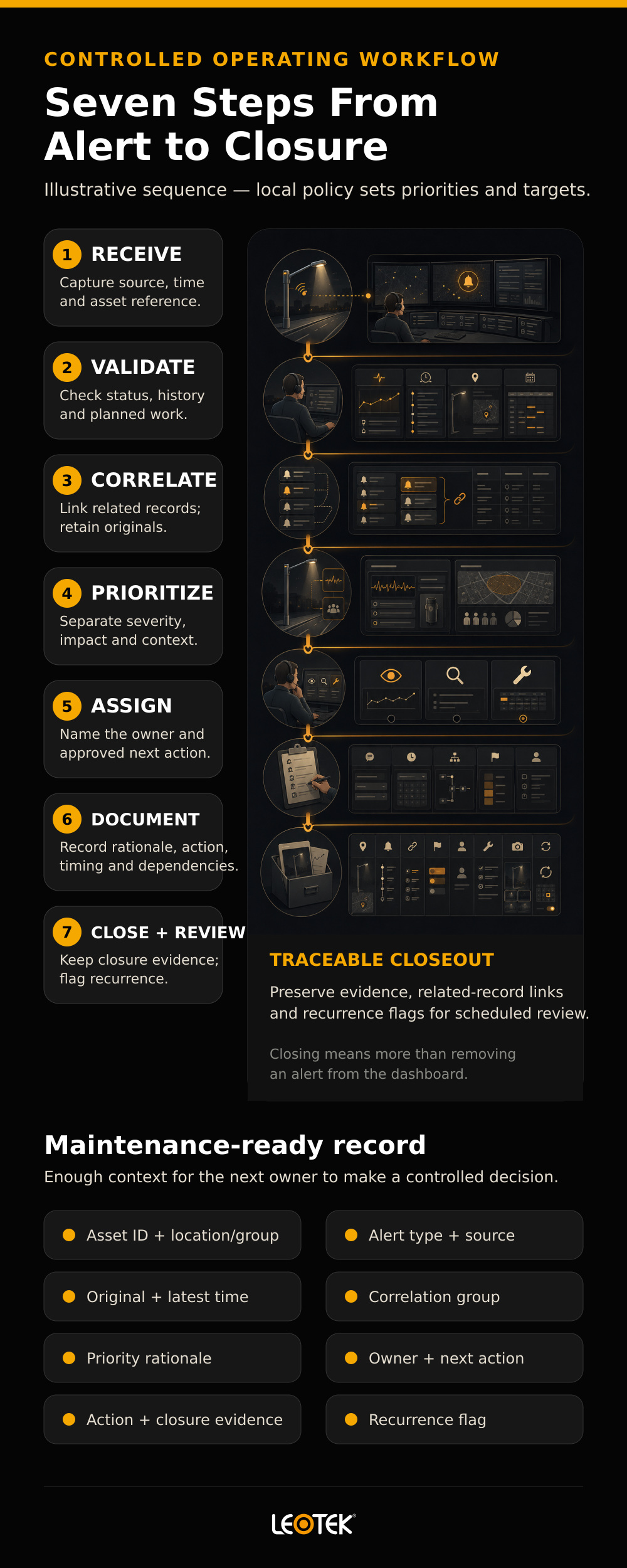
A practical streetlight alarm management workflow
The following seven-step flow is illustrative. It gives teams a shared sequence without replacing local operating procedures.
- Receive: Capture the original alert, timestamp, source, and asset or group reference.
- Validate: Check current status, history, planned work, and the minimum information needed to decide whether to investigate.
- Correlate: Link duplicates and related alerts using documented rules such as asset, area, time window, or common context.
- Prioritize: Assess technical severity, documented service impact, persistence, recurrence, and local operating constraints separately.
- Assign: Name an owner and select the next action: monitor, investigate, create work, or follow an approved escalation path.
- Document response: Record the rationale, actions, decision times, dependencies, and any change to priority.
- Close and review: Preserve closure evidence, retain related-record links, and flag recurring patterns for a scheduled review.
An illustrative matrix can help supervisors make the sequence repeatable:
| Observed situation | Suggested handling question | Example disposition |
|---|---|---|
| New alert with incomplete asset context | Is there enough information to validate the signal? | Investigate or request the missing record; do not infer failure. |
| Repeated alerts tied to one existing incident | Are these duplicates or evidence that scope/persistence has changed? | Link to the incident and reassess only when the documented rule is met. |
| Validated persistent condition with documented local impact | Does local policy call for a defined escalation or work action? | Assign the policy-defined owner and response target. |
| Multiple related records with uncertain cause | Is a shared context plausible, and who can investigate it? | Group provisionally, retain source records, and assign investigation. |
The table intentionally avoids numeric scores and fixed response windows. A scoring method can be useful, but it should be designed, tested, and approved by the agency that will use it. A formula cannot substitute for local knowledge of asset criticality, maintenance arrangements, or active work conditions.
Designing alert rules without creating alarm fatigue
Alarm fatigue is a workflow problem as much as a volume problem. If staff cannot distinguish a new item from a duplicate, a transient condition from a persistent one, or an assigned incident from an unowned one, the queue becomes harder to act on. Good rules clarify those distinctions before the next alert arrives.
Start with a small, controlled set of decisions. Define which alerts should be visible to which role, what information an alert must carry, when repeated notifications are linked, and who may change a rule. Include planned-work handling so expected maintenance activity does not create avoidable confusion. Any suppression rule should be documented, time-bounded where appropriate, and reviewable.
Then examine the full lifecycle. A threshold that creates a useful notification at intake may be unhelpful if it cannot be investigated with available data. A rule that groups events well in one asset arrangement may not work in another. Review changes with the people who operate the system, own the assets, manage field work, and administer access.
Govern changes to priority rules
Treat a priority rule as an operating-control change, not merely a dashboard preference. Name the role that can request a change, the role that can approve it, and the information that must accompany the request. That record might include the affected alert type, the reason for the change, the expected effect on routing, the systems or asset groups in scope, and the date for review. The agency can then distinguish a deliberate policy adjustment from an unexplained change in alert behavior.
Use a controlled test period when local policy permits. During that period, retain the prior rule, the changed rule, the approval record, and the criteria for deciding whether to retain, revise, or roll back the change. Operators and field-work managers should be able to report whether the new routing creates missing context, duplicate incidents, unclear ownership, or an impractical investigation path. Their observations are operational input, not proof of a performance outcome.
Changes affecting access, integrations, communications, or data handling may need review under the agency’s applicable information-technology, operational-technology, and cybersecurity processes. Documenting this handoff avoids treating an alarm rule as isolated from the environment in which it operates. The appropriate approval path, retention period, and rollback process remain local decisions.
LEOTEK describes its roadway asset management platform as providing alarms, asset management, fault detection, reporting, and controller-related data. When evaluating any platform, verify the current documentation for the precise configuration, data handling, integrations, and controls needed by the agency. Do not assume that a described platform function establishes a particular workflow, security outcome, or project result.
What to include in a maintenance-ready alarm record
A maintenance-ready record gives the next owner enough context to make a controlled decision. It should not force the team to reconstruct why an item was prioritized after the fact.
| Field | Why it belongs in the record |
|---|---|
| Asset ID and location or group | Connects the alert to the agency’s asset reference. |
| Alert type and source | Preserves what was reported without relabeling it as a confirmed cause. |
| Original and latest timestamps | Shows sequence, persistence, and timing of updates. |
| Current and relevant prior status | Supports validation and review of change over time. |
| Correlation group | Links related records while preserving their individual history. |
| Priority rationale | States the severity, impact, recurrence, and policy factors considered. |
| Assigned owner and next action | Makes accountability and the investigation path visible. |
| Action and closure evidence | Documents what was done and the basis for closure. |
| Recurrence flag | Supports later review of repeat conditions or rule behavior. |
Data retention, access control, and the detail retained in each field should follow the agency’s policy and the applicable system design. Do not place sensitive operational details in a broadly accessible alert note merely for convenience.
Questions agencies ask about smart-lighting alerts
What should make a streetlight alarm urgent?
Urgency should come from a validated condition, documented service impact, scope, duration, recurrence, and the agency’s own operating policy. An alert count or a vendor-generated label alone is not a complete priority decision. Local engineering and operations leaders should define the escalation criteria that apply to their assets and service commitments.
How should duplicate smart-lighting alerts be handled?
Link related notifications to one incident when the documented correlation rule supports it, but preserve the source records needed for investigation and audit. Reassess the priority if the scope, persistence, or other recorded context changes. Grouping helps organize work; it does not prove a common cause.
Should every fault alert create a work order?
No universal rule supports that approach. Validate the alert, correlate related events, assess local service impact, and apply the agency’s work-management policy. Some records may need investigation, monitoring, or a different escalation path before a field work action is authorized.
What should be reviewed after an alarm is closed?
Review the closure evidence, the reason for the final priority, related or duplicate alerts, recurrence, and whether the rule or escalation path needs attention. The review should help the agency maintain a defensible process rather than simply confirm that the item disappeared from the dashboard.
Make the priority logic visible
Effective streetlight alarm management does not depend on treating every notification as equal or every alert as a confirmed failure. It depends on making the path from alert to action clear: validate the signal, assess local impact, correlate related records, assign ownership, and retain enough evidence to review the outcome.
Teams evaluating a connected-lighting solution can consult product specifications and resources for current technical documents. The agency should then match any platform evaluation to its own asset data, operating procedures, security policy, and maintenance requirements.
References
- National Institute of Standards and Technology, Guide to Industrial Control Systems Security; accessed July 26, 2026.
- LEOTEK, LEOLink Solutions; accessed July 26, 2026.
- LEOTEK, RenAI AI Roadway Infrastructure Management System; accessed July 26, 2026.
- LEOTEK, Predictive Maintenance; accessed July 26, 2026.
- LEOTEK, Resources and Documents; accessed July 26, 2026.
Streetlight Alarm Management FAQs
Practical answers about validating, prioritizing, grouping, assigning, and closing smart streetlight alarms.
What is streetlight alarm management?
Streetlight alarm management is the process of validating, grouping, prioritizing, assigning, investigating, and closing alerts generated by a connected-lighting system. Its purpose is to turn raw system notifications into a controlled and documented maintenance workflow.
How should cities prioritize smart streetlight alarms?
Cities should evaluate the validated condition, documented service impact, affected scope, duration, recurrence, and applicable operating policy. The priority should reflect local circumstances rather than relying only on alert volume or a platform-generated severity label.
Does a smart streetlight alert confirm that a luminaire has failed?
No. An alert is a system-reported observation, such as a status change, missed communication, measured condition, or threshold event. It may justify investigation, but it does not independently confirm the root cause or prove that a luminaire has failed in the field.
What should make a streetlight alarm urgent?
Urgency should be based on a validated condition, documented local service impact, affected scope, persistence, recurrence, and the agency’s approved escalation policy. Engineering and operations leaders should define the criteria that apply to their assets and commitments.
How should duplicate smart-lighting alerts be handled?
Related notifications can be linked to one incident when a documented correlation rule supports the grouping. The original alerts, timestamps, asset references, and grouping rationale should be retained. Grouping organizes the investigation but does not prove that the alerts share a common cause.
Should every streetlight fault alert create a work order?
Not necessarily. The agency should first validate the alert, review related events, assess service impact, and apply its work-management policy. Depending on the available evidence, the next action may be monitoring, remote investigation, field verification, escalation, or creation of a work order.
What information should a streetlight alarm record contain?
A maintenance-ready record should include the asset ID and location, alert type and source, timestamps, current and prior status, related alerts, priority rationale, assigned owner, next action, investigation history, closure evidence, and any recurrence flag required by local policy.
How can cities reduce smart-lighting alarm fatigue?
Cities can reduce alarm fatigue by defining role-based alert visibility, grouping duplicate notifications, separating transient from persistent conditions, identifying planned work, assigning clear ownership, and periodically reviewing thresholds and routing rules. Suppression rules should remain documented, controlled, and reviewable.
Who should own an escalated streetlight alarm?
Every escalated incident should have one accountable owner responsible for the next decision. Depending on the condition, that owner may investigate remotely, coordinate with engineering or cybersecurity, request field verification, or create a work order under the agency’s approved procedure.
What should be reviewed after a streetlight alarm is closed?
The agency should review the closure evidence, final priority rationale, related alerts, recurrence, actions taken, and whether the alarm rule or escalation path needs adjustment. Closure should reflect a documented decision rather than simply removing the alert from the dashboard.